Implement a 2D Convolutional Filter
From-scratch implementation of convolution operation for CNNs
Problem Statement
Implement a 2D convolution operation. Given an input image/matrix and a kernel/filter, compute the convolution output.
Clarifying Questions to Ask
- Padding type? (Valid/no padding, same/zero padding, or specified?)
- Stride? (Default 1, or specified?)
- Input format? (Single channel or multiple channels?)
- Return output size formula? (Should explain the math)
- Handle edge cases? (Kernel larger than image?)
Visual Overview: What is Convolution?
Convolution slides a kernel (small matrix of learnable weights) over the input, computing element-wise multiplication and summation at each position.
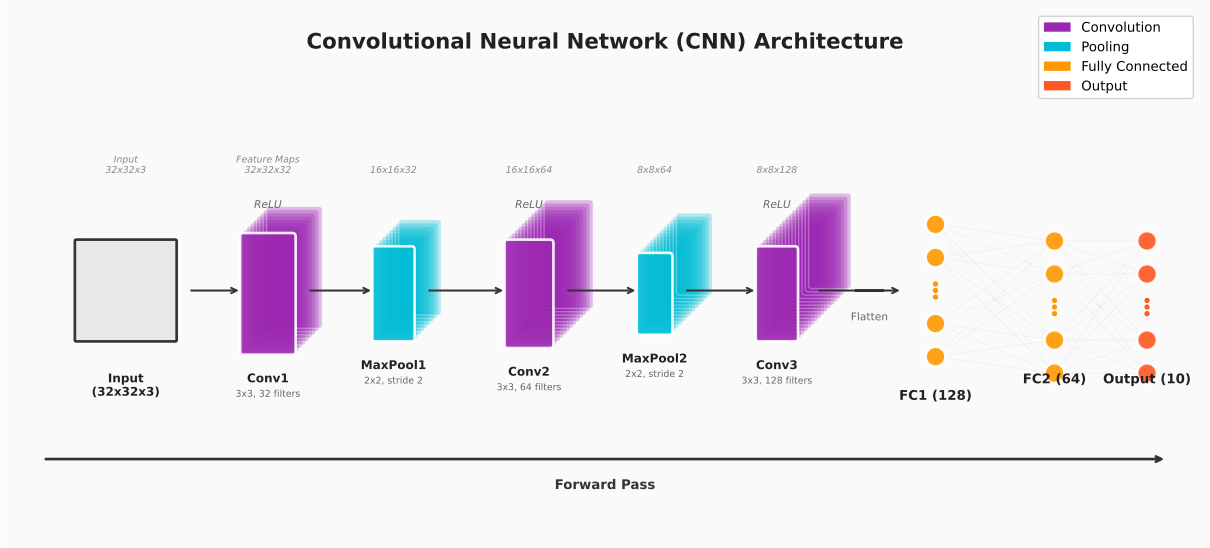
Complete CNN architecture showing progression from convolutional layers to fully-connected classification layers.
The Convolution Formula
Where
Step-by-Step Convolution Flow
Visual: Kernel Sliding Window
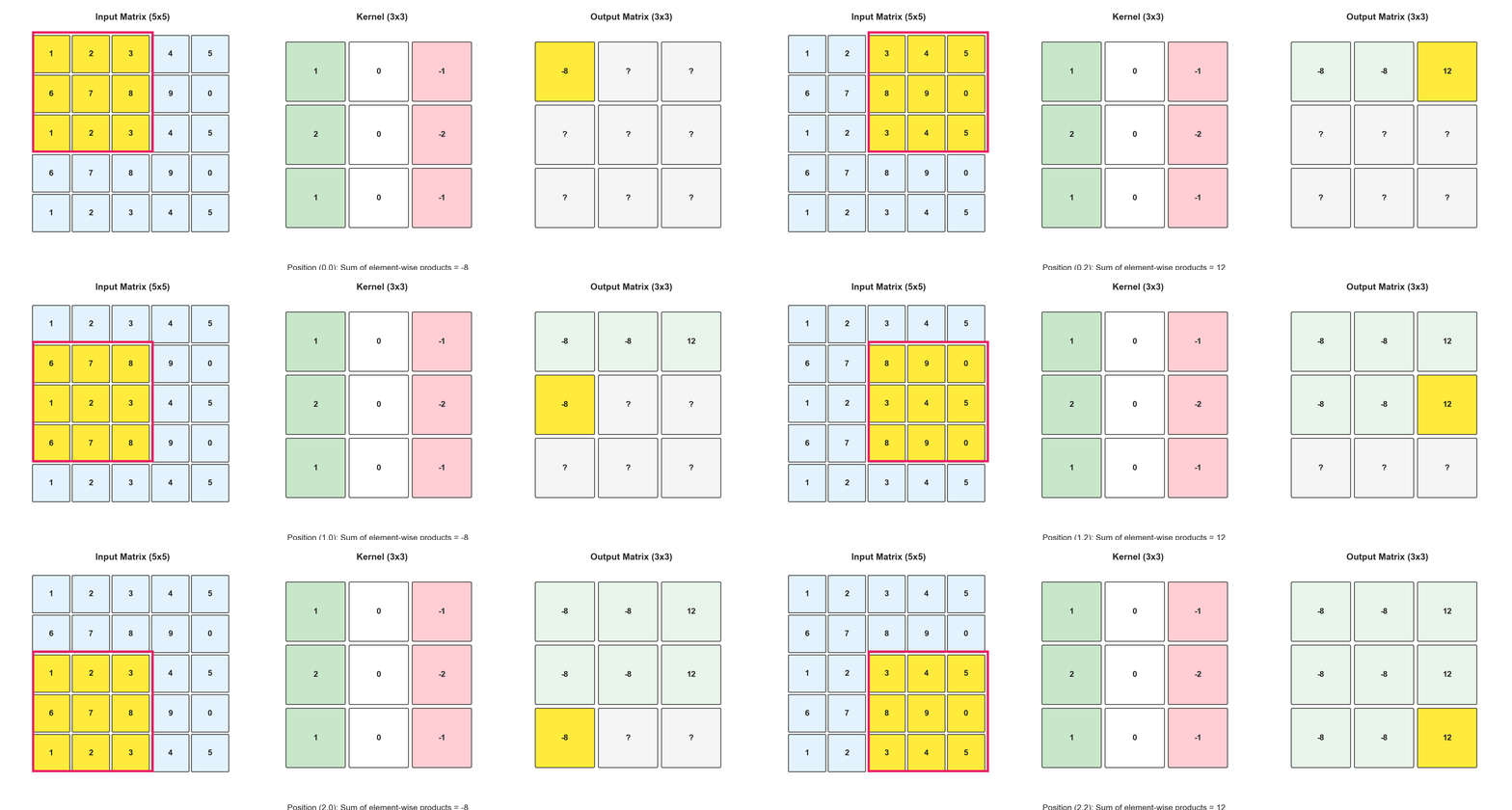
The animated GIF above shows all 9 kernel positions for a 5x5 input with a 3x3 kernel (stride=1). At each position:
- Extract the region under the kernel
- Element-wise multiply with kernel weights
- Sum all products to get one output value
Output Size Formula
Example: Input 5x5, Kernel 3x3, Padding 0, Stride 1 -> Output = (5 - 3 + 0) / 1 + 1 = 3x3
Padding and Stride Decision Flowchart
Visual: Padding and Stride Comparison
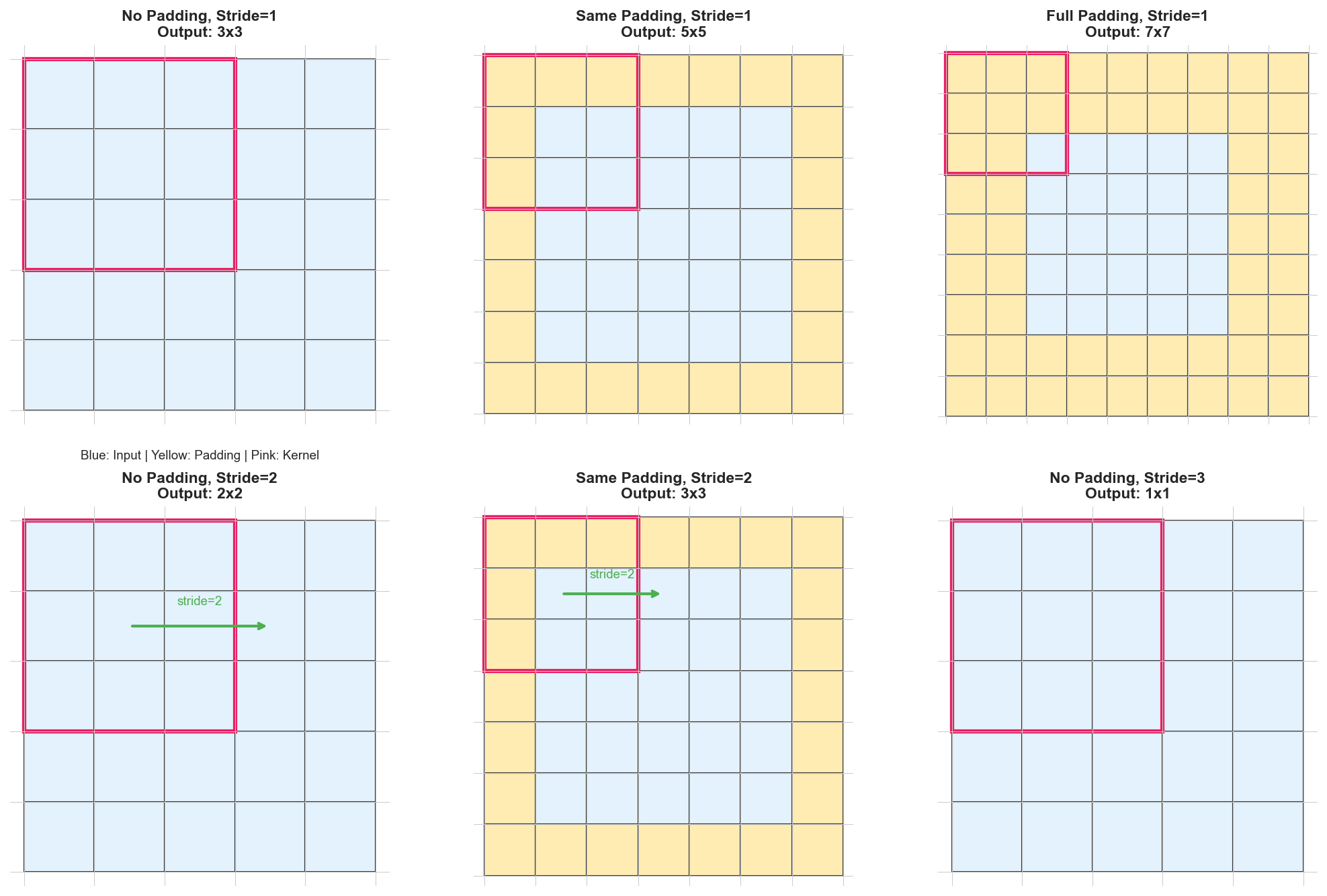
| Padding Type | Description | Output Size (stride=1) |
|---|---|---|
| Valid (no padding) | No zeros added | Smaller than input |
| Same | Zeros added to preserve size | Same as input |
| Full | Maximum padding | Larger than input |
| Stride | Effect | Use Case |
|---|---|---|
| 1 | Dense output, overlapping regions | Feature detection |
| 2 | 2x downsampling | Reduce spatial size |
| 3+ | Aggressive downsampling | Very large inputs |
Full CNN Pipeline: Feature Maps Through Layers
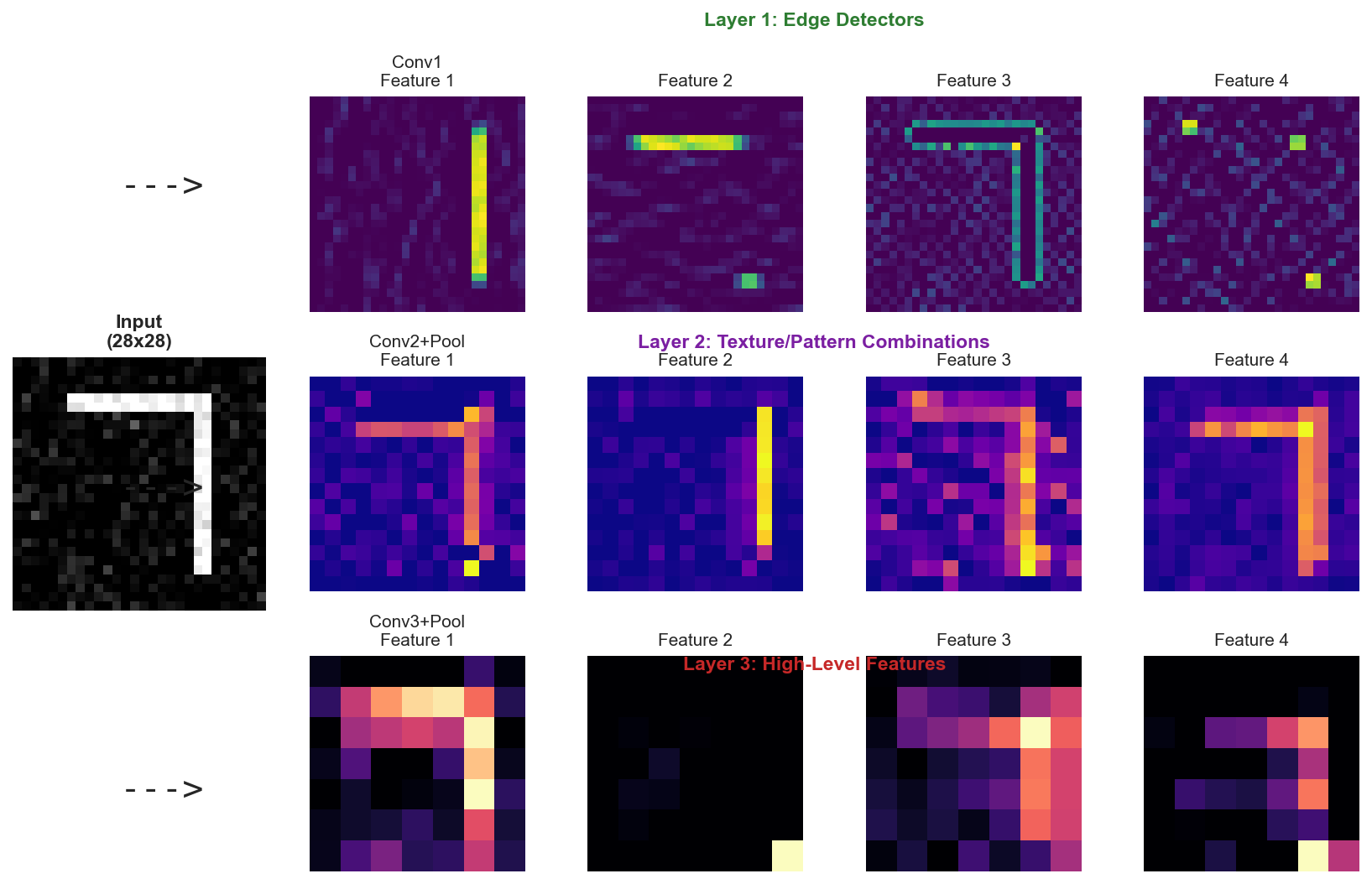
The visualization shows how features evolve through CNN layers:
- Layer 1: Simple edge detectors (vertical, horizontal, diagonal)
- Layer 2: Combinations of edges form textures and patterns
- Layer 3: High-level abstract features for classification
Receptive Field Growth
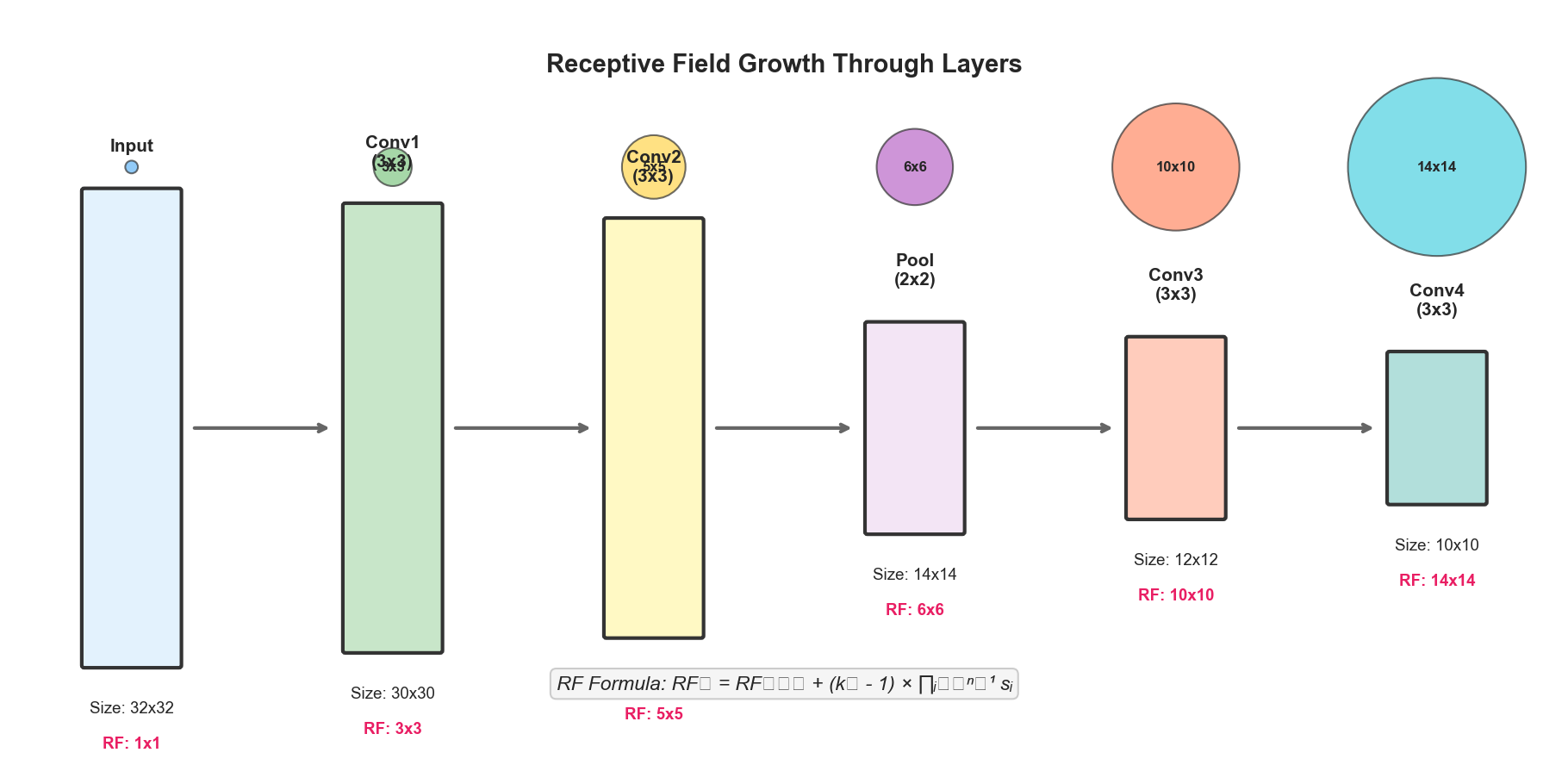
Each deeper layer "sees" a larger region of the original input, enabling hierarchical feature learning.
Common Kernels and Their Effects
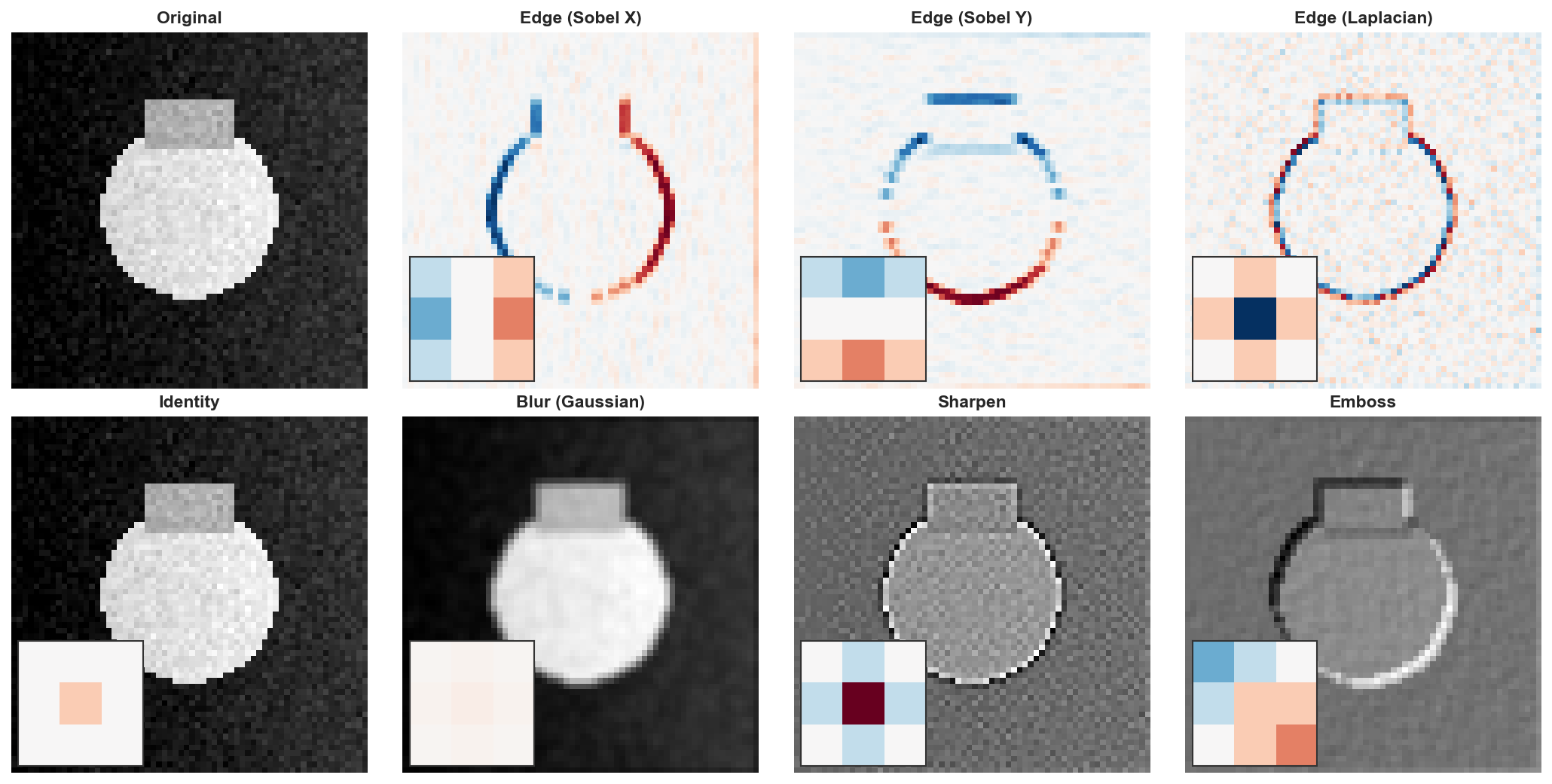
Pooling Operations
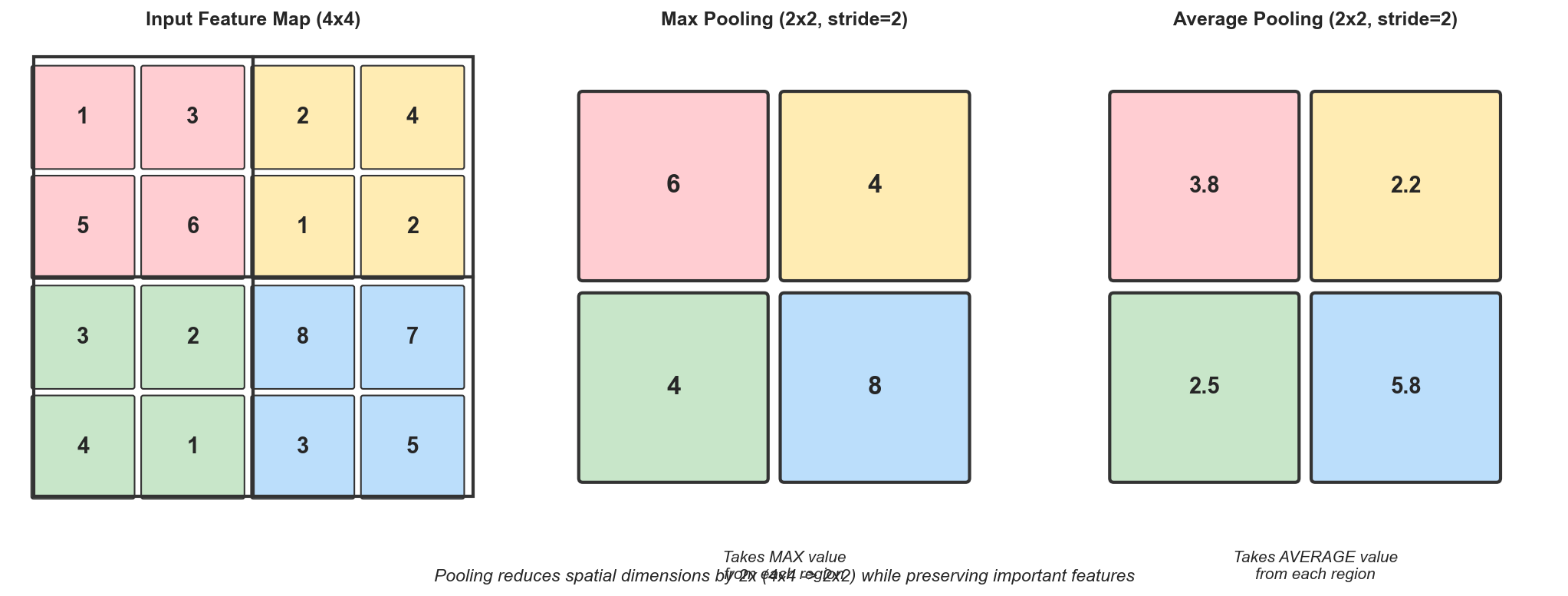
Pooling reduces spatial dimensions while retaining important features. Max pooling (most common) preserves the strongest activations, while average pooling smooths the output.
Solution: Basic 2D Convolution
Step-by-Step Implementation
from typing import List

def conv2d(input_matrix: List[List[float]], kernel: List[List[float]],
           stride: int = 1, padding: int = 0) -> List[List[float]]:
    """
    2D Convolution operation.

    Args:
        input_matrix: Input image/matrix, shape (H, W)
        kernel: Convolution kernel, shape (kH, kW)
        stride: Step size for sliding kernel
        padding: Zero-padding to add around input

    Returns:
        output: Convolution result
    """
    # Get dimensions
    input_h = len(input_matrix)
    input_w = len(input_matrix[0])
    kernel_h = len(kernel)
    kernel_w = len(kernel[0])

    # Add padding if specified
    if padding > 0:
        padded = [[0.0] * (input_w + 2 * padding) for _ in range(input_h + 2 * padding)]
        for i in range(input_h):
            for j in range(input_w):
                padded[i + padding][j + padding] = input_matrix[i][j]
        input_matrix = padded
        input_h = len(input_matrix)
        input_w = len(input_matrix[0])

    # Calculate output dimensions
    output_h = (input_h - kernel_h) // stride + 1
    output_w = (input_w - kernel_w) // stride + 1

    # Initialize output
    output = [[0.0] * output_w for _ in range(output_h)]

    # Perform convolution
    for i in range(output_h):
        for j in range(output_w):
            # Extract the region of interest
            row_start = i * stride
            col_start = j * stride

            # Element-wise multiply and sum
            total = 0.0
            for ki in range(kernel_h):
                for kj in range(kernel_w):
                    total += input_matrix[row_start + ki][col_start + kj] * kernel[ki][kj]
            output[i][j] = total

return outputimport numpy as np
def conv2d(input_matrix, kernel, stride=1, padding=0):
"""
2D Convolution operation.
Args:
input_matrix: Input image/matrix, shape (H, W)
kernel: Convolution kernel, shape (kH, kW)
stride: Step size for sliding kernel
padding: Zero-padding to add around input
Returns:
output: Convolution result
"""
# Get dimensions
input_h, input_w = input_matrix.shape
kernel_h, kernel_w = kernel.shape
# Add padding if specified
if padding > 0:
input_matrix = np.pad(
input_matrix,
pad_width=padding,
mode='constant',
constant_values=0
)
input_h, input_w = input_matrix.shape
# Calculate output dimensions
output_h = (input_h - kernel_h) // stride + 1
output_w = (input_w - kernel_w) // stride + 1
# Initialize output
output = np.zeros((output_h, output_w))
# Perform convolution
for i in range(output_h):
for j in range(output_w):
# Extract the region of interest
row_start = i * stride
row_end = row_start + kernel_h
col_start = j * stride
col_end = col_start + kernel_w
region = input_matrix[row_start:row_end, col_start:col_end]
# Element-wise multiply and sum
output[i, j] = np.sum(region * kernel)
return outputimport torch
def conv2d(input_matrix: torch.Tensor, kernel: torch.Tensor,
stride: int = 1, padding: int = 0) -> torch.Tensor:
"""
2D Convolution operation.
Args:
input_matrix: Input image/matrix, shape (H, W)
kernel: Convolution kernel, shape (kH, kW)
stride: Step size for sliding kernel
padding: Zero-padding to add around input
Returns:
output: Convolution result
"""
# Get dimensions
input_h, input_w = input_matrix.shape
kernel_h, kernel_w = kernel.shape
# Add padding if specified
if padding > 0:
input_matrix = torch.nn.functional.pad(
input_matrix.unsqueeze(0).unsqueeze(0),
(padding, padding, padding, padding),
mode='constant',
value=0
).squeeze(0).squeeze(0)
input_h, input_w = input_matrix.shape
# Calculate output dimensions
output_h = (input_h - kernel_h) // stride + 1
output_w = (input_w - kernel_w) // stride + 1
# Initialize output
output = torch.zeros((output_h, output_w), dtype=input_matrix.dtype)
# Perform convolution
for i in range(output_h):
for j in range(output_w):
# Extract the region of interest
row_start = i * stride
row_end = row_start + kernel_h
col_start = j * stride
col_end = col_start + kernel_w
region = input_matrix[row_start:row_end, col_start:col_end]
# Element-wise multiply and sum
output[i, j] = torch.sum(region * kernel)
return outputWalkthrough Example
# Simple example
input_matrix = np.array([
    [1, 2, 3, 4],
    [5, 6, 7, 8],
    [9, 10, 11, 12],
    [13, 14, 15, 16]
])

# Edge detection kernel (Sobel-like)
kernel = np.array([
    [-1, 0, 1],
    [-2, 0, 2],
    [-1, 0, 1]
])

output = conv2d(input_matrix, kernel, stride=1, padding=0)
print("Output shape:", output.shape)  # (2, 2)
print(output)

# Trace for position (0, 0):
# Region:
#   [[1, 2, 3],
#    [5, 6, 7],
#    [9, 10, 11]]
# Kernel:
#   [[-1, 0, 1],
#    [-2, 0, 2],
#    [-1, 0, 1]]
# Computation:
#   1*(-1) + 2*0 + 3*1 = 2
#   5*(-2) + 6*0 + 7*2 = 4
#   9*(-1) + 10*0 + 11*1 = 2
# Sum = 2 + 4 + 2 = 8With Padding (Same Convolution)
from typing import List

def conv2d_same(input_matrix: List[List[float]], kernel: List[List[float]],
                stride: int = 1) -> List[List[float]]:
    """
    Convolution with 'same' padding (output size = input size when stride=1).
    """
    kernel_h = len(kernel)
    kernel_w = len(kernel[0])

    # Calculate padding needed for 'same' output
    pad_h = (kernel_h - 1) // 2
    pad_w = (kernel_w - 1) // 2

return conv2d(input_matrix, kernel, stride=stride, padding=max(pad_h, pad_w))import numpy as np
def conv2d_same(input_matrix, kernel, stride=1):
"""
Convolution with 'same' padding (output size = input size when stride=1).
"""
kernel_h, kernel_w = kernel.shape
# Calculate padding needed for 'same' output
pad_h = (kernel_h - 1) // 2
pad_w = (kernel_w - 1) // 2
return conv2d(input_matrix, kernel, stride=stride, padding=max(pad_h, pad_w))
# Example
input_matrix = np.array([
[1, 2, 3, 4, 5],
[6, 7, 8, 9, 0],
[1, 2, 3, 4, 5],
[6, 7, 8, 9, 0],
[1, 2, 3, 4, 5]
])
kernel = np.array([
[1, 0, -1],
[2, 0, -2],
[1, 0, -1]
])
output = conv2d_same(input_matrix, kernel)
print("Input shape:", input_matrix.shape) # (5, 5)
print("Output shape:", output.shape) # (5, 5) - same!import torch
def conv2d_same(input_matrix: torch.Tensor, kernel: torch.Tensor,
stride: int = 1) -> torch.Tensor:
"""
Convolution with 'same' padding (output size = input size when stride=1).
"""
kernel_h, kernel_w = kernel.shape
# Calculate padding needed for 'same' output
pad_h = (kernel_h - 1) // 2
pad_w = (kernel_w - 1) // 2
return conv2d(input_matrix, kernel, stride=stride, padding=max(pad_h, pad_w))Multi-Channel Convolution
For RGB images or multi-channel inputs:
from typing import List

def conv2d_multichannel(input_tensor: List[List[List[float]]],
                        kernel: List[List[List[float]]],
                        stride: int = 1, padding: int = 0) -> List[List[float]]:
    """
    Multi-channel 2D convolution.

    Args:
        input_tensor: Input with channels, shape (C, H, W)
        kernel: Convolution kernel, shape (C, kH, kW) - same channels as input
        stride: Step size
        padding: Zero-padding

    Returns:
        output: Single-channel output, shape (oH, oW)
    """
    num_channels = len(input_tensor)
    assert len(kernel) == num_channels, "Kernel channels must match input"

    # Convolve each channel and sum
    output = None
    for c in range(num_channels):
        channel_output = conv2d(input_tensor[c], kernel[c], stride, padding)
        if output is None:
            output = channel_output
        else:
            for i in range(len(output)):
                for j in range(len(output[0])):
                    output[i][j] += channel_output[i][j]

    return output


def conv2d_multifilter(input_tensor: List[List[List[float]]],
                       kernels: List[List[List[List[float]]]],
                       stride: int = 1, padding: int = 0) -> List[List[List[float]]]:
    """
    Multi-channel input, multiple output filters.

    Args:
        input_tensor: Input, shape (C_in, H, W)
        kernels: Multiple kernels, shape (num_filters, C_in, kH, kW)
        stride: Step size
        padding: Zero-padding

    Returns:
        output: Multi-channel output, shape (num_filters, oH, oW)
    """
    num_filters = len(kernels)
    outputs = []

    for f in range(num_filters):
        output = conv2d_multichannel(input_tensor, kernels[f], stride, padding)
        outputs.append(output)

return outputsimport numpy as np
def conv2d_multichannel(input_tensor, kernel, stride=1, padding=0):
"""
Multi-channel 2D convolution.
Args:
input_tensor: Input with channels, shape (C, H, W)
kernel: Convolution kernel, shape (C, kH, kW) - same channels as input
stride: Step size
padding: Zero-padding
Returns:
output: Single-channel output, shape (oH, oW)
"""
num_channels = input_tensor.shape[0]
assert kernel.shape[0] == num_channels, "Kernel channels must match input"
# Convolve each channel and sum
output = None
for c in range(num_channels):
channel_output = conv2d(input_tensor[c], kernel[c], stride, padding)
if output is None:
output = channel_output
else:
output += channel_output
return output
def conv2d_multifilter(input_tensor, kernels, stride=1, padding=0):
"""
Multi-channel input, multiple output filters.
Args:
input_tensor: Input, shape (C_in, H, W)
kernels: Multiple kernels, shape (num_filters, C_in, kH, kW)
stride: Step size
padding: Zero-padding
Returns:
output: Multi-channel output, shape (num_filters, oH, oW)
"""
num_filters = kernels.shape[0]
outputs = []
for f in range(num_filters):
output = conv2d_multichannel(input_tensor, kernels[f], stride, padding)
outputs.append(output)
return np.array(outputs)import torch
def conv2d_multichannel(input_tensor: torch.Tensor, kernel: torch.Tensor,
stride: int = 1, padding: int = 0) -> torch.Tensor:
"""
Multi-channel 2D convolution.
Args:
input_tensor: Input with channels, shape (C, H, W)
kernel: Convolution kernel, shape (C, kH, kW) - same channels as input
stride: Step size
padding: Zero-padding
Returns:
output: Single-channel output, shape (oH, oW)
"""
num_channels = input_tensor.shape[0]
assert kernel.shape[0] == num_channels, "Kernel channels must match input"
# Convolve each channel and sum
output = None
for c in range(num_channels):
channel_output = conv2d(input_tensor[c], kernel[c], stride, padding)
if output is None:
output = channel_output
else:
output = output + channel_output
return output
def conv2d_multifilter(input_tensor: torch.Tensor, kernels: torch.Tensor,
stride: int = 1, padding: int = 0) -> torch.Tensor:
"""
Multi-channel input, multiple output filters.
Args:
input_tensor: Input, shape (C_in, H, W)
kernels: Multiple kernels, shape (num_filters, C_in, kH, kW)
stride: Step size
padding: Zero-padding
Returns:
output: Multi-channel output, shape (num_filters, oH, oW)
"""
num_filters = kernels.shape[0]
outputs = []
for f in range(num_filters):
output = conv2d_multichannel(input_tensor, kernels[f], stride, padding)
outputs.append(output)
return torch.stack(outputs)Example: RGB Image with Multiple Filters
# RGB image: 3 channels, 5x5
rgb_image = np.random.rand(3, 5, 5)

# 4 filters, each 3 channels (to match input), 3x3
filters = np.random.rand(4, 3, 3, 3)

# Output: 4 channels (one per filter)
output = conv2d_multifilter(rgb_image, filters, padding=1)
print("Output shape:", output.shape) # (4, 5, 5)Common Kernels (Code Reference)
# Edge Detection - Sobel X/Y and Laplacian
sobel_x = np.array([[-1, 0, 1], [-2, 0, 2], [-1, 0, 1]])
sobel_y = np.array([[-1, -2, -1], [0, 0, 0], [1, 2, 1]])
laplacian = np.array([[0, 1, 0], [1, -4, 1], [0, 1, 0]])

# Blur - Box and Gaussian
box_blur = np.ones((3, 3)) / 9
gaussian_blur = np.array([[1, 2, 1], [2, 4, 2], [1, 2, 1]]) / 16

# Sharpen and Emboss
sharpen = np.array([[0, -1, 0], [-1, 5, -1], [0, -1, 0]])
emboss = np.array([[-2, -1, 0], [-1, 1, 1], [0, 1, 2]])Vectorized Implementation (Faster)
from typing import List

def conv2d_vectorized(input_matrix: List[List[float]], kernel: List[List[float]],
                      stride: int = 1, padding: int = 0) -> List[List[float]]:
    """
    Convolution using im2col transformation (conceptually).

    Converts convolution to matrix multiplication for efficiency.
    """
    input_h = len(input_matrix)
    input_w = len(input_matrix[0])
    kernel_h = len(kernel)
    kernel_w = len(kernel[0])

    # Add padding
    if padding > 0:
        padded = [[0.0] * (input_w + 2 * padding) for _ in range(input_h + 2 * padding)]
        for i in range(input_h):
            for j in range(input_w):
                padded[i + padding][j + padding] = input_matrix[i][j]
        input_matrix = padded
        input_h = len(input_matrix)
        input_w = len(input_matrix[0])

    output_h = (input_h - kernel_h) // stride + 1
    output_w = (input_w - kernel_w) // stride + 1

    # Extract patches
    patches = []
    for i in range(output_h):
        for j in range(output_w):
            row_start = i * stride
            col_start = j * stride
            patch = []
            for ki in range(kernel_h):
                for kj in range(kernel_w):
                    patch.append(input_matrix[row_start + ki][col_start + kj])
            patches.append(patch)

    # Flatten kernel
    kernel_flat = [kernel[i][j] for i in range(kernel_h) for j in range(kernel_w)]

    # Convolution as dot products
    output_flat = []
    for patch in patches:
        output_flat.append(sum(p * k for p, k in zip(patch, kernel_flat)))

    # Reshape to output
    output = []
    for i in range(output_h):
        row = []
        for j in range(output_w):
            row.append(output_flat[i * output_w + j])
        output.append(row)

return outputimport numpy as np
def conv2d_vectorized(input_matrix, kernel, stride=1, padding=0):
"""
Vectorized convolution using im2col transformation.
Converts convolution to matrix multiplication for efficiency.
"""
# Add padding
if padding > 0:
input_matrix = np.pad(input_matrix, padding, mode='constant')
input_h, input_w = input_matrix.shape
kernel_h, kernel_w = kernel.shape
output_h = (input_h - kernel_h) // stride + 1
output_w = (input_w - kernel_w) // stride + 1
# Extract patches using stride tricks (advanced!)
# Each column of patches contains one flattened patch
patches = np.zeros((kernel_h * kernel_w, output_h * output_w))
idx = 0
for i in range(output_h):
for j in range(output_w):
row_start = i * stride
col_start = j * stride
patch = input_matrix[row_start:row_start+kernel_h,
col_start:col_start+kernel_w]
patches[:, idx] = patch.flatten()
idx += 1
# Convolution as matrix multiplication
kernel_flat = kernel.flatten().reshape(1, -1)
output_flat = np.dot(kernel_flat, patches)
return output_flat.reshape(output_h, output_w)import torch
def conv2d_vectorized(input_matrix: torch.Tensor, kernel: torch.Tensor,
stride: int = 1, padding: int = 0) -> torch.Tensor:
"""
Vectorized convolution using PyTorch's unfold.
Converts convolution to matrix multiplication for efficiency.
"""
# Add padding
if padding > 0:
input_matrix = torch.nn.functional.pad(
input_matrix.unsqueeze(0).unsqueeze(0),
(padding, padding, padding, padding),
mode='constant',
value=0
).squeeze(0).squeeze(0)
input_h, input_w = input_matrix.shape
kernel_h, kernel_w = kernel.shape
output_h = (input_h - kernel_h) // stride + 1
output_w = (input_w - kernel_w) // stride + 1
# Use unfold to extract patches
# Unfold along height then width
patches = input_matrix.unfold(0, kernel_h, stride).unfold(1, kernel_w, stride)
# patches shape: (output_h, output_w, kernel_h, kernel_w)
# Reshape for matrix multiplication
patches = patches.contiguous().view(output_h * output_w, -1)
kernel_flat = kernel.flatten()
# Convolution as matrix-vector multiplication
output_flat = torch.mv(patches, kernel_flat)
return output_flat.reshape(output_h, output_w)With Bias and Activation (Full Conv Layer)
from typing import List
import math

def conv_layer(input_tensor: List[List[List[float]]],
               weights: List[List[List[List[float]]]],
               bias: List[float], stride: int = 1, padding: int = 0,
               activation: str = 'relu') -> List[List[List[float]]]:
    """
    Complete convolutional layer with bias and activation.

    Args:
        input_tensor: Input, shape (C_in, H, W)
        weights: Kernels, shape (C_out, C_in, kH, kW)
        bias: Bias terms, shape (C_out,)
        activation: 'relu', 'sigmoid', or 'none'

    Returns:
        output: Activated output, shape (C_out, oH, oW)
    """
    # Convolution
    output = conv2d_multifilter(input_tensor, weights, stride, padding)

    # Add bias (broadcast across spatial dimensions)
    for c in range(len(bias)):
        for i in range(len(output[c])):
            for j in range(len(output[c][0])):
                output[c][i][j] += bias[c]

    # Activation
    if activation == 'relu':
        for c in range(len(output)):
            for i in range(len(output[c])):
                for j in range(len(output[c][0])):
                    output[c][i][j] = max(0, output[c][i][j])
    elif activation == 'sigmoid':
        for c in range(len(output)):
            for i in range(len(output[c])):
                for j in range(len(output[c][0])):
                    output[c][i][j] = 1 / (1 + math.exp(-output[c][i][j]))

return outputimport numpy as np
def conv_layer(input_tensor, weights, bias, stride=1, padding=0, activation='relu'):
"""
Complete convolutional layer with bias and activation.
Args:
input_tensor: Input, shape (C_in, H, W)
weights: Kernels, shape (C_out, C_in, kH, kW)
bias: Bias terms, shape (C_out,)
activation: 'relu', 'sigmoid', or 'none'
Returns:
output: Activated output, shape (C_out, oH, oW)
"""
# Convolution
output = conv2d_multifilter(input_tensor, weights, stride, padding)
# Add bias (broadcast across spatial dimensions)
for c in range(len(bias)):
output[c] += bias[c]
# Activation
if activation == 'relu':
output = np.maximum(0, output)
elif activation == 'sigmoid':
output = 1 / (1 + np.exp(-output))
return outputimport torch
def conv_layer(input_tensor: torch.Tensor, weights: torch.Tensor,
bias: torch.Tensor, stride: int = 1, padding: int = 0,
activation: str = 'relu') -> torch.Tensor:
"""
Complete convolutional layer with bias and activation.
Args:
input_tensor: Input, shape (C_in, H, W)
weights: Kernels, shape (C_out, C_in, kH, kW)
bias: Bias terms, shape (C_out,)
activation: 'relu', 'sigmoid', or 'none'
Returns:
output: Activated output, shape (C_out, oH, oW)
"""
# Convolution
output = conv2d_multifilter(input_tensor, weights, stride, padding)
# Add bias (broadcast across spatial dimensions)
output = output + bias.view(-1, 1, 1)
# Activation
if activation == 'relu':
output = torch.relu(output)
elif activation == 'sigmoid':
output = torch.sigmoid(output)
return outputComplexity Analysis
| Operation | Time Complexity | Space Complexity |
|---|---|---|
| Basic conv2d | ||
| Multi-channel | ||
| Multi-filter |
Where:
= output height, width = kernel height, width = number of input channels = number of filters
Edge Cases
from typing import List

def conv2d_robust(input_matrix: List[List[float]], kernel: List[List[float]],
                  stride: int = 1, padding: int = 0) -> List[List[float]]:
    """Convolution with edge case handling."""

    # Check 1: Input and kernel dimensions
    if not input_matrix or not input_matrix[0]:
        raise ValueError("Input must be non-empty 2D")
    if not kernel or not kernel[0]:
        raise ValueError("Kernel must be non-empty 2D")

    input_h = len(input_matrix)
    input_w = len(input_matrix[0])
    kernel_h = len(kernel)
    kernel_w = len(kernel[0])

    # Check 2: Kernel larger than input
    if kernel_h > input_h or kernel_w > input_w:
        raise ValueError("Kernel cannot be larger than input")

    # Check 3: Valid output size
    output_h = (input_h + 2*padding - kernel_h) // stride + 1
    output_w = (input_w + 2*padding - kernel_w) // stride + 1

    if output_h <= 0 or output_w <= 0:
        raise ValueError("Invalid combination of parameters produces zero output")

return conv2d(input_matrix, kernel, stride, padding)import numpy as np
def conv2d_robust(input_matrix, kernel, stride=1, padding=0):
"""Convolution with edge case handling."""
# Check 1: Input and kernel dimensions
if input_matrix.ndim != 2 or kernel.ndim != 2:
raise ValueError("Input and kernel must be 2D")
# Check 2: Kernel larger than input
input_h, input_w = input_matrix.shape
kernel_h, kernel_w = kernel.shape
if kernel_h > input_h or kernel_w > input_w:
raise ValueError("Kernel cannot be larger than input")
# Check 3: Valid output size
output_h = (input_h + 2*padding - kernel_h) // stride + 1
output_w = (input_w + 2*padding - kernel_w) // stride + 1
if output_h <= 0 or output_w <= 0:
raise ValueError("Invalid combination of parameters produces zero output")
return conv2d(input_matrix, kernel, stride, padding)import torch
def conv2d_robust(input_matrix: torch.Tensor, kernel: torch.Tensor,
stride: int = 1, padding: int = 0) -> torch.Tensor:
"""Convolution with edge case handling."""
# Check 1: Input and kernel dimensions
if input_matrix.ndim != 2 or kernel.ndim != 2:
raise ValueError("Input and kernel must be 2D")
# Check 2: Kernel larger than input
input_h, input_w = input_matrix.shape
kernel_h, kernel_w = kernel.shape
if kernel_h > input_h or kernel_w > input_w:
raise ValueError("Kernel cannot be larger than input")
# Check 3: Valid output size
output_h = (input_h + 2*padding - kernel_h) // stride + 1
output_w = (input_w + 2*padding - kernel_w) // stride + 1
if output_h <= 0 or output_w <= 0:
raise ValueError("Invalid combination of parameters produces zero output")
return conv2d(input_matrix, kernel, stride, padding)Test Suite
def test_conv2d():
    """Test cases for convolution implementation."""

    # Test 1: Identity kernel (should preserve input)
    input_mat = np.array([[1, 2], [3, 4]])
    identity = np.array([[0, 0, 0], [0, 1, 0], [0, 0, 0]])
    output = conv2d(input_mat, identity, padding=1)
    np.testing.assert_array_equal(output, input_mat)
    print("Test 1 passed: Identity kernel")

    # Test 2: Output size calculation
    input_mat = np.ones((10, 10))
    kernel = np.ones((3, 3))
    output = conv2d(input_mat, kernel, stride=1, padding=0)
    assert output.shape == (8, 8), f"Expected (8,8), got {output.shape}"
    print("Test 2 passed: Output size (no padding)")

    # Test 3: Same padding
    output = conv2d(input_mat, kernel, stride=1, padding=1)
    assert output.shape == (10, 10), f"Expected (10,10), got {output.shape}"
    print("Test 3 passed: Same padding")

    # Test 4: Stride
    output = conv2d(input_mat, kernel, stride=2, padding=0)
    assert output.shape == (4, 4), f"Expected (4,4), got {output.shape}"
    print("Test 4 passed: Stride=2")

    print("\nAll tests passed!")

test_conv2d()Interview Tips
Know the output size formula - be ready to derive it:
Explain valid vs same padding - understand when each is used:
- Valid: No padding, output shrinks
- Same: Pad to maintain spatial dimensions
Mention stride's purpose - downsampling, reducing computation
Discuss optimization - im2col, GEMM-based convolution
Know common kernels - edge detection, blur, sharpen
Connect to CNNs - how convolution enables feature learning through:
- Translation invariance
- Parameter sharing
- Hierarchical feature extraction