Weekend Sprint
32 Problems. 6 Tiers. 1 Weekend. Focused DSA prep based on real SDE interview reports (2024-2025).
Start with Graphs | View Schedule | Interview Day
| Icon | Tier | Problems | Description | Link |
|---|---|---|---|---|
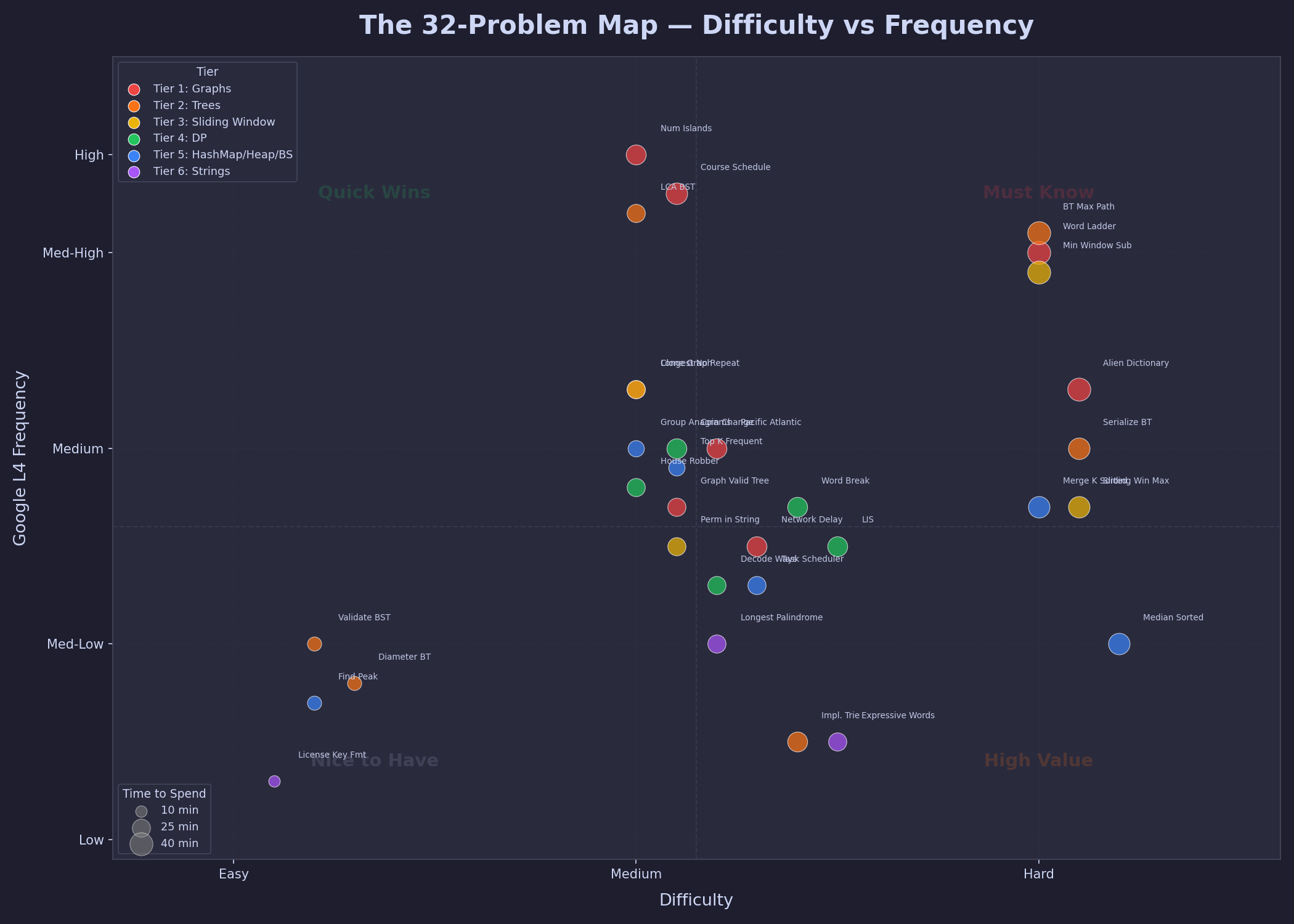
| 🔴 | Tier 1: Graphs | 8 problems | Highest frequency. BFS/DFS, topo sort, Dijkstra's. Appeared in nearly every SDE onsite. | Study Graphs |
| 🟠 | Tier 2: Trees | 6 problems | Tree DP, LCA, serialize/deserialize. Second highest frequency in SDE interviews. | Study Trees |
| 🟡 | Tier 3: Sliding Window | 4 problems | Phone screen favorites. Master the expand/shrink template and you're golden. | Study Sliding Window |
| 🟢 | Tier 4: DP | 5 problems | 1 DP question per loop typical. Cover 1D, 2D, and DFS+memo patterns. | Study DP |
| 🔵 | Tier 5: HashMap/Heap/BS | 6 problems | Pattern matching and optimization. Group anagrams, top-K, binary search variants. | Study Data Structures |
| 🟣 | Tier 6: Strings | 3 problems | Tries, two-pointer string matching, and backtracking. | Study Strings |
The Reality Check
You have an interview this week. No time for a 3-month grind. This site is your battle plan.
YOUR SITUATION
This is not a "learn DSA from scratch" resource. This is a focused, prioritized list of 32 problems that actually show up in SDE interviews, based on real interview reports from 2024-2025.
Here is what your interview looks like:
- 2 coding rounds, 45 minutes each, conducted virtually
- Plain text editor (no IDE) -- you cannot run your code, no syntax highlighting, no autocomplete
- Based on actual SDE interview reports collected from candidates who interviewed in 2024-2025
- Expect 1 main problem per round, possibly with a follow-up or extension
NO CODE EXECUTION
You will write code in a plain text editor (no IDE). Practice writing syntactically correct solutions without an IDE. Every character matters when you cannot hit "Run".
What Interviews Test
| Area | Focus | Weight |
|---|---|---|
| Data Structures & Algorithms | Graphs, Trees, DP, Sliding Window, HashMap/Heap, Strings | ~70% |
| System Design | High-level architecture, trade-offs, scalability | ~25% |
| Behavioral | Collaboration, ambiguity, leadership | ~5% |
DSA IS THE GATE
Your coding rounds are the make-or-break. System design matters, but you will not reach the hiring committee if you bomb the coding rounds. Prioritize DSA above everything else this week.
How to Use This Site
Step-by-step guide (click to expand)
Start with Tier 1 (Graphs) -- This is the highest-frequency category. If you only have a few hours, spend them here. Work through all 8 problems.
Work through each tier in order -- The tiers are ranked by frequency of appearance in real SDE interviews. Tier 1 first, Tier 6 last.
Use the Templates page for quick reference -- Memorize the BFS template, the sliding window template, and the topo sort template. These cover at least 60% of problems.
Follow the Schedule for a structured plan -- If you have a full weekend, the schedule breaks the 32 problems across Saturday and Sunday with morning/afternoon/evening blocks.
Review the Interview Day checklist before your rounds -- Communication phrases, time allocation per section, and tips from candidates who received offers.
The fastest path if you are short on time
| Time Available | What to Cover |
|---|---|
| 2 hours | Graphs (#1-4): Islands, Course Schedule I/II, Word Ladder |
| 4 hours | Add Trees (#9-11): Max Path Sum, LCA (BST + BT) |
| 8 hours | Add Sliding Window (#15-18) and DP (#19-21) |
| Full weekend | All 32 problems + 2 timed mocks in a plain text editor |
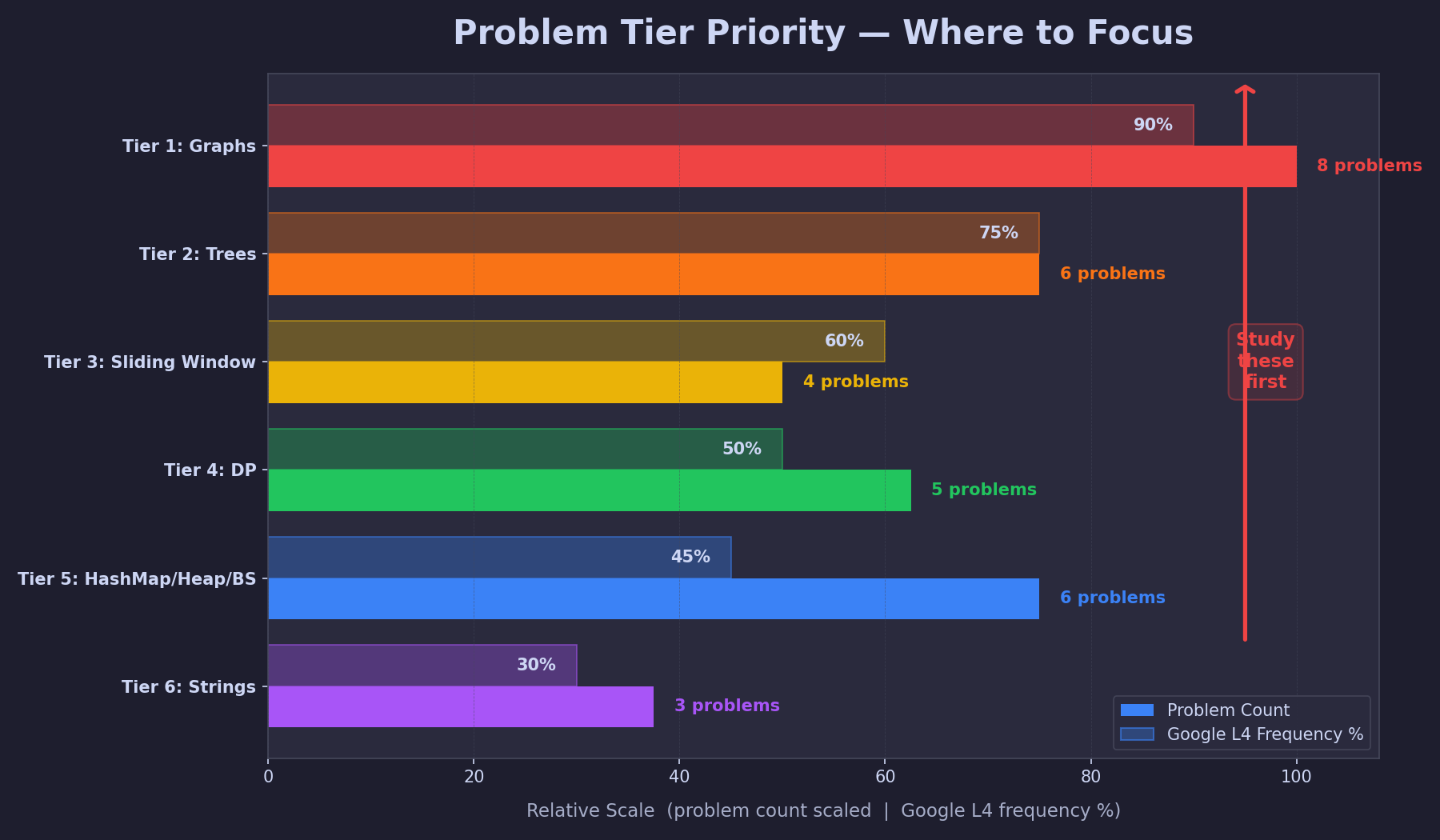
Problem Distribution at a Glance
| Tier | Category | Count | Priority |
|---|---|---|---|
| 🔴 T1 | Graphs | 8 | Critical |
| 🟠 T2 | Trees | 6 | High |
| 🟡 T3 | Sliding Window | 4 | High |
| 🟢 T4 | DP | 5 | Medium |
| 🔵 T5 | HashMap / Heap / BS | 6 | Medium |
| 🟣 T6 | Strings | 3 | Lower |
| Total | 32 |
DIMINISHING RETURNS
Going from 0 to 20 problems is massive. Going from 20 to 32 is incremental. If you are running out of time, stop at Tier 4 and spend the remaining hours doing timed mock rounds in a plain text editor instead.
Interview Day at a Glance
INTERVIEW FORMAT
Your rounds: 2 coding rounds, 45 min each, in a plain text editor (no code execution). Start with brute force, optimize, dry-run your code, communicate constantly.
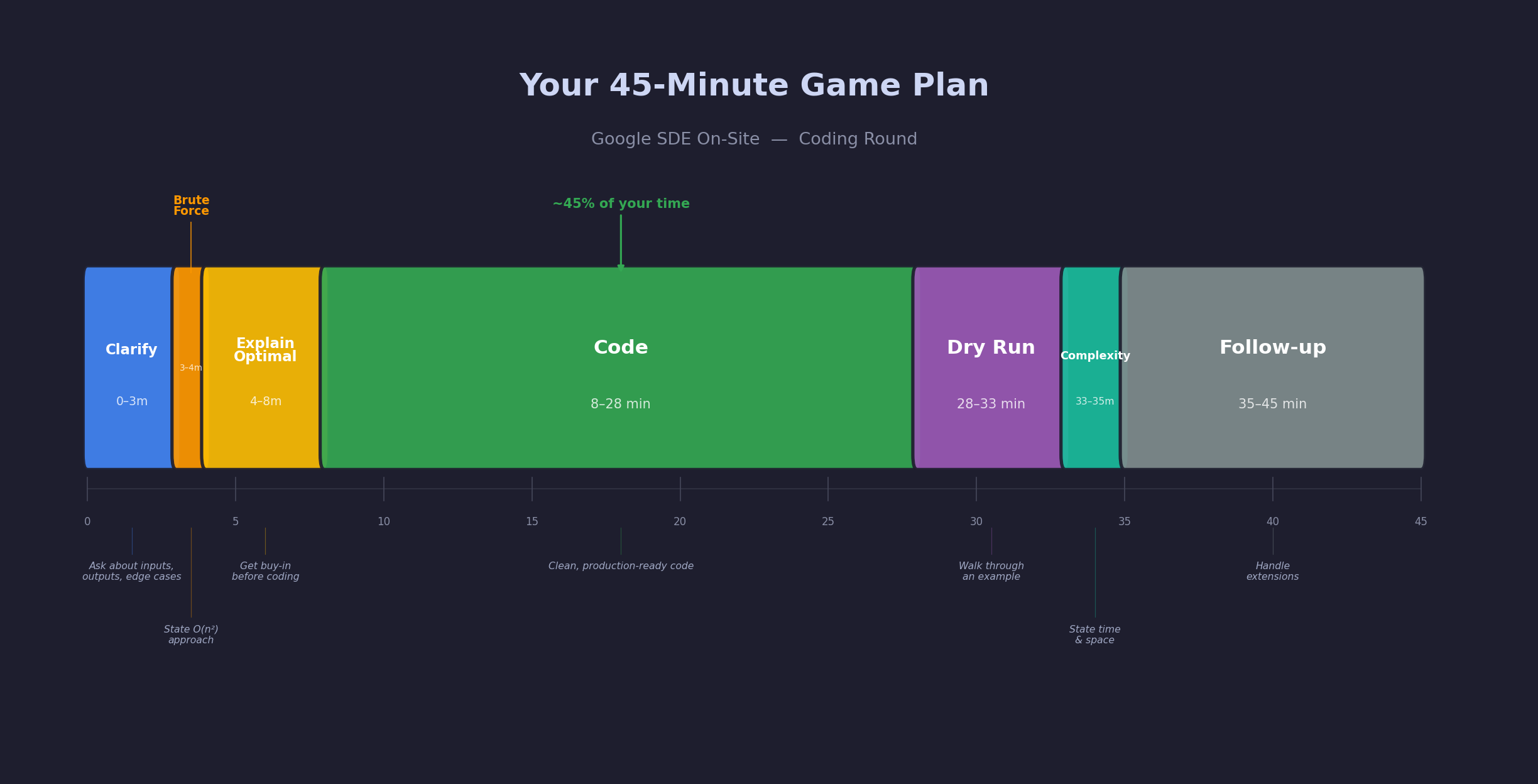
Time allocation per 45-minute round
| Phase | Time | What to Do |
|---|---|---|
| Clarify | 2-3 min | Restate the problem, confirm inputs/outputs, ask about edge cases |
| Brute Force | 1 min | State the naive approach and its complexity |
| Optimal Approach | 3-5 min | Explain your optimized solution before writing any code |
| Code | 15-20 min | Write clean, well-named code in a plain text editor |
| Dry Run | 3-5 min | Walk through an example step by step -- do this without being asked |
| Complexity | 1 min | State time and space complexity |
| Follow-up | Remaining | Handle extensions or optimizations |
Communication phrases that work
"This looks like a [pattern] problem because..."
"The brute force would be O(n^2), but we can optimize with..."
"Let me verify with a quick dry run..."
"The trade-off here is memory vs time -- I'll go with..."
MAX 1 HINT
Needing more than 1 hint from your interviewer pushes you toward "Lean Hire" or worse. If you are stuck, talk through your thought process out loud rather than sitting in silence.
Tips from Candidates Who Got Offers
Start with brute force -- One candidate was explicitly told: "start brute force before diving into optimal."
Dry-run your code -- A candidate received a "Hire" rating despite having a bug, because they caught it during their dry run.
Never go silent -- Communicate even when stuck: "I'm considering whether BFS or DFS fits better here because..."
Write production-ready code -- The grading criteria is tight. The expectation is production-ready code that handles every corner case.
You cannot run your code -- Practice writing correct solutions in a plain text editor. Syntax errors in a plain text editor look bad.
YOU GOT THIS
32 problems. 6 tiers. A clear plan. You are more prepared than most candidates who spend months grinding random problems. Focus beats volume. Now go start with Graphs.