Contains Duplicate
Problem Statement
Given an integer array nums, return true if any value appears at least twice in the array, and return false if every element is distinct.
LeetCode: 217. Contains Duplicate
Examples
Example 1:
Input: nums = [1,2,3,1]
Output: true
Explanation: 1 appears twice.Example 2:
Input: nums = [1,2,3,4]
Output: false
Explanation: All elements are distinct.Example 3:
Input: nums = [1,1,1,3,3,4,3,2,4,2]
Output: trueConstraints
1 <= nums.length <= 10^5-10^9 <= nums[i] <= 10^9
Hash Set Approach
Key Insight
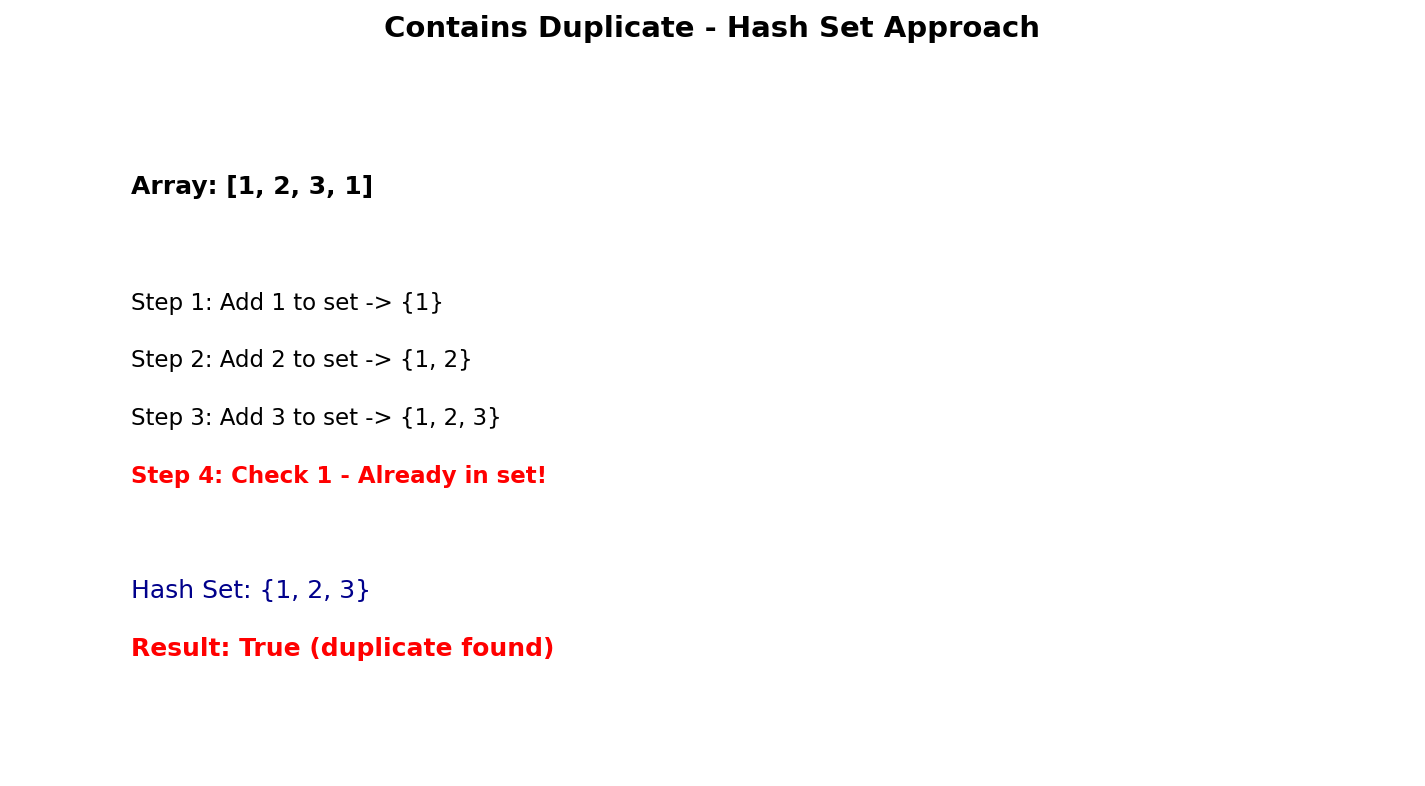
Use a hash set to track seen elements. If we encounter an element already in the set, we found a duplicate.
Algorithm
- Create an empty hash set
- Iterate through the array
- For each element, check if it's in the set
- If yes, return
True(duplicate found) - Otherwise, add element to the set
- If loop completes, return
False
Solution
from typing import List

def containsDuplicate(nums: List[int]) -> bool:
    """
    Check if array contains any duplicate values.

    Time: O(n) - single pass
    Space: O(n) - hash set storage
    """
    seen = set()

    for num in nums:
        if num in seen:
            return True
        seen.add(num)

return Falseimport java.util.*;
class Solution {
public boolean containsDuplicate(int[] nums) {
Set<Integer> seen = new HashSet<>();
for (int num : nums) {
if (!seen.add(num)) {
return true;
}
}
return false;
}
}Complexity: Time O(n) · Space O(n)
- Time: Single pass with O(1) average hash set lookup and insertion per element
- Space: Set stores up to n elements if all are unique
# One-liner alternative
def containsDuplicateOneLiner(nums: List[int]) -> bool:
    """Compare set size with array length."""
return len(nums) != len(set(nums))Complexity: Time O(n) · Space O(n)
- Time: Building set from list is O(n); comparing lengths is O(1)
- Space: Creates a set of up to n unique elements
# Early termination optimization
def containsDuplicateOptimized(nums: List[int]) -> bool:
    """
    Optimization: If array length > range of possible values,
    must contain duplicates (pigeonhole principle).
    """
    # For this problem, values can be -10^9 to 10^9
    # So this optimization rarely helps, but useful for limited ranges
    if nums:
        value_range = max(nums) - min(nums) + 1
        if len(nums) > value_range:
            return True

    seen = set()
    for num in nums:
        if num in seen:
            return True
        seen.add(num)
return FalseComplexity: Time O(n) · Space O(n)
- Time: Same as basic approach - early termination on first duplicate found
- Space: Set grows until duplicate found or all elements processed
Alternative Approaches
Sorting Approach
def containsDuplicateSorting(nums: List[int]) -> bool:
    """
    Sort and check adjacent elements.

    Time: O(n log n) - sorting
    Space: O(log n) or O(n) - depends on sort implementation
    """
    nums.sort()
    for i in range(1, len(nums)):
        if nums[i] == nums[i - 1]:
            return True
return FalseComplexity: Time O(n log n) · Space O(log n) to O(n)
- Time: Dominated by sorting; linear scan afterward is O(n)
- Space: In-place sort uses O(log n) for recursion stack; Python's Timsort may use O(n)
Brute Force (Not Recommended)
def containsDuplicateBruteForce(nums: List[int]) -> bool:
    """
    Compare every pair.

    Time: O(n^2)
    Space: O(1)
    """
    n = len(nums)
    for i in range(n):
        for j in range(i + 1, n):
            if nums[i] == nums[j]:
                return True
return FalseComplexity: Time O(n^2) · Space O(1)
- Time: Nested loops check all n*(n-1)/2 pairs in worst case
- Space: Only uses loop variables, no additional data structures
Complexity Analysis
| Approach | Time | Space |
|---|---|---|
| Hash Set | O(n) | O(n) |
| Sorting | O(n log n) | O(log n) to O(n) |
| Brute Force | O(n^2) | O(1) |
Edge Cases
- Single element:
[1]- No duplicates possible, returnFalse - All same:
[1,1,1,1]- ReturnTrueimmediately - All different:
[1,2,3,4]- Check all elements, returnFalse - Negative numbers:
[-1,-1]- Hash set handles negatives
Variations
Contains Duplicate II
Check if there are duplicates within distance k:
def containsNearbyDuplicate(nums: List[int], k: int) -> bool:
    """
    Check if nums[i] == nums[j] where |i - j| <= k.

    Time: O(n)
    Space: O(min(n, k))
    """
    window = set()

    for i, num in enumerate(nums):
        if num in window:
            return True

        window.add(num)

        # Maintain window size of k
        if len(window) > k:
            window.remove(nums[i - k])

return FalseComplexity: Time O(n) · Space O(min(n, k))
- Time: Single pass with O(1) set operations; window maintenance is constant time
- Space: Set maintains at most k+1 elements in the sliding window
Contains Duplicate III
Check if there are duplicates with value difference at most t within distance k:
def containsNearbyAlmostDuplicate(nums: List[int], k: int, t: int) -> bool:
    """
    Check if |nums[i] - nums[j]| <= t and |i - j| <= k.
    Uses bucket sort approach.

    Time: O(n)
    Space: O(min(n, k))
    """
    if t < 0:
        return False

    buckets = {}
    bucket_size = t + 1  # +1 to handle t=0

    for i, num in enumerate(nums):
        bucket_id = num // bucket_size

        # Check same bucket
        if bucket_id in buckets:
            return True

        # Check adjacent buckets
        if bucket_id - 1 in buckets and num - buckets[bucket_id - 1] <= t:
            return True
        if bucket_id + 1 in buckets and buckets[bucket_id + 1] - num <= t:
            return True

        buckets[bucket_id] = num

        # Maintain window
        if i >= k:
            del buckets[nums[i - k] // bucket_size]

return FalseComplexity: Time O(n) · Space O(min(n, k))
- Time: Single pass with O(1) bucket operations; each element maps to exactly one bucket
- Space: At most k buckets maintained in sliding window
Related Problems
Contains Duplicate II (LeetCode 219)
Problem: Return true if nums[i] == nums[j] and abs(i - j) <= k.
Key Insight: Maintain sliding window of size k+1 using hash set. Check for duplicates within window.
Approach: Use set to track elements in current window. Remove oldest when window exceeds k.
Complexity: Time O(n), Space O(min(n, k))
Contains Duplicate III (LeetCode 220)
Problem: Return true if nums[i] and nums[j] differ by at most t and indices differ by at most k.
Key Insight: Use bucket sort with bucket size t+1. Elements in same bucket or adjacent buckets could be valid.
Approach: Map elements to buckets. Check same bucket and neighbors. Maintain sliding window of k buckets.
Complexity: Time O(n), Space O(min(n, k))
Two Sum (LeetCode 1)
Problem: Find two numbers that add up to target.
Key Insight: Use hash map to store complement. One-pass solution checking and storing simultaneously.
Approach: For each num, check if complement (target - num) exists in map. If not, store num.
Complexity: Time O(n), Space O(n)
Intersection of Two Arrays (LeetCode 349)
Problem: Return array of elements that appear in both arrays.
Key Insight: Use set for one array, then check membership for second array.
Approach: Convert smaller array to set. Iterate larger array, add matches to result set.
Complexity: Time O(n + m), Space O(min(n, m))