Network Delay Time
Finding shortest paths in weighted graphs using Dijkstra's algorithm
Problem Statement
LeetCode 743: Network Delay Time
You are given a network of n nodes, labeled from 1 to n. You are also given times, a list of travel times as directed edges times[i] = (ui, vi, wi), where ui is the source node, vi is the target node, and wi is the time it takes for a signal to travel from source to target.
We will send a signal from a given node k. Return the minimum time it takes for all the n nodes to receive the signal. If it is impossible for all the n nodes to receive the signal, return -1.
Visual Overview
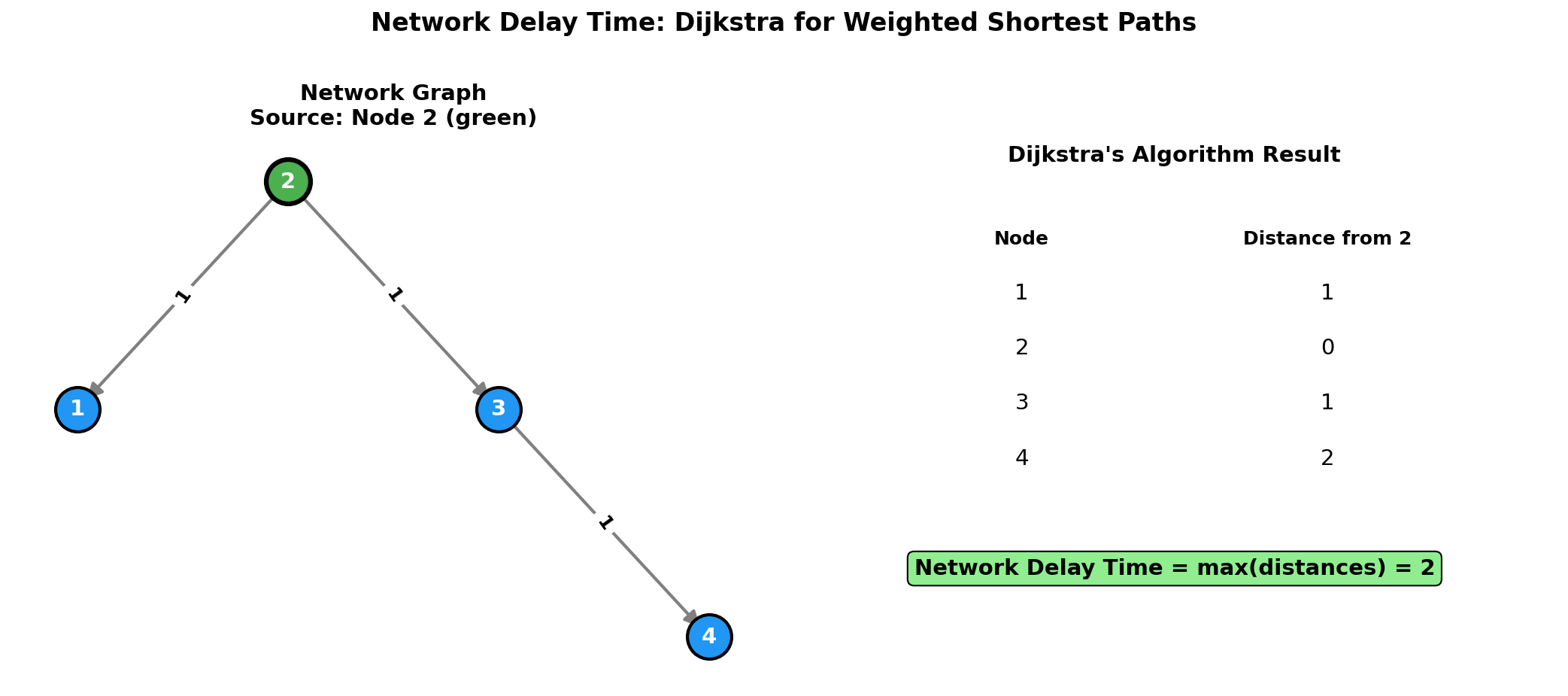
Examples
Example 1
Input: times = [[2,1,1],[2,3,1],[3,4,1]], n = 4, k = 2
Output: 2

Network:
     1
     ^
    /1
   2 --1--> 3
            |
            1
            v
            4

From node 2:
  To node 1: 1 (direct)
  To node 3: 1 (direct)
  To node 4: 2 (via 3)

Maximum time = 2Example 2
Input: times = [[1,2,1]], n = 2, k = 2
Output: -1

Explanation: Node 1 is unreachable from node 2Key Insight
This is a single-source shortest path problem in a weighted directed graph with non-negative weights. The answer is the maximum of all shortest paths from the source.
Dijkstra's Algorithm is perfect for this:
- Find shortest path from source to all nodes
- Return the maximum distance (time for last node to receive signal)
- If any node is unreachable, return -1
Solution: Dijkstra's Algorithm
import heapq
from collections import defaultdict

def networkDelayTime(times: list[list[int]], n: int, k: int) -> int:
    # Build adjacency list
    graph = defaultdict(list)
    for u, v, w in times:
        graph[u].append((v, w))

    # Dijkstra's algorithm
    # Min-heap: (distance, node)
    heap = [(0, k)]  # Start from node k with distance 0
    dist = {}  # Shortest distance to each node

    while heap:
        d, node = heapq.heappop(heap)

        # Skip if we've already found a shorter path
        if node in dist:
            continue

        dist[node] = d

        # Explore neighbors
        for neighbor, weight in graph[node]:
            if neighbor not in dist:
                heapq.heappush(heap, (d + weight, neighbor))

    # Check if all nodes are reachable
    if len(dist) != n:
        return -1

return max(dist.values())public int networkDelayTime(int[][] times, int n, int k) {
Map<Integer, List<int[]>> graph = new HashMap<>();
for (int[] t : times) {
graph.computeIfAbsent(t[0], x -> new ArrayList<>()).add(new int[]{t[1], t[2]});
}
// Min-heap: [distance, node]
PriorityQueue<int[]> pq = new PriorityQueue<>((a, b) -> Integer.compare(a[0], b[0]));
pq.offer(new int[]{0, k});
Map<Integer, Integer> dist = new HashMap<>();
while (!pq.isEmpty()) {
int[] cur = pq.poll();
int d = cur[0], node = cur[1];
if (dist.containsKey(node)) continue;
dist.put(node, d);
for (int[] neighbor : graph.getOrDefault(node, Collections.emptyList())) {
if (!dist.containsKey(neighbor[0]))
pq.offer(new int[]{d + neighbor[1], neighbor[0]});
}
}
if (dist.size() != n) return -1;
return Collections.max(dist.values());
}Complexity: Time O((V + E) log V) · Space O(V + E)
- Time: Each node extracted from heap once O(V log V), each edge relaxation involves heap push O(E log V)
- Space: Adjacency list O(E), min-heap up to O(E) entries, distance dictionary O(V)
How Dijkstra's Works
Step-by-Step for Example 1
Initial: heap = [(0, 2)], dist = {}

Step 1: Pop (0, 2)
  dist = {2: 0}
  Add neighbors: heap = [(1, 1), (1, 3)]

Step 2: Pop (1, 1)
  dist = {2: 0, 1: 1}
  No outgoing edges from 1

Step 3: Pop (1, 3)
  dist = {2: 0, 1: 1, 3: 1}
  Add neighbor: heap = [(2, 4)]

Step 4: Pop (2, 4)
  dist = {2: 0, 1: 1, 3: 1, 4: 2}

Result: max(dist.values()) = 2Complexity Analysis
| Aspect | Complexity | Explanation |
|---|---|---|
| Time | O((V + E) log V) | Each node/edge processed once, heap operations O(log V) |
| Space | O(V + E) | Graph + heap + dist dictionary |
For this problem:
- V = n (number of nodes)
- E = len(times) (number of edges)
Alternative: Bellman-Ford
Use when edges can have negative weights (Dijkstra's doesn't work with negative weights).
def networkDelayTime(times: list[list[int]], n: int, k: int) -> int:
    # Initialize distances
    INF = float('inf')
    dist = [INF] * (n + 1)
    dist[k] = 0

    # Relax all edges n-1 times
    for _ in range(n - 1):
        for u, v, w in times:
            if dist[u] != INF and dist[u] + w < dist[v]:
                dist[v] = dist[u] + w

    # Find maximum distance
    max_dist = max(dist[1:])  # Skip index 0 (1-indexed)

return max_dist if max_dist != INF else -1Complexity: Time O(V * E) · Space O(V)
- Time: V-1 relaxation passes, each examining all E edges; handles negative weights unlike Dijkstra
- Space: Single distance array of size V; no heap or adjacency list needed (edges processed directly)
Complexity
| Aspect | Complexity | Explanation |
|---|---|---|
| Time | O(V * E) | V-1 iterations, each processing E edges |
| Space | O(V) | Distance array |
Comparison of Approaches
| Aspect | Dijkstra's | Bellman-Ford |
|---|---|---|
| Time | O((V+E) log V) | O(V * E) |
| Negative weights | No | Yes |
| Negative cycles | No | Detects them |
| Best for | Sparse graphs, non-negative weights | Negative weights, cycle detection |
Common Mistakes
1. Using BFS Instead of Dijkstra
# WRONG - BFS doesn't account for edge weights
from collections import deque
queue = deque([k])
dist[k] = 0
while queue:
    node = queue.popleft()
    for neighbor, weight in graph[node]:
        if dist[neighbor] > dist[node] + weight:
            dist[neighbor] = dist[node] + weight
queue.append(neighbor) # May not be optimal!BFS works for unweighted graphs, but for weighted graphs, you need a priority queue.
2. Not Checking Visited Before Processing
# WRONG - processes same node multiple times
while heap:
    d, node = heapq.heappop(heap)
    # Should check: if node in dist: continue
dist[node] = d # Might overwrite with larger value!3. 1-Indexed vs 0-Indexed Confusion
# The problem uses 1-indexed nodes!
# Make sure to handle correctly
dist = [float('inf')] * (n + 1)  # n+1 to use 1-indexing
dist[k] = 0
# Don't forget to exclude index 0 in final answer
return max(dist[1:]) if all(d != float('inf') for d in dist[1:]) else -1Variations
Find Shortest Path to Specific Target
def shortestPath(times, n, k, target):
    # Same as above, but return dist[target]
    # Can optimize by stopping when target is popped
    if node == target:
return d # Early terminationCount Reachable Nodes Within Time Limit
def reachableNodes(times, n, k, max_time):
    # Run Dijkstra, count nodes with dist <= max_time
return sum(1 for d in dist.values() if d <= max_time)Reconstruct Shortest Path
def shortestPathWithReconstruction(times, n, k, target):
    parent = {k: None}

    while heap:
        d, node = heapq.heappop(heap)
        if node in dist:
            continue
        dist[node] = d

        for neighbor, weight in graph[node]:
            if neighbor not in dist:
                heapq.heappush(heap, (d + weight, neighbor))
                if neighbor not in parent or d + weight < dist.get(neighbor, float('inf')):
                    parent[neighbor] = node

    # Reconstruct path
    path = []
    current = target
    while current is not None:
        path.append(current)
        current = parent.get(current)
return path[::-1], dist.get(target, -1)Edge Cases
- Source node with no outgoing edges: Other nodes unreachable, return -1
- Disconnected graph: Some nodes unreachable, return -1
- Single node (n=1): Return 0 (signal already at destination)
- Self-loops: Dijkstra handles correctly (never optimal to revisit)
- Multiple edges between same nodes: Take minimum automatically
Interview Tips
- Recognize Dijkstra pattern: Weighted graph + shortest path + non-negative weights
- Explain the heap: Min-heap ensures we process nodes in order of increasing distance
- Mention the key insight: Answer is max(all shortest paths), not sum
- Handle edge cases: Unreachable nodes, single node
Follow-up Questions
Q: What if some edges have negative weights?
- A: Use Bellman-Ford instead
Q: What if we need all-pairs shortest paths?
- A: Run Dijkstra from each node (O(V(V+E) log V)) or use Floyd-Warshall (O(V^3))
Q: How to find the actual path, not just the distance?
- A: Track parent pointers and backtrack from destination
Related Problems
Cheapest Flights Within K Stops (LeetCode 787)
Problem: Find the cheapest price from source to destination with at most K stops in a flight network.
Key Insight: Modified Dijkstra or Bellman-Ford with hop constraint.
Approach: Use Bellman-Ford with K+1 iterations, or BFS level-by-level tracking costs at each stop count.
Complexity: O(E * K) time, O(N) space
Path with Minimum Effort (LeetCode 1631)
Problem: Find a path from top-left to bottom-right in a grid where effort is the maximum absolute height difference between consecutive cells.
Key Insight: Dijkstra on a grid where edge weight is height difference (minimax path problem).
Approach: Modified Dijkstra where we minimize the maximum edge weight along the path, not the sum.
Complexity: O(MN log(MN)) time, O(M*N) space
Shortest Path in Binary Matrix (LeetCode 1091)
Problem: Find shortest clear path (all 0s) from top-left to bottom-right with 8-directional movement.
Key Insight: BFS for unweighted shortest path with diagonal neighbors.
Approach: Standard BFS since all moves have equal cost. Use 8 directions instead of 4.
Complexity: O(N^2) time, O(N^2) space
Find the City With Smallest Number of Neighbors (LeetCode 1334)
Problem: Find the city with fewest reachable cities within a distance threshold. Return highest numbered city on tie.
Key Insight: All-pairs shortest paths using Floyd-Warshall or Dijkstra from each node.
Approach: Run Floyd-Warshall for dense graphs or Dijkstra from each node for sparse graphs.
Complexity: O(V^3) time with Floyd-Warshall, O(V + E) space