Permutations & Combination Sum
Classic backtracking with different constraints
Overview
Permutations and Combination Sum represent two fundamental backtracking patterns:
- Permutations: Arrange ALL elements in every possible order
- Combination Sum: Select elements (with possible reuse) to reach a target
Understanding these patterns unlocks solutions to dozens of related problems.
Permutations
Problem Statement
Given an array nums of distinct integers, return all possible permutations. You can return the answer in any order.
Example:
Input: nums = [1, 2, 3]
Output: [[1,2,3], [1,3,2], [2,1,3], [2,3,1], [3,1,2], [3,2,1]]Key Insight: For n distinct elements, there are n! (n factorial) possible permutations.
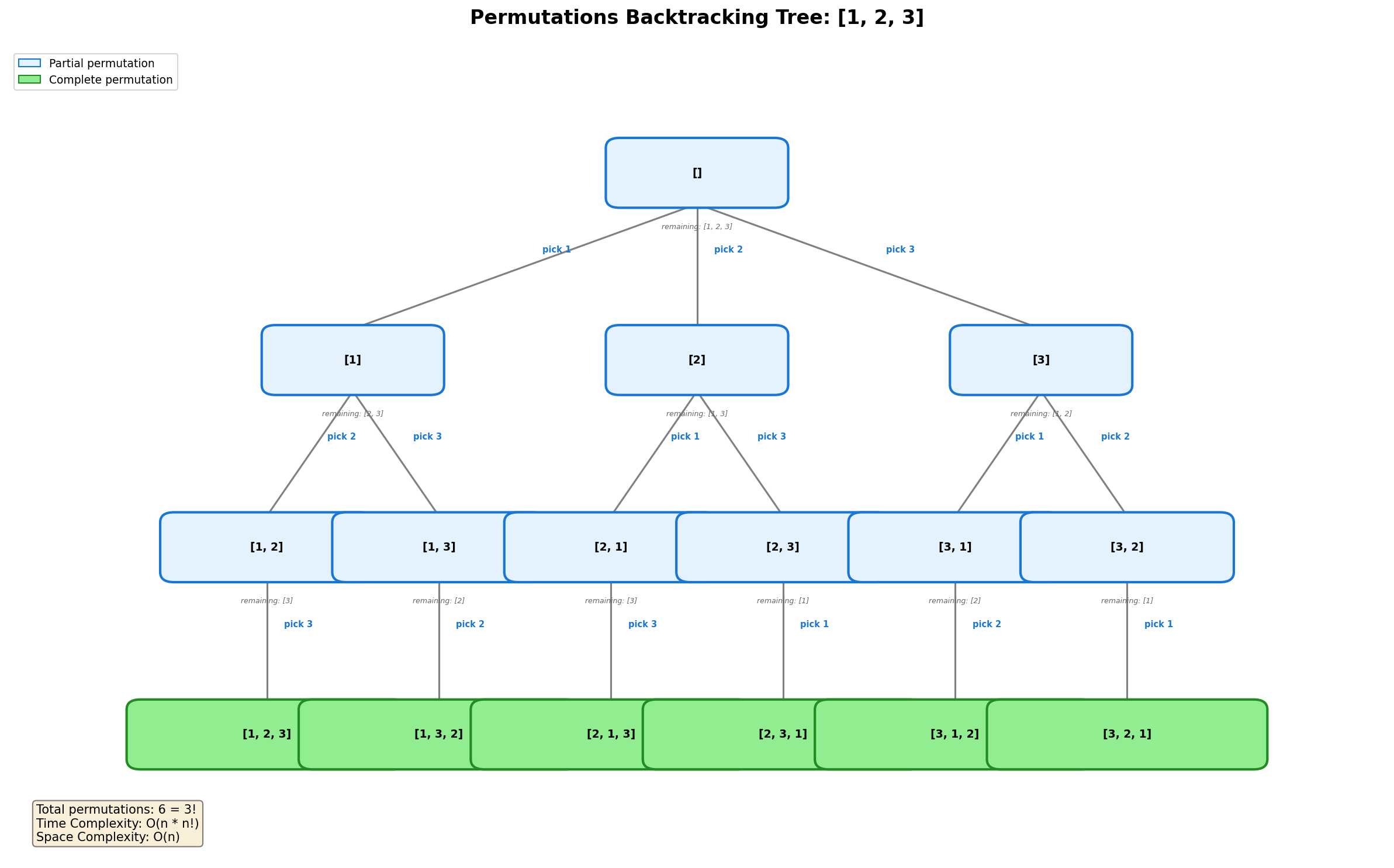
Backtracking Tree
nums = [1, 2, 3]

                              []
               /              |              \
             [1]             [2]             [3]
            /   \           /   \           /   \
        [1,2] [1,3]     [2,1] [2,3]     [3,1] [3,2]
          |     |         |     |         |     |
      [1,2,3][1,3,2]  [2,1,3][2,3,1]  [3,1,2][3,2,1]
          ^     ^         ^     ^         ^     ^
RESULT RESULT RESULT RESULT RESULT RESULTDetailed Decision Tree Visualization
Building permutation step-by-step:

Step 1: Choose first element
   Available: [1, 2, 3]

   Pick 1 -> remaining: [2, 3]
   Pick 2 -> remaining: [1, 3]
   Pick 3 -> remaining: [1, 2]

Step 2: Choose second element (example: picked 1 first)
   Current: [1], Available: [2, 3]

   Pick 2 -> current: [1, 2], remaining: [3]
   Pick 3 -> current: [1, 3], remaining: [2]

Step 3: Choose third element (example: picked 1, then 2)
   Current: [1, 2], Available: [3]

   Pick 3 -> current: [1, 2, 3], remaining: []

Base case reached! Add [1, 2, 3] to resultsSolution Approach 1: Using Remaining Elements
def permute(nums: list[int]) -> list[list[int]]:
    """
    Generate all permutations using backtracking with remaining list.

    Time: O(n! * n) - n! permutations, each takes O(n) to copy
    Space: O(n) - recursion depth + current path
    """
    result = []

    def backtrack(current: list[int], remaining: list[int]) -> None:
        # Base case: no more elements to add
        if not remaining:
            result.append(current[:])  # Add copy of current permutation
            return

        # Try each remaining element as the next choice
        for i in range(len(remaining)):
            # Choose: add element to current permutation
            current.append(remaining[i])

            # Explore: recurse with remaining elements (excluding chosen)
            new_remaining = remaining[:i] + remaining[i+1:]
            backtrack(current, new_remaining)

            # Unchoose: backtrack by removing the element
            current.pop()

    backtrack([], nums)
    return result


# Example usage
print(permute([1, 2, 3]))
# Output: [[1,2,3], [1,3,2], [2,1,3], [2,3,1], [3,1,2], [3,2,1]]import java.util.*;
class Solution {
public List<List<Integer>> permute(int[] nums) {
List<List<Integer>> result = new ArrayList<>();
backtrack(result, new ArrayList<>(), new ArrayList<>(boxed(nums)));
return result;
}
private void backtrack(List<List<Integer>> result,
List<Integer> current,
List<Integer> remaining) {
if (remaining.isEmpty()) {
result.add(new ArrayList<>(current)); // deep copy
return;
}
for (int i = 0; i < remaining.size(); i++) {
int val = remaining.get(i);
current.add(val);
remaining.remove(i);
backtrack(result, current, remaining);
remaining.add(i, val); // restore
current.remove(current.size() - 1);
}
}
private List<Integer> boxed(int[] nums) {
List<Integer> list = new ArrayList<>();
for (int n : nums) list.add(n);
return list;
}
}Complexity: Time O(n! * n) · Space O(n)
- Time: O(n! * n) where n! is the number of permutations and O(n) to copy each permutation to the result
- Space: O(n) for recursion depth plus O(n) for the remaining list at each level
Solution Approach 2: In-Place Swapping (Python)
def permute_swap(nums: list[int]) -> list[list[int]]:
    """
    Generate permutations using in-place swapping.
    More memory efficient - modifies array in place.

    Time: O(n! * n)
    Space: O(n) - only recursion stack
    """
    result = []

    def backtrack(start: int) -> None:
        # Base case: all positions filled
        if start == len(nums):
            result.append(nums[:])  # Add copy
            return

        # Try placing each element at position 'start'
        for i in range(start, len(nums)):
            # Choose: swap element to current position
            nums[start], nums[i] = nums[i], nums[start]

            # Explore: fix this position, recurse on rest
            backtrack(start + 1)

            # Unchoose: swap back (backtrack)
            nums[start], nums[i] = nums[i], nums[start]

    backtrack(0)
return resultComplexity: Time O(n! * n) · Space O(n)
- Time: O(n! * n) where n! permutations are generated and O(n) to copy each one
- Space: O(n) for recursion stack only - more memory efficient as swaps are done in-place
Swap-Based Visualization
nums = [1, 2, 3], start = 0

backtrack(0):
  i=0: swap(0,0) -> [1,2,3]
       backtrack(1):
         i=1: swap(1,1) -> [1,2,3]
              backtrack(2):
                i=2: swap(2,2) -> [1,2,3]
                     backtrack(3): ADD [1,2,3]
                     swap(2,2) -> [1,2,3]
              swap(1,1) -> [1,2,3]
         i=2: swap(1,2) -> [1,3,2]
              backtrack(2):
                i=2: swap(2,2) -> [1,3,2]
                     backtrack(3): ADD [1,3,2]
              swap(1,2) -> [1,2,3]
       swap(0,0) -> [1,2,3]

  i=1: swap(0,1) -> [2,1,3]
       backtrack(1): ... generates [2,1,3], [2,3,1]
       swap(0,1) -> [1,2,3]

  i=2: swap(0,2) -> [3,2,1]
       backtrack(1): ... generates [3,2,1], [3,1,2]
swap(0,2) -> [1,2,3]Visual Guides
Permutations II: With Duplicates
def permuteUnique(nums: list[int]) -> list[list[int]]:
    """
    Generate unique permutations when input contains duplicates.

    Key insight: Sort array first, then skip duplicates at same level.

    Example: [1, 1, 2] -> [[1,1,2], [1,2,1], [2,1,1]]
    """
    nums.sort()  # Critical for duplicate detection!
    result = []
    used = [False] * len(nums)

    def backtrack(current: list[int]) -> None:
        if len(current) == len(nums):
            result.append(current[:])
            return

        for i in range(len(nums)):
            # Skip if already used in current permutation
            if used[i]:
                continue

            # Skip duplicates: if same as previous AND previous not used
            # This ensures we only use duplicates in order
            if i > 0 and nums[i] == nums[i-1] and not used[i-1]:
                continue

            used[i] = True
            current.append(nums[i])
            backtrack(current)
            current.pop()
            used[i] = False

    backtrack([])
return resultComplexity: Time O(n! * n) · Space O(n)
- Time: O(n! * n) worst case - sorting takes O(n log n), then generating permutations with duplicate skipping
- Space: O(n) for recursion depth plus O(n) for the used array
Duplicate Skipping Visualization
nums = [1, 1, 2] (sorted)

Without duplicate handling:
   [1a, 1b, 2] and [1b, 1a, 2] would both be generated

With duplicate handling:
   At position 0:
     - Pick 1a (index 0): OK
     - Pick 1b (index 1): SKIP! Same as 1a and 1a not used
     - Pick 2 (index 2): OK

   This ensures 1a is always used before 1b

Result: [[1,1,2], [1,2,1], [2,1,1]]Combination Sum
Problem Statement
Given an array of distinct integers candidates and a target integer target, return a list of all unique combinations of candidates where the chosen numbers sum to target.
The same number may be chosen unlimited times.
Example:
Input: candidates = [2, 3, 6, 7], target = 7
Output: [[2, 2, 3], [7]]
Explanation:
  - 2 + 2 + 3 = 7
- 7 = 7Key Insight: Preventing Duplicates
To avoid duplicate combinations like [2,3,2] and [2,2,3]:
- Only consider candidates from current index forward
- This ensures elements are chosen in non-decreasing order of indices
Decision Tree Visualization
candidates = [2, 3, 6, 7], target = 7

Start: sum=0, path=[], start_index=0
|
+-- Choose 2 (idx=0): sum=2, path=[2]
|   |
|   +-- Choose 2 (idx=0): sum=4, path=[2,2]
|   |   |
|   |   +-- Choose 2 (idx=0): sum=6, path=[2,2,2]
|   |   |   |
|   |   |   +-- Choose 2: sum=8 > 7  PRUNE
|   |   |   +-- Choose 3: sum=9 > 7  PRUNE
|   |   |
|   |   +-- Choose 3 (idx=1): sum=7, path=[2,2,3]  FOUND!
|   |   +-- Choose 6 (idx=2): sum=10 > 7  PRUNE
|   |   +-- Choose 7 (idx=3): sum=11 > 7  PRUNE
|   |
|   +-- Choose 3 (idx=1): sum=5, path=[2,3]
|   |   |
|   |   +-- Choose 3: sum=8 > 7  PRUNE
|   |
|   +-- Choose 6 (idx=2): sum=8 > 7  PRUNE
|   +-- Choose 7 (idx=3): sum=9 > 7  PRUNE
|
+-- Choose 3 (idx=1): sum=3, path=[3]
|   |
|   +-- Choose 3: sum=6, path=[3,3]
|   |   +-- Choose 3: sum=9 > 7  PRUNE
|   +-- Choose 6: sum=9 > 7  PRUNE
|   +-- Choose 7: sum=10 > 7  PRUNE
|
+-- Choose 6 (idx=2): sum=6, path=[6]
|   +-- Choose 6: sum=12 > 7  PRUNE
|   +-- Choose 7: sum=13 > 7  PRUNE
|
+-- Choose 7 (idx=3): sum=7, path=[7]  FOUND!

Results: [[2,2,3], [7]]Solution
def combinationSum(candidates: list[int], target: int) -> list[list[int]]:
    """
    Find all unique combinations that sum to target.
    Same number can be used unlimited times.

    Time: O(n^(t/m)) where t=target, m=min(candidates)
    Space: O(t/m) for recursion depth
    """
    result = []

    def backtrack(start: int, current: list[int], remaining: int) -> None:
        # Base case: found valid combination
        if remaining == 0:
            result.append(current[:])
            return

        # Base case: exceeded target
        if remaining < 0:
            return

        # Try each candidate from start index onward
        for i in range(start, len(candidates)):
            # Choose
            current.append(candidates[i])

            # Explore: pass i (not i+1) to allow reuse
            backtrack(i, current, remaining - candidates[i])

            # Unchoose
            current.pop()

    backtrack(0, [], target)
    return result


# Example
print(combinationSum([2, 3, 6, 7], 7))
# Output: [[2, 2, 3], [7]]import java.util.*;
class Solution {
public List<List<Integer>> combinationSum(int[] candidates, int target) {
List<List<Integer>> result = new ArrayList<>();
backtrack(candidates, 0, new ArrayList<>(), target, result);
return result;
}
private void backtrack(int[] candidates, int start,
List<Integer> current, int remaining,
List<List<Integer>> result) {
if (remaining == 0) {
result.add(new ArrayList<>(current)); // deep copy
return;
}
if (remaining < 0) return;
for (int i = start; i < candidates.length; i++) {
current.add(candidates[i]);
// pass i (not i+1) to allow reuse of same element
backtrack(candidates, i, current, remaining - candidates[i], result);
current.remove(current.size() - 1);
}
}
}Complexity: Time O(n^(t/m)) · Space O(t/m)
- Time: O(n^(t/m)) where t is the target sum and m is the minimum candidate value - represents max branching
- Space: O(t/m) for recursion depth in the worst case (using only minimum value repeatedly)
Optimized with Sorting and Pruning
def combinationSum_optimized(candidates: list[int], target: int) -> list[list[int]]:
    """
    Optimized version with early termination.
    Sorting allows us to break early when candidate exceeds remaining.
    """
    candidates.sort()  # Sort for early termination
    result = []

    def backtrack(start: int, current: list[int], remaining: int) -> None:
        if remaining == 0:
            result.append(current[:])
            return

        for i in range(start, len(candidates)):
            # Early termination: all subsequent candidates are larger
            if candidates[i] > remaining:
                break

            current.append(candidates[i])
            backtrack(i, current, remaining - candidates[i])
            current.pop()

    backtrack(0, [], target)
return resultComplexity: Time O(n^(t/m)) · Space O(t/m)
- Time: O(n^(t/m)) with better constants due to sorting and early termination pruning
- Space: O(t/m) for recursion depth plus O(n log n) for sorting
Combination Sum II: Each Element Used Once
Problem Statement
Given a collection of candidate numbers (may contain duplicates) and a target, find all unique combinations that sum to target. Each number may only be used once.
Solution
def combinationSum2(candidates: list[int], target: int) -> list[list[int]]:
    """
    Find combinations where each element can only be used once.
    Input may contain duplicates.

    Key insight: Sort first, then skip duplicates at same recursion level.
    """
    candidates.sort()  # Critical for duplicate handling!
    result = []

    def backtrack(start: int, current: list[int], remaining: int) -> None:
        if remaining == 0:
            result.append(current[:])
            return
        if remaining < 0:
            return

        for i in range(start, len(candidates)):
            # Skip duplicates at the same level
            if i > start and candidates[i] == candidates[i-1]:
                continue

            # Early termination (since sorted)
            if candidates[i] > remaining:
                break

            current.append(candidates[i])
            # Move to next index (i+1) since each element used once
            backtrack(i + 1, current, remaining - candidates[i])
            current.pop()

    backtrack(0, [], target)
    return result


# Example
print(combinationSum2([10, 1, 2, 7, 6, 1, 5], 8))
# Output: [[1,1,6], [1,2,5], [1,7], [2,6]]import java.util.*;
class Solution {
public List<List<Integer>> combinationSum2(int[] candidates, int target) {
Arrays.sort(candidates); // critical for duplicate skipping
List<List<Integer>> result = new ArrayList<>();
backtrack(candidates, 0, new ArrayList<>(), target, result);
return result;
}
private void backtrack(int[] candidates, int start,
List<Integer> current, int remaining,
List<List<Integer>> result) {
if (remaining == 0) {
result.add(new ArrayList<>(current));
return;
}
for (int i = start; i < candidates.length; i++) {
// Skip duplicates at the same recursion level
if (i > start && candidates[i] == candidates[i - 1]) continue;
if (candidates[i] > remaining) break; // early termination (sorted)
current.add(candidates[i]);
// i+1: each element used at most once
backtrack(candidates, i + 1, current, remaining - candidates[i], result);
current.remove(current.size() - 1);
}
}
}Complexity: Time O(2^n) · Space O(n)
- Time: O(2^n) where each element can be included or excluded - duplicate skipping reduces actual exploration
- Space: O(n) for recursion depth plus O(n log n) for sorting the candidates
Duplicate Skipping Visualization
candidates = [1, 1, 2, 5, 6, 7, 10] (sorted), target = 8

At start=0:
  i=0: Pick 1 (first)  -> Continue to explore
  i=1: Skip! 1 == previous 1, and i > start
  i=2: Pick 2          -> Continue to explore
  ...

Within the subtree of picking first 1:
  At start=1:
    i=1: Pick second 1 -> OK (i == start, not skipping)
    i=2: Pick 2        -> Continue
    ...

This ensures [1a, 1b, 6] is generated
but [1b, 1a, 6] is NOT (1b skipped at level 0)Combination Sum III: K Numbers Sum to N
Problem Statement
Find all valid combinations of k numbers that sum up to n. Only numbers 1-9 may be used, and each number may be used at most once.
Solution
def combinationSum3(k: int, n: int) -> list[list[int]]:
    """
    Find k numbers from 1-9 that sum to n.
    Each number used at most once.
    """
    result = []

    def backtrack(start: int, current: list[int], remaining: int) -> None:
        # Found valid combination
        if len(current) == k and remaining == 0:
            result.append(current[:])
            return

        # Pruning: too many numbers or sum exceeded
        if len(current) >= k or remaining <= 0:
            return

        for num in range(start, 10):
            # Pruning: remaining numbers too small
            if num > remaining:
                break

            current.append(num)
            backtrack(num + 1, current, remaining - num)
            current.pop()

    backtrack(1, [], n)
    return result


# Example
print(combinationSum3(3, 7))   # Output: [[1,2,4]]
print(combinationSum3(3, 9)) # Output: [[1,2,6], [1,3,5], [2,3,4]]import java.util.*;
class Solution {
public List<List<Integer>> combinationSum3(int k, int n) {
List<List<Integer>> result = new ArrayList<>();
backtrack(1, k, n, new ArrayList<>(), result);
return result;
}
private void backtrack(int start, int k, int remaining,
List<Integer> current,
List<List<Integer>> result) {
if (current.size() == k && remaining == 0) {
result.add(new ArrayList<>(current));
return;
}
if (current.size() >= k || remaining <= 0) return;
for (int num = start; num <= 9; num++) {
if (num > remaining) break; // pruning
current.add(num);
backtrack(num + 1, k, remaining - num, current, result);
current.remove(current.size() - 1);
}
}
}Complexity: Time O(C(9,k) * k) · Space O(k)
- Time: O(C(9,k) * k) where C(9,k) is the number of ways to choose k numbers from 1-9, and O(k) to copy each combination
- Space: O(k) for recursion depth and current combination being built
Pattern Comparison: Permutations vs Combinations
Visual Comparison
PERMUTATIONS: Order matters, use all elements
[1, 2, 3] -> [1,2,3], [1,3,2], [2,1,3], [2,3,1], [3,1,2], [3,2,1]
              ^Different arrangements of same elements^

COMBINATIONS: Order doesn't matter, select subset
[1, 2, 3], k=2 -> [1,2], [1,3], [2,3]
                  ^Unique subsets, no [2,1] since same as [1,2]^

COMBINATION SUM: Find combinations that sum to target
[2, 3, 6, 7], target=7 -> [2,2,3], [7]
^Can reuse elements^Code Pattern Comparison
# PERMUTATIONS: Use all elements, track what's used
def permute(nums):
    def backtrack(current, remaining):
        if not remaining:           # Used all elements
            result.append(current[:])
        for i in range(len(remaining)):
            current.append(remaining[i])
            backtrack(current, remaining[:i] + remaining[i+1:])
            current.pop()

# COMBINATIONS: Select k elements
def combine(n, k):
    def backtrack(start, current):
        if len(current) == k:       # Selected k elements
            result.append(current[:])
        for i in range(start, n+1):
            current.append(i)
            backtrack(i + 1, current)  # i+1: no reuse
            current.pop()

# COMBINATION SUM: Select elements summing to target
def combinationSum(candidates, target):
    def backtrack(start, current, remaining):
        if remaining == 0:          # Sum equals target
            result.append(current[:])
        for i in range(start, len(candidates)):
            current.append(candidates[i])
            backtrack(i, current, remaining - candidates[i])  # i: allow reuse
current.pop()Key Differences Table
| Aspect | Permutations | Combinations | Combination Sum |
|---|---|---|---|
| Order matters? | Yes | No | No |
| Use all elements? | Yes | Select k | Select any |
| Reuse allowed? | No | No | Yes (variant I) |
| Base case | len == n | len == k | sum == target |
| Next index | N/A (track used) | i + 1 | i (reuse) or i + 1 |
Complexity Analysis
| Problem | Time Complexity | Space Complexity | Notes |
|---|---|---|---|
| Permutations | O(n! * n) | O(n) | n! permutations, O(n) to copy each |
| Permutations II | O(n! * n) | O(n) | Same worst case, better with many duplicates |
| Subsets | O(2^n * n) | O(n) | 2^n subsets, O(n) to copy each |
| Combinations | O(C(n,k) * k) | O(k) | C(n,k) combinations |
| Combination Sum | O(n^(t/m)) | O(t/m) | t=target, m=min candidate |
| Combination Sum II | O(2^n) | O(n) | Each element included/excluded |
| Combination Sum III | O(C(9,k) * k) | O(k) | Limited to 9 numbers |
Complexity Derivation for Combination Sum
Why O(n^(t/m))?

- Maximum recursion depth: t/m (using only minimum element)
- At each level: up to n choices
- Total nodes: approximately n^(t/m)

Example: candidates=[2,3], target=10
- Depth: 10/2 = 5
- Branching: 2 at each level
- Nodes: ~2^5 = 32Interview Applications
These patterns are foundational for many interview questions:
1. Phone Number Letter Combinations (LeetCode 17)
Similar to permutations: generate all possible letter combinations
"23" -> ["ad","ae","af","bd","be","bf","cd","ce","cf"]2. Generate Parentheses (LeetCode 22)
Backtracking with constraints: balance open/close parentheses
n=3 -> ["((()))","(()())","(())()","()(())","()()()"]3. Word Search (LeetCode 79)
Backtracking on 2D grid: explore all paths
Used in Google's web crawling and indexing problems4. N-Queens (LeetCode 51)
Classic backtracking with constraint checking
Tests understanding of state space search5. Sudoku Solver (LeetCode 37)
Constraint satisfaction via backtracking
Common in Google constraint optimization interviewsCommon Mistakes and Tips
Mistake 1: Forgetting to Copy
# WRONG - adds reference, gets modified later
result.append(current)

# CORRECT - adds copy
result.append(current[:])
# or
result.append(list(current))Mistake 2: Wrong Index in Combination Sum
# Combination Sum I (reuse allowed)
backtrack(i, current, remaining - candidates[i])
#         ^ same index

# Combination Sum II (no reuse)
backtrack(i + 1, current, remaining - candidates[i])
# ^ next indexMistake 3: Not Sorting Before Duplicate Handling
# WRONG - duplicate detection fails without sorting
def combinationSum2(candidates, target):
    # candidates NOT sorted
    if i > start and candidates[i] == candidates[i-1]:
        continue  # Won't work!

# CORRECT
def combinationSum2(candidates, target):
    candidates.sort()  # Sort first!
# Now duplicate detection worksMistake 4: Inefficient State Copying
# INEFFICIENT - creates new list at each level
backtrack(current + [nums[i]], remaining[:i] + remaining[i+1:])

# BETTER - modify in place, backtrack
current.append(nums[i])
backtrack(current, ...)
current.pop()Practice Problems
Essential Problems
- Permutations (LeetCode 46)
- Permutations II (LeetCode 47)
- Combination Sum (LeetCode 39)
- Combination Sum II (LeetCode 40)
- Combination Sum III (LeetCode 216)
Related Problems
- Subsets (LeetCode 78)
- Subsets II (LeetCode 90)
- Combinations (LeetCode 77)
- Letter Combinations of Phone Number (LeetCode 17)
- Generate Parentheses (LeetCode 22)
Summary
The Backtracking Template
def backtrack_template(state):
    """
    Universal backtracking template for permutation/combination problems.
    """
    # 1. Base case: check if we found a valid solution
    if is_valid_solution(state):
        result.append(copy_of_current_solution())
        return

    # 2. Pruning: check if we should stop exploring this path
    if should_prune(state):
        return

    # 3. Explore: try all possible choices
    for choice in get_choices(state):
        # 3a. Make choice (modify state)
        make_choice(state, choice)

        # 3b. Recurse
        backtrack_template(new_state)

        # 3c. Undo choice (backtrack)
undo_choice(state, choice)Key Takeaways
- Permutations: Arrange all elements - track what's used/remaining
- Combinations: Select subset - use start index to avoid duplicates
- Combination Sum: Find sums - control reuse via index (i vs i+1)
- Duplicates: Always sort first, then skip at same level
- Optimization: Sort + early termination when possible