Palindrome Partitioning
Backtracking with dynamic programming optimization
Palindrome Partitioning is a classic backtracking problem that tests your ability to generate all valid solutions while efficiently checking palindrome conditions. It combines recursion, memoization, and string manipulation.
Problem Statement
Given a string s, partition s such that every substring of the partition is a palindrome. Return all possible palindrome partitioning of s.
This is LeetCode Problem #131 - a Medium difficulty problem.
Examples
| Input | Output |
|---|---|
"aab" | [["a","a","b"],["aa","b"]] |
"a" | [["a"]] |
"racecar" | [["r","a","c","e","c","a","r"],["r","a","cec","a","r"],["r","aceca","r"],["racecar"]] |
Constraints
1 <= s.length <= 16scontains only lowercase English letters
Approach: Backtracking
Key Insight
We need to explore all ways to partition the string such that each partition is a palindrome. This is a classic backtracking problem where we:
- At each position, try all possible palindrome prefixes
- Recursively partition the remaining string
- If we reach the end, we've found a valid partition
Decision Tree Visualization
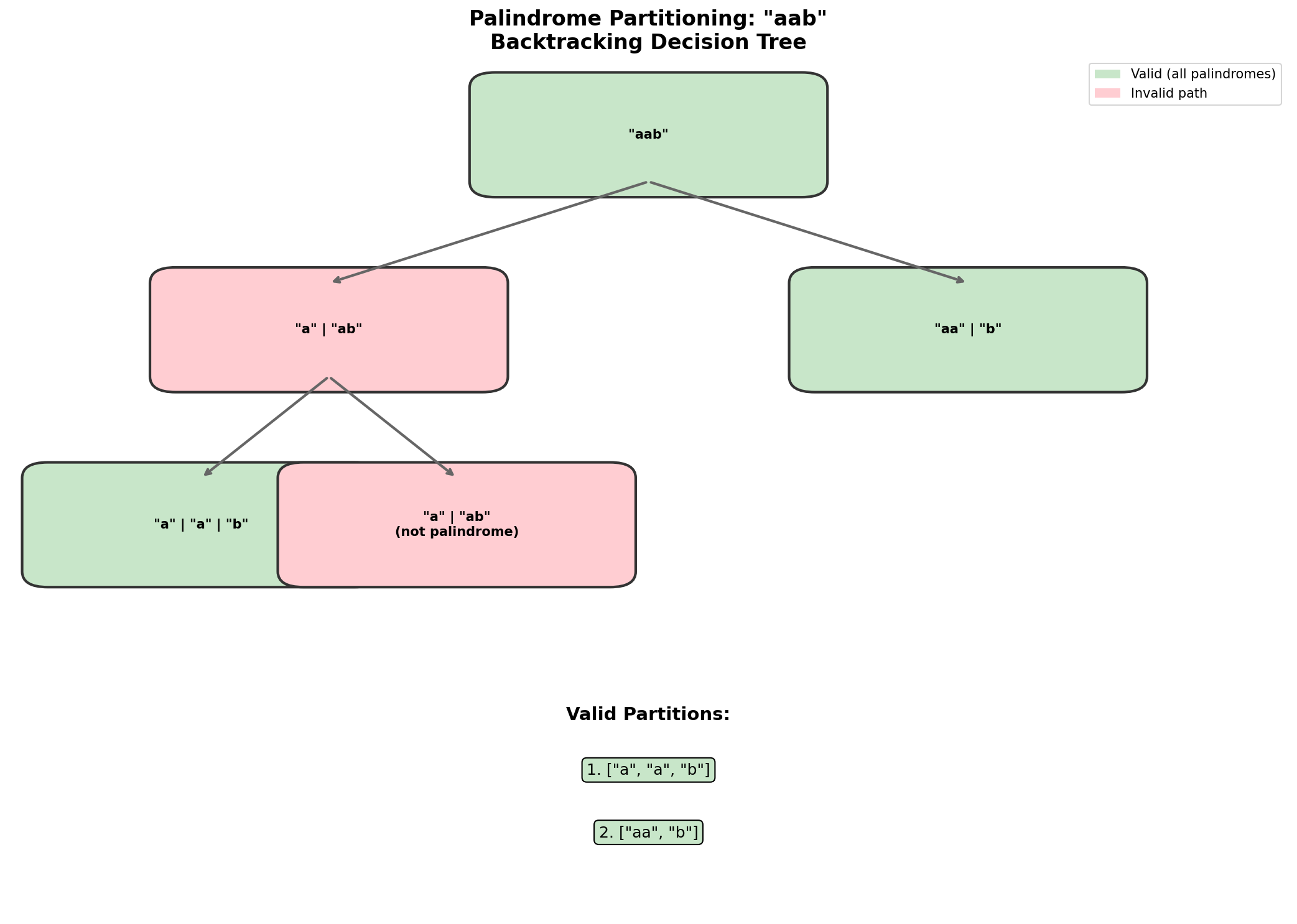
Mermaid Diagram
Algorithm
partition(s, start, path, result):
    if start == len(s):
        result.append(path.copy())
        return

    for end in range(start + 1, len(s) + 1):
        substring = s[start:end]
        if is_palindrome(substring):
            path.append(substring)
            partition(s, end, path, result)
path.pop() # backtrackSolution: Basic Backtracking
def partition(s: str) -> list[list[str]]:
    """
    Find all palindrome partitions using backtracking.

    Args:
        s: Input string

    Returns:
        List of all valid palindrome partitions

    Time: O(n * 2^n) - 2^n possible partitions, O(n) to check each
    Space: O(n) for recursion depth + O(n) for current path
    """
    result = []

    def is_palindrome(string: str) -> bool:
        return string == string[::-1]

    def backtrack(start: int, path: list[str]) -> None:
        # Base case: reached end of string
        if start == len(s):
            result.append(path.copy())
            return

        # Try all possible substrings starting at 'start'
        for end in range(start + 1, len(s) + 1):
            substring = s[start:end]

            if is_palindrome(substring):
                # Choose
                path.append(substring)
                # Explore
                backtrack(end, path)
                # Unchoose (backtrack)
                path.pop()

    backtrack(0, [])
return resultpublic List<List<String>> partition(String s) {
List<List<String>> result = new ArrayList<>();
backtrack(s, 0, new ArrayList<>(), result);
return result;
}
private void backtrack(String s, int start, List<String> path, List<List<String>> result) {
if (start == s.length()) {
result.add(new ArrayList<>(path));
return;
}
for (int end = start + 1; end <= s.length(); end++) {
String sub = s.substring(start, end);
if (isPalin(sub)) {
path.add(sub);
backtrack(s, end, path, result);
path.remove(path.size() - 1);
}
}
}
private boolean isPalin(String s) {
int l = 0, r = s.length() - 1;
while (l < r) {
if (s.charAt(l++) != s.charAt(r--)) return false;
}
return true;
}Complexity: Time O(n * 2^n) - Space O(n)
- Time: O(n * 2^n) - there are 2^(n-1) possible partitions (each gap can be cut or not), and each palindrome check is O(n).
- Space: O(n) for recursion stack depth plus O(n) for the current path being built.
Optimized Solution: DP + Backtracking
Optimization: Precompute Palindrome Check
Instead of checking palindrome at each step (O(n)), precompute a DP table where dp[i][j] = True if s[i:j+1] is a palindrome.
def partition_optimized(s: str) -> list[list[str]]:
    """
    Optimized palindrome partitioning with DP preprocessing.

    Time: O(n^2 + 2^n) - O(n^2) for DP table, O(2^n) for partitions
    Space: O(n^2) for DP table
    """
    n = len(s)
    result = []

    # Precompute palindrome DP table
    # dp[i][j] = True if s[i:j+1] is palindrome
    dp = [[False] * n for _ in range(n)]

    # Single characters are palindromes
    for i in range(n):
        dp[i][i] = True

    # Two characters
    for i in range(n - 1):
        dp[i][i + 1] = (s[i] == s[i + 1])

    # Length 3 and above
    for length in range(3, n + 1):
        for i in range(n - length + 1):
            j = i + length - 1
            dp[i][j] = (s[i] == s[j]) and dp[i + 1][j - 1]

    def backtrack(start: int, path: list[str]) -> None:
        if start == n:
            result.append(path.copy())
            return

        for end in range(start, n):
            if dp[start][end]:  # O(1) palindrome check
                path.append(s[start:end + 1])
                backtrack(end + 1, path)
                path.pop()

    backtrack(0, [])
return resultComplexity: Time O(n^2 + 2^n) - Space O(n^2)
- Time: O(n^2) to build the palindrome DP table plus O(2^n) for generating all partitions with O(1) palindrome checks.
- Space: O(n^2) for the DP table storing palindrome status for all (i, j) pairs.
Visual Walkthrough
For input "aab":
                        partition("aab")
                              |
            +----------------+-----------------+
            |                                  |
     "a" palindrome?                    "aa" palindrome?
          YES                                YES
            |                                  |
    partition("ab")                    partition("b")
            |                                  |
    +-------+-------+                   "b" palindrome?
    |               |                        YES
"a" palin?    "ab" palin?                     |
   YES            NO                      END: ["aa","b"]
    |
partition("b")
    |
"b" palindrome?
   YES
    |
END: ["a","a","b"]

Results: [["a","a","b"], ["aa","b"]]Alternative: Using Memoization
from functools import lru_cache

def partition_memo(s: str) -> list[list[str]]:
    """
    Using memoization for palindrome check.
    """
    @lru_cache(maxsize=None)
    def is_palindrome(i: int, j: int) -> bool:
        if i >= j:
            return True
        if s[i] != s[j]:
            return False
        return is_palindrome(i + 1, j - 1)

    result = []

    def backtrack(start: int, path: tuple) -> None:
        if start == len(s):
            result.append(list(path))
            return

        for end in range(start, len(s)):
            if is_palindrome(start, end):
                backtrack(end + 1, path + (s[start:end + 1],))

    backtrack(0, ())
return resultRelated Problem: Palindrome Partitioning II (Minimum Cuts)
LeetCode 132: Find the minimum number of cuts needed.
def minCut(s: str) -> int:
    """
    Find minimum cuts for palindrome partitioning.

    This is a DP problem, not backtracking.

    dp[i] = minimum cuts for s[0:i+1]

    Time: O(n^2)
    Space: O(n^2) for palindrome table, O(n) for dp array
    """
    n = len(s)
    if n <= 1:
        return 0

    # Precompute palindrome table
    is_palin = [[False] * n for _ in range(n)]
    for i in range(n - 1, -1, -1):
        for j in range(i, n):
            if s[i] == s[j] and (j - i < 2 or is_palin[i + 1][j - 1]):
                is_palin[i][j] = True

    # dp[i] = min cuts for s[0:i+1]
    dp = list(range(n))  # Worst case: cut after each char

    for i in range(n):
        if is_palin[0][i]:
            dp[i] = 0  # Entire prefix is palindrome
        else:
            for j in range(i):
                if is_palin[j + 1][i]:
                    dp[i] = min(dp[i], dp[j] + 1)

return dp[n - 1]Complexity Analysis
| Approach | Time | Space | Notes |
|---|---|---|---|
| Basic Backtracking | O(n * 2^n) | O(n) | Check palindrome each time |
| DP + Backtracking | O(n^2 + 2^n) | O(n^2) | Precompute palindromes |
| With Memoization | O(n * 2^n) | O(n^2) | Cache palindrome results |
Why O(2^n)? In the worst case (all same characters like "aaaa"), there are 2^(n-1) ways to partition (each gap can be cut or not).
Edge Cases
| Case | Input | Output | Note |
|---|---|---|---|
| Single char | "a" | [["a"]] | One trivial partition |
| All same | "aaa" | [["a","a","a"],["a","aa"],["aa","a"],["aaa"]] | All substrings are palindromes |
| No partition needed | "aba" | [["a","b","a"],["aba"]] | Whole string is palindrome |
| Two chars different | "ab" | [["a","b"]] | Only char-by-char partition |
Interview Tips
- Start with the recursive structure: Explain the backtracking approach first
- Mention optimization: DP preprocessing for O(1) palindrome checks
- Know the complexity: O(2^n) is unavoidable since we need all partitions
- Handle the base case: When start == len(s), add current path to result
Common Follow-up Questions
- "What's the time complexity?" - O(n * 2^n) or O(n^2 + 2^n) with optimization
- "Can you optimize?" - Yes, precompute palindrome table
- "What about minimum cuts?" - That's a DP problem (Palindrome Partitioning II)
Related Problems
Palindrome Partitioning II (LeetCode 132)
Problem: Given a string s, return the minimum cuts needed for a palindrome partitioning of s.
Key Insight: Convert from "find all" (backtracking) to "find minimum" (DP). dp[i] = min cuts for s[0:i+1].
Approach: Precompute palindrome table. For each position i, if s[0:i+1] is palindrome, 0 cuts needed. Otherwise, try all cut points j where s[j+1:i+1] is palindrome.
Complexity: O(n^2) time, O(n^2) space
Palindrome Partitioning III (LeetCode 1278)
Problem: Given string s and integer k, change at most k characters to divide s into k non-empty disjoint substrings such that each is a palindrome.
Key Insight: DP with two dimensions: position in string and number of partitions remaining.
Approach: Precompute cost to make each substring a palindrome. Use DP to find minimum total cost to partition into exactly k palindromes.
Complexity: O(n^2 * k) time, O(n^2 + n*k) space
Longest Palindromic Substring (LeetCode 5)
Problem: Given a string s, return the longest palindromic substring in s.
Key Insight: Expand around center technique or DP table for O(1) palindrome checks.
Approach: For each center (single char or between chars), expand outward while characters match. Track the longest palindrome found.
Complexity: O(n^2) time, O(1) space with expansion
Palindromic Substrings (LeetCode 647)
Problem: Given a string s, return the number of palindromic substrings in it.
Key Insight: Same expand-around-center technique, but count instead of finding max.
Approach: For each center, expand and count valid palindromes. Sum counts for all centers.
Complexity: O(n^2) time, O(1) space
Complete Solution with Tests
def partition(s: str) -> list[list[str]]:
    """
    Find all palindrome partitions of string s.

    Time: O(n * 2^n)
    Space: O(n^2) for DP table
    """
    n = len(s)
    result = []

    # Precompute palindrome DP table
    dp = [[False] * n for _ in range(n)]

    for i in range(n):
        dp[i][i] = True

    for i in range(n - 1):
        dp[i][i + 1] = (s[i] == s[i + 1])

    for length in range(3, n + 1):
        for i in range(n - length + 1):
            j = i + length - 1
            dp[i][j] = (s[i] == s[j]) and dp[i + 1][j - 1]

    def backtrack(start: int, path: list[str]) -> None:
        if start == n:
            result.append(path.copy())
            return

        for end in range(start, n):
            if dp[start][end]:
                path.append(s[start:end + 1])
                backtrack(end + 1, path)
                path.pop()

    backtrack(0, [])
    return result


# Test cases
if __name__ == "__main__":
    test_cases = [
        ("aab", [["a", "a", "b"], ["aa", "b"]]),
        ("a", [["a"]]),
        ("ab", [["a", "b"]]),
        ("aaa", [["a", "a", "a"], ["a", "aa"], ["aa", "a"], ["aaa"]]),
    ]

    for s, expected in test_cases:
        result = partition(s)
        # Sort for comparison (order doesn't matter)
        result_sorted = sorted([sorted(p) for p in result])
        expected_sorted = sorted([sorted(p) for p in expected])
        status = "PASS" if result_sorted == expected_sorted else "FAIL"
        print(f'{status}: partition("{s}")')
        print(f'  Result: {result}')
print(f' Expected: {expected}')Summary
| Key Point | Details |
|---|---|
| Pattern | Backtracking with optional DP optimization |
| Time Complexity | O(n * 2^n) unavoidable for generating all partitions |
| Space Complexity | O(n) for recursion, O(n^2) with DP optimization |
| Key Insight | Each position can extend to any valid palindrome substring |
Takeaway: Palindrome Partitioning is a great example of combining backtracking with dynamic programming. The backtracking explores all possibilities, while DP precomputation speeds up the palindrome checks.