Clone Graph
Creating a deep copy of an undirected graph
Problem Statement
LeetCode 133: Clone Graph
Given a reference of a node in a connected undirected graph, return a deep copy (clone) of the graph.
Each node in the graph contains a value (int) and a list (List[Node]) of its neighbors.
class Node:
    def __init__(self, val = 0, neighbors = None):
        self.val = val
self.neighbors = neighbors if neighbors is not None else []Key Constraints:
- The number of nodes is in the range
[0, 100] 1 <= Node.val <= 100- Node.val is unique for each node
- The graph is connected and has no repeated edges or self-loops
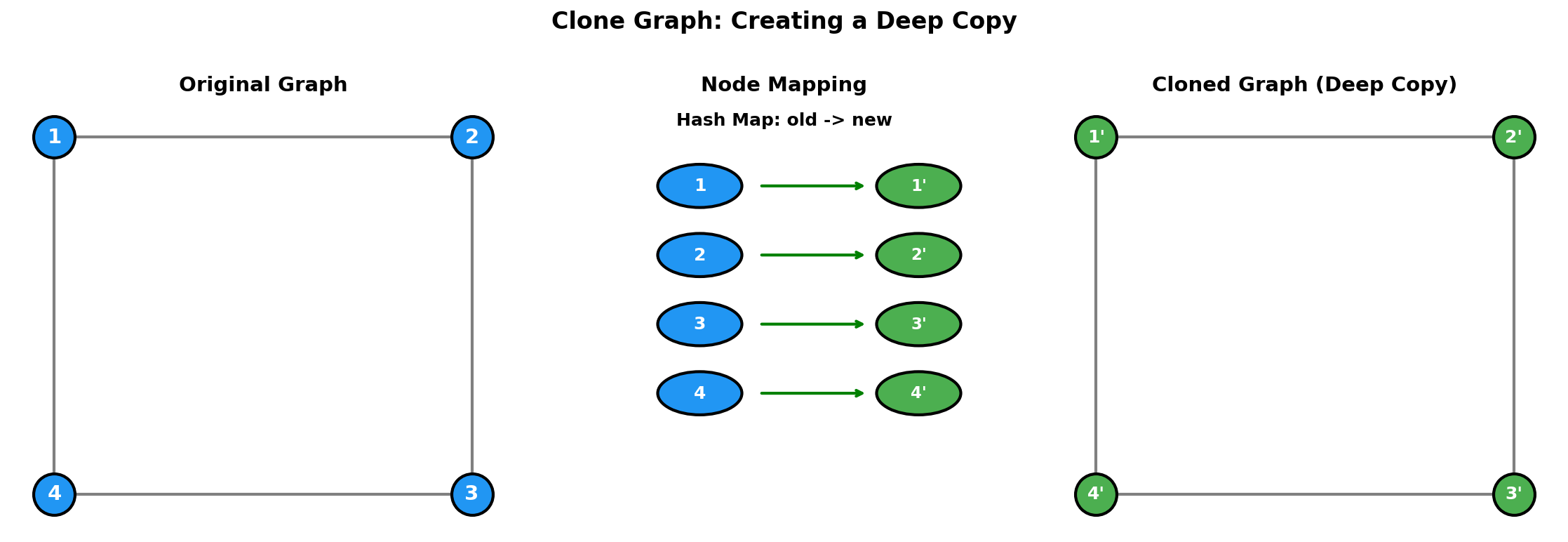
Visual Overview
Examples
Example 1
Input: adjList = [[2,4],[1,3],[2,4],[1,3]]
Output: [[2,4],[1,3],[2,4],[1,3]]

Explanation:
Graph structure:
    1 --- 2
    |     |
    4 --- 3

Node 1: neighbors = [2, 4]
Node 2: neighbors = [1, 3]
Node 3: neighbors = [2, 4]
Node 4: neighbors = [1, 3]Example 2
Input: adjList = [[]]
Output: [[]]

Explanation: Single node with no neighborsExample 3
Input: adjList = []
Output: []

Explanation: Empty graphApproach
Key Insight
The main challenge is handling cycles and shared references. When we encounter a node we've already cloned, we must return the existing clone rather than creating a duplicate.
Strategy
- Use a hash map to track:
original_node -> cloned_node - DFS or BFS to traverse the graph
- For each node:
- If already cloned, return the clone from hash map
- Otherwise, create a clone and recursively clone all neighbors
Why Hash Map?
Without hash map (WRONG):
  Clone(1) -> creates 1'
    Clone neighbor 2 -> creates 2'
      Clone neighbor 1 -> creates 1'' (DUPLICATE!)

With hash map (CORRECT):
  Clone(1) -> creates 1', stores {1: 1'}
    Clone neighbor 2 -> creates 2', stores {1: 1', 2: 2'}
Clone neighbor 1 -> sees 1 in map, returns 1' (NO DUPLICATE!)Solution 1: DFS (Recursive)
class Node:
    def __init__(self, val = 0, neighbors = None):
        self.val = val
        self.neighbors = neighbors if neighbors is not None else []

def cloneGraph(node: 'Node') -> 'Node':
    if not node:
        return None

    # Hash map: original -> clone
    cloned = {}

    def dfs(node: 'Node') -> 'Node':
        # If already cloned, return the clone
        if node in cloned:
            return cloned[node]

        # Create clone and store in hash map
        copy = Node(node.val)
        cloned[node] = copy

        # Recursively clone all neighbors
        for neighbor in node.neighbors:
            copy.neighbors.append(dfs(neighbor))

        return copy

return dfs(node)public Node cloneGraph(Node node) {
if (node == null) return null;
Map<Node, Node> cloned = new HashMap<>();
return dfs(node, cloned);
}
private Node dfs(Node node, Map<Node, Node> cloned) {
if (cloned.containsKey(node)) return cloned.get(node);
Node copy = new Node(node.val);
cloned.put(node, copy);
for (Node neighbor : node.neighbors)
copy.neighbors.add(dfs(neighbor, cloned));
return copy;
}Complexity: Time O(V + E) · Space O(V)
- Time: Each node cloned exactly once, each edge traversed once when building neighbor lists
- Space: Hash map stores V node mappings, recursion stack depth up to O(V) for linear graphs
Complexity Analysis
| Aspect | Complexity | Explanation |
|---|---|---|
| Time | O(V + E) | Visit each node and edge once |
| Space | O(V) | Hash map stores all nodes + recursion stack |
Solution 2: BFS (Iterative)
from collections import deque

def cloneGraph(node: 'Node') -> 'Node':
    if not node:
        return None

    # Create clone of starting node
    cloned = {node: Node(node.val)}
    queue = deque([node])

    while queue:
        curr = queue.popleft()

        for neighbor in curr.neighbors:
            # If neighbor not yet cloned, clone it
            if neighbor not in cloned:
                cloned[neighbor] = Node(neighbor.val)
                queue.append(neighbor)

            # Add cloned neighbor to current node's clone
            cloned[curr].neighbors.append(cloned[neighbor])

return cloned[node]Complexity: Time O(V + E) · Space O(V)
- Time: Each node added to queue once, each edge examined once when wiring neighbors
- Space: Hash map O(V), queue up to O(V) nodes at widest level of graph
BFS Process Visualization
Solution 3: DFS with Explicit Stack
def cloneGraph(node: 'Node') -> 'Node':
    if not node:
        return None

    cloned = {node: Node(node.val)}
    stack = [node]

    while stack:
        curr = stack.pop()

        for neighbor in curr.neighbors:
            if neighbor not in cloned:
                cloned[neighbor] = Node(neighbor.val)
                stack.append(neighbor)

            cloned[curr].neighbors.append(cloned[neighbor])

return cloned[node]Complexity: Time O(V + E) · Space O(V)
- Time: Same as BFS - each node and edge processed once during traversal
- Space: Hash map O(V), explicit stack replaces recursion stack with same O(V) depth
Common Mistakes
1. Not Handling Cycles
# WRONG - infinite loop on cycles
def cloneGraph_wrong(node):
    copy = Node(node.val)
    for neighbor in node.neighbors:
        copy.neighbors.append(cloneGraph_wrong(neighbor))  # Never terminates!
return copy2. Creating Duplicate Clones
# WRONG - creates multiple copies of same node
cloned = {}
def dfs(node):
    copy = Node(node.val)  # Should check if already cloned first!
    cloned[node] = copy
# ...3. Not Storing Clone Before Recursing
# WRONG - race condition on back edges
def dfs(node):
    if node in cloned:
        return cloned[node]
    copy = Node(node.val)
    for neighbor in node.neighbors:
        copy.neighbors.append(dfs(neighbor))  # May recurse back to node before storing!
    cloned[node] = copy  # Too late - should store before recursion
return copyCorrect order:
def dfs(node):
    if node in cloned:
        return cloned[node]
    copy = Node(node.val)
    cloned[node] = copy  # Store BEFORE recursion
    for neighbor in node.neighbors:
        copy.neighbors.append(dfs(neighbor))
return copyRelated Problems
Copy List with Random Pointer (LeetCode 138)
Problem: Deep copy a linked list where each node has a next pointer and a random pointer to any node in the list.
Key Insight: Same hash map pattern - map original nodes to clones to handle random pointers.
Approach: Two-pass: first create all clones with hash map, then wire up next and random pointers.
Complexity: O(N) time, O(N) space (can optimize to O(1) space with interleaving)
Clone Binary Tree With Random Pointer (LeetCode 1485)
Problem: Deep copy a binary tree where each node has left, right, and random pointers.
Key Insight: Combine tree traversal with hash map for random pointer handling.
Approach: DFS/BFS traversal with hash map mapping original to clone nodes.
Complexity: O(N) time, O(N) space
Clone N-ary Tree (LeetCode 1490)
Problem: Deep copy an N-ary tree where each node can have multiple children.
Key Insight: Simpler than graph clone - no cycles possible, so no need for visited tracking.
Approach: Recursive DFS - for each node, create clone and recursively clone all children.
Complexity: O(N) time, O(H) space where H is tree height
Interview Tips
- Clarify the graph structure: Ask about the Node class definition
- Discuss cycle handling: Explain why hash map is needed
- Choose DFS vs BFS: Both work, DFS is often more natural for this problem
- Mention edge cases: Empty graph, single node, fully connected graph
- Verify deep copy: Modifying clone should not affect original
Follow-up Questions
Q: What if nodes don't have unique values?
- A: Use object identity (the node reference itself) as hash key, not node.val
Q: What if the graph is directed?
- A: Same approach works, just follow directed edges
Q: How would you verify the clone is correct?
- A: Compare structure using BFS/DFS, ensure no shared references between original and clone