Evaluate Reverse Polish Notation
LeetCode 150 | Difficulty: Medium | Pattern: Stack Evaluation
Problem Statement
You are given an array of strings tokens that represents an arithmetic expression in Reverse Polish Notation (RPN).
Evaluate the expression. Return an integer that represents the value of the expression.
Note:
- The valid operators are
'+','-','*', and'/' - Each operand may be an integer or another expression
- The division between two integers always truncates toward zero
- There will not be any division by zero
- The input represents a valid RPN expression
- The answer and all intermediate calculations fit in a 32-bit signed integer
What is Reverse Polish Notation?
RPN (postfix notation) places operators after their operands. No parentheses are needed.
Infix:   (2 + 1) * 3
RPN:     2 1 + 3 *

Infix:   4 + 13 / 5
RPN: 4 13 5 / +Examples
Example 1:
Input: tokens = ["2","1","+","3","*"]
Output: 9
Explanation: ((2 + 1) * 3) = 9Example 2:
Input: tokens = ["4","13","5","/","+"]
Output: 6
Explanation: (4 + (13 / 5)) = 6Example 3:
Input: tokens = ["10","6","9","3","+","-11","*","/","*","17","+","5","+"]
Output: 22
Explanation:
  ((10 * (6 / ((9 + 3) * -11))) + 17) + 5
= ((10 * (6 / (12 * -11))) + 17) + 5
= ((10 * (6 / -132)) + 17) + 5
= ((10 * 0) + 17) + 5
= 22Constraints
1 <= tokens.length <= 10^4tokens[i]is either an operator or an integer in range[-200, 200]
Intuition
RPN is designed for stack-based evaluation:
- When we see a number, push it onto the stack
- When we see an operator, pop two operands, apply the operator, push the result
Key Insight: The stack naturally handles operator precedence and parentheses - they're encoded in the token order!
Stack State Visualization
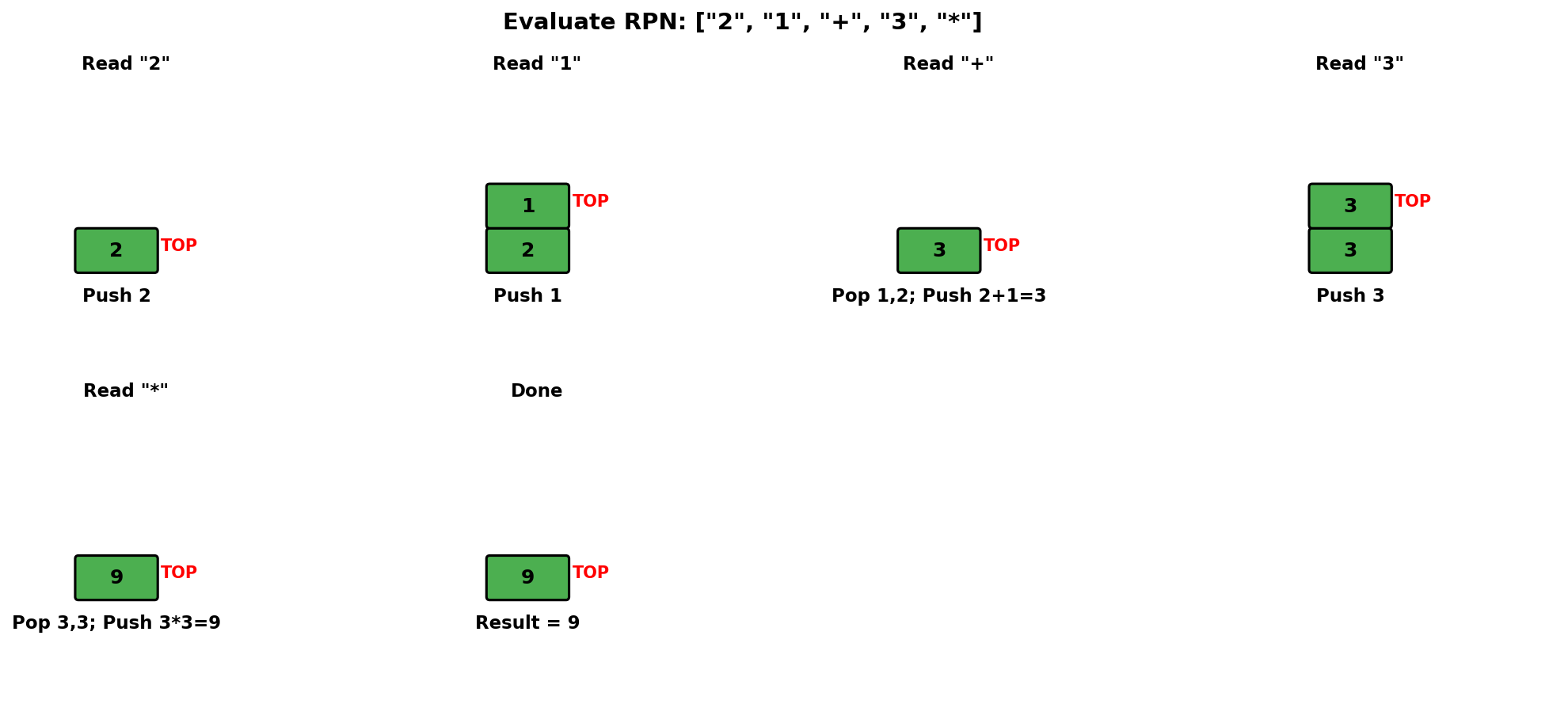
For ["2", "1", "+", "3", "*"]:
Token "2":
  Push 2
  Stack: [2]

Token "1":
  Push 1
  Stack: [2, 1]

Token "+":
  Pop 1, Pop 2
  Calculate: 2 + 1 = 3
  Push 3
  Stack: [3]

Token "3":
  Push 3
  Stack: [3, 3]

Token "*":
  Pop 3, Pop 3
  Calculate: 3 * 3 = 9
  Push 9
  Stack: [9]

Result: 9Solution
def evalRPN(tokens: list[str]) -> int:
    """
    Evaluate Reverse Polish Notation expression.

    Time: O(n) - process each token once
    Space: O(n) - stack can hold up to n/2 operands
    """
    stack = []
    operators = {
        '+': lambda a, b: a + b,
        '-': lambda a, b: a - b,
        '*': lambda a, b: a * b,
        '/': lambda a, b: int(a / b)  # Truncate toward zero
    }

    for token in tokens:
        if token in operators:
            # Pop operands (order matters for - and /)
            b = stack.pop()  # Second operand (popped first)
            a = stack.pop()  # First operand
            result = operators[token](a, b)
            stack.append(result)
        else:
            # It's a number
            stack.append(int(token))

return stack[0]public int evalRPN(String[] tokens) {
Deque<Integer> stack = new ArrayDeque<>();
Set<String> ops = new HashSet<>(Arrays.asList("+", "-", "*", "/"));
for (String token : tokens) {
if (ops.contains(token)) {
int b = stack.pop();
int a = stack.pop();
switch (token) {
case "+" -> stack.push(a + b);
case "-" -> stack.push(a - b);
case "*" -> stack.push(a * b);
case "/" -> stack.push((int)(a / (double) b)); // truncate toward zero
}
} else {
stack.push(Integer.parseInt(token));
}
}
return stack.pop();
}Complexity: Time O(n) · Space O(n)
- Time: Process each token exactly once; all stack/dictionary operations are O(1)
- Space: Stack holds at most (n+1)/2 operands in worst case (all numbers pushed before any operator)
Why int(a / b) for Division?
Python's // operator floors toward negative infinity, but we need truncation toward zero:
# Python // behavior
7 // -3   # = -3 (floor)
-7 // 3   # = -3 (floor)

# We need truncation toward zero
int(7 / -3)   # = -2 (truncate)
int(-7 / 3) # = -2 (truncate)Alternative Solutions
Using If-Else
def evalRPN(tokens: list[str]) -> int:
    stack = []

    for token in tokens:
        if token == '+':
            b, a = stack.pop(), stack.pop()
            stack.append(a + b)
        elif token == '-':
            b, a = stack.pop(), stack.pop()
            stack.append(a - b)
        elif token == '*':
            b, a = stack.pop(), stack.pop()
            stack.append(a * b)
        elif token == '/':
            b, a = stack.pop(), stack.pop()
            stack.append(int(a / b))
        else:
            stack.append(int(token))

return stack[0]Complexity: Time O(n) · Space O(n)
- Time: Single pass through tokens; each operator/operand processed in O(1)
- Space: Stack size bounded by (n+1)/2 where n is token count (valid RPN has more operands than operators by 1)
Using eval() (Not Recommended for Interviews)
def evalRPN(tokens: list[str]) -> int:
    stack = []

    for token in tokens:
        if token in '+-*/':
            b, a = stack.pop(), stack.pop()
            if token == '/':
                stack.append(int(a / b))
            else:
                stack.append(eval(f'{a}{token}{b}'))
        else:
            stack.append(int(token))

return stack[0]Complexity: Time O(n) · Space O(n)
- Time: Each token processed once; eval() adds negligible overhead for simple expressions
- Space: Stack stores at most (n+1)/2 intermediate results
Step-by-Step Walkthrough
For ["4", "13", "5", "/", "+"]:
Initial: stack = []

Token "4":
  Is "4" an operator? No
  Push int("4") = 4
  stack = [4]

Token "13":
  Is "13" an operator? No
  Push int("13") = 13
  stack = [4, 13]

Token "5":
  Is "5" an operator? No
  Push int("5") = 5
  stack = [4, 13, 5]

Token "/":
  Is "/" an operator? Yes
  b = pop() = 5
  a = pop() = 13
  result = int(13 / 5) = 2
  Push 2
  stack = [4, 2]

Token "+":
  Is "+" an operator? Yes
  b = pop() = 2
  a = pop() = 4
  result = 4 + 2 = 6
  Push 6
  stack = [6]

Done! Return stack[0] = 6Complexity Analysis
| Aspect | Complexity | Explanation |
|---|---|---|
| Time | O(n) | Process each token once |
| Space | O(n) | Stack holds at most (n+1)/2 operands |
Space Analysis
- In valid RPN, if there are
ntokens:- Operators: (n-1)/2
- Operands: (n+1)/2
- Maximum stack size: (n+1)/2 (when all operands pushed before any operator)
Edge Cases
def test_eval_rpn():
    # Single number
    assert evalRPN(["42"]) == 42

    # Negative numbers
    assert evalRPN(["-5", "3", "+"]) == -2

    # Division truncates toward zero
    assert evalRPN(["7", "-3", "/"]) == -2   # Not -3
    assert evalRPN(["-7", "3", "/"]) == -2   # Not -3

    # Complex expression
    assert evalRPN(["10", "6", "9", "3", "+", "-11", "*", "/", "*", "17", "+", "5", "+"]) == 22

    # All same operator
assert evalRPN(["1", "2", "+", "3", "+", "4", "+"]) == 10Converting Infix to RPN (Shunting Yard Algorithm)
def infixToRPN(expression: str) -> list[str]:
    """
    Convert infix expression to RPN using Shunting Yard algorithm.
    Example: "3 + 4 * 2" -> ["3", "4", "2", "*", "+"]
    """
    precedence = {'+': 1, '-': 1, '*': 2, '/': 2}
    output = []
    operator_stack = []

    tokens = expression.split()

    for token in tokens:
        if token.lstrip('-').isdigit():  # Number (including negative)
            output.append(token)
        elif token in precedence:  # Operator
            while (operator_stack and
                   operator_stack[-1] != '(' and
                   operator_stack[-1] in precedence and
                   precedence[operator_stack[-1]] >= precedence[token]):
                output.append(operator_stack.pop())
            operator_stack.append(token)
        elif token == '(':
            operator_stack.append(token)
        elif token == ')':
            while operator_stack and operator_stack[-1] != '(':
                output.append(operator_stack.pop())
            operator_stack.pop()  # Remove '('

    while operator_stack:
        output.append(operator_stack.pop())

return outputComplexity: Time O(n) · Space O(n)
- Time: Each token processed once; stack operations are O(1); total work proportional to input length
- Space: Operator stack can hold up to n/2 operators; output list holds all tokens
Interview Tips
What Interviewers Look For
- Stack Usage: Natural fit for RPN evaluation
- Operator Order: Remember second operand is popped first
- Division Behavior: Truncation toward zero, not floor
Common Follow-up Questions
"How would you handle more operators like ^?"
pythonoperators = { '+': lambda a, b: a + b, '-': lambda a, b: a - b, '*': lambda a, b: a * b, '/': lambda a, b: int(a / b), '^': lambda a, b: a ** b }"How would you convert infix to RPN?"
- Use Shunting Yard algorithm (shown above)
- Handle parentheses and operator precedence
"How would you evaluate infix directly?"
- Use two stacks: one for operands, one for operators
- This is Basic Calculator problem
"What if the expression is invalid?"
- Check stack has exactly one element at end
- Catch exceptions for insufficient operands
Error Handling
def evalRPN_safe(tokens: list[str]) -> int:
    stack = []
    operators = {'+', '-', '*', '/'}

    for token in tokens:
        if token in operators:
            if len(stack) < 2:
                raise ValueError("Invalid expression: insufficient operands")
            b, a = stack.pop(), stack.pop()
            if token == '/' and b == 0:
                raise ValueError("Division by zero")
            # ... rest of evaluation
        else:
            try:
                stack.append(int(token))
            except ValueError:
                raise ValueError(f"Invalid token: {token}")

    if len(stack) != 1:
        raise ValueError("Invalid expression: extra operands")

return stack[0]Complexity: Time O(n) · Space O(n)
- Time: Same as basic solution; additional validation checks are O(1) per token
- Space: Stack size bounded by number of operands; error checking uses O(1) extra
Why RPN?
- No Parentheses Needed: Order of operations is explicit
- Simple to Evaluate: Just a stack and O(n) time
- Used in Calculators: HP calculators use RPN
- Compiler Intermediate: Many compilers use postfix for expression evaluation
Related Problems
Basic Calculator (LeetCode 224)
Problem: Evaluate infix expression with +, -, and parentheses.
Key Insight: Stack saves state (result, sign) on '(', restores and combines on ')'.
Approach: Track running result and current sign. Push state on '(', pop and apply on ')'.
Complexity: O(n) time, O(n) space
Basic Calculator II (LeetCode 227)
Problem: Evaluate infix expression with +, -, *, / (no parentheses).
Key Insight: Handle precedence: * and / apply immediately to stack top, + and - defer.
Approach: Stack stores signed terms. Multiply/divide modify top. Sum stack at end.
Complexity: O(n) time, O(n) space
Basic Calculator III (LeetCode 772)
Problem: Evaluate infix with all operators and parentheses.
Key Insight: Combine precedence handling (like II) with recursion for parentheses (like I).
Approach: Recursive helper for parenthesized subexpressions. Stack for operator precedence.
Complexity: O(n) time, O(n) space
Design Hit Counter (LeetCode 362)
Problem: Count hits in past 5 minutes for a logging system.
Key Insight: Queue or circular buffer with timestamp-based expiration.
Approach: Queue stores timestamps. On query, dequeue expired hits, return queue size.
Complexity: O(1) amortized hit, O(n) getHits worst case