Rotation Operations
Rotating linked lists by k positions
Overview
Rotation operations involve moving nodes from one end of the list to the other. The key insight is that rotation is equivalent to finding a new split point and reconnecting the list.
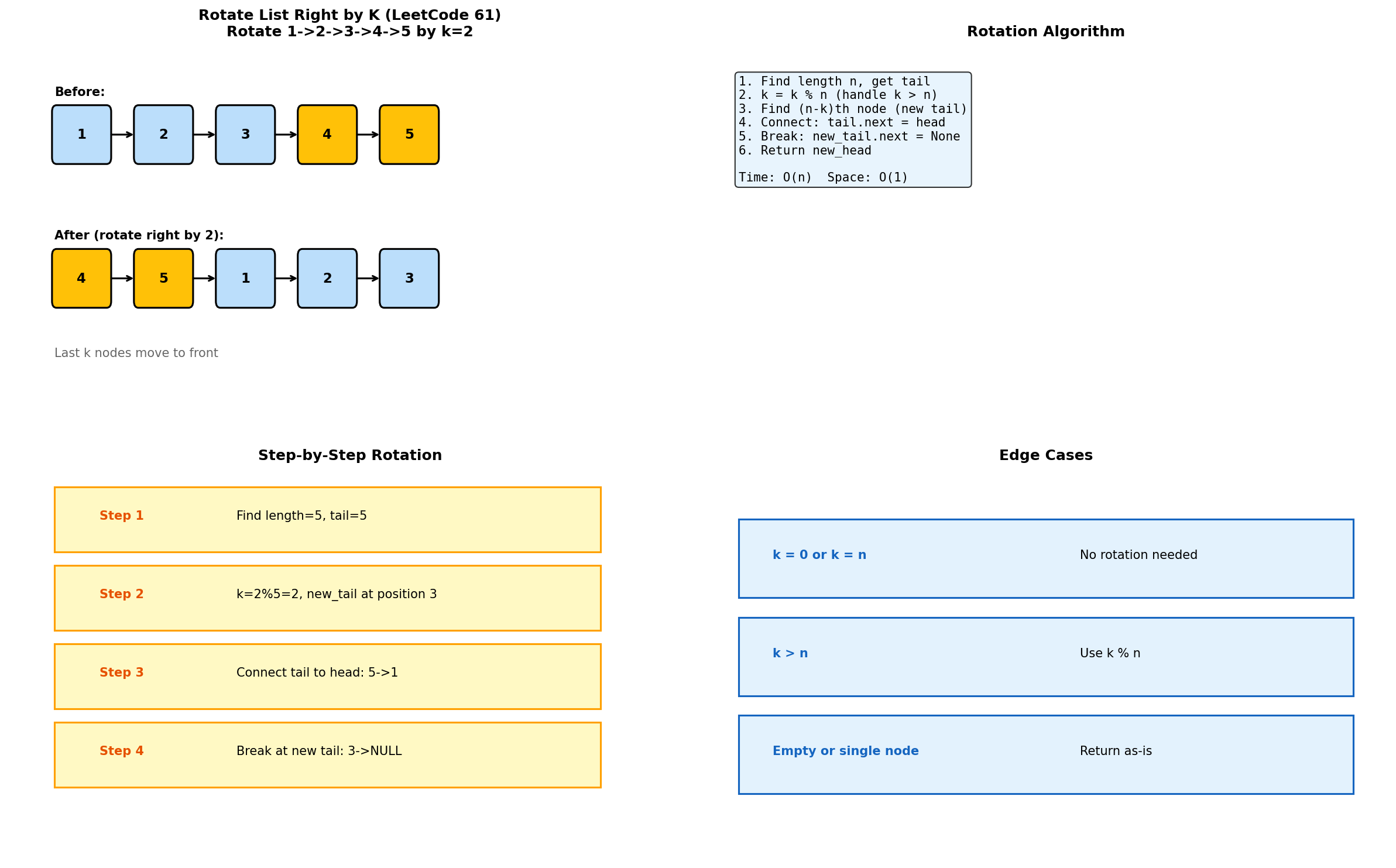
Rotate List (LeetCode #61)
Problem Statement
Given the head of a linked list, rotate the list to the right by k places.
Example
Input: 1 -> 2 -> 3 -> 4 -> 5, k = 2
Output: 4 -> 5 -> 1 -> 2 -> 3

Explanation:
- Last 2 nodes (4, 5) move to front
- Remaining nodes (1, 2, 3) followSolution
def rotateRight(head: ListNode, k: int) -> ListNode:
    """
    Rotate list right by k positions.

    Algorithm:
    1. Find length and tail
    2. Normalize k (k = k % length)
    3. Find new tail at position (length - k)
    4. Reconnect: tail.next = head, new_tail.next = None

    Time: O(n), Space: O(1)
    """
    if not head or not head.next or k == 0:
        return head

    # Step 1: Find length and tail
    length = 1
    tail = head
    while tail.next:
        length += 1
        tail = tail.next

    # Step 2: Normalize k
    k = k % length
    if k == 0:
        return head  # No rotation needed

    # Step 3: Find new tail (length - k - 1 steps from head)
    new_tail = head
    for _ in range(length - k - 1):
        new_tail = new_tail.next

    # Step 4: Reconnect
    new_head = new_tail.next
    new_tail.next = None
    tail.next = head

return new_headpublic ListNode rotateRight(ListNode head, int k) {
if (head == null || head.next == null || k == 0) return head;
int length = 1;
ListNode tail = head;
while (tail.next != null) {
length++;
tail = tail.next;
}
k = k % length;
if (k == 0) return head;
ListNode newTail = head;
for (int i = 0; i < length - k - 1; i++) {
newTail = newTail.next;
}
ListNode newHead = newTail.next;
newTail.next = null;
tail.next = head;
return newHead;
}Complexity: Time O(n) · Space O(1)
- Time: O(n) because we traverse the list twice: once to find length/tail, once to find new tail position
- Space: O(1) because we only use pointers (tail, new_tail, new_head) to rearrange the list
Step-by-Step Example
List: 1 -> 2 -> 3 -> 4 -> 5, k = 2
Length = 5, k = 2 % 5 = 2

Step 1: Find tail
tail = node 5

Step 2: k = 2 (already normalized)

Step 3: Find new tail at position (5-2-1) = 2
new_tail = node 3

Step 4: Reconnect
new_head = node 4
3.next = None
5.next = 1

Result: 4 -> 5 -> 1 -> 2 -> 3Alternative: Make Circular Then Break
def rotateRight_circular(head: ListNode, k: int) -> ListNode:
    """
    Make list circular, then break at the right position.
    """
    if not head or not head.next or k == 0:
        return head

    # Find length and make circular
    length = 1
    current = head
    while current.next:
        length += 1
        current = current.next
    current.next = head  # Make circular

    # Find break point
    k = k % length
    steps_to_new_tail = length - k

    new_tail = current
    for _ in range(steps_to_new_tail):
        new_tail = new_tail.next

    new_head = new_tail.next
    new_tail.next = None

return new_headComplexity: Time O(n) · Space O(1)
- Time: O(n) because we traverse once to find length and make circular, once to find break point
- Space: O(1) because we only use pointers to manipulate the circular list
Rotate Left by K
Problem Variant
Rotate list to the left by k positions.
def rotateLeft(head: ListNode, k: int) -> ListNode:
    """
    Rotate left is equivalent to rotate right by (length - k).
    Or: first k nodes move to end.
    """
    if not head or not head.next or k == 0:
        return head

    # Find length
    length = 0
    current = head
    while current:
        length += 1
        current = current.next

    # Normalize and convert to right rotation
    k = k % length
    if k == 0:
        return head

    # Rotate right by (length - k) is same as rotate left by k
return rotateRight(head, length - k)Complexity: Time O(n) · Space O(1)
- Time: O(n) because we calculate length once and reuse the rotateRight function
- Space: O(1) because the conversion to right rotation uses no extra space
Direct Implementation
def rotateLeft_direct(head: ListNode, k: int) -> ListNode:
    """
    Direct left rotation: move first k nodes to end.
    """
    if not head or not head.next or k == 0:
        return head

    # Find length and tail
    length = 1
    tail = head
    while tail.next:
        length += 1
        tail = tail.next

    k = k % length
    if k == 0:
        return head

    # Find new tail (k-1 steps from head)
    new_tail = head
    for _ in range(k - 1):
        new_tail = new_tail.next

    # Reconnect
    new_head = new_tail.next
    new_tail.next = None
    tail.next = head

return new_headComplexity: Time O(n) · Space O(1)
- Time: O(n) because we traverse to find length/tail, then traverse again to find new tail
- Space: O(1) because we only use pointers to rearrange the existing nodes
Rotate by Position (Not Count)
Problem Variant
Rotate so that the node at position k becomes the new head.
def rotateToPosition(head: ListNode, k: int) -> ListNode:
    """
    Make the k-th node (0-indexed) the new head.
    """
    if not head or not head.next or k == 0:
        return head

    # Find length and tail
    length = 1
    tail = head
    while tail.next:
        length += 1
        tail = tail.next

    k = k % length
    if k == 0:
        return head

    # Find new tail (k-1 steps from head)
    new_tail = head
    for _ in range(k - 1):
        new_tail = new_tail.next

    new_head = new_tail.next
    new_tail.next = None
    tail.next = head

return new_headComplexity: Time O(n) · Space O(1)
- Time: O(n) because we traverse the list twice: once for length/tail, once to find new tail
- Space: O(1) because we only manipulate pointers without additional data structures
Rotation with Circular List
Problem Variant
For a circular list, rotation changes the head position.
def rotateCircular(head: ListNode, k: int) -> ListNode:
    """
    Rotate a circular list - just move head pointer.
    """
    if not head or head.next == head or k == 0:
        return head

    # Find length
    length = 1
    current = head
    while current.next != head:
        length += 1
        current = current.next

    k = k % length
    if k == 0:
        return head

    # Move head forward by (length - k) for right rotation
    new_head = head
    for _ in range(length - k):
        new_head = new_head.next

return new_headComplexity: Time O(n) · Space O(1)
- Time: O(n) because we traverse once to find length, then traverse (length - k) steps to find new head
- Space: O(1) because we only update the head pointer without modifying the circular structure
Edge Cases
| Case | Handling |
|---|---|
| Empty list | Return None |
| Single node | Return head (no change) |
| k = 0 | Return head (no change) |
| k = length | Return head (full rotation = no change) |
| k > length | Use k % length |
| k = length - 1 | Move tail to front |
Complexity Analysis
| Approach | Time | Space |
|---|---|---|
| Two-pass (find length, then rotate) | O(n) | O(1) |
| Circular approach | O(n) | O(1) |
Both approaches require traversing the entire list at least once.
Common Mistakes
- Not normalizing k: If k > length, must use k % length
- Off-by-one errors: Careful with (length - k) vs (length - k - 1)
- Forgetting to null-terminate: New tail must point to None
- Not handling edge cases: Single node, k = 0, k = length
Related Problems
Rotate List (LeetCode 61)
Problem: Rotate the linked list to the right by k places.
Key Insight: Rotation is finding a new split point. Last k nodes move to front.
Approach: Find length and tail, normalize k (k%length), find new tail at (length-k-1), reconnect.
Complexity: O(n) time, O(1) space
Rotate Array (LeetCode 189)
Problem: Rotate array to the right by k steps.
Key Insight: Triple reversal: reverse all, reverse first k, reverse rest.
Approach: Reverse entire array, reverse first k elements, reverse remaining n-k elements.
Complexity: O(n) time, O(1) space
Reverse Linked List (LeetCode 206)
Problem: Reverse a singly linked list.
Key Insight: Iteratively change next pointers, maintaining prev, curr, and next references.
Approach: Three pointers: prev=null, curr=head. For each node: save next, point to prev, advance pointers.
Complexity: O(n) time, O(1) space
Reorder List (LeetCode 143)
Problem: Reorder L0->L1->...->Ln to L0->Ln->L1->Ln-1->L2->Ln-2->...
Key Insight: Combine finding middle, reversing second half, and interleaving both halves.
Approach: Find middle with fast-slow, reverse second half, merge alternating from both halves.
Complexity: O(n) time, O(1) space
Interview Tips
- Clarify direction: Right rotation vs left rotation
- Ask about k: Can k be larger than length?
- Draw the transformation: Before and after states
- Mention edge cases: What about empty list, single node?
- Optimize: Can skip full rotations with k % length
Rotation vs Reversal
| Operation | Effect | Example |
|---|---|---|
| Rotate right by k | Last k nodes move to front | 1,2,3,4,5 (k=2) -> 4,5,1,2,3 |
| Rotate left by k | First k nodes move to end | 1,2,3,4,5 (k=2) -> 3,4,5,1,2 |
| Reverse | All nodes in opposite order | 1,2,3,4,5 -> 5,4,3,2,1 |