Fibonacci, Generate Parentheses & Subsets
Foundation recursion and backtracking problems
These three problems form the cornerstone of understanding recursion and backtracking. Fibonacci teaches memoization, Generate Parentheses introduces constrained backtracking, and Subsets demonstrates exhaustive enumeration.
Fibonacci Numbers
Problem Statement
The Fibonacci sequence is defined as:
- F(0) = 0
- F(1) = 1
- F(n) = F(n-1) + F(n-2) for n > 1
Sequence: 0, 1, 1, 2, 3, 5, 8, 13, 21, 34, ...
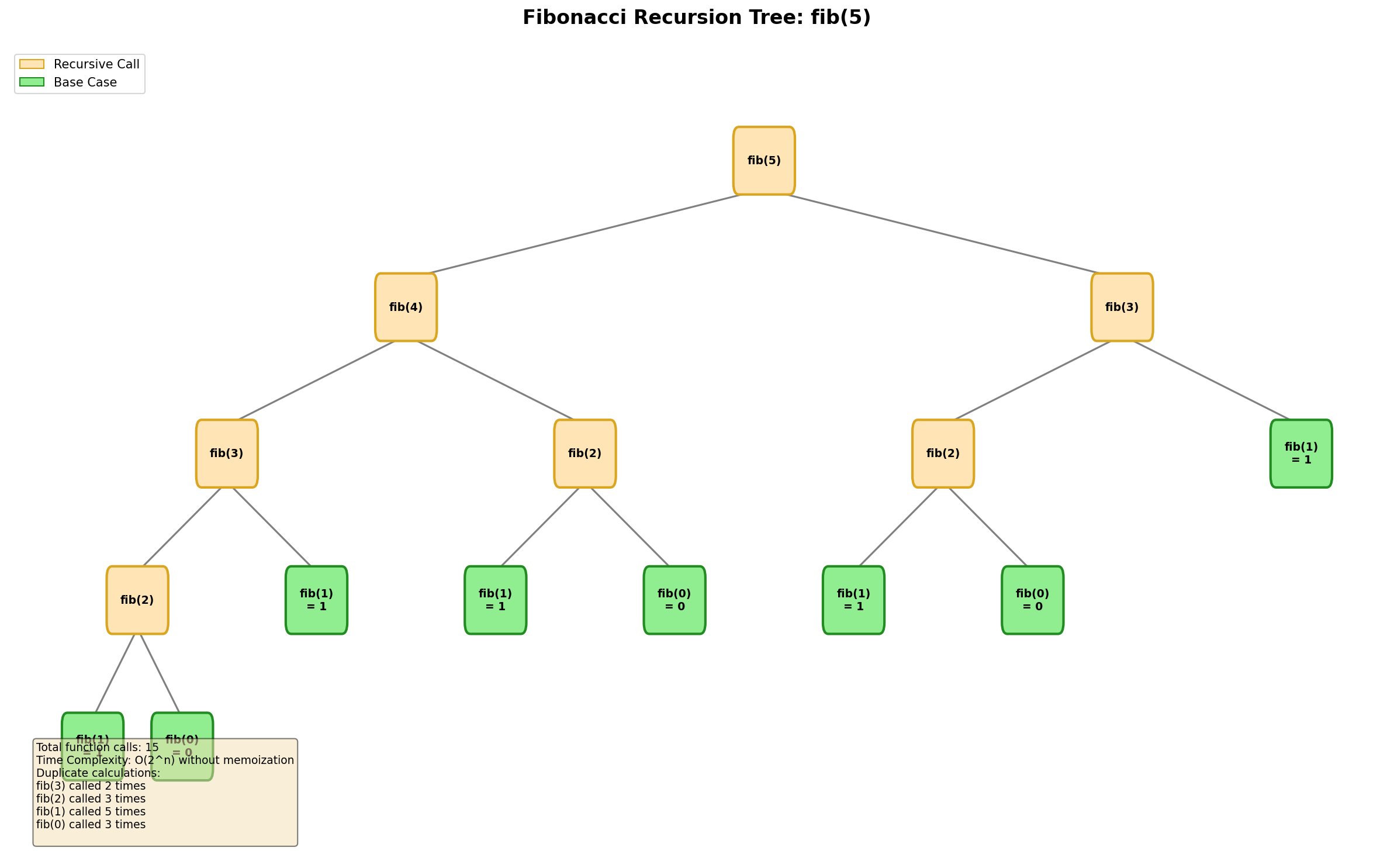
Visualization: Recursion Tree
Without Memoization (Exponential Redundancy):
                                    fib(5)
                                   /      \
                             fib(4)        fib(3)
                            /     \        /     \
                       fib(3)   fib(2)  fib(2)  fib(1)
                       /    \    /   \   /   \     |
                  fib(2) fib(1) f(1) f(0) f(1) f(0) 1
                  /   \    |     |    |    |    |
               f(1)  f(0)  1     0    1    0    0
                 |     |
                 1     0

Total calls for fib(5): 15 calls
Notice: fib(3) computed 2 times, fib(2) computed 3 timesWith Memoization (Linear - Pruned Tree):
                                    fib(5)
                                   /      \
                             fib(4)        fib(3) [CACHED]
                            /     \
                       fib(3)   fib(2) [CACHED]
                       /    \
                  fib(2) fib(1) [CACHED]
                  /   \
               f(1)  f(0)

Total calls for fib(5): 9 calls (and only 6 unique computations)
Each subproblem solved exactly ONCE!Growth Comparison:
n     | Naive Calls | Memoized Calls | Speedup
------|-------------|----------------|--------
5     |      15     |       9        |  1.7x
10    |     177     |      19        |  9.3x
20    |   21,891    |      39        | 561x
30    | 2,692,537   |      59        | 45,636x
40 | 331,160,281 | 79 | 4.2M xSolutions Comparison
# Naive recursive - O(2^n) time, O(n) space (call stack)
def fib_naive(n):
    """
    Simple but extremely inefficient.
    Time: O(2^n) - each call spawns 2 more calls
    Space: O(n) - maximum recursion depth
    """
    if n <= 1:
        return n
    return fib_naive(n-1) + fib_naive(n-2)


# Memoized - O(n) time, O(n) space
from functools import lru_cache

@lru_cache(maxsize=None)
def fib_memo(n):
    """
    Optimal recursive with caching.
    Time: O(n) - each subproblem computed once
    Space: O(n) - cache + call stack
    """
    if n <= 1:
        return n
    return fib_memo(n-1) + fib_memo(n-2)


# Manual memoization (interview-friendly)
def fib_memo_manual(n, memo=None):
    """
    Explicit memoization - good for interviews.
    """
    if memo is None:
        memo = {}
    if n <= 1:
        return n
    if n in memo:
        return memo[n]
    memo[n] = fib_memo_manual(n-1, memo) + fib_memo_manual(n-2, memo)
    return memo[n]


# Iterative (Bottom-up DP) - O(n) time, O(n) space
def fib_dp(n):
    """
    Bottom-up dynamic programming.
    Time: O(n)
    Space: O(n) - stores all values
    """
    if n <= 1:
        return n
    dp = [0] * (n + 1)
    dp[1] = 1
    for i in range(2, n + 1):
        dp[i] = dp[i-1] + dp[i-2]
    return dp[n]


# Space-optimized iterative - O(n) time, O(1) space
def fib_iter(n):
    """
    Most efficient - only tracks last two values.
    Time: O(n)
    Space: O(1)
    """
    if n <= 1:
        return n
    prev, curr = 0, 1
    for _ in range(2, n + 1):
        prev, curr = curr, prev + curr
    return curr


# Matrix exponentiation - O(log n) time, O(1) space
def fib_matrix(n):
    """
    Fastest theoretical approach using matrix exponentiation.
    | F(n+1)  F(n)   |   | 1 1 |^n
    | F(n)    F(n-1) | = | 1 0 |

    Time: O(log n)
    Space: O(1)
    """
    if n <= 1:
        return n

    def matrix_mult(A, B):
        return [
            [A[0][0]*B[0][0] + A[0][1]*B[1][0], A[0][0]*B[0][1] + A[0][1]*B[1][1]],
            [A[1][0]*B[0][0] + A[1][1]*B[1][0], A[1][0]*B[0][1] + A[1][1]*B[1][1]]
        ]

    def matrix_pow(M, p):
        if p == 1:
            return M
        if p % 2 == 0:
            half = matrix_pow(M, p // 2)
            return matrix_mult(half, half)
        else:
            return matrix_mult(M, matrix_pow(M, p - 1))

    base = [[1, 1], [1, 0]]
    result = matrix_pow(base, n)
return result[0][1]Complexity: Time varies by approach · Space varies by approach
- Time: O(2^n) naive, O(n) memoized/iterative, O(log n) matrix exponentiation
- Space: O(n) for naive/memoized (call stack + cache), O(1) for space-optimized iterative and matrix approaches
Key Takeaways for Fibonacci
| Approach | Time | Space | When to Use |
|---|---|---|---|
| Naive | O(2^n) | O(n) | Never in production |
| Memoized | O(n) | O(n) | When recursion is natural |
| Iterative | O(n) | O(1) | Best for interviews |
| Matrix | O(log n) | O(1) | Very large n |
Generate Parentheses
LeetCode 22 - Generate Parentheses
Problem Statement
Given n pairs of parentheses, write a function to generate all combinations of well-formed parentheses.
Example:
- Input: n = 3
- Output: ["((()))", "(()())", "(())()", "()(())", "()()()"]
Backtracking Constraints
The key insight is understanding when we can add '(' or ')':
- Add '(': Only if open_count < n (we have opening brackets left)
- Add ')': Only if close_count < open_count (there's an unmatched '(' to close)
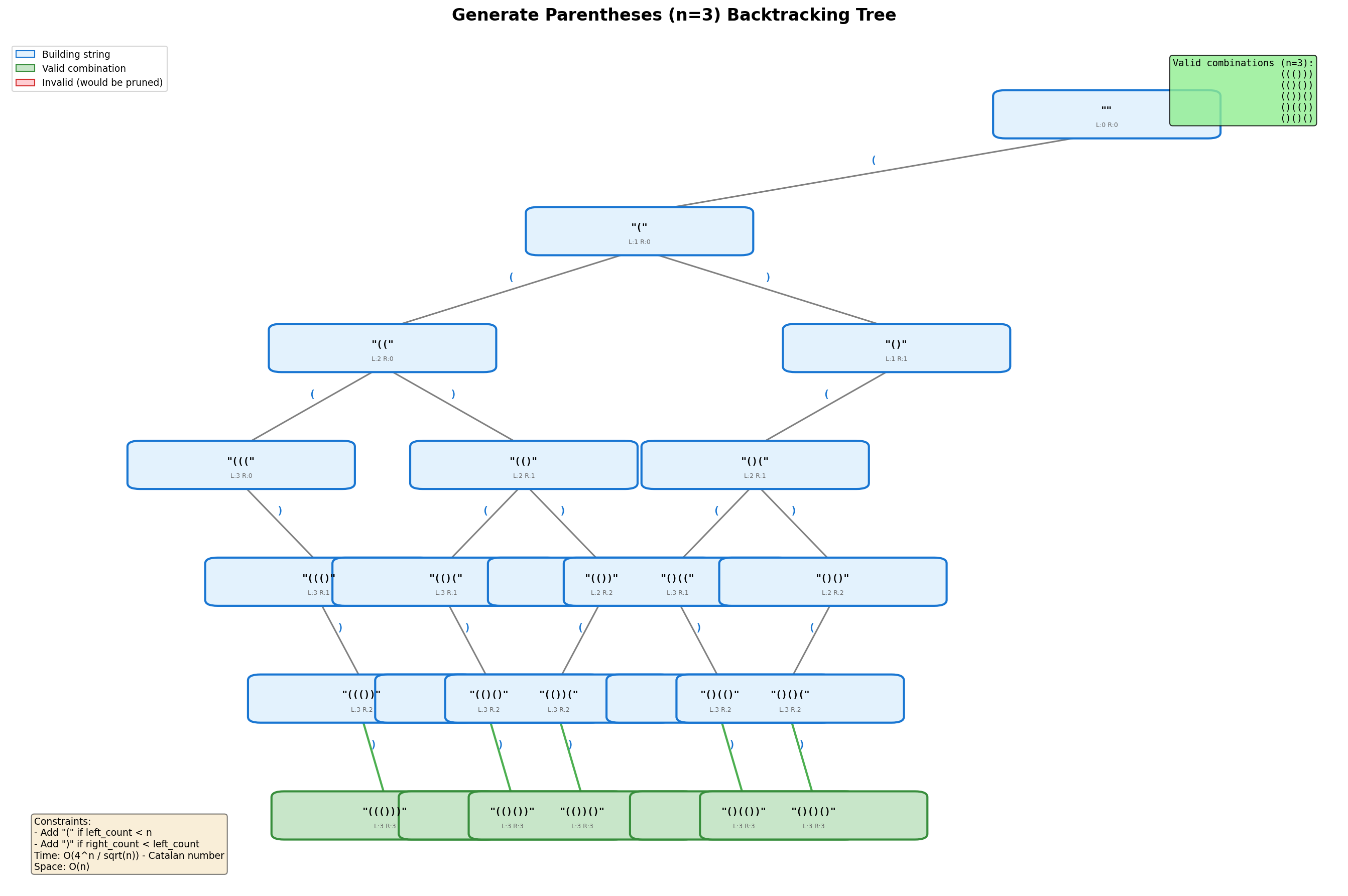
Backtracking Tree Visualization
n = 2

                                ""
                               /
                             "("
                           /     \
                        "(("      "()"
                        /           \
                     "(()"         "()(
                      /               \
                   "(())"           "()()"
                   VALID!           VALID!

Legend:
  - At each node, we try adding '(' first (if possible)
  - Then we try adding ')' (if valid)
- We prune branches that would create invalid sequencesDetailed Decision Tree for n = 3:
Level 0:                            ""
                                    |
Level 1:                           "("
                                 /     \
Level 2:                      "(("     "()"
                             /    \       \
Level 3:                  "((("       "(()"        "()("
                           |          /   \        /   \
Level 4:                "((()"     "(()(" "(())" "()((" "()()"
                           |          |      |      |      |
Level 5:               "((())"   "(()()" "(())(" "()(()" "()()("
                           |          |      |      |      |
Level 6:              "((()))"  "(()())" "(())()" "()(())" "()()()"
                       VALID!     VALID!  VALID!   VALID!   VALID!

Catalan number C(3) = 5 valid combinationsVisual Representation of Pruning:
Why we can't start with ')':
"" -> ")" INVALID! (close_count > open_count)

Why "((" -> ")" is valid but "(" -> "))" is not:
"((" has open=2, close=0, so close < open, can add ')'
"()" has open=1, close=1, so close == open, CANNOT add ')'

Pruning saves exponential work:
Without pruning: 2^6 = 64 paths for n=3
With pruning: Only 5 valid paths (Catalan number)Solution with Detailed Comments
from typing import List

def generateParenthesis(n: int) -> List[str]:
    """
    Generate all valid combinations of n pairs of parentheses.

    Time Complexity: O(4^n / sqrt(n)) - Catalan number bound
    Space Complexity: O(n) - recursion depth + current string

    Args:
        n: Number of pairs of parentheses
    Returns:
        List of all valid parentheses combinations
    """
    result = []

    def backtrack(current: str, open_count: int, close_count: int):
        """
        Recursively build valid parentheses combinations.

        Args:
            current: Current string being built
            open_count: Number of '(' used so far
            close_count: Number of ')' used so far
        """
        # Base case: we've used all parentheses
        if len(current) == 2 * n:
            result.append(current)
            return

        # Choice 1: Add opening parenthesis if we haven't used all
        if open_count < n:
            backtrack(current + '(', open_count + 1, close_count)

        # Choice 2: Add closing parenthesis if it won't create invalid sequence
        # We can only close if there's an unmatched opening parenthesis
        if close_count < open_count:
            backtrack(current + ')', open_count, close_count + 1)

    backtrack('', 0, 0)
    return result


# Alternative: Using list for better memory efficiency
def generateParenthesis_optimized(n: int) -> List[str]:
    """
    Memory-optimized version using list instead of string concatenation.
    """
    result = []

    def backtrack(path: list, open_count: int, close_count: int):
        if len(path) == 2 * n:
            result.append(''.join(path))
            return

        if open_count < n:
            path.append('(')
            backtrack(path, open_count + 1, close_count)
            path.pop()  # Backtrack

        if close_count < open_count:
            path.append(')')
            backtrack(path, open_count, close_count + 1)
            path.pop()  # Backtrack

    backtrack([], 0, 0)
    return result


# Iterative BFS approach
from collections import deque

def generateParenthesis_bfs(n: int) -> List[str]:
    """
    BFS approach - builds solutions level by level.
    """
    result = []
    # Queue entries: (current_string, open_count, close_count)
    queue = deque([('', 0, 0)])

    while queue:
        current, open_count, close_count = queue.popleft()

        if len(current) == 2 * n:
            result.append(current)
            continue

        if open_count < n:
            queue.append((current + '(', open_count + 1, close_count))

        if close_count < open_count:
            queue.append((current + ')', open_count, close_count + 1))

return resultimport java.util.*;
class Solution {
public List<String> generateParenthesis(int n) {
List<String> result = new ArrayList<>();
backtrack(result, new StringBuilder(), 0, 0, n);
return result;
}
private void backtrack(List<String> result, StringBuilder path,
int openCount, int closeCount, int n) {
// Base case: used all parentheses
if (path.length() == 2 * n) {
result.add(path.toString());
return;
}
// Add '(' if we still have opening brackets left
if (openCount < n) {
path.append('(');
backtrack(result, path, openCount + 1, closeCount, n);
path.deleteCharAt(path.length() - 1);
}
// Add ')' only if there is an unmatched '('
if (closeCount < openCount) {
path.append(')');
backtrack(result, path, openCount, closeCount + 1, n);
path.deleteCharAt(path.length() - 1);
}
}
}Complexity: Time O(4^n / sqrt(n)) · Space O(n)
- Time: O(4^n / sqrt(n)) bounded by the nth Catalan number - represents the number of valid parentheses combinations
- Space: O(n) for recursion depth (building strings of length 2n) plus O(n) for storing each result string
Subsets (Power Set)
LeetCode 78 - Subsets
Problem Statement
Given an integer array nums of unique elements, return all possible subsets (the power set). The solution set must not contain duplicate subsets.
Example:
- Input: nums = [1, 2, 3]
- Output: [[], [1], [2], [3], [1,2], [1,3], [2,3], [1,2,3]]
Key Insight
For an array of n elements, there are 2^n possible subsets. Each element can either be included or excluded from a subset.
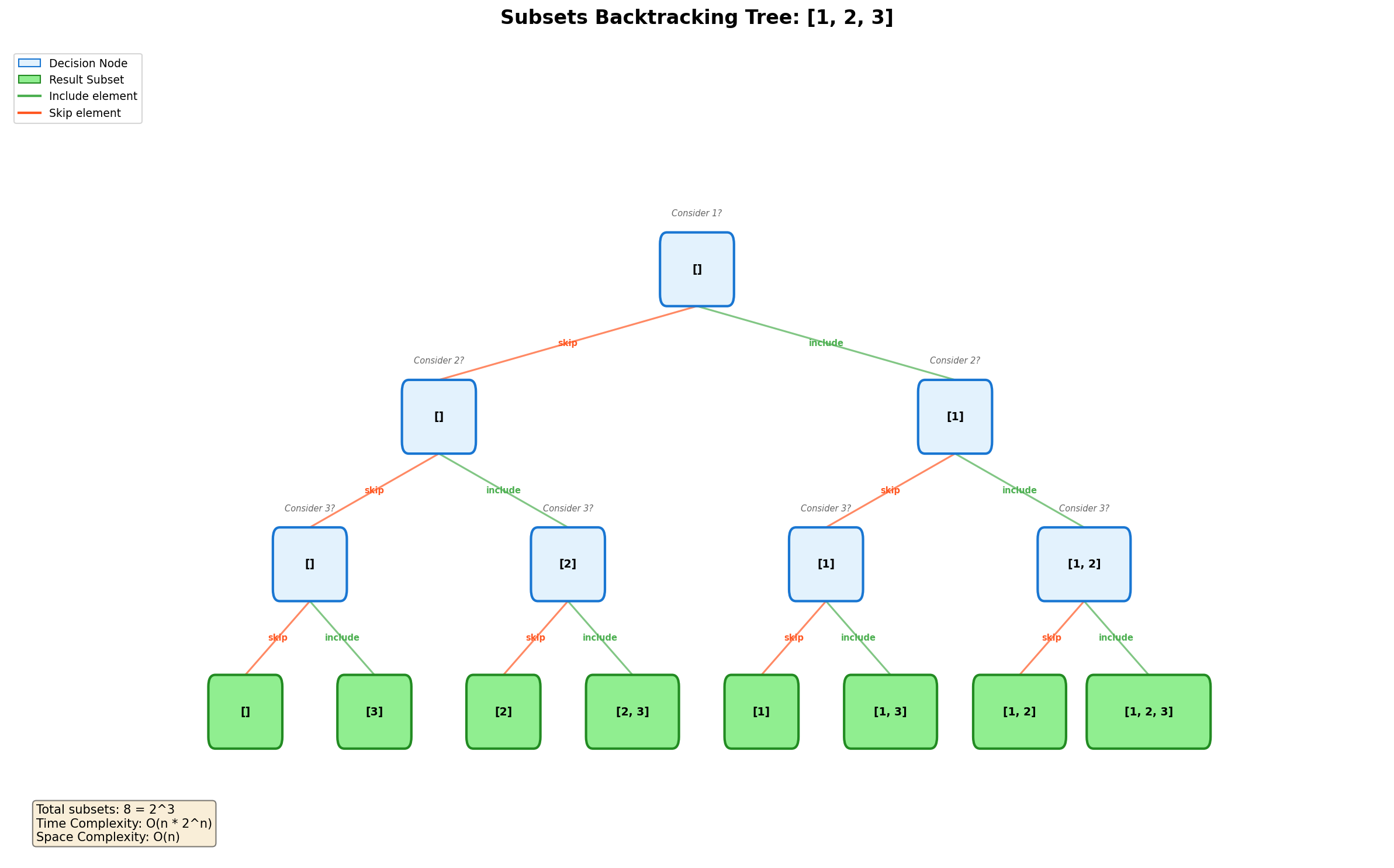
Backtracking Tree Visualization
nums = [1, 2, 3]

                           []
                      /          \
                   [1]            []
                 /    \         /    \
             [1,2]   [1]      [2]    []
            /    \   /  \    /  \   /  \
       [1,2,3] [1,2] [1,3] [1] [2,3] [2] [3] []

                    OR (Include/Exclude View)

                           start
                             |
                    include 1? -----+
                   /                 \
                 yes                 no
                  |                   |
          include 2? ----+    include 2? ----+
          /              \     /              \
        yes             no   yes             no
         |               |    |               |
   include 3?     include 3? include 3?  include 3?
    /      \       /      \   /      \    /      \
  yes     no    yes     no  yes     no  yes     no
   |       |     |       |   |       |   |       |
[1,2,3] [1,2] [1,3] [1] [2,3] [2] [3] []Alternative Visualization (Index-based):
nums = [1, 2, 3]
Subsets built by choosing starting index:

                         backtrack(0, [])
                              |
              +---------------+---------------+
              |               |               |
         add nums[0]    add nums[1]    add nums[2]
         backtrack(1,[1]) backtrack(2,[2]) backtrack(3,[3])
              |               |               |
      +-------+-------+   +---+---+          done
      |       |       |   |       |
   [1,2]    [1,3]   done [2,3]  done
   /   \      |            |
[1,2,3] done done        done

All subsets collected: [[], [1], [1,2], [1,2,3], [1,3], [2], [2,3], [3]]Solutions
from typing import List

# Solution 1: Backtracking (Most Intuitive)
def subsets(nums: List[int]) -> List[List[int]]:
    """
    Generate all subsets using backtracking.

    Time Complexity: O(n * 2^n) - 2^n subsets, each takes O(n) to copy
    Space Complexity: O(n) - recursion depth (excluding output)

    Key Insight: At each position, decide to include or skip each remaining element.
    """
    result = []

    def backtrack(start: int, current: List[int]):
        # Add current subset to result (captures all intermediate states)
        result.append(current[:])  # Make a copy!

        # Try adding each remaining element
        for i in range(start, len(nums)):
            current.append(nums[i])      # Include nums[i]
            backtrack(i + 1, current)    # Recurse with next index
            current.pop()                # Backtrack (exclude nums[i])

    backtrack(0, [])
    return result


# Solution 2: Cascading (Iterative)
def subsets_iterative(nums: List[int]) -> List[List[int]]:
    """
    Build subsets iteratively by adding each number to existing subsets.

    Process for [1, 2, 3]:
    Start: [[]]
    Add 1: [[], [1]]
    Add 2: [[], [1], [2], [1,2]]
    Add 3: [[], [1], [2], [1,2], [3], [1,3], [2,3], [1,2,3]]

    Time: O(n * 2^n)
    Space: O(1) excluding output
    """
    result = [[]]

    for num in nums:
        # For each existing subset, create a new one with num added
        result += [subset + [num] for subset in result]

    return result


# Solution 3: Bit Manipulation
def subsets_bits(nums: List[int]) -> List[List[int]]:
    """
    Use bit manipulation to generate all subsets.

    For n=3, we have masks 000 to 111 (0 to 7):
    000 -> []
    001 -> [1]
    010 -> [2]
    011 -> [1,2]
    100 -> [3]
    101 -> [1,3]
    110 -> [2,3]
    111 -> [1,2,3]

    Time: O(n * 2^n)
    Space: O(1) excluding output
    """
    n = len(nums)
    result = []

    # Iterate through all possible 2^n combinations
    for mask in range(2 ** n):
        subset = []
        for i in range(n):
            # Check if bit i is set in mask
            if mask & (1 << i):
                subset.append(nums[i])
        result.append(subset)

    return result


# Solution 4: Include/Exclude Pattern
def subsets_include_exclude(nums: List[int]) -> List[List[int]]:
    """
    At each index, make binary choice: include or exclude.

    More explicit decision tree representation.
    """
    result = []

    def backtrack(index: int, current: List[int]):
        if index == len(nums):
            result.append(current[:])
            return

        # Choice 1: Exclude nums[index]
        backtrack(index + 1, current)

        # Choice 2: Include nums[index]
        current.append(nums[index])
        backtrack(index + 1, current)
        current.pop()

    backtrack(0, [])
return resultimport java.util.*;
class Solution {
public List<List<Integer>> subsets(int[] nums) {
List<List<Integer>> result = new ArrayList<>();
backtrack(nums, 0, new ArrayList<>(), result);
return result;
}
private void backtrack(int[] nums, int start,
List<Integer> current,
List<List<Integer>> result) {
// Capture every prefix as a valid subset
result.add(new ArrayList<>(current)); // deep copy
for (int i = start; i < nums.length; i++) {
current.add(nums[i]);
backtrack(nums, i + 1, current, result);
current.remove(current.size() - 1);
}
}
}Complexity: Time O(n * 2^n) · Space O(n)
- Time: O(n * 2^n) where 2^n is the number of subsets and O(n) to copy each subset to the result
- Space: O(n) for recursion depth (excluding output storage)
Handling Duplicates: Subsets II
LeetCode 90 - Subsets II
def subsetsWithDup(nums: List[int]) -> List[List[int]]:
    """
    Generate subsets when nums may contain duplicates.

    Key: Sort first, then skip duplicates at the same level.

    Example: nums = [1, 2, 2]
    After sorting: [1, 2, 2]

    Without skip: [1,2], [1,2] <- duplicate!
    With skip: Only process first 2 at each level
    """
    result = []
    nums.sort()  # Critical: sort to group duplicates

    def backtrack(start: int, current: List[int]):
        result.append(current[:])

        for i in range(start, len(nums)):
            # Skip duplicates at the same level
            if i > start and nums[i] == nums[i-1]:
                continue
            current.append(nums[i])
            backtrack(i + 1, current)
            current.pop()

    backtrack(0, [])
return resultComplexity: Time O(n * 2^n) · Space O(n)
- Time: O(n * 2^n) worst case - sorting takes O(n log n), then generating up to 2^n subsets with O(n) copy each
- Space: O(n) for recursion depth plus O(n log n) for sorting
Visual Guides
Fibonacci Recursion Tree
Subsets Generation Tree
Generate Parentheses Decision Tree
Comparison of All Three Problems
| Problem | Pattern | Time Complexity | Space | Key Insight |
|---|---|---|---|---|
| Fibonacci | Recursion + Memoization | O(n) | O(n) or O(1) | Overlapping subproblems |
| Generate Parentheses | Constrained Backtracking | O(4^n/sqrt(n)) | O(n) | Balance constraint pruning |
| Subsets | Exhaustive Backtracking | O(n * 2^n) | O(n) | Include/exclude each element |
Common Backtracking Template
def backtrack_template(candidates, target):
    """
    Universal backtracking template.
    """
    result = []

    def backtrack(state, choices):
        # Base case: found a valid solution
        if is_solution(state):
            result.append(format_solution(state))
            return

        # Pruning: abandon invalid paths early
        if not is_valid(state):
            return

        # Try each choice
        for choice in choices:
            # Make choice
            state.add(choice)

            # Recurse with updated state
            backtrack(state, get_next_choices(choice))

            # Undo choice (backtrack)
            state.remove(choice)

    backtrack(initial_state(), candidates)
return resultInterview Applications
Real Interview Problems
- Phone Number Letter Combinations (LeetCode 17) - Similar to Generate Parentheses
- Combination Sum (LeetCode 39) - Subsets variation with target sum
- Permutations (LeetCode 46) - Related to subsets but order matters
- N-Queens (LeetCode 51) - Complex constrained backtracking
- Word Search (LeetCode 79) - Grid-based backtracking
Interview Tips
- Fibonacci: Always discuss trade-offs between approaches
- Generate Parentheses: Clearly explain the constraint pruning
- Subsets: Know all three approaches and when to use each
Common Follow-ups
| Problem | Follow-up Question |
|---|---|
| Fibonacci | "How would you handle very large n?" (Matrix exponentiation) |
| Parentheses | "What if we need to generate strings with multiple bracket types?" |
| Subsets | "How do you handle duplicates?" (Sort + skip) |
Practice Problems
Fibonacci Extensions
- 509. Fibonacci Number - Basic
- 70. Climbing Stairs - Fibonacci variant
- 1137. N-th Tribonacci Number - Three-term recurrence
Parentheses Extensions
- 22. Generate Parentheses - Core problem
- 20. Valid Parentheses - Stack validation
- 32. Longest Valid Parentheses - DP
Subsets Extensions
- 78. Subsets - Core problem
- 90. Subsets II - With duplicates
- 46. Permutations - Order matters
- 39. Combination Sum - With target