Product of Array Except Self
Problem Statement
Given an integer array nums, return an array answer such that answer[i] is equal to the product of all the elements of nums except nums[i].
The product of any prefix or suffix of nums is guaranteed to fit in a 32-bit integer.
You must write an algorithm that runs in O(n) time and without using the division operation.
Examples
Example 1
Input: nums = [1, 2, 3, 4]
Output: [24, 12, 8, 6]
Explanation:
- answer[0] = 2 * 3 * 4 = 24
- answer[1] = 1 * 3 * 4 = 12
- answer[2] = 1 * 2 * 4 = 8
- answer[3] = 1 * 2 * 3 = 6Example 2
Input: nums = [-1, 1, 0, -3, 3]
Output: [0, 0, 9, 0, 0]
Explanation: Only answer[2] is non-zero because it doesn't include 0.Visual Explanation
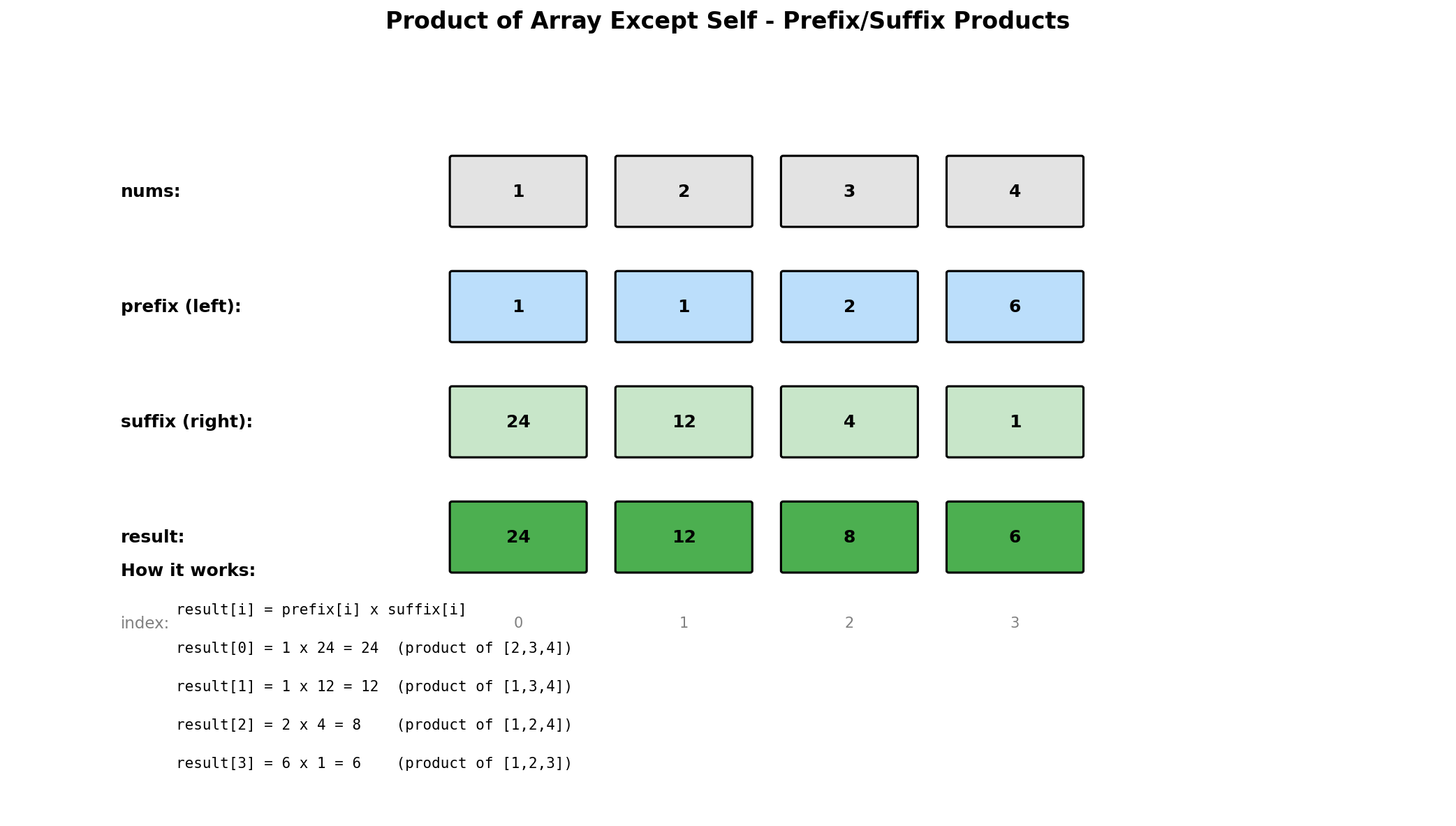
Key Insight
For each index i: answer[i] = (product of nums[0..i-1]) * (product of nums[i+1..n-1])
We can compute this in two passes:
- Left pass: Build prefix products (products to the left of each index)
- Right pass: Multiply by suffix products (products to the right of each index)
Solution
def productExceptSelf(nums: list[int]) -> list[int]:
    """
    Calculate product of all elements except self.

    Time Complexity: O(n)
    Space Complexity: O(1) - excluding output array
    """
    n = len(nums)
    answer = [1] * n

    # Left pass: answer[i] = product of all elements to the left
    prefix = 1
    for i in range(n):
        answer[i] = prefix
        prefix *= nums[i]

    # Right pass: multiply by product of all elements to the right
    suffix = 1
    for i in range(n - 1, -1, -1):
        answer[i] *= suffix
        suffix *= nums[i]

return answerpublic int[] productExceptSelf(int[] nums) {
int n = nums.length;
int[] answer = new int[n];
// Left pass: answer[i] = product of all elements to the left
int prefix = 1;
for (int i = 0; i < n; i++) {
answer[i] = prefix;
prefix *= nums[i];
}
// Right pass: multiply by product of all elements to the right
int suffix = 1;
for (int i = n - 1; i >= 0; i--) {
answer[i] *= suffix;
suffix *= nums[i];
}
return answer;
}Complexity: Time O(n) · Space O(1)
- Time: Two sequential passes through the array: left-to-right builds prefixes, right-to-left multiplies suffixes
- Space: O(1) extra space (excluding the output array which is required); only
prefixandsuffixvariables used
# Two arrays approach (easier to understand)
def productExceptSelf_twoArrays(nums: list[int]) -> list[int]:
    """
    Use separate prefix and suffix arrays.

    Time Complexity: O(n)
    Space Complexity: O(n)
    """
    n = len(nums)
    prefix = [1] * n
    suffix = [1] * n

    # Build prefix products
    for i in range(1, n):
        prefix[i] = prefix[i - 1] * nums[i - 1]

    # Build suffix products
    for i in range(n - 2, -1, -1):
        suffix[i] = suffix[i + 1] * nums[i + 1]

    # Combine
return [prefix[i] * suffix[i] for i in range(n)]Complexity: Time O(n) · Space O(n)
- Time: Three separate O(n) passes: build prefix array, build suffix array, combine into result
- Space: Two auxiliary arrays of size n (
prefixandsuffix) plus the output array
# With division (not allowed by problem, but for reference)
def productExceptSelf_division(nums: list[int]) -> list[int]:
    """
    Using division - NOT ALLOWED by problem constraints.
    Also fails with zeros.
    """
    total_product = 1
    zero_count = 0

    for num in nums:
        if num == 0:
            zero_count += 1
        else:
            total_product *= num

    result = []
    for num in nums:
        if zero_count > 1:
            result.append(0)
        elif zero_count == 1:
            result.append(0 if num != 0 else total_product)
        else:
            result.append(total_product // num)

return resultComplexity: Time O(n) · Space O(1)
- Time: Two passes: first computes total product while counting zeros O(n), second builds result O(n)
- Space: Only constant variables (
total_product,zero_count) plus the output array
Step-by-Step Trace
For nums = [1, 2, 3, 4]:
Left Pass (Build Prefix Products)
| i | nums[i] | prefix (before) | answer[i] | prefix (after) |
|---|---|---|---|---|
| 0 | 1 | 1 | 1 | 1 |
| 1 | 2 | 1 | 1 | 2 |
| 2 | 3 | 2 | 2 | 6 |
| 3 | 4 | 6 | 6 | 24 |
After left pass: answer = [1, 1, 2, 6]
Right Pass (Multiply by Suffix Products)
| i | nums[i] | suffix (before) | answer[i] (before) | answer[i] (after) | suffix (after) |
|---|---|---|---|---|---|
| 3 | 4 | 1 | 6 | 6 | 4 |
| 2 | 3 | 4 | 2 | 8 | 12 |
| 1 | 2 | 12 | 1 | 12 | 24 |
| 0 | 1 | 24 | 1 | 24 | 24 |
Final: answer = [24, 12, 8, 6]
Complexity Analysis
| Approach | Time | Space |
|---|---|---|
| Optimal (single output array) | O(n) | O(1)* |
| Two arrays | O(n) | O(n) |
| Division | O(n) | O(1) |
*O(1) extra space excluding the output array
Edge Cases
- Two elements:
[2, 3]->[3, 2] - Contains zero:
[1, 0, 2]->[0, 2, 0] - Multiple zeros:
[0, 0, 1]->[0, 0, 0] - All ones:
[1, 1, 1, 1]->[1, 1, 1, 1] - Negative numbers:
[-1, 2, -3]->[-6, 3, -2] - Single element: Not valid per constraints (n >= 2)
Handling Zeros
Case 1: No zeros
  - Normal calculation works

Case 2: Exactly one zero
  - Only the position with zero has non-zero result
  - All other positions have result = 0

Case 3: Multiple zeros
- All positions have result = 0Common Mistakes
- Using division - Problem explicitly forbids it
- Not handling zeros - Zeros make most products zero
- Wrong initialization - Prefix/suffix start at 1, not 0
- Off-by-one errors - Careful with loop bounds
Related Problems
Trapping Rain Water (LeetCode 42)
Problem: Calculate water trapped in elevation map.
Key Insight: Same prefix/suffix pattern - water at position i depends on max heights on both sides.
Approach: Compute maxLeft and maxRight arrays (or use two pointers). Water = min(maxLeft, maxRight) - height.
Complexity: O(n) time, O(1) space with two pointers
Maximum Product Subarray (LeetCode 152)
Problem: Find contiguous subarray with largest product.
Key Insight: Different pattern - track running product. Handle negatives by tracking both max and min.
Approach: Maintain maxProd and minProd at each position. Swap when encountering negative numbers.
Complexity: O(n) time, O(1) space
Subarray Product Less Than K (LeetCode 713)
Problem: Count subarrays where product of all elements is less than k.
Key Insight: Use sliding window - expand right, shrink left when product >= k.
Approach: Maintain window [left, right] with product < k. Each new right position adds (right - left + 1) new valid subarrays.
Complexity: O(n) time, O(1) space
Key Takeaways
- Prefix and suffix products are a powerful technique
- The O(1) space solution cleverly uses the output array
- This pattern of "compute from both directions" appears in many problems
- Division is tempting but fails with zeros and is disallowed here