Search in Rotated Sorted Array
Problem Statement
There is an integer array nums sorted in ascending order (with distinct values).
Prior to being passed to your function, nums is possibly rotated at an unknown pivot index k (1 <= k < nums.length) such that the resulting array is [nums[k], nums[k+1], ..., nums[n-1], nums[0], nums[1], ..., nums[k-1]] (0-indexed).
Given the array nums after the possible rotation and an integer target, return the index of target if it is in nums, or -1 if it is not in nums.
You must write an algorithm with O(log n) runtime complexity.
Examples
Example 1
Input: nums = [4, 5, 6, 7, 0, 1, 2], target = 0
Output: 4Example 2
Input: nums = [4, 5, 6, 7, 0, 1, 2], target = 3
Output: -1Example 3
Input: nums = [1], target = 0
Output: -1Visual Explanation
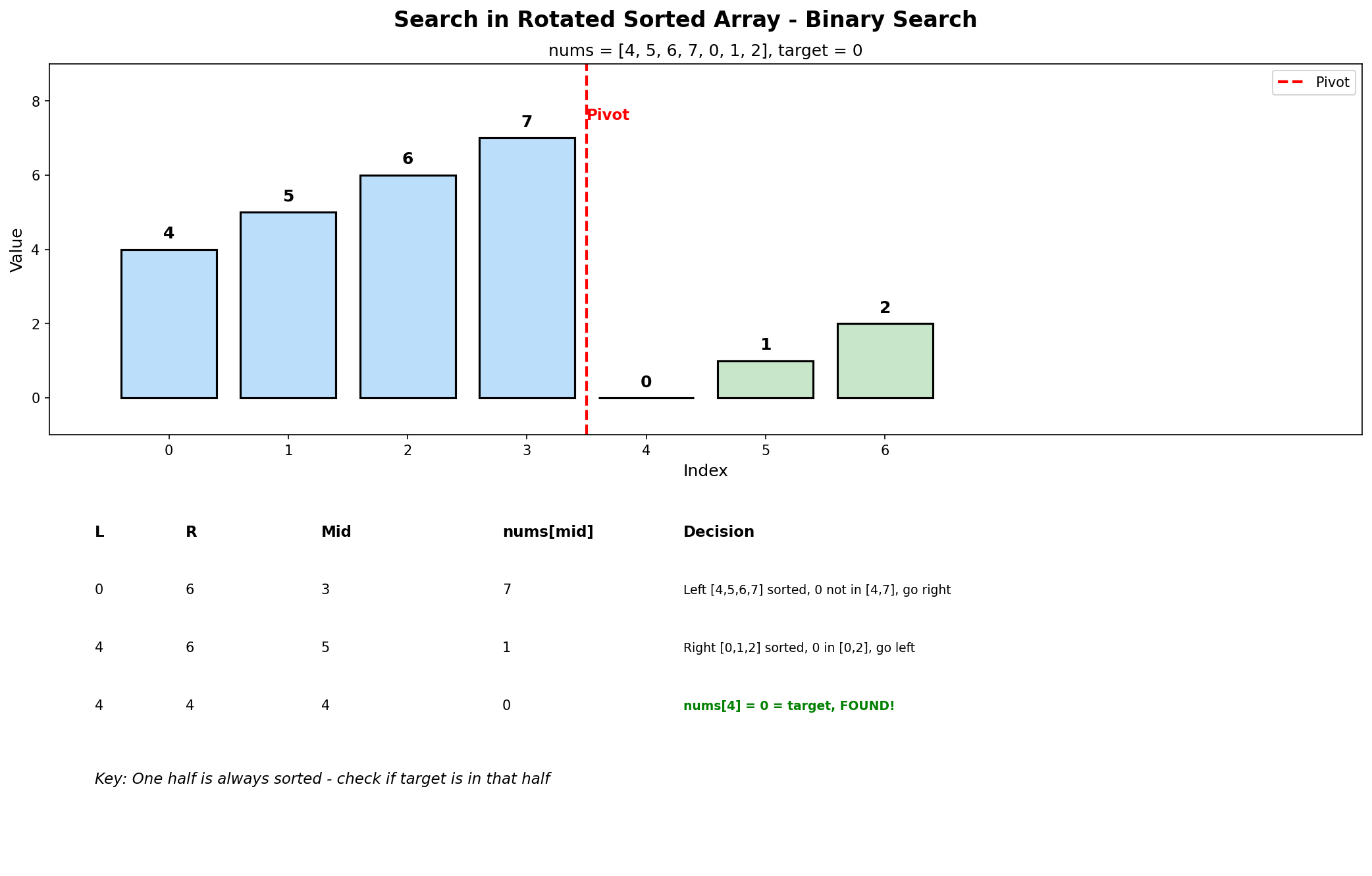
Key Insight
In a rotated sorted array:
- At least one half is always sorted after splitting at mid
- We can easily check if target lies within a sorted range
- Use this to decide which half to search
How to determine which half is sorted:
- If
nums[left] <= nums[mid]: left half is sorted - Otherwise: right half is sorted
Solution
def search(nums: list[int], target: int) -> int:
    """
    Search in rotated sorted array using binary search.

    Time Complexity: O(log n)
    Space Complexity: O(1)
    """
    left, right = 0, len(nums) - 1

    while left <= right:
        mid = (left + right) // 2

        if nums[mid] == target:
            return mid

        # Determine which half is sorted
        if nums[left] <= nums[mid]:
            # Left half is sorted
            if nums[left] <= target < nums[mid]:
                # Target is in the sorted left half
                right = mid - 1
            else:
                # Target is in the right half
                left = mid + 1
        else:
            # Right half is sorted
            if nums[mid] < target <= nums[right]:
                # Target is in the sorted right half
                left = mid + 1
            else:
                # Target is in the left half
                right = mid - 1

return -1public int search(int[] nums, int target) {
int left = 0, right = nums.length - 1;
while (left <= right) {
int mid = left + (right - left) / 2;
if (nums[mid] == target) return mid;
// Determine which half is sorted
if (nums[left] <= nums[mid]) {
// Left half is sorted
if (nums[left] <= target && target < nums[mid]) {
// Target is in the sorted left half
right = mid - 1;
} else {
// Target is in the right half
left = mid + 1;
}
} else {
// Right half is sorted
if (nums[mid] < target && target <= nums[right]) {
// Target is in the sorted right half
left = mid + 1;
} else {
// Target is in the left half
right = mid - 1;
}
}
}
return -1;
}Complexity: Time O(log n) · Space O(1)
- Time: Binary search halves the search space each iteration - at most log(n) comparisons needed
- Space: Only uses three pointer variables (
left,right,mid) with no recursion or auxiliary data structures
# Alternative: Find pivot first, then binary search
def search_two_step(nums: list[int], target: int) -> int:
    """
    Step 1: Find the pivot (smallest element)
    Step 2: Binary search in the appropriate half
    """
    def find_pivot() -> int:
        left, right = 0, len(nums) - 1

        while left < right:
            mid = (left + right) // 2
            if nums[mid] > nums[right]:
                left = mid + 1
            else:
                right = mid

        return left

    def binary_search(left: int, right: int) -> int:
        while left <= right:
            mid = (left + right) // 2
            if nums[mid] == target:
                return mid
            elif nums[mid] < target:
                left = mid + 1
            else:
                right = mid - 1
        return -1

    n = len(nums)
    pivot = find_pivot()

    # Determine which half to search
    if target >= nums[pivot] and target <= nums[n - 1]:
        return binary_search(pivot, n - 1)
    else:
return binary_search(0, pivot - 1)Complexity: Time O(log n) · Space O(1)
- Time: Two binary searches - O(log n) to find pivot, O(log n) to search in the appropriate half
- Space: Constant space using only pointer variables in both helper functions
Step-by-Step Trace
For nums = [4, 5, 6, 7, 0, 1, 2], target = 0:
| Step | left | right | mid | nums[mid] | Sorted Half | Target Range? | Action |
|---|---|---|---|---|---|---|---|
| 1 | 0 | 6 | 3 | 7 | Left [4,5,6,7] | 0 not in [4,7) | left = 4 |
| 2 | 4 | 6 | 5 | 1 | Left [0,1] | 0 in [0,1) | right = 4 |
| 3 | 4 | 4 | 4 | 0 | Found! | - | return 4 |
Result: Index 4
Decision Tree
At each step:
1. Is nums[mid] == target? -> Return mid

2. Is left half sorted? (nums[left] <= nums[mid])
   YES -> Is target in [nums[left], nums[mid])?
          YES -> Search left (right = mid - 1)
          NO  -> Search right (left = mid + 1)
   NO  -> Right half is sorted
          Is target in (nums[mid], nums[right]]?
          YES -> Search right (left = mid + 1)
NO -> Search left (right = mid - 1)Complexity Analysis
| Metric | Complexity |
|---|---|
| Time | O(log n) - Binary search |
| Space | O(1) - Constant extra space |
Edge Cases
- Single element:
[1], target = 1 -> Return 0 - Not rotated:
[1, 2, 3, 4, 5]- Works as normal binary search - Fully rotated: Same as not rotated
- Target not found: Return -1
- Target at pivot:
[4, 5, 1, 2, 3], target = 1 -> Return 2 - Target at ends: Check both boundaries work
Variations
Search in Rotated Sorted Array II (with duplicates)
def search_with_duplicates(nums: list[int], target: int) -> bool:
    """
    Handle arrays with duplicate elements.
    Worst case: O(n) when all elements are same except one.
    """
    left, right = 0, len(nums) - 1

    while left <= right:
        mid = (left + right) // 2

        if nums[mid] == target:
            return True

        # Handle duplicates: can't determine sorted half
        if nums[left] == nums[mid] == nums[right]:
            left += 1
            right -= 1
        elif nums[left] <= nums[mid]:
            # Left half is sorted
            if nums[left] <= target < nums[mid]:
                right = mid - 1
            else:
                left = mid + 1
        else:
            # Right half is sorted
            if nums[mid] < target <= nums[right]:
                left = mid + 1
            else:
                right = mid - 1

return FalseComplexity: Time O(log n) average, O(n) worst case · Space O(1)
- Time: Usually O(log n), but degrades to O(n) when many duplicates exist (e.g.,
[1,1,1,1,1,0,1,1]) requiring linear shrinking - Space: Only constant pointer variables used regardless of duplicates
Find Minimum in Rotated Sorted Array
def findMin(nums: list[int]) -> int:
    """
    Find the minimum element (pivot point).
    """
    left, right = 0, len(nums) - 1

    while left < right:
        mid = (left + right) // 2

        if nums[mid] > nums[right]:
            # Minimum is in right half
            left = mid + 1
        else:
            # Minimum is at mid or in left half
            right = mid

return nums[left]Complexity: Time O(log n) · Space O(1)
- Time: Binary search converges to the minimum element, halving search space each iteration
- Space: Only uses two pointer variables for the search bounds
Find Rotation Count
def findRotationCount(nums: list[int]) -> int:
    """
    Find how many times array was rotated.
    This is the same as finding index of minimum element.
    """
    left, right = 0, len(nums) - 1

    while left < right:
        mid = (left + right) // 2

        if nums[mid] > nums[right]:
            # Minimum is in right half
            left = mid + 1
        else:
            # Minimum is at mid or in left half
            right = mid

return leftCommon Mistakes
- Wrong comparison for sorted half - Use
<=not<fornums[left] <= nums[mid] - Incorrect target range checks - Be careful with inclusive/exclusive bounds
- Not handling duplicates - In variant with duplicates, need special handling
- Infinite loop - Ensure proper boundary updates
Related Problems
Find Minimum in Rotated Sorted Array (LeetCode 153)
Problem: Find minimum element in rotated sorted array (no duplicates).
Key Insight: Minimum is the pivot point where rotation occurred.
Approach: Binary search - if nums[mid] > nums[right], minimum is in right half. Otherwise in left half (including mid).
Complexity: O(log n) time, O(1) space
Find Minimum in Rotated Sorted Array II (LeetCode 154)
Problem: Find minimum in rotated sorted array with duplicates.
Key Insight: Duplicates make it impossible to determine sorted half when nums[left] == nums[mid] == nums[right].
Approach: When all three equal, shrink by one (left++ or right--). Otherwise apply normal logic.
Complexity: O(log n) average, O(n) worst case
Search in Rotated Sorted Array II (LeetCode 81)
Problem: Search for target in rotated array with duplicates.
Key Insight: Same challenge - can't determine sorted half when all boundaries equal.
Approach: When nums[left] == nums[mid] == nums[right], increment left and decrement right. Otherwise apply standard logic.
Complexity: O(log n) average, O(n) worst case
Find Peak Element (LeetCode 162)
Problem: Find any local peak in array where neighbors are smaller.
Key Insight: Binary search works even on unsorted array - always climb toward higher values.
Approach: If nums[mid] < nums[mid+1], peak is on right. Otherwise peak is at mid or left.
Complexity: O(log n) time, O(1) space
Key Takeaways
- In rotated sorted array, one half is always sorted
- Determine the sorted half, then check if target is in that range
- The key is identifying which half to search based on sorted property
- With duplicates, worst case degrades to O(n) but average is still O(log n)
- This is a classic interview problem - understand the intuition deeply