Design HashMap
Problem Statement
Design a HashMap without using any built-in hash table libraries.
Implement the MyHashMap class:
MyHashMap()initializes the object with an empty map.void put(int key, int value)inserts a(key, value)pair into the HashMap. If thekeyalready exists in the map, update the correspondingvalue.int get(int key)returns thevalueto which the specifiedkeyis mapped, or-1if this map contains no mapping for thekey.void remove(int key)removes thekeyand its correspondingvalueif the map contains the mapping for thekey.
LeetCode: 706. Design HashMap
Examples
Example 1:
Input:
["MyHashMap", "put", "put", "get", "get", "put", "get", "remove", "get"]
[[], [1, 1], [2, 2], [1], [3], [2, 1], [2], [2], [2]]

Output:
[null, null, null, 1, -1, null, 1, null, -1]

Explanation:
MyHashMap myHashMap = new MyHashMap();
myHashMap.put(1, 1); // The map is now [[1,1]]
myHashMap.put(2, 2); // The map is now [[1,1], [2,2]]
myHashMap.get(1);    // return 1
myHashMap.get(3);    // return -1 (not found)
myHashMap.put(2, 1); // The map is now [[1,1], [2,1]] (update existing)
myHashMap.get(2);    // return 1
myHashMap.remove(2); // The map is now [[1,1]]
myHashMap.get(2); // return -1 (not found)Constraints
0 <= key, value <= 10^6- At most
10^4calls will be made toput,get, andremove.
Array of Buckets with Chaining
Key Insight
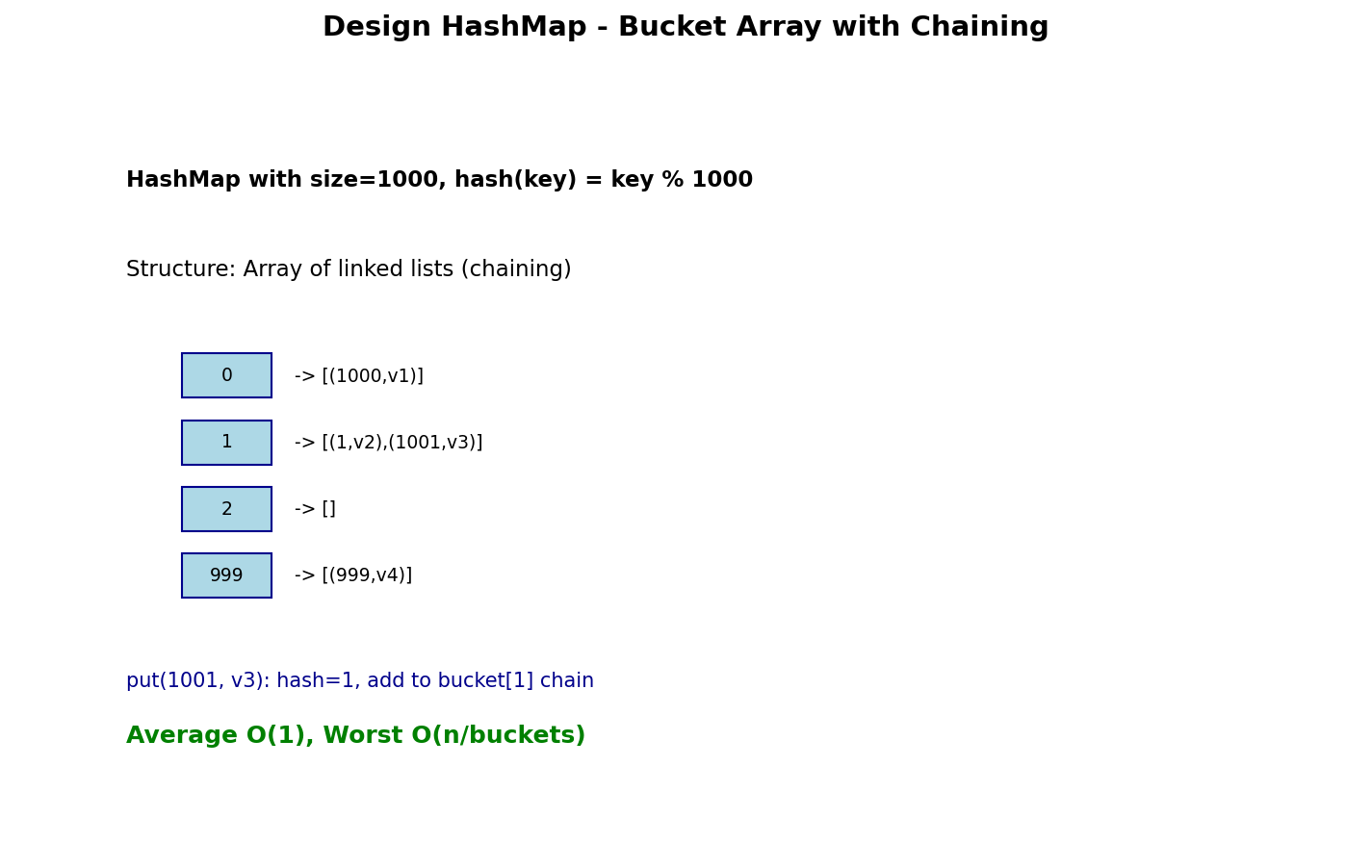
Use an array of buckets where each bucket is a linked list (chaining) to handle collisions. Hash function: key % bucket_size.
Data Structure
Buckets Array (size = 1000):
[0] -> (key1, val1) -> (key2, val2)
[1] -> (key3, val3)
[2] -> None
...
[999] -> (key4, val4)

Hash function: bucket_index = key % 1000Solution
class ListNode:
    """Node for chaining in bucket."""
    def __init__(self, key: int = -1, val: int = -1):
        self.key = key
        self.val = val
        self.next = None


class MyHashMap:
    """
    HashMap using array of buckets with chaining.

    Time: O(n/k) average, O(n) worst for operations
    Space: O(k + n) where k = bucket size, n = elements
    """

    def __init__(self):
        self.size = 1000  # Number of buckets
        self.buckets = [ListNode() for _ in range(self.size)]  # Dummy heads

    def _hash(self, key: int) -> int:
        """Hash function."""
        return key % self.size

    def _find(self, key: int) -> ListNode:
        """Find node before the one with key (or last node)."""
        bucket_idx = self._hash(key)
        prev = self.buckets[bucket_idx]

        curr = prev.next
        while curr:
            if curr.key == key:
                return prev
            prev = curr
            curr = curr.next

        return prev

    def put(self, key: int, value: int) -> None:
        """Insert or update key-value pair."""
        prev = self._find(key)

        if prev.next:
            # Key exists, update value
            prev.next.val = value
        else:
            # Key doesn't exist, insert new node
            prev.next = ListNode(key, value)

    def get(self, key: int) -> int:
        """Get value by key, -1 if not found."""
        prev = self._find(key)

        if prev.next:
            return prev.next.val
        return -1

    def remove(self, key: int) -> None:
        """Remove key-value pair."""
        prev = self._find(key)

        if prev.next:
prev.next = prev.next.nextimport java.util.*;
class MyHashMap {
private static final int SIZE = 1000;
// Inner node for chaining
private static class Node {
int key, val;
Node next;
Node(int key, int val) { this.key = key; this.val = val; }
}
private final Node[] buckets;
public MyHashMap() {
buckets = new Node[SIZE];
// Each bucket has a dummy head
for (int i = 0; i < SIZE; i++) buckets[i] = new Node(-1, -1);
}
private int hash(int key) { return key % SIZE; }
/** Find node before the one with key (or last node). */
private Node find(int key) {
Node prev = buckets[hash(key)];
while (prev.next != null && prev.next.key != key) {
prev = prev.next;
}
return prev;
}
public void put(int key, int value) {
Node prev = find(key);
if (prev.next != null) {
prev.next.val = value; // Key exists: update
} else {
prev.next = new Node(key, value); // Insert new
}
}
public int get(int key) {
Node prev = find(key);
return prev.next != null ? prev.next.val : -1;
}
public void remove(int key) {
Node prev = find(key);
if (prev.next != null) prev.next = prev.next.next;
}
}Complexity: Time O(n/k) average · Space O(k + n)
- Time: O(n/k) average case where k is number of buckets; O(n) worst case when all keys hash to same bucket
- Space: O(k + n) for k buckets with linked list nodes, where n is number of stored key-value pairs
Alternative: Using List of Lists
class MyHashMapSimpler:
    """
    Simpler implementation using list of lists.
    """

    def __init__(self):
        self.size = 1000
        self.buckets = [[] for _ in range(self.size)]

    def put(self, key: int, value: int) -> None:
        bucket_idx = key % self.size
        bucket = self.buckets[bucket_idx]

        for i, (k, v) in enumerate(bucket):
            if k == key:
                bucket[i] = (key, value)
                return

        bucket.append((key, value))

    def get(self, key: int) -> int:
        bucket_idx = key % self.size
        bucket = self.buckets[bucket_idx]

        for k, v in bucket:
            if k == key:
                return v

        return -1

    def remove(self, key: int) -> None:
        bucket_idx = key % self.size
        bucket = self.buckets[bucket_idx]

        for i, (k, v) in enumerate(bucket):
            if k == key:
                bucket.pop(i)
returnComplexity: Time O(n/k) average · Space O(k + n)
- Time: O(n/k) average for operations; list iteration within bucket is O(bucket_size)
- Space: O(k + n) for k empty bucket lists plus tuples for n stored elements
Open Addressing (Linear Probing)
class MyHashMapOpenAddressing:
    """
    HashMap using open addressing with linear probing.
    """

    def __init__(self):
        self.size = 10007  # Prime number for better distribution
        self.keys = [None] * self.size
        self.vals = [None] * self.size
        self.DELETED = -1  # Marker for deleted slots

    def _hash(self, key: int) -> int:
        return key % self.size

    def _find_slot(self, key: int) -> int:
        """Find slot for key (existing or empty)."""
        idx = self._hash(key)
        first_deleted = -1

        while self.keys[idx] is not None:
            if self.keys[idx] == key:
                return idx
            if self.keys[idx] == self.DELETED and first_deleted == -1:
                first_deleted = idx
            idx = (idx + 1) % self.size

        return first_deleted if first_deleted != -1 else idx

    def put(self, key: int, value: int) -> None:
        idx = self._find_slot(key)
        self.keys[idx] = key
        self.vals[idx] = value

    def get(self, key: int) -> int:
        idx = self._hash(key)

        while self.keys[idx] is not None:
            if self.keys[idx] == key:
                return self.vals[idx]
            idx = (idx + 1) % self.size

        return -1

    def remove(self, key: int) -> None:
        idx = self._hash(key)

        while self.keys[idx] is not None:
            if self.keys[idx] == key:
                self.keys[idx] = self.DELETED
                self.vals[idx] = None
                return
idx = (idx + 1) % self.sizeComplexity: Time O(1) average · Space O(size)
- Time: O(1) average case with good hash distribution; O(n) worst case with clustering
- Space: O(size) for the fixed-size arrays storing keys and values
With Dynamic Resizing
class MyHashMapDynamic:
    """
    HashMap with dynamic resizing.
    Doubles size when load factor > 0.75.
    """

    def __init__(self):
        self.size = 16
        self.count = 0
        self.buckets = [[] for _ in range(self.size)]
        self.load_factor_threshold = 0.75

    def _hash(self, key: int) -> int:
        return key % self.size

    def _resize(self) -> None:
        """Double the size and rehash all elements."""
        old_buckets = self.buckets
        self.size *= 2
        self.buckets = [[] for _ in range(self.size)]
        self.count = 0

        for bucket in old_buckets:
            for key, value in bucket:
                self.put(key, value)

    def put(self, key: int, value: int) -> None:
        # Check if resize needed
        if self.count / self.size > self.load_factor_threshold:
            self._resize()

        bucket_idx = self._hash(key)
        bucket = self.buckets[bucket_idx]

        for i, (k, v) in enumerate(bucket):
            if k == key:
                bucket[i] = (key, value)
                return

        bucket.append((key, value))
        self.count += 1

    def get(self, key: int) -> int:
        bucket_idx = self._hash(key)
        for k, v in self.buckets[bucket_idx]:
            if k == key:
                return v
        return -1

    def remove(self, key: int) -> None:
        bucket_idx = self._hash(key)
        bucket = self.buckets[bucket_idx]

        for i, (k, v) in enumerate(bucket):
            if k == key:
                bucket.pop(i)
                self.count -= 1
returnComplexity: Time O(1) amortized · Space O(n)
- Time: O(1) amortized - occasional O(n) resize operations are spread across many insertions
- Space: O(n) for storing n elements; doubles capacity when load factor exceeds threshold
Complexity Analysis
| Operation | Average | Worst Case |
|---|---|---|
| put | O(1) | O(n) |
| get | O(1) | O(n) |
| remove | O(1) | O(n) |
| Space | O(k + n) | O(k + n) |
Where k = number of buckets, n = number of elements.
Choosing Bucket Size
- Too small: More collisions, longer chains
- Too large: Wasted memory
- Prime numbers: Better distribution (e.g., 10007, 1009, 769)
- Powers of 2: Faster modulo (use bitmask)
Edge Cases
- Key 0: Valid key, don't confuse with "not found"
- Same key twice: Update value, don't add duplicate
- Remove non-existent: No-op, don't throw error
- All same hash: All in one bucket (worst case)
Hash Function Improvements
def better_hash(self, key: int) -> int:
    """
    Better hash function for integer keys.
    Uses bit manipulation for better distribution.
    """
    key = ((key >> 16) ^ key) * 0x45d9f3b
    key = ((key >> 16) ^ key) * 0x45d9f3b
    key = (key >> 16) ^ key
    return key % self.size


def string_hash(self, key: str) -> int:
    """Hash function for string keys."""
    h = 0
    for char in key:
        h = (h * 31 + ord(char)) % self.size
return hInterview Tips
- Discuss collision handling: Chaining vs open addressing
- Mention load factor: When to resize
- Hash function quality: Distribution, speed
- Trade-offs: Space vs time, simplicity vs efficiency
Related Problems
Design HashSet (LeetCode 705)
Problem: Implement HashSet with add, remove, contains operations.
Key Insight: Same as HashMap but only store keys (no values).
Approach: Array of buckets with chaining or open addressing. Hash function maps key to bucket.
Complexity: Time O(1) average, O(n/k) worst case per operation
LRU Cache (LeetCode 146)
Problem: Design cache evicting least recently used item first.
Key Insight: Combine HashMap with doubly linked list for O(1) operations.
Approach: HashMap maps keys to list nodes. Move accessed items to front, evict from back.
Complexity: Time O(1) for get/put, Space O(capacity)
Insert Delete GetRandom O(1) (LeetCode 380)
Problem: Design set supporting O(1) insert, delete, and random access.
Key Insight: Array for random access + HashMap for O(1) lookup + swap-delete trick.
Approach: Store elements in array, indices in map. Swap with last to delete in O(1).
Complexity: Time O(1) for all operations, Space O(n)
All O(1) Data Structure (LeetCode 432)
Problem: Design structure for O(1) inc, dec, getMaxKey, getMinKey.
Key Insight: Doubly linked list of frequency buckets + hash map for key lookup.
Approach: Each bucket holds keys with same count. Move keys between adjacent buckets.
Complexity: Time O(1) for all operations, Space O(n)