Sliding Window Maximum
Problem Statement
You are given an array of integers nums, there is a sliding window of size k which is moving from the very left of the array to the very right. You can only see the k numbers in the window. Each time the sliding window moves right by one position.
Return the max sliding window.
Examples
Example 1
Input: nums = [1, 3, -1, -3, 5, 3, 6, 7], k = 3
Output: [3, 3, 5, 5, 6, 7]
Explanation:
Window position                Max
---------------               -----
[1  3  -1] -3  5  3  6  7       3
 1 [3  -1  -3] 5  3  6  7       3
 1  3 [-1  -3  5] 3  6  7       5
 1  3  -1 [-3  5  3] 6  7       5
 1  3  -1  -3 [5  3  6] 7       6
1 3 -1 -3 5 [3 6 7] 7Example 2
Input: nums = [1], k = 1
Output: [1]Example 3
Input: nums = [1, -1], k = 1
Output: [1, -1]Visual Explanation
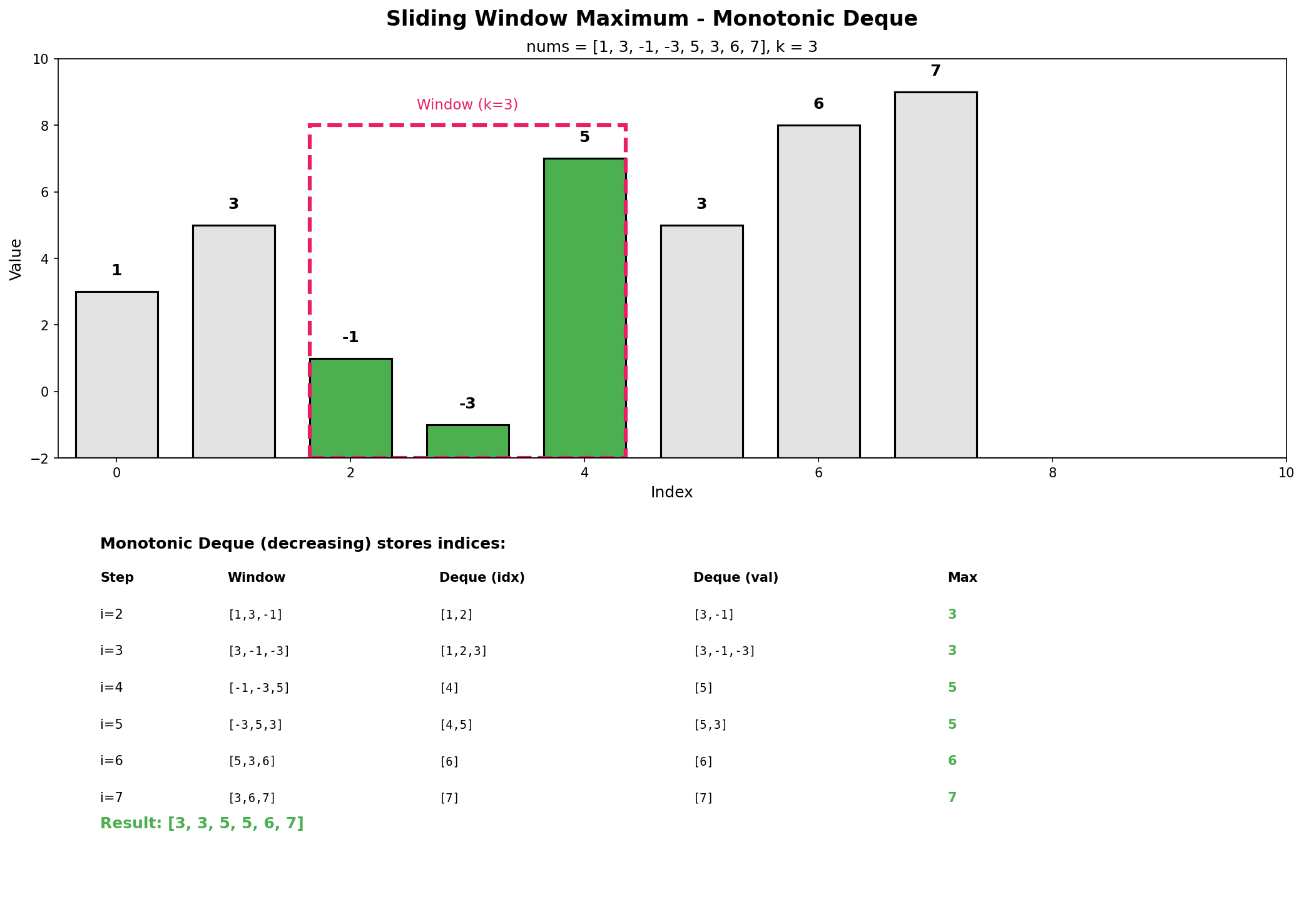
Key Insight: Monotonic Deque
A monotonic decreasing deque maintains elements in decreasing order:
- The front always holds the maximum element's index
- When adding a new element, remove all smaller elements from the back
- When the window slides, remove elements outside the window from the front
Why does this work?
- If a newer element is larger, older smaller elements can never be the maximum
- The deque only stores "candidates" that could become maximum as window slides
Solution
from collections import deque

def maxSlidingWindow(nums: list[int], k: int) -> list[int]:
    """
    Find maximum in each sliding window using monotonic deque.

    Time Complexity: O(n) - each element added/removed at most once
    Space Complexity: O(k) - deque stores at most k elements
    """
    if not nums or k == 0:
        return []

    result = []
    dq = deque()  # Store indices

    for i, num in enumerate(nums):
        # Remove indices outside the current window
        while dq and dq[0] < i - k + 1:
            dq.popleft()

        # Remove indices with values smaller than current
        # (they can never be maximum)
        while dq and nums[dq[-1]] < num:
            dq.pop()

        dq.append(i)

        # Window is complete, record maximum
        if i >= k - 1:
            result.append(nums[dq[0]])

return resultpublic int[] maxSlidingWindow(int[] nums, int k) {
if (nums == null || nums.length == 0 || k == 0) return new int[0];
int n = nums.length;
int[] result = new int[n - k + 1];
Deque<Integer> dq = new ArrayDeque<>(); // Store indices
for (int i = 0; i < n; i++) {
// Remove indices outside the current window
while (!dq.isEmpty() && dq.peekFirst() < i - k + 1) {
dq.pollFirst();
}
// Remove indices with values smaller than current
// (they can never be maximum)
while (!dq.isEmpty() && nums[dq.peekLast()] < nums[i]) {
dq.pollLast();
}
dq.offerLast(i);
// Window is complete, record maximum
if (i >= k - 1) {
result[i - k + 1] = nums[dq.peekFirst()];
}
}
return result;
}Complexity: Time O(n) · Space O(k)
- Time: Each element is added to and removed from the deque at most once - amortized O(1) per element across n elements
- Space: Deque stores at most k indices at any time since elements outside the window are removed
# Using max-heap (less efficient but simpler concept)
import heapq

def maxSlidingWindow_heap(nums: list[int], k: int) -> list[int]:
    """
    Using max-heap. O(n log n) worst case.
    """
    result = []
    # Max-heap: store (-value, index) for max-heap behavior
    heap = []

    for i in range(len(nums)):
        heapq.heappush(heap, (-nums[i], i))

        # Remove elements outside window
        while heap[0][1] <= i - k:
            heapq.heappop(heap)

        # Window is complete
        if i >= k - 1:
            result.append(-heap[0][0])

return resultComplexity: Time O(n log n) · Space O(n)
- Time: Each element is pushed once O(log n), and lazy deletion may process each element again on pop - worst case O(n log n)
- Space: Heap can grow to size n since we use lazy deletion instead of eagerly removing outdated elements
# Brute force for comparison
def maxSlidingWindow_bruteforce(nums: list[int], k: int) -> list[int]:
    """
    Brute force: O(n*k).
    """
return [max(nums[i:i+k]) for i in range(len(nums) - k + 1)]Complexity: Time O(n * k) · Space O(1)
- Time: For each of (n - k + 1) windows, finding the maximum requires scanning k elements
- Space: Only creates the output list - no auxiliary data structures used during computation
Step-by-Step Trace
For nums = [1, 3, -1, -3, 5, 3, 6, 7], k = 3:
| i | num | Remove outdated | Remove smaller | Deque (indices) | Values | Result |
|---|---|---|---|---|---|---|
| 0 | 1 | - | - | [0] | [1] | - |
| 1 | 3 | - | [0] | [1] | [3] | - |
| 2 | -1 | - | - | [1, 2] | [3, -1] | [3] |
| 3 | -3 | - | - | [1, 2, 3] | [3, -1, -3] | [3, 3] |
| 4 | 5 | [1] | [2, 3] | [4] | [5] | [3, 3, 5] |
| 5 | 3 | - | - | [4, 5] | [5, 3] | [3, 3, 5, 5] |
| 6 | 6 | - | [5] | [6] | [6] | [3, 3, 5, 5, 6] |
| 7 | 7 | - | [6] | [7] | [7] | [3, 3, 5, 5, 6, 7] |
Result: [3, 3, 5, 5, 6, 7]
Complexity Analysis
| Approach | Time | Space |
|---|---|---|
| Monotonic Deque | O(n) | O(k) |
| Max-Heap | O(n log n) | O(n) |
| Brute Force | O(n * k) | O(1) |
Why is deque O(n)? Each element is added and removed from the deque at most once.
Edge Cases
- k = 1: Each element is its own maximum
- k = n: Return single element, the global maximum
- All same elements:
[5, 5, 5, 5], k = 2 ->[5, 5, 5] - Descending array:
[5, 4, 3, 2, 1]- deque always has size 1 - Ascending array:
[1, 2, 3, 4, 5]- deque fills up to k
Variations
Sliding Window Minimum
def minSlidingWindow(nums: list[int], k: int) -> list[int]:
    """
    Find minimum in each sliding window.
    Use monotonic INCREASING deque instead.
    """
    result = []
    dq = deque()

    for i, num in enumerate(nums):
        # Remove outdated
        while dq and dq[0] < i - k + 1:
            dq.popleft()

        # Remove larger elements (opposite condition)
        while dq and nums[dq[-1]] > num:
            dq.pop()

        dq.append(i)

        if i >= k - 1:
            result.append(nums[dq[0]])

return resultComplexity: Time O(n) · Space O(k)
- Time: Same amortized analysis as max version - each element added/removed from deque at most once
- Space: Deque holds at most k indices representing the current window's candidates
Shortest Subarray with Sum at Least K
def shortestSubarray(nums: list[int], k: int) -> int:
    """
    Find shortest subarray with sum >= k.
    Uses monotonic deque on prefix sums.
    """
    n = len(nums)
    prefix = [0] * (n + 1)
    for i in range(n):
        prefix[i + 1] = prefix[i] + nums[i]

    result = float('inf')
    dq = deque()  # Monotonic increasing deque of indices

    for i in range(n + 1):
        # Check if we can form valid subarray
        while dq and prefix[i] - prefix[dq[0]] >= k:
            result = min(result, i - dq.popleft())

        # Maintain monotonic increasing property
        while dq and prefix[i] <= prefix[dq[-1]]:
            dq.pop()

        dq.append(i)

return result if result != float('inf') else -1Complexity: Time O(n) · Space O(n)
- Time: Each index is added to and removed from the deque at most once - O(n) total operations
- Space: Prefix sum array of size n+1, plus deque that can hold up to n+1 indices in worst case
Common Mistakes
- Storing values instead of indices - Need indices to check if element is in window
- Wrong deque ordering - Must be monotonic DECREASING for max
- Forgetting to check window bounds - Must remove elements outside window
- Off-by-one errors - Window starts producing results at index k-1
- Using wrong end of deque - Remove from front for outdated, back for smaller
Related Problems
Sliding Window Minimum
Problem: Find minimum in each sliding window (opposite of maximum).
Key Insight: Use monotonic INCREASING deque instead of decreasing.
Approach: Same algorithm, but remove elements LARGER than current (they can never be minimum).
Complexity: O(n) time, O(k) space
Shortest Subarray with Sum at Least K (LeetCode 862)
Problem: Find shortest subarray with sum >= K (can have negative numbers).
Key Insight: Monotonic deque on prefix sums. Can't use simple sliding window due to negatives.
Approach: For prefix sum at i, find smallest j where prefix[i] - prefix[j] >= K. Maintain monotonic increasing deque of prefix sum indices.
Complexity: O(n) time, O(n) space
Jump Game VI (LeetCode 1696)
Problem: Max score to reach end, can jump 1 to k steps, score = sum of visited elements.
Key Insight: DP with sliding window maximum. dp[i] = nums[i] + max(dp[i-k:i]).
Approach: Use monotonic deque to maintain max of last k dp values efficiently.
Complexity: O(n) time, O(k) space
Constrained Subsequence Sum (LeetCode 1425)
Problem: Max sum of subsequence where adjacent elements are at most k indices apart.
Key Insight: Similar to Jump Game VI - DP with monotonic deque optimization.
Approach: dp[i] = nums[i] + max(0, max(dp[i-k:i])). Use deque to maintain max efficiently.
Complexity: O(n) time, O(k) space
Longest Continuous Subarray With Absolute Diff <= Limit (LeetCode 1438)
Problem: Find longest subarray where max - min <= limit.
Key Insight: Need to track both max AND min in sliding window. Use two deques.
Approach: Maintain monotonic decreasing deque for max, monotonic increasing for min. Shrink window when max - min > limit.
Complexity: O(n) time, O(n) space
Key Takeaways
- Monotonic deque is the key data structure for sliding window extrema
- Each element is processed (added/removed) at most once -> O(n)
- Store indices, not values, to track window boundaries
- For maximum: monotonic decreasing; for minimum: monotonic increasing
- The front of deque always holds the answer for current window
- This pattern appears in many dynamic programming optimization problems