Wildcard Matching
Problem Statement
Given an input string s and a pattern p, implement wildcard pattern matching with support for '?' and '*' where:
'?'Matches any single character.'*'Matches any sequence of characters (including the empty sequence).
The matching should cover the entire input string (not partial).
Input/Output Format
Input:
s(str): Input stringp(str): Pattern with?and*wildcards
Output:
- (bool): True if the entire string matches the pattern
Constraints
0 <= s.length, p.length <= 2000scontains only lowercase English letterspcontains only lowercase English letters,'?'or'*'
Examples
Example 1: Star Not Enough
Input: s = "aa", p = "a"
Output: false
Explanation: Pattern "a" doesn't match the entire string "aa".
Example 2: Star Matches All
Input: s = "aa", p = "*"
Output: true
Explanation:'*' matches any sequence, including "aa".
Example 3: Question Mark
Input: s = "cb", p = "?a"
Output: false
Explanation:'?' matches 'c', but 'a' doesn't match 'b'.
Example 4: Complex Pattern
Input: s = "adceb", p = "*a*b"
Output: true
Explanation:
*  -> matches "" (empty)
a  -> matches "a"
*  -> matches "dce"
b  -> matches "b"

So "*a*b" matches "adceb"Example 5: No Match
Input: s = "acdcb", p = "a*c?b"
Output: false
Explanation:
a   -> matches "a"
*   -> must match "cdc" or "cd" or ...
c?b -> needs to match "cb" or "c?b"

No valid way to split - "a*c?b" doesn't match "acdcb"Visual Explanation
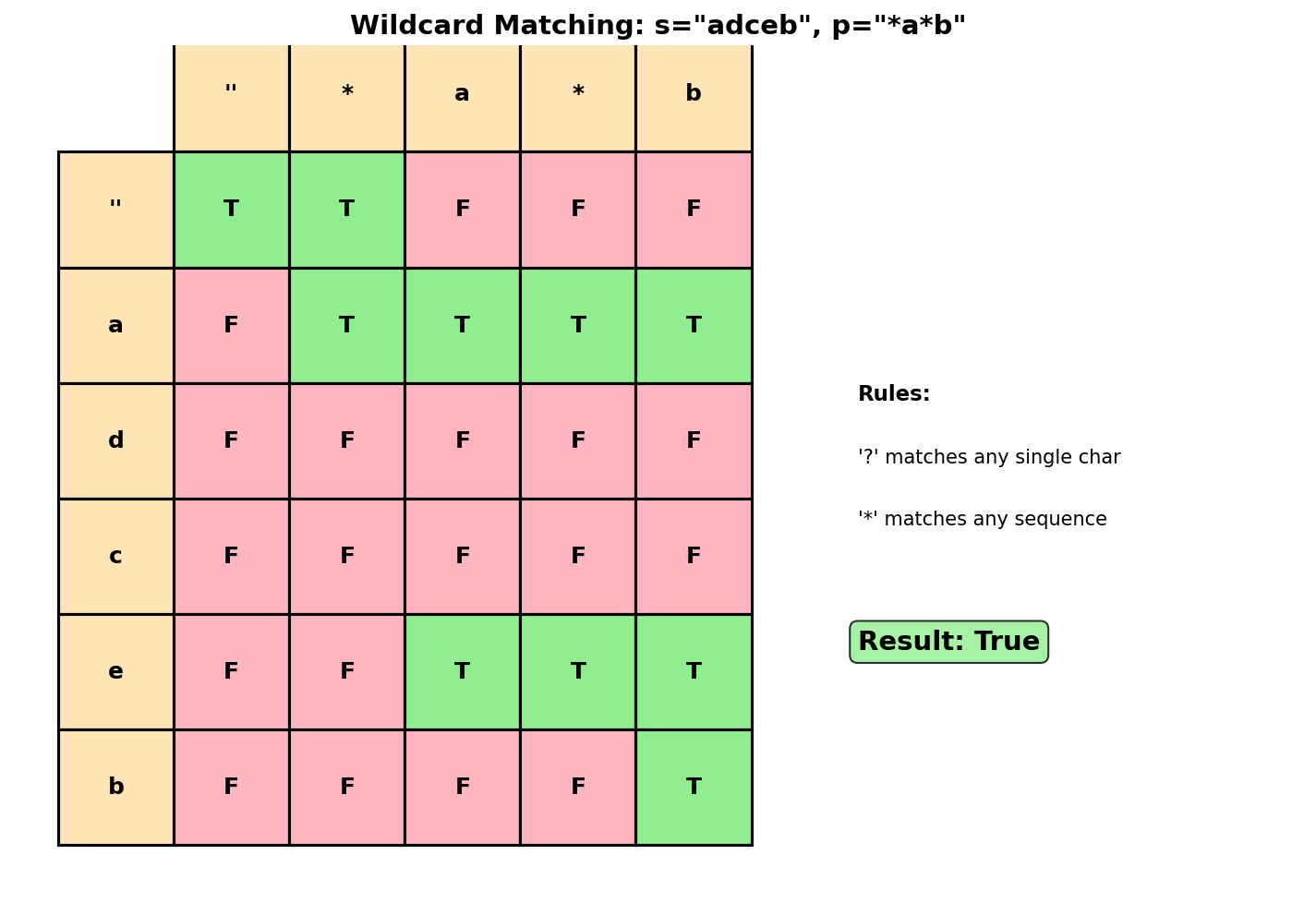
ASCII Art: Pattern Matching
s = "adceb", p = "*a*b"

DP Table: dp[i][j] = does s[0:i] match p[0:j]?

            ""   *    a    *    b
           p[0] p[1] p[2] p[3] p[4]
         +----+----+----+----+----+
 ""      | T  | T  | F  | F  | F  |
 s[0]    +----+----+----+----+----+
 a       | F  | T  | T  | T  | F  |
 s[1]    +----+----+----+----+----+
 d       | F  | T  | F  | T  | F  |
 s[2]    +----+----+----+----+----+
 c       | F  | T  | F  | T  | F  |
 s[3]    +----+----+----+----+----+
 e       | F  | T  | F  | T  | F  |
 s[4]    +----+----+----+----+----+
 b       | F  | T  | F  | T  | T  |
 s[5]    +----+----+----+----+----+

How '*' propagates:
- '*' can match empty: look at dp[i][j-1]
- '*' can match one more char: look at dp[i-1][j]

dp[5][4] = True -> Match!Difference from Regex Matching
Wildcard Matching:
- '*' matches ANY sequence independently
- Pattern: "*a*" means (any)(a)(any)

Regular Expression Matching:
- '*' modifies the PRECEDING character
- Pattern: ".*a.*" means (any repeated)(a)(any repeated)

Example:
- Wildcard "*" matches "abc"
- Regex ".*" matches "abc" (. repeated 3 times)

Wildcard is simpler because '*' doesn't depend on preceding char.Solution Code
Approach 1: Top-Down (Memoization)
from functools import lru_cache

def isMatch(s: str, p: str) -> bool:
    """
    Check wildcard match using memoization.

    Handle three cases:
    1. Regular character match
    2. '?' matches any single character
    3. '*' matches any sequence (including empty)

    Args:
        s: Input string
        p: Pattern

    Returns:
        True if entire string matches pattern

    Time Complexity: O(m * n)
    Space Complexity: O(m * n)
    """
    @lru_cache(maxsize=None)
    def dp(i: int, j: int) -> bool:
        """Check if s[i:] matches p[j:]."""
        # Both exhausted
        if j == len(p):
            return i == len(s)

        # Pattern has '*'
        if p[j] == '*':
            # '*' matches empty OR '*' matches one char and continues
            return dp(i, j + 1) or (i < len(s) and dp(i + 1, j))

        # Match single character
        if i < len(s) and (p[j] == '?' or p[j] == s[i]):
            return dp(i + 1, j + 1)

        return False

return dp(0, 0)Complexity: Time O(m * n) · Space O(m * n)
- Time: Each (i, j) pair is computed once due to memoization, where i is position in string (length m) and j is position in pattern (length n).
- Space: The cache stores O(m * n) states, plus recursion stack of O(m + n) for the deepest call path.
Approach 2: Bottom-Up (Tabulation)
def isMatch(s: str, p: str) -> bool:
    """
    Check wildcard match using bottom-up DP.

    Build solution from beginning of strings.

    Args:
        s: Input string
        p: Pattern

    Returns:
        True if entire string matches pattern

    Time Complexity: O(m * n)
    Space Complexity: O(m * n)
    """
    m, n = len(s), len(p)

    # dp[i][j] = True if s[0:i] matches p[0:j]
    dp = [[False] * (n + 1) for _ in range(m + 1)]
    dp[0][0] = True

    # Initialize: patterns starting with '*' can match empty string
    for j in range(1, n + 1):
        if p[j - 1] == '*':
            dp[0][j] = dp[0][j - 1]
        else:
            break  # Can't match empty string after non-'*'

    for i in range(1, m + 1):
        for j in range(1, n + 1):
            if p[j - 1] == '*':
                # '*' matches empty (dp[i][j-1]) OR
                # '*' matches current char (dp[i-1][j])
                dp[i][j] = dp[i][j - 1] or dp[i - 1][j]
            elif p[j - 1] == '?' or p[j - 1] == s[i - 1]:
                # Direct match
                dp[i][j] = dp[i - 1][j - 1]

return dp[m][n]public boolean isMatch(String s, String p) {
int m = s.length(), n = p.length();
// dp[i][j] = true if s[0:i] matches p[0:j]
boolean[][] dp = new boolean[m + 1][n + 1];
dp[0][0] = true;
// Initialize: patterns starting with '*' can match empty string
for (int j = 1; j <= n; j++) {
if (p.charAt(j - 1) == '*') {
dp[0][j] = dp[0][j - 1];
} else {
break; // Can't match empty string after non-'*'
}
}
for (int i = 1; i <= m; i++) {
for (int j = 1; j <= n; j++) {
if (p.charAt(j - 1) == '*') {
// '*' matches empty (dp[i][j-1]) OR
// '*' matches current char (dp[i-1][j])
dp[i][j] = dp[i][j - 1] || dp[i - 1][j];
} else if (p.charAt(j - 1) == '?' || p.charAt(j - 1) == s.charAt(i - 1)) {
// Direct match
dp[i][j] = dp[i - 1][j - 1];
}
}
}
return dp[m][n];
}Complexity: Time O(m * n) · Space O(m * n)
- Time: Two nested loops process all (m+1) * (n+1) cells with constant-time work per cell.
- Space: The 2D boolean table stores match results for all (string prefix, pattern prefix) combinations.
Approach 3: Space-Optimized
def isMatch(s: str, p: str) -> bool:
    """
    Check wildcard match with O(n) space.

    Only need current and previous row.

    Args:
        s: Input string
        p: Pattern

    Returns:
        True if entire string matches pattern

    Time Complexity: O(m * n)
    Space Complexity: O(n)
    """
    m, n = len(s), len(p)

    # Previous row
    prev = [False] * (n + 1)
    prev[0] = True

    for j in range(1, n + 1):
        if p[j - 1] == '*':
            prev[j] = prev[j - 1]
        else:
            break

    for i in range(1, m + 1):
        curr = [False] * (n + 1)

        for j in range(1, n + 1):
            if p[j - 1] == '*':
                curr[j] = curr[j - 1] or prev[j]
            elif p[j - 1] == '?' or p[j - 1] == s[i - 1]:
                curr[j] = prev[j - 1]

        prev = curr

return prev[n]Complexity: Time O(m * n) · Space O(n)
- Time: Same as Approach 2, iterating through all m rows and n columns.
- Space: Reduced to O(n) by keeping only two arrays (prev and curr) of size n+1 instead of the full 2D table.
Approach 4: Greedy with Backtracking (O(1) Extra Space)
def isMatch(s: str, p: str) -> bool:
    """
    Check wildcard match using greedy approach with backtracking.

    Track position of last '*' and retry from there if needed.

    Args:
        s: Input string
        p: Pattern

    Returns:
        True if entire string matches pattern

    Time Complexity: O(m * n) worst case, often better
    Space Complexity: O(1)
    """
    m, n = len(s), len(p)
    i = j = 0
    star_idx = -1  # Position of last '*' in pattern
    match_idx = 0  # Position in s when we saw last '*'

    while i < m:
        # Current characters match
        if j < n and (p[j] == '?' or p[j] == s[i]):
            i += 1
            j += 1
        # '*' found - record and skip
        elif j < n and p[j] == '*':
            star_idx = j
            match_idx = i
            j += 1
        # No match, but we have a previous '*' to backtrack to
        elif star_idx != -1:
            j = star_idx + 1
            match_idx += 1
            i = match_idx
        # No match and no '*' to help
        else:
            return False

    # Check remaining pattern (should be all '*')
    while j < n and p[j] == '*':
        j += 1

return j == nComplexity: Time O(m * n) worst case · Space O(1)
- Time: In the worst case (e.g., pattern "*a" and string "aaaa...b"), backtracking can revisit positions, but each character pair is processed at most O(m) times overall.
- Space: Only four integer variables (i, j, star_idx, match_idx) are used regardless of input size.
Complexity Analysis
| Approach | Time Complexity | Space Complexity |
|---|---|---|
| Top-Down | O(m * n) | O(m * n) |
| Bottom-Up | O(m * n) | O(m * n) |
| Space-Optimized | O(m * n) | O(n) |
| Greedy | O(m * n) worst | O(1) |
Where m = len(s), n = len(p).
Edge Cases
Empty strings:
pythonisMatch("", "") # True isMatch("", "*") # True isMatch("", "?") # False isMatch("a", "") # FalseOnly stars:
pythonisMatch("abc", "***") # True isMatch("", "***") # TrueOnly question marks:
pythonisMatch("abc", "???") # True isMatch("ab", "???") # FalseMixed:
pythonisMatch("abcd", "*?*?*") # True (flexible matching) isMatch("a", "*?*") # TrueLong string of stars:
pythonisMatch("a", "*" * 1000 + "a") # True (but can be slow without optimization)
Understanding '*' Behavior
'*' can match ANY sequence, including empty.

For pattern "*a*b":
- First '*' can match: "", "x", "xy", "xyz", ...
- Then 'a' must match exactly 'a'
- Second '*' can match anything
- Then 'b' must match exactly 'b'

Example: s = "xyzaAAAbBBb"
First '*' matches "xyz"
'a' matches 'a'
Second '*' matches "AAAbBB"
'b' matches 'b'
Result: True

The DP handles this by:
- dp[i][j-1]: '*' matches empty (move past '*' in pattern)
- dp[i-1][j]: '*' matches current char (consume char, stay at '*')Key Insights
'*' is Independent: Unlike regex, '*' doesn't depend on preceding character.
Two Choices for '*':
- Match empty: skip to next pattern char
- Match current string char: consume char, stay at '*'
'?' is Simple: Just matches any single character.
Greedy Approach: Track last '*' position for backtracking. Often faster in practice.
State Definition:
dp[i][j]= whethers[0:i]matchesp[0:j].
Comparison: Wildcard vs Regex
| Feature | Wildcard | Regex |
|---|---|---|
* meaning | Any sequence | Zero+ of preceding |
? meaning | Any single char | Not used (. instead) |
. meaning | Literal dot | Any single char |
| Complexity | Simpler | More expressive |
Related Problems
Regular Expression Matching (LeetCode 10)
Problem: Match with . (any char) and * (zero or more of preceding element).
Key Insight: More complex because * depends on preceding character. Must handle x* as a unit.
Approach: For regex x*: dp[i][j] = dp[i][j-2] (zero x) OR dp[i-1][j] if x matches s[i] (one+ x). The preceding character matters.
Complexity: O(m * n) time, O(n) space
Longest Common Subsequence (LeetCode 1143)
Problem: Find length of longest subsequence present in both strings.
Key Insight: Similar 2D DP table structure, but maximizing length instead of boolean match.
Approach: dp[i][j] = dp[i-1][j-1] + 1 if chars match, else max(dp[i-1][j], dp[i][j-1]).
Complexity: O(m * n) time, O(min(m,n)) space
Edit Distance (LeetCode 72)
Problem: Minimum operations (insert, delete, replace) to transform one string to another.
Key Insight: Same 2D DP on string prefixes. Three choices when characters don't match.
Approach: dp[i][j] = dp[i-1][j-1] if match, else 1 + min(dp[i-1][j], dp[i][j-1], dp[i-1][j-1]).
Complexity: O(m * n) time, O(min(m,n)) space
Interleaving String (LeetCode 97)
Problem: Check if s3 is formed by interleaving s1 and s2.
Key Insight: 2D DP where state tracks position in both source strings. s3 position is determined by i+j.
Approach: dp[i][j] = (dp[i-1][j] and s1[i-1]==s3[i+j-1]) or (dp[i][j-1] and s2[j-1]==s3[i+j-1]).
Complexity: O(m * n) time, O(n) space