Reorder Operations
Rearranging linked list nodes in specific patterns
Overview
Reorder operations involve rearranging nodes in a linked list according to specific rules. The classic "reorder list" problem combines multiple techniques: finding the middle, reversing, and merging.
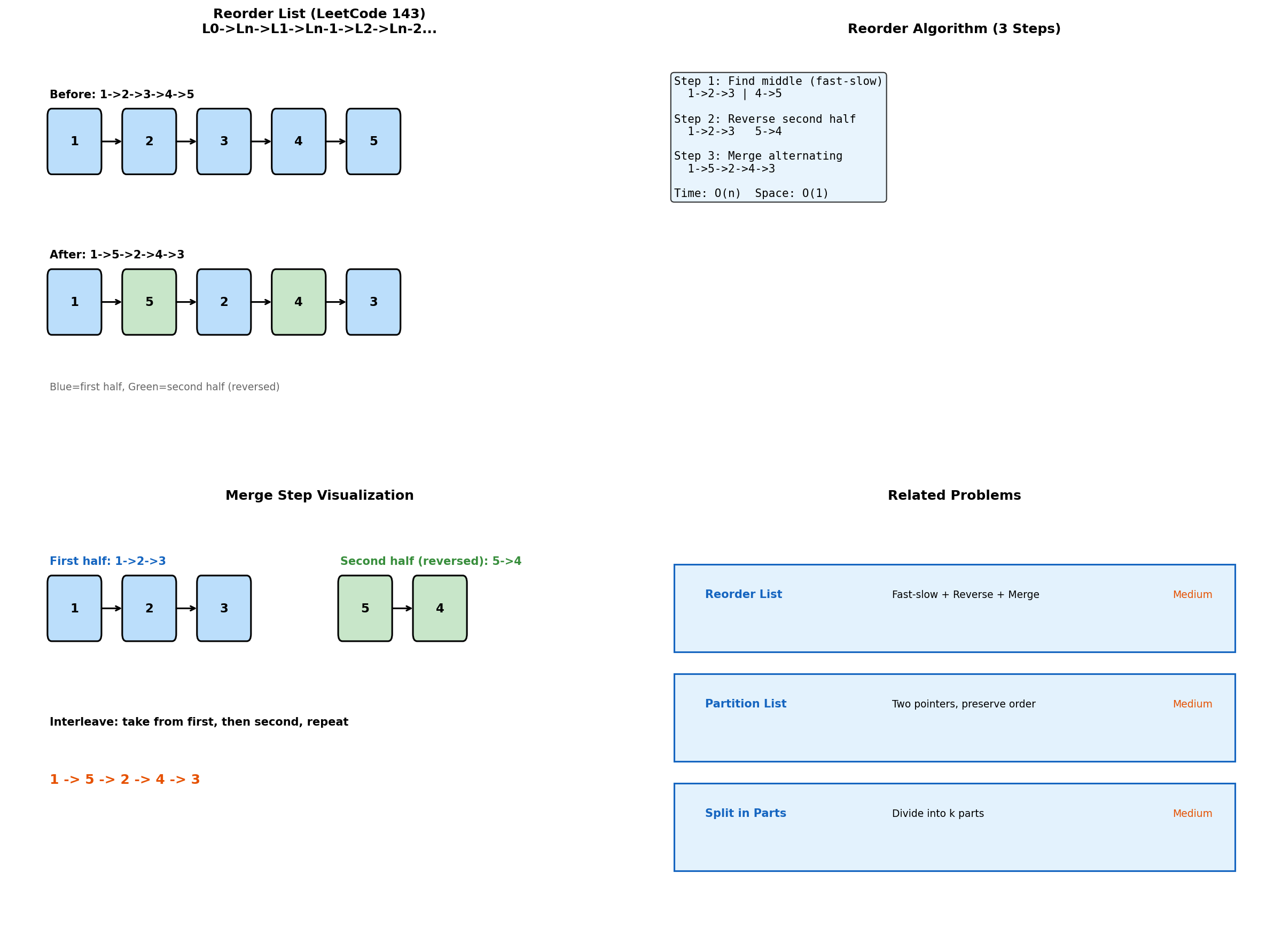
Reorder List (LeetCode #143)
Problem Statement
Given a singly linked list: L0 -> L1 -> ... -> Ln-1 -> Ln Reorder it to: L0 -> Ln -> L1 -> Ln-1 -> L2 -> Ln-2 -> ...
Example
Input:  1 -> 2 -> 3 -> 4 -> 5
Output: 1 -> 5 -> 2 -> 4 -> 3

Pattern: first, last, second, second-last, ...Solution
def reorderList(head: ListNode) -> None:
    """
    Three-step algorithm:
    1. Find middle using fast-slow pointers
    2. Reverse second half
    3. Merge two halves alternately

    Time: O(n), Space: O(1)
    """
    if not head or not head.next:
        return

    # Step 1: Find middle
    slow, fast = head, head
    while fast.next and fast.next.next:
        slow = slow.next
        fast = fast.next.next

    # Step 2: Reverse second half
    second = slow.next
    slow.next = None  # Split the list
    prev = None
    while second:
        next_temp = second.next
        second.next = prev
        prev = second
        second = next_temp
    second = prev  # New head of reversed second half

    # Step 3: Merge alternately
    first = head
    while second:
        # Save next pointers
        first_next = first.next
        second_next = second.next

        # Interleave
        first.next = second
        second.next = first_next

        # Advance
        first = first_next
second = second_nextpublic void reorderList(ListNode head) {
if (head == null || head.next == null) return;
// Step 1: Find middle
ListNode slow = head, fast = head;
while (fast.next != null && fast.next.next != null) {
slow = slow.next;
fast = fast.next.next;
}
// Step 2: Reverse second half
ListNode second = slow.next;
slow.next = null;
ListNode prev = null;
while (second != null) {
ListNode nextTemp = second.next;
second.next = prev;
prev = second;
second = nextTemp;
}
second = prev;
// Step 3: Merge alternately
ListNode first = head;
while (second != null) {
ListNode firstNext = first.next;
ListNode secondNext = second.next;
first.next = second;
second.next = firstNext;
first = firstNext;
second = secondNext;
}
}Complexity: Time O(n) · Space O(1)
- Time: O(n) because we traverse the list three times: find middle, reverse second half, merge alternating
- Space: O(1) because all operations are done in-place with only pointer manipulation
Step-by-Step Visualization
Original: 1 -> 2 -> 3 -> 4 -> 5

Step 1: Find middle
slow at 3, fast at 5
Split: [1 -> 2 -> 3] and [4 -> 5]

Step 2: Reverse second half
[4 -> 5] becomes [5 -> 4]

Step 3: Merge
first: 1 -> 2 -> 3
second: 5 -> 4

Merge step by step:
- 1 -> 5 -> (2 -> 3)
- 1 -> 5 -> 2 -> 4 -> (3)
- 1 -> 5 -> 2 -> 4 -> 3

Result: 1 -> 5 -> 2 -> 4 -> 3Partition List (LeetCode #86)
Problem Statement
Given a linked list and a value x, partition it such that all nodes less than x come before nodes greater than or equal to x. Preserve original relative order.
Solution
def partition(head: ListNode, x: int) -> ListNode:
    """
    Create two separate lists and connect them.
    Time: O(n), Space: O(1)
    """
    # Dummy heads for two partitions
    less_head = ListNode(0)
    greater_head = ListNode(0)
    less = less_head
    greater = greater_head

    current = head
    while current:
        if current.val < x:
            less.next = current
            less = less.next
        else:
            greater.next = current
            greater = greater.next
        current = current.next

    # Connect partitions
    greater.next = None  # Terminate greater list
    less.next = greater_head.next

return less_head.nextpublic ListNode partition(ListNode head, int x) {
ListNode lessHead = new ListNode(0);
ListNode greaterHead = new ListNode(0);
ListNode less = lessHead, greater = greaterHead;
ListNode current = head;
while (current != null) {
if (current.val < x) {
less.next = current;
less = less.next;
} else {
greater.next = current;
greater = greater.next;
}
current = current.next;
}
greater.next = null;
less.next = greaterHead.next;
return lessHead.next;
}Complexity: Time O(n) · Space O(1)
- Time: O(n) because we traverse the list once, distributing nodes to two partitions
- Space: O(1) because we use dummy nodes and pointers to rearrange existing nodes in-place
Example
Input: 1 -> 4 -> 3 -> 2 -> 5 -> 2, x = 3
Output: 1 -> 2 -> 2 -> 4 -> 3 -> 5

Partition:
- less than 3: 1 -> 2 -> 2
- >= 3: 4 -> 3 -> 5
- Connect: 1 -> 2 -> 2 -> 4 -> 3 -> 5Sort List by Parity
Problem Statement
Rearrange so all odd values come before even values.
def sortByParity(head: ListNode) -> ListNode:
    """
    Separate odd and even values, then connect.
    """
    odd_head = ListNode(0)
    even_head = ListNode(0)
    odd = odd_head
    even = even_head

    current = head
    while current:
        if current.val % 2 == 1:  # Odd
            odd.next = current
            odd = odd.next
        else:  # Even
            even.next = current
            even = even.next
        current = current.next

    # Connect
    even.next = None
    odd.next = even_head.next

return odd_head.nextComplexity: Time O(n) · Space O(1)
- Time: O(n) because we traverse the list once, separating odd and even valued nodes
- Space: O(1) because we only use dummy heads and pointers, rearranging nodes in-place
Rearrange by Position (Odd-Even Positions)
Problem (LeetCode #328)
Group nodes by their position: all odd-positioned nodes before even-positioned.
def oddEvenList(head: ListNode) -> ListNode:
    """
    Group odd-indexed then even-indexed nodes.
    Index starts from 1.
    """
    if not head or not head.next:
        return head

    odd = head
    even = head.next
    even_head = even

    while even and even.next:
        odd.next = even.next
        odd = odd.next
        even.next = odd.next
        even = even.next

    odd.next = even_head
return headpublic ListNode oddEvenList(ListNode head) {
if (head == null || head.next == null) return head;
ListNode odd = head, even = head.next, evenHead = even;
while (even != null && even.next != null) {
odd.next = even.next;
odd = odd.next;
even.next = odd.next;
even = even.next;
}
odd.next = evenHead;
return head;
}Complexity: Time O(n) · Space O(1)
- Time: O(n) because we traverse the list once, weaving through odd and even positions
- Space: O(1) because we only use pointers (odd, even, even_head) to rearrange in-place
Split Linked List in Parts (LeetCode #725)
Problem Statement
Split a linked list into k parts with sizes as equal as possible.
def splitListToParts(head: ListNode, k: int) -> List[ListNode]:
    """
    Calculate part sizes, split accordingly.
    Earlier parts get extra nodes if not evenly divisible.
    """
    # Find length
    length = 0
    current = head
    while current:
        length += 1
        current = current.next

    # Calculate sizes
    base_size = length // k
    extra = length % k

    result = []
    current = head

    for i in range(k):
        result.append(current)
        size = base_size + (1 if i < extra else 0)

        # Move to end of this part
        for _ in range(size - 1):
            if current:
                current = current.next

        # Cut the list
        if current:
            next_head = current.next
            current.next = None
            current = next_head

return resultpublic ListNode[] splitListToParts(ListNode head, int k) {
int length = 0;
ListNode current = head;
while (current != null) { length++; current = current.next; }
int baseSize = length / k, extra = length % k;
ListNode[] result = new ListNode[k];
current = head;
for (int i = 0; i < k; i++) {
result[i] = current;
int size = baseSize + (i < extra ? 1 : 0);
for (int j = 0; j < size - 1; j++) {
if (current != null) current = current.next;
}
if (current != null) {
ListNode nextHead = current.next;
current.next = null;
current = nextHead;
}
}
return result;
}Complexity: Time O(n) · Space O(k)
- Time: O(n) because we traverse the list twice: once for length, once to split into k parts
- Space: O(k) for the result array containing k list heads (nodes themselves are reused)
Interleave Two Lists
Problem Statement
Interleave nodes from two lists alternately.
def interleave(l1: ListNode, l2: ListNode) -> ListNode:
    """
    Create list: l1[0] -> l2[0] -> l1[1] -> l2[1] -> ...
    """
    dummy = ListNode(0)
    current = dummy
    turn = True  # True = l1's turn

    while l1 or l2:
        if turn and l1:
            current.next = l1
            l1 = l1.next
            current = current.next
        elif not turn and l2:
            current.next = l2
            l2 = l2.next
            current = current.next
        elif l1:
            current.next = l1
            break
        elif l2:
            current.next = l2
            break

        turn = not turn

return dummy.nextComplexity: Time O(m + n) · Space O(1)
- Time: O(m + n) because we traverse both lists once, interleaving their nodes
- Space: O(1) because we use a dummy node and pointers to create the interleaved result
Common Patterns
Split Pattern
def split_pattern(head, condition):
    list1_head = ListNode(0)
    list2_head = ListNode(0)
    tail1, tail2 = list1_head, list2_head

    while head:
        if condition(head):
            tail1.next = head
            tail1 = tail1.next
        else:
            tail2.next = head
            tail2 = tail2.next
        head = head.next

    tail1.next = None
    tail2.next = None

return list1_head.next, list2_head.nextMerge Alternating Pattern
def merge_alternating(l1, l2):
    while l1 and l2:
        l1_next, l2_next = l1.next, l2.next
        l1.next = l2
        l2.next = l1_next
l1, l2 = l1_next, l2_nextComplexity Summary
| Problem | Time | Space |
|---|---|---|
| Reorder List | O(n) | O(1) |
| Partition List | O(n) | O(1) |
| Odd-Even List | O(n) | O(1) |
| Split in Parts | O(n) | O(k) for result |
Edge Cases
- Empty list: Return None or empty result
- Single node: Return as-is
- Two nodes: Simple swap (for reorder)
- All same partition: One list empty
- k > length: Some parts will be null
Related Problems
Reorder List (LeetCode 143)
Problem: Reorder L0->L1->...->Ln to L0->Ln->L1->Ln-1->L2->Ln-2->...
Key Insight: Three classic operations combined: find middle, reverse, merge alternating.
Approach: Fast-slow to find middle, in-place reversal of second half, interleave nodes.
Complexity: O(n) time, O(1) space
Partition List (LeetCode 86)
Problem: Partition list around value x: all nodes < x before nodes >= x, preserving order.
Key Insight: Build two separate lists, then concatenate. Simpler than in-place partitioning.
Approach: Two dummy heads for less and greater lists. Iterate appending to appropriate list. Connect and null-terminate.
Complexity: O(n) time, O(1) space
Odd Even Linked List (LeetCode 328)
Problem: Group odd-indexed nodes together followed by even-indexed nodes (1-indexed).
Key Insight: Build odd and even chains simultaneously by skipping nodes.
Approach: Maintain odd and even pointers. Weave through: odd.next = even.next, advance odd, even.next = odd.next, advance even.
Complexity: O(n) time, O(1) space
Split Linked List in Parts (LeetCode 725)
Problem: Split list into k parts with sizes as equal as possible (earlier parts larger).
Key Insight: Base size is n/k, first n%k parts get one extra node.
Approach: Calculate length, determine base size and extras. Iterate cutting at each part boundary.
Complexity: O(n) time, O(k) space for result
Sort List (LeetCode 148)
Problem: Sort a linked list in O(n log n) time using constant space.
Key Insight: Merge sort is ideal for linked lists - natural splitting and merging.
Approach: Find middle with fast-slow, recursively sort halves, merge sorted lists.
Complexity: O(n log n) time, O(log n) space for recursion
Interview Tips
- For reorder: Draw the transformation step by step
- Remember the three steps: Middle, Reverse, Merge
- For partition: Always null-terminate both lists
- Handle edge cases: Empty, single node, all in one partition
- Mention in-place: Most solutions should use O(1) extra space