Min Stack
LeetCode 155 | Difficulty: Medium | Pattern: Auxiliary Stack
Problem Statement
Design a stack that supports push, pop, top, and retrieving the minimum element in constant time.
Implement the MinStack class:
MinStack()initializes the stack objectvoid push(int val)pushes the element val onto the stackvoid pop()removes the element on the top of the stackint top()gets the top element of the stackint getMin()retrieves the minimum element in the stack
You must implement a solution with O(1) time complexity for each function.
Examples
Example 1:
Input:
["MinStack","push","push","push","getMin","pop","top","getMin"]
[[],[-2],[0],[-3],[],[],[],[]]

Output: [null,null,null,null,-3,null,0,-2]

Explanation:
MinStack minStack = new MinStack();
minStack.push(-2);
minStack.push(0);
minStack.push(-3);
minStack.getMin(); // return -3
minStack.pop();
minStack.top();    // return 0
minStack.getMin(); // return -2Constraints
-2^31 <= val <= 2^31 - 1- Methods
pop,topandgetMinoperations will always be called on non-empty stacks - At most
3 * 10^4calls will be made topush,pop,top, andgetMin
Intuition
The challenge is tracking the minimum efficiently. A naive approach would scan the stack on every getMin() call - O(n). Instead, we track the minimum at each "level" of the stack.
Key Insight: The minimum can only change when we push or pop. By storing the current minimum with each element (or in a separate stack), we always know the minimum in O(1).
Stack State Visualization
Operations: push(-2), push(0), push(-3), pop()

Push -2:
  Main Stack:  [-2]
  Min Stack:   [-2]    <- -2 is minimum

Push 0:
  Main Stack:  [-2, 0]
  Min Stack:   [-2]    <- -2 still minimum (0 > -2)

Push -3:
  Main Stack:  [-2, 0, -3]
  Min Stack:   [-2, -3]  <- -3 is new minimum

getMin() -> -3

Pop:
  Main Stack:  [-2, 0]
  Min Stack:   [-2]    <- -3 removed, -2 is minimum again

getMin() -> -2Solution 1: Two Stack Approach
class MinStack:
    """
    Track minimum using auxiliary stack.

    min_stack only grows when we see a new minimum.
    """

    def __init__(self):
        self.stack = []
        self.min_stack = []

    def push(self, val: int) -> None:
        """O(1) - Push to main stack, update min_stack if needed"""
        self.stack.append(val)
        # Push to min_stack if it's empty OR val is new minimum
        if not self.min_stack or val <= self.min_stack[-1]:
            self.min_stack.append(val)

    def pop(self) -> None:
        """O(1) - Pop from main stack, update min_stack if needed"""
        if self.stack.pop() == self.min_stack[-1]:
            self.min_stack.pop()

    def top(self) -> int:
        """O(1) - Return top of main stack"""
        return self.stack[-1]

    def getMin(self) -> int:
        """O(1) - Return top of min_stack"""
return self.min_stack[-1]class MinStack {
private Deque<Integer> stack;
private Deque<Integer> minStack;
public MinStack() {
stack = new ArrayDeque<>();
minStack = new ArrayDeque<>();
}
public void push(int val) {
stack.push(val);
if (minStack.isEmpty() || val <= minStack.peek()) {
minStack.push(val);
}
}
public void pop() {
int popped = stack.pop();
if (popped == minStack.peek()) {
minStack.pop();
}
}
public int top() {
return stack.peek();
}
public int getMin() {
return minStack.peek();
}
}Complexity: Time O(1) per operation · Space O(n)
- Time: All operations (push, pop, top, getMin) are single array access or append/pop operations, each O(1)
- Space: Main stack uses O(n); min_stack uses O(k) where k is the number of times a new minimum was pushed (worst case O(n) for decreasing sequence)
Why <= Not <?
Using <= handles duplicates correctly:
push(1), push(1), pop()
With <=: min_stack = [1, 1] -> [1] after pop, correct!
With <: min_stack = [1] -> [] after pop, WRONG!Solution 2: Stack of Pairs
class MinStack:
    """
    Store (value, current_minimum) pairs.

    Pros: Simpler logic
    Cons: More space (stores min with every element)
    """

    def __init__(self):
        self.stack = []  # Each element: (val, current_min)

    def push(self, val: int) -> None:
        """O(1)"""
        if not self.stack:
            self.stack.append((val, val))
        else:
            current_min = min(val, self.stack[-1][1])
            self.stack.append((val, current_min))

    def pop(self) -> None:
        """O(1)"""
        self.stack.pop()

    def top(self) -> int:
        """O(1)"""
        return self.stack[-1][0]

    def getMin(self) -> int:
        """O(1)"""
return self.stack[-1][1]Complexity: Time O(1) per operation · Space O(2n)
- Time: All operations involve single tuple access or min comparison, each O(1)
- Space: Each element stores a tuple of (value, current_min), doubling storage to O(2n) compared to a simple stack
Solution 3: Single Stack with Encoding
class MinStack:
    """
    Space-optimized: Store difference from minimum.

    When val < min: store (val - min) which is negative
    This negative value signals that val was a new minimum.

    Pros: O(1) extra space for min tracking
    Cons: Complex logic, potential integer overflow
    """

    def __init__(self):
        self.stack = []
        self.min_val = float('inf')

    def push(self, val: int) -> None:
        """O(1)"""
        if not self.stack:
            self.stack.append(0)  # Difference from itself
            self.min_val = val
        else:
            diff = val - self.min_val
            self.stack.append(diff)
            if val < self.min_val:
                self.min_val = val

    def pop(self) -> None:
        """O(1)"""
        diff = self.stack.pop()
        if diff < 0:
            # This was the minimum, restore previous min
            self.min_val = self.min_val - diff

        if not self.stack:
            self.min_val = float('inf')

    def top(self) -> int:
        """O(1)"""
        diff = self.stack[-1]
        if diff < 0:
            return self.min_val  # This element was the minimum
        return diff + self.min_val

    def getMin(self) -> int:
        """O(1)"""
return self.min_valComplexity: Time O(1) per operation · Space O(n) + O(1) for min tracking
- Time: All operations are arithmetic or single array access, each O(1)
- Space: Stack stores n difference values; only a single variable tracks the minimum, making min tracking O(1) extra space
How Encoding Works
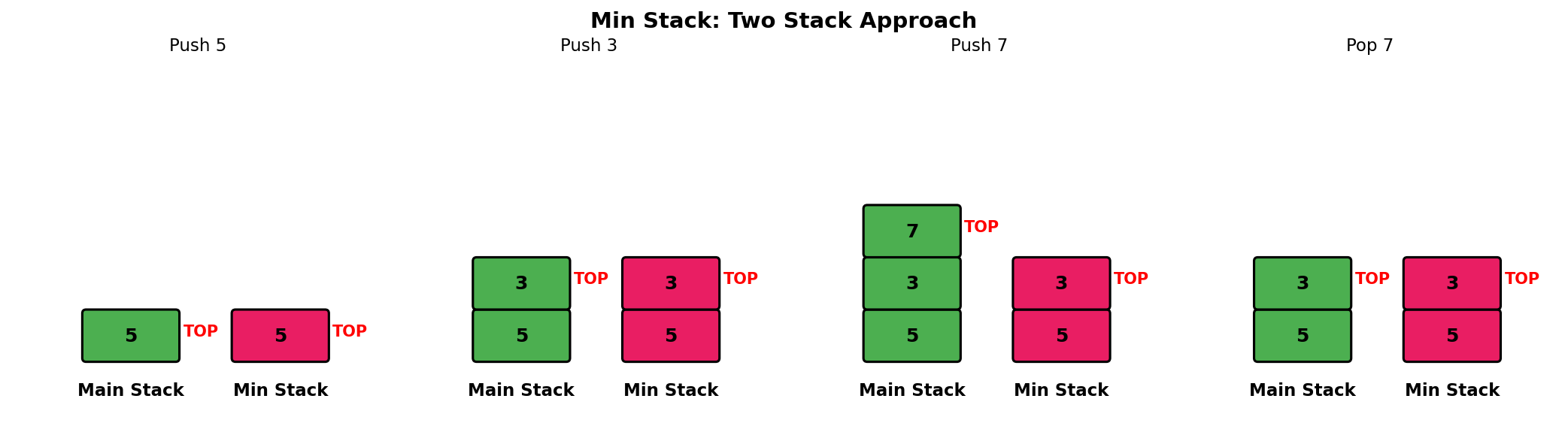
Push 5: min = 5, stack = [0]        (5-5=0)
Push 3: min = 3, stack = [0, -2]    (3-5=-2, negative!)
Push 7: min = 3, stack = [0, -2, 4] (7-3=4)

Pop 7: diff=4 >= 0, actual = 4+3=7
Pop 3: diff=-2 < 0, actual = min=3, restore min = 3-(-2)=5Algorithm Comparison
| Approach | Push | Pop | Top | getMin | Space |
|---|---|---|---|---|---|
| Two Stacks | O(1) | O(1) | O(1) | O(1) | O(n) |
| Stack of Pairs | O(1) | O(1) | O(1) | O(1) | O(2n) |
| Encoding | O(1) | O(1) | O(1) | O(1) | O(n) + O(1) |
Recommendation: Two Stack approach - good balance of simplicity and efficiency.
Step-by-Step Walkthrough
Operations: push(-2), push(0), push(-3), getMin(), pop(), getMin()

push(-2):
  stack = [-2]
  min_stack = [-2]  (empty, so push)

push(0):
  stack = [-2, 0]
  min_stack = [-2]  (0 > -2, don't push)

push(-3):
  stack = [-2, 0, -3]
  min_stack = [-2, -3]  (-3 <= -2, push)

getMin():
  return min_stack[-1] = -3

pop():
  popped = -3
  stack = [-2, 0]
  -3 == min_stack[-1], so pop min_stack too
  min_stack = [-2]

getMin():
return min_stack[-1] = -2Complexity Analysis
| Operation | Time | Space | Notes |
|---|---|---|---|
push | O(1) | - | Constant time append |
pop | O(1) | - | Constant time pop |
top | O(1) | - | Array index access |
getMin | O(1) | - | Array index access |
Overall Space: O(n) for main stack + O(k) for min_stack where k is number of times minimum decreased.
Worst case for min_stack: O(n) when elements are in decreasing order (e.g., [5, 4, 3, 2, 1]).
Edge Cases
def test_min_stack():
    ms = MinStack()

    # Single element
    ms.push(5)
    assert ms.getMin() == 5
    assert ms.top() == 5

    # Duplicate minimums
    ms = MinStack()
    ms.push(1)
    ms.push(1)
    ms.push(1)
    ms.pop()
    assert ms.getMin() == 1  # Still works

    # Decreasing sequence
    ms = MinStack()
    ms.push(3)
    ms.push(2)
    ms.push(1)
    assert ms.getMin() == 1
    ms.pop()
    assert ms.getMin() == 2

    # Large values
    ms = MinStack()
    ms.push(2**31 - 1)
    ms.push(-2**31)
assert ms.getMin() == -2**31Common Variations
1. Max Stack (LeetCode 716)
class MaxStack:
    """Support peekMax() and popMax() in addition to regular operations."""

    def __init__(self):
        from sortedcontainers import SortedList
        self.stack = []
        self.sorted_vals = SortedList()  # For O(log n) max operations
        self.id = 0

    # popMax is tricky - need to find and remove from middle of stack
# Use soft delete or sorted container with lazy removal2. Min Queue
from collections import deque

class MinQueue:
    """Queue with O(1) getMin using monotonic deque."""

    def __init__(self):
        self.queue = deque()
        self.min_deque = deque()  # Monotonic increasing

    def enqueue(self, val):
        self.queue.append(val)
        while self.min_deque and self.min_deque[-1] > val:
            self.min_deque.pop()
        self.min_deque.append(val)

    def dequeue(self):
        val = self.queue.popleft()
        if val == self.min_deque[0]:
            self.min_deque.popleft()
        return val

    def getMin(self):
return self.min_deque[0]Interview Tips
What Interviewers Look For
- O(1) all operations: Must achieve constant time
- Space trade-offs: Discuss different approaches
- Edge cases: Handle duplicates, empty stack
Common Follow-up Questions
"What if we also need getMax()?"
- Add another auxiliary stack for maximum
- Or use stack of tuples: (val, min, max)
"Can you optimize space?"
- Encoding approach uses O(1) extra for min tracking
- But has overflow risks and complex logic
"What about a Min Queue?"
- Use monotonic deque (discussed above)
- Sliding window maximum/minimum uses this
"How would you handle concurrent access?"
- Lock-based: mutex around all operations
- Lock-free: atomic operations, more complex
Related Problems
Max Stack (LeetCode 716)
Problem: Design a stack that supports push, pop, top, peekMax, and popMax operations.
Key Insight: popMax() is tricky - need to find and remove from middle of stack. Use soft deletion or sorted container.
Approach: Use stack + sorted container (TreeMap/SortedList) + lazy deletion with unique IDs for each element.
Complexity: O(log n) for push/pop/peekMax/popMax
Sliding Window Maximum (LeetCode 239)
Problem: Given array and window size k, return max element in each sliding window position.
Key Insight: Monotonic decreasing deque - front is always the max. Remove elements outside window and smaller elements.
Approach: Deque stores indices in decreasing order of values. Popleft when outside window, pop when smaller than current.
Complexity: O(n) time, O(k) space
Online Stock Span (LeetCode 901)
Problem: Design class that returns span (consecutive days with price <= today) for each new price.
Key Insight: Previous greater element problem. Monotonic decreasing stack accumulates spans of popped elements.
Approach: Stack stores (price, span). Pop prices <= current, sum their spans + 1.
Complexity: O(1) amortized time per call, O(n) space total
Daily Temperatures (LeetCode 739)
Problem: Given daily temperatures, return array where answer[i] = days until warmer temperature.
Key Insight: Next greater element pattern. Monotonic decreasing stack of indices, calculate index difference.
Approach: Stack stores indices. When current temp > stack top, pop and record day difference.
Complexity: O(n) time, O(n) space