First Unique Character in a String
Problem Statement
Given a string s, find the first non-repeating character in it and return its index. If it does not exist, return -1.
LeetCode: 387. First Unique Character in a String
Examples
Example 1:
Input: s = "leetcode"
Output: 0
Explanation: The character 'l' at index 0 is the first non-repeating character.Example 2:
Input: s = "loveleetcode"
Output: 2
Explanation: The character 'v' at index 2 is the first non-repeating character.Example 3:
Input: s = "aabb"
Output: -1
Explanation: All characters repeat.Constraints
1 <= s.length <= 10^5sconsists of only lowercase English letters.
Hash Map Approach
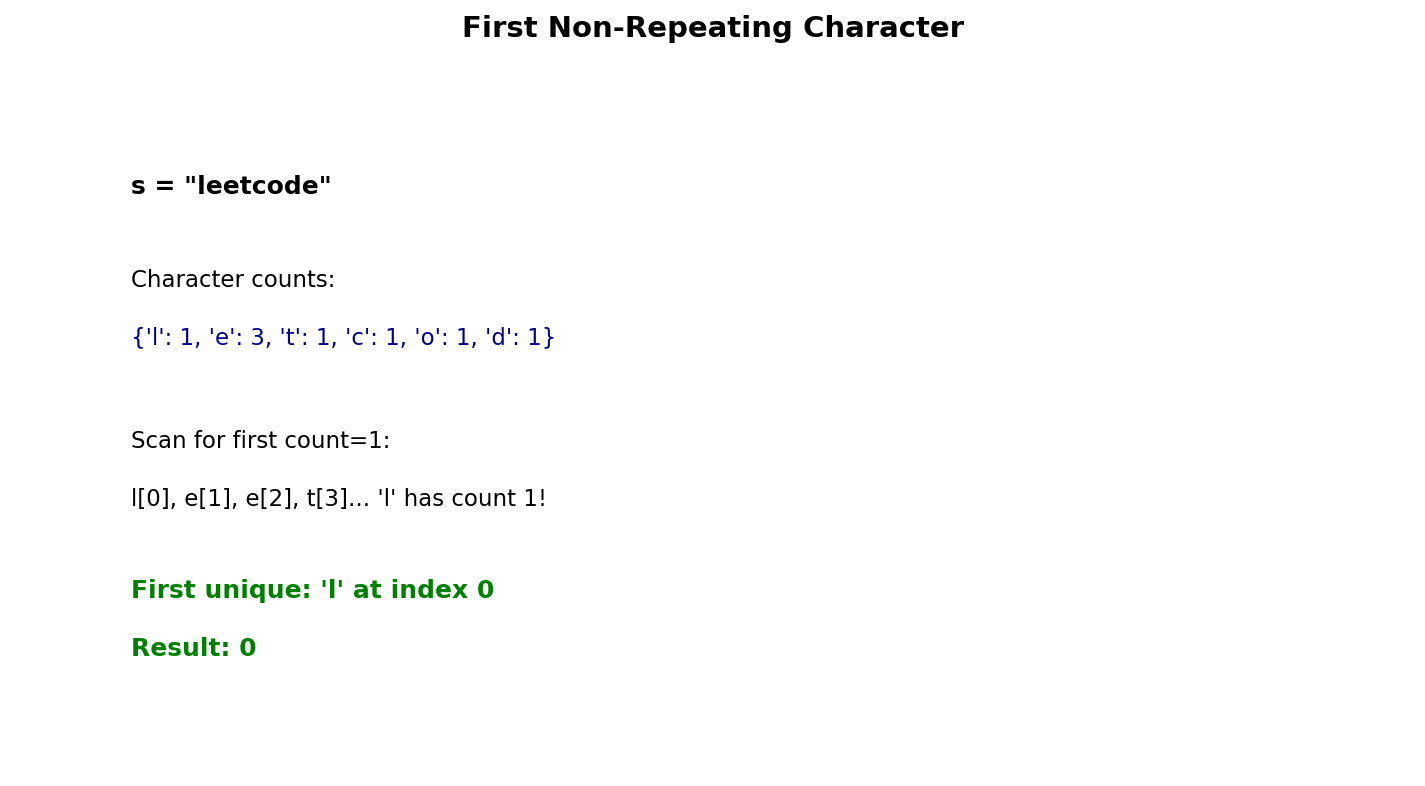
Key Insight
- First pass: Count frequency of each character
- Second pass: Find first character with count = 1
Algorithm
- Build a frequency map of all characters
- Iterate through string again
- Return index of first character with frequency 1
- If no such character exists, return -1
Solution
from collections import Counter

def firstUniqChar(s: str) -> int:
    """
    Find index of first non-repeating character.

    Time: O(n) - two passes through string
    Space: O(1) - at most 26 characters
    """
    # Count character frequencies
    count = Counter(s)

    # Find first unique character
    for i, char in enumerate(s):
        if count[char] == 1:
            return i

return -1import java.util.*;
class Solution {
public int firstUniqChar(String s) {
int[] count = new int[26];
for (char c : s.toCharArray()) count[c - 'a']++;
for (int i = 0; i < s.length(); i++) {
if (count[s.charAt(i) - 'a'] == 1) return i;
}
return -1;
}
}Complexity: Time O(n) · Space O(1)
- Time: O(n) for two passes through the string - first to count frequencies, second to find first unique character
- Space: O(1) because at most 26 lowercase English letters can be stored in the hash map
# Manual counting approach
def firstUniqCharManual(s: str) -> int:
    """Without using Counter."""
    count = {}

    # First pass: count frequencies
    for char in s:
        count[char] = count.get(char, 0) + 1

    # Second pass: find first unique
    for i, char in enumerate(s):
        if count[char] == 1:
            return i

    return -1


# Array-based approach (faster for lowercase letters)
def firstUniqCharArray(s: str) -> int:
    """
    Use fixed array for lowercase letters.

    Time: O(n)
    Space: O(1) - always 26 elements
    """
    count = [0] * 26

    for char in s:
        count[ord(char) - ord('a')] += 1

    for i, char in enumerate(s):
        if count[ord(char) - ord('a')] == 1:
            return i

return -1Complexity: Time O(n) · Space O(1)
- Time: Two passes through the string (count frequencies, then find first unique) with O(1) array access per character
- Space: Fixed 26-element array regardless of input size (constant for ASCII charset)
Alternative: Single Pass with Index Tracking
def firstUniqCharSinglePass(s: str) -> int:
    """
    Track first occurrence index for each character.

    Time: O(n)
    Space: O(1)
    """
    # Store (count, first_index) for each character
    char_info = {}

    for i, char in enumerate(s):
        if char in char_info:
            char_info[char] = (char_info[char][0] + 1, char_info[char][1])
        else:
            char_info[char] = (1, i)

    # Find minimum index with count = 1
    min_index = float('inf')
    for char, (count, index) in char_info.items():
        if count == 1:
            min_index = min(min_index, index)

return min_index if min_index != float('inf') else -1Complexity: Time O(n) · Space O(1)
- Time: O(n) for single pass through string plus O(26) to find minimum index among unique characters
- Space: O(1) because hash map stores at most 26 characters with their count and first index
Complexity Analysis
| Approach | Time | Space |
|---|---|---|
| Two Pass Hash Map | O(n) | O(1)* |
| Array (26 chars) | O(n) | O(1) |
| Single Pass | O(n) | O(1)* |
*Space is O(1) for fixed character set (26 lowercase letters)
Edge Cases
- Single character:
"a"- Return 0 - All same characters:
"aaaa"- Return -1 - All repeating:
"aabbcc"- Return -1 - Unique at end:
"aabbccd"- Return 6
Variations
First Unique Character in a Stream
Design a data structure that supports finding the first unique character at any point:
from collections import OrderedDict

class FirstUnique:
    """
    Maintain first unique character in a stream.

    Uses OrderedDict to maintain insertion order and track unique characters.
    """
    def __init__(self):
        self.char_count = {}
        self.unique_chars = OrderedDict()

    def add(self, char: str) -> None:
        """Add a character to the stream."""
        self.char_count[char] = self.char_count.get(char, 0) + 1

        if self.char_count[char] == 1:
            self.unique_chars[char] = True
        elif char in self.unique_chars:
            del self.unique_chars[char]

    def getFirstUnique(self) -> str:
        """Get the first unique character, or '#' if none."""
        if self.unique_chars:
            return next(iter(self.unique_chars))
        return '#'


# Using Queue approach
from collections import deque

class FirstUniqueQueue:
    def __init__(self):
        self.queue = deque()
        self.char_count = {}

    def add(self, char: str) -> None:
        self.char_count[char] = self.char_count.get(char, 0) + 1
        self.queue.append(char)

        # Clean up front of queue
        while self.queue and self.char_count[self.queue[0]] > 1:
            self.queue.popleft()

    def getFirstUnique(self) -> str:
return self.queue[0] if self.queue else '#'All Unique Characters
Find all positions of unique characters:
from typing import List

def allUniqCharIndices(s: str) -> List[int]:
    """Return indices of all non-repeating characters."""
    count = Counter(s)
return [i for i, char in enumerate(s) if count[char] == 1]Last Unique Character
def lastUniqChar(s: str) -> int:
    """Find index of last non-repeating character."""
    count = Counter(s)

    for i in range(len(s) - 1, -1, -1):
        if count[s[i]] == 1:
            return i

return -1Interview Tips
- Clarify constraints: Ask about character set (lowercase only? Unicode?)
- Consider streaming: What if characters come one at a time?
- Discuss trade-offs: Two-pass vs single-pass approaches
Related Problems
Sort Characters By Frequency (LeetCode 451)
Problem: Sort string so most frequent characters come first.
Key Insight: Count frequencies, then sort/bucket by count.
Approach: Build frequency map, sort by frequency, reconstruct string.
Complexity: Time O(n log n) or O(n) with bucket sort, Space O(n)
Count Substrings with Only One Distinct Letter (LeetCode 1180)
Problem: Count substrings that have only one distinct character.
Key Insight: Consecutive same characters form n*(n+1)/2 valid substrings.
Approach: Find runs of same character, add n*(n+1)/2 for each run of length n.
Complexity: Time O(n), Space O(1)
Valid Anagram (LeetCode 242)
Problem: Determine if two strings are anagrams.
Key Insight: Same character frequencies means anagram.
Approach: Count chars in both strings, compare. Or sort both and compare.
Complexity: Time O(n), Space O(1)