Word Ladder
Finding shortest transformation sequence using BFS
Problem Statement
LeetCode 127: Word Ladder
A transformation sequence from word beginWord to word endWord using a dictionary wordList is a sequence of words beginWord -> s1 -> s2 -> ... -> sk such that:
- Every adjacent pair of words differs by a single letter
- Every
sifor1 <= i <= kis inwordList - Note that
beginWorddoes not need to be inwordList
Given two words, beginWord and endWord, and a dictionary wordList, return the number of words in the shortest transformation sequence from beginWord to endWord, or 0 if no such sequence exists.
Visual Overview
Examples
Example 1
Input: beginWord = "hit", endWord = "cog", wordList = ["hot","dot","dog","lot","log","cog"]
Output: 5

Explanation: One shortest transformation sequence is:
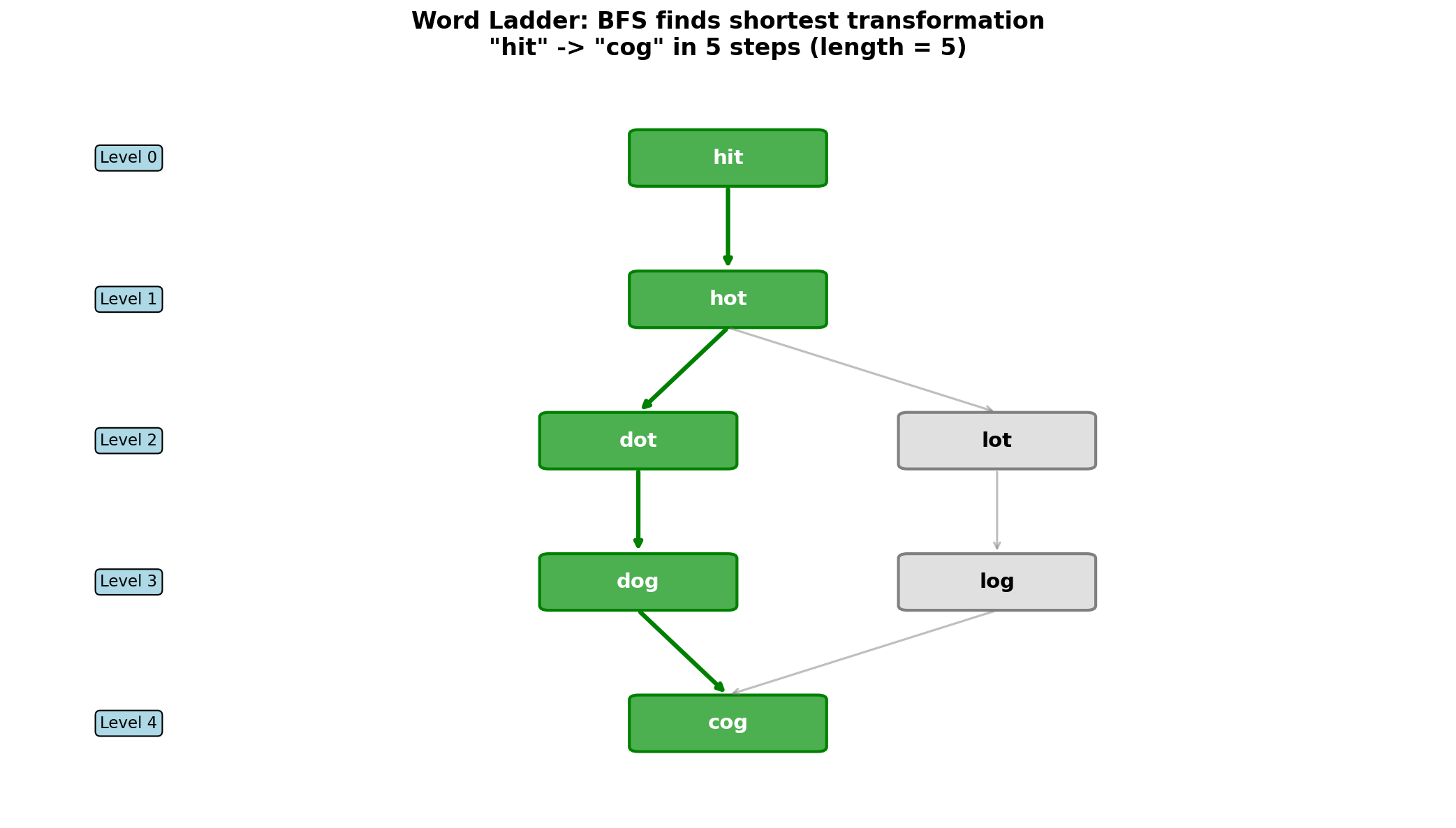
"hit" -> "hot" -> "dot" -> "dog" -> "cog"
         (h->o)   (h->d)   (o->g)   (d->c)

Length = 5 words in the sequenceExample 2
Input: beginWord = "hit", endWord = "cog", wordList = ["hot","dot","dog","lot","log"]
Output: 0

Explanation: The endWord "cog" is not in wordList, so no valid transformation exists.Key Insight
This is a shortest path problem in an implicit graph where:
- Nodes: Words
- Edges: Connect words that differ by exactly one letter
- Goal: Find shortest path from beginWord to endWord
Since the graph is unweighted, BFS finds the shortest path.
Approach 1: BFS with Word Generation
For each word, generate all possible one-letter transformations and check if they exist in wordList.
from collections import deque

def ladderLength(beginWord: str, endWord: str, wordList: list[str]) -> int:
    # Convert to set for O(1) lookup
    word_set = set(wordList)

    # Edge case: endWord not reachable
    if endWord not in word_set:
        return 0

    # BFS
    queue = deque([(beginWord, 1)])  # (word, length)
    visited = {beginWord}

    while queue:
        word, length = queue.popleft()

        # Try changing each character
        for i in range(len(word)):
            for c in 'abcdefghijklmnopqrstuvwxyz':
                if c == word[i]:
                    continue

                # Generate new word
                new_word = word[:i] + c + word[i+1:]

                if new_word == endWord:
                    return length + 1

                if new_word in word_set and new_word not in visited:
                    visited.add(new_word)
                    queue.append((new_word, length + 1))

return 0 # No path foundpublic int ladderLength(String beginWord, String endWord, List<String> wordList) {
Set<String> wordSet = new HashSet<>(wordList);
if (!wordSet.contains(endWord)) return 0;
// Queue stores [word, length] pairs — mirrors Python's (word, length) tuples
Deque<Object[]> queue = new ArrayDeque<>();
queue.offer(new Object[]{beginWord, 1});
Set<String> visited = new HashSet<>();
visited.add(beginWord);
while (!queue.isEmpty()) {
Object[] entry = queue.poll();
String word = (String) entry[0];
int length = (int) entry[1];
char[] chars = word.toCharArray();
for (int i = 0; i < chars.length; i++) {
char orig = chars[i];
for (char c = 'a'; c <= 'z'; c++) {
if (c == orig) continue;
chars[i] = c;
String newWord = new String(chars);
if (newWord.equals(endWord)) return length + 1;
if (wordSet.contains(newWord) && visited.add(newWord))
queue.offer(new Object[]{newWord, length + 1});
}
chars[i] = orig;
}
}
return 0;
}Complexity: Time O(M^2 * N) · Space O(M * N)
- Time: For each of N words in BFS, generate 26*M candidates; each string slice costs O(M)
- Space: Visited set stores up to N words of length M; queue holds word-length pairs
Complexity
| Aspect | Complexity | Explanation |
|---|---|---|
| Time | O(M^2 * N) | M = word length, N = wordList size |
| Space | O(M * N) | Queue and visited set |
- For each word (N), we try M positions
- At each position, we try 26 letters
- String operations (slicing) take O(M)
Approach 2: Bidirectional BFS (Optimal)
Start BFS from both ends and meet in the middle. This dramatically reduces the search space.
def ladderLength(beginWord: str, endWord: str, wordList: list[str]) -> int:
    word_set = set(wordList)

    if endWord not in word_set:
        return 0

    # Two frontiers
    front = {beginWord}
    back = {endWord}
    visited = {beginWord, endWord}
    length = 1

    while front and back:
        # Always expand the smaller frontier
        if len(front) > len(back):
            front, back = back, front

        next_front = set()

        for word in front:
            for i in range(len(word)):
                for c in 'abcdefghijklmnopqrstuvwxyz':
                    new_word = word[:i] + c + word[i+1:]

                    # Check if frontiers meet
                    if new_word in back:
                        return length + 1

                    if new_word in word_set and new_word not in visited:
                        visited.add(new_word)
                        next_front.add(new_word)

        front = next_front
        length += 1

return 0Complexity: Time O(M^2 * N) · Space O(M * N)
- Time: Same worst case but explores O(b^(d/2)) vs O(b^d) nodes in practice where b=26, d=path length
- Space: Two frontier sets and visited set, each up to O(N) words of length M
Why Bidirectional is Faster
Regular BFS: Explores branching factor b to depth d
  Nodes visited: O(b^d)

Bidirectional BFS: Two searches each go depth d/2
  Nodes visited: O(2 * b^(d/2)) = O(b^(d/2))

Example: b=26, d=10
  Regular: 26^10 = 141 trillion
Bidirectional: 2 * 26^5 = 23 millionApproach 3: Pre-build Adjacency List (Pattern Matching)
Group words by patterns like h*t, *ot, ho* for faster neighbor lookup.
from collections import defaultdict, deque

def ladderLength(beginWord: str, endWord: str, wordList: list[str]) -> int:
    if endWord not in wordList:
        return 0

    word_len = len(beginWord)

    # Build pattern -> words mapping
    # "hot" -> {"*ot": ["hot"], "h*t": ["hot"], "ho*": ["hot"]}
    patterns = defaultdict(list)
    for word in wordList:
        for i in range(word_len):
            pattern = word[:i] + '*' + word[i+1:]
            patterns[pattern].append(word)

    # BFS
    queue = deque([(beginWord, 1)])
    visited = {beginWord}

    while queue:
        word, length = queue.popleft()

        for i in range(word_len):
            pattern = word[:i] + '*' + word[i+1:]

            for neighbor in patterns[pattern]:
                if neighbor == endWord:
                    return length + 1

                if neighbor not in visited:
                    visited.add(neighbor)
                    queue.append((neighbor, length + 1))

            # Clear to avoid revisiting
            patterns[pattern] = []

return 0Complexity: Time O(M^2 * N) · Space O(M^2 * N)
- Time: Building patterns O(M^2 * N), BFS accesses patterns instead of generating transformations
- Space: Pattern dictionary stores M patterns per word, each pattern maps to list of words
Complexity
| Aspect | Complexity | Explanation |
|---|---|---|
| Time | O(M^2 * N) | Building patterns + BFS |
| Space | O(M^2 * N) | Pattern dictionary |
BFS Level Visualization
Common Mistakes
1. Forgetting to Check endWord in wordList
# WRONG - can infinite loop or return wrong answer
def ladderLength(beginWord, endWord, wordList):
    # Should check: if endWord not in wordList: return 0
...2. Not Marking Visited Before Adding to Queue
# WRONG - may add same word multiple times
if new_word in word_set:
    queue.append((new_word, length + 1))
    visited.add(new_word)  # Too late!

# CORRECT - mark visited immediately
if new_word in word_set and new_word not in visited:
    visited.add(new_word)  # Before adding to queue
queue.append((new_word, length + 1))3. Returning Length Instead of Word Count
# The problem asks for number of WORDS in sequence, not edges
# "hit" -> "hot" -> "cog" has 3 words, not 2 transformations
return length + 1 # Add 1 for the final wordEdge Cases
- beginWord equals endWord: Return 1 (or 0 if endWord not in list)
- endWord not in wordList: Return 0
- No valid transformation exists: Return 0
- Single letter words: Each letter is a potential neighbor
- Large wordList: Use efficient data structures
Word Ladder II (LeetCode 126)
Find ALL shortest transformation sequences (Hard problem).
Key differences:
- Store parent pointers during BFS
- Backtrack from endWord to find all paths
- More complex but uses same BFS foundation
from collections import defaultdict

def findLadders(beginWord, endWord, wordList):
    word_set = set(wordList)
    if endWord not in word_set:
        return []

    # BFS level by level, recording every shortest-path parent of each word.
    parents = defaultdict(set)   # word -> set of predecessors on a shortest path
    current = {beginWord}
    found = False

    while current and not found:
        # Remove this level's words so deeper levels can't revisit them.
        word_set -= current
        next_level = set()

        for word in current:
            for i in range(len(word)):
                for c in 'abcdefghijklmnopqrstuvwxyz':
                    new_word = word[:i] + c + word[i+1:]
                    if new_word in word_set:
                        next_level.add(new_word)
                        parents[new_word].add(word)
                        if new_word == endWord:
                            found = True

        current = next_level

    if not found:
        return []

    # Backtrack from endWord to beginWord using the parent pointers.
    paths = []

    def backtrack(word, path):
        if word == beginWord:
            paths.append([beginWord] + path[::-1])
            return
        for parent in parents[word]:
            backtrack(parent, path + [word])

    backtrack(endWord, [])
return pathsRelated Problems
Word Ladder II (LeetCode 126)
Problem: Find ALL shortest transformation sequences from beginWord to endWord.
Key Insight: BFS to find shortest length + backtracking to reconstruct all paths.
Approach: First BFS to build parent map at each level, then backtrack from endWord to find all paths.
Complexity: O(N * M^2) for BFS, path reconstruction can be exponential in worst case
Minimum Genetic Mutation (LeetCode 433)
Problem: Find minimum mutations to transform startGene to endGene using valid genes from bank.
Key Insight: Same as Word Ladder but with 4-character alphabet {A,C,G,T} and 8-char strings.
Approach: BFS where neighbors are genes differing by exactly one character.
Complexity: O(N * 8 * 4) = O(N) time where N = bank size
Open the Lock (LeetCode 752)
Problem: Find minimum turns to go from "0000" to target, avoiding deadends.
Key Insight: BFS on state space where each state is a 4-digit combination.
Approach: BFS from "0000", each state has 8 neighbors (4 wheels x 2 directions). Skip deadends.
Complexity: O(10^4 * 4 * 2) = O(1) since state space is bounded
Shortest Path to Get All Keys (LeetCode 864)
Problem: Find shortest path in grid to collect all keys, where locks require matching keys.
Key Insight: BFS with state = (position, keys_collected_bitmask).
Approach: BFS where state includes position and bitmask of collected keys. Different key sets = different states.
Complexity: O(M * N * 2^K) time and space where K = number of keys
Interview Tips
- Recognize BFS pattern: Shortest path + unweighted graph = BFS
- Explain word as graph node: Each word is a node, one-letter-different words are connected
- Mention bidirectional BFS: Shows optimization thinking
- Discuss time complexity: M^2 * N where M = word length, N = list size
Follow-up Questions
Q: How would you find all shortest paths?
- A: BFS first to find length, then backtrack with parent tracking
Q: What if words have different lengths?
- A: Would need to allow insertions/deletions, becomes edit distance problem
Q: How to optimize for very long words?
- A: Use hash-based pattern matching or rolling hash