Edit Distance (Levenshtein Distance)
Problem Statement
Given two strings word1 and word2, return the minimum number of operations required to convert word1 to word2.
You have the following three operations permitted on a word:
- Insert a character
- Delete a character
- Replace a character
This problem is also known as the Levenshtein Distance and has applications in spell checking, DNA sequence alignment, and plagiarism detection.
Input/Output Format
Input:
word1(str): Source string to transformword2(str): Target string
Output:
- (int): Minimum number of operations to transform word1 to word2
Constraints
0 <= word1.length, word2.length <= 500word1andword2consist of lowercase English letters
Examples
Example 1: Standard Case
Input: word1 = "horse", word2 = "ros"
Output: 3
Explanation:
horse -> rorse (replace 'h' with 'r')
rorse -> rose  (delete 'r')
rose  -> ros   (delete 'e')

Total: 3 operationsExample 2: Longer Transformation
Input: word1 = "intention", word2 = "execution"
Output: 5
Explanation:
intention -> inention  (delete 't')
inention  -> enention  (replace 'i' with 'e')
enention  -> exention  (replace 'n' with 'x')
exention  -> exection  (replace 'n' with 'c')
exection  -> execution (insert 'u')

Total: 5 operationsExample 3: Empty String
Input: word1 = "", word2 = "abc"
Output: 3
Explanation: Insert 'a', insert 'b', insert 'c'.
Example 4: Same Strings
Input: word1 = "abc", word2 = "abc"
Output: 0
Explanation: No operations needed.
Visual Explanation
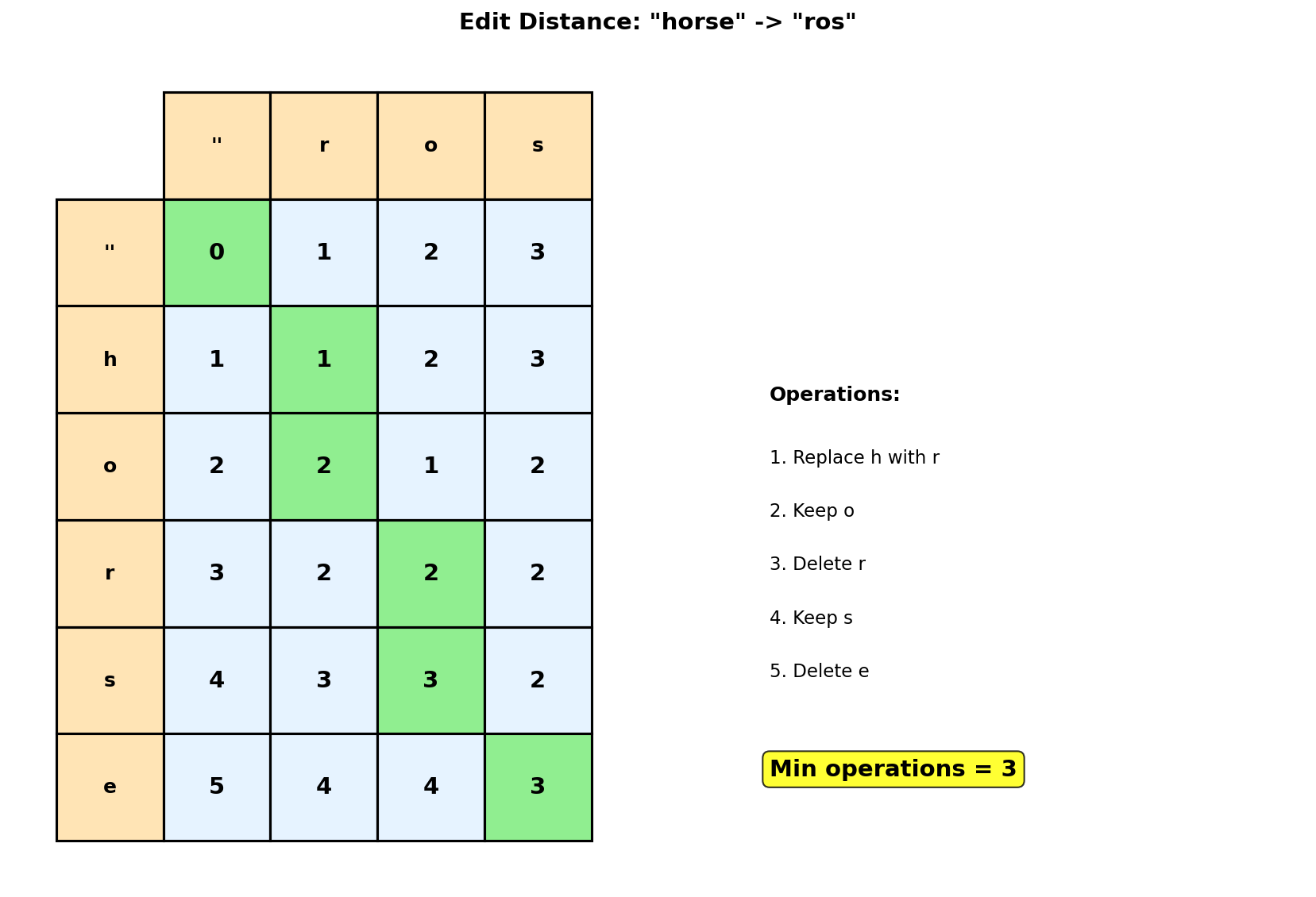
ASCII Art: DP Table Building
word1 = "horse", word2 = "ros"

DP Table: dp[i][j] = min operations to convert word1[0..i-1] to word2[0..j-1]

            ""    r    o    s
          +----+----+----+----+
    ""    | 0  | 1  | 2  | 3  |  <- insert all of word2
          +----+----+----+----+
    h     | 1  | 1  | 2  | 3  |  <- h != r, replace
          +----+----+----+----+
    o     | 2  | 2  | 1  | 2  |  <- o == o, diagonal
          +----+----+----+----+
    r     | 3  | 2  | 2  | 2  |  <- r == r, but...
          +----+----+----+----+
    s     | 4  | 3  | 3  | 2  |  <- s == s, diagonal
          +----+----+----+----+
    e     | 5  | 4  | 4  | 3  |  <- e != s, min+1
          +----+----+----+----+
          ^
          |
      delete all of word1

Recurrence:
If word1[i-1] == word2[j-1]:
    dp[i][j] = dp[i-1][j-1]           (no operation needed)
Else:
    dp[i][j] = 1 + min(
        dp[i-1][j-1],  (replace)
        dp[i-1][j],    (delete from word1)
        dp[i][j-1]     (insert into word1)
    )

Answer: dp[5][3] = 3Solution Code
Approach 1: Top-Down (Memoization)
from functools import lru_cache

def minDistance(word1: str, word2: str) -> int:
    """
    Find minimum edit distance using memoization.

    At each position, if characters match, move diagonally.
    Otherwise, try all three operations and take minimum.

    Args:
        word1: Source string
        word2: Target string

    Returns:
        Minimum number of operations

    Time Complexity: O(m * n)
    Space Complexity: O(m * n)
    """
    @lru_cache(maxsize=None)
    def dp(i: int, j: int) -> int:
        """
        Return min operations to convert word1[i:] to word2[j:].
        """
        # Base cases
        if i == len(word1):
            return len(word2) - j  # Insert remaining chars
        if j == len(word2):
            return len(word1) - i  # Delete remaining chars

        if word1[i] == word2[j]:
            # Characters match, no operation needed
            return dp(i + 1, j + 1)
        else:
            # Try all three operations
            replace = dp(i + 1, j + 1)  # Replace word1[i] with word2[j]
            delete = dp(i + 1, j)        # Delete word1[i]
            insert = dp(i, j + 1)        # Insert word2[j]
            return 1 + min(replace, delete, insert)

return dp(0, 0)Complexity: Time O(m * n) · Space O(m * n)
- Time: Each (i, j) state is computed once via memoization. With m characters in word1 and n in word2, there are O(m * n) unique states.
- Space: The cache stores O(m * n) entries, plus recursion stack depth of O(m + n) in the worst case.
Approach 2: Bottom-Up (Tabulation)
def minDistance(word1: str, word2: str) -> int:
    """
    Find minimum edit distance using bottom-up DP.

    Build a 2D table where dp[i][j] represents minimum operations
    to convert word1[0..i-1] to word2[0..j-1].

    Args:
        word1: Source string
        word2: Target string

    Returns:
        Minimum number of operations

    Time Complexity: O(m * n)
    Space Complexity: O(m * n)
    """
    m, n = len(word1), len(word2)

    # dp[i][j] = min ops to convert word1[0..i-1] to word2[0..j-1]
    dp = [[0] * (n + 1) for _ in range(m + 1)]

    # Base cases: converting to/from empty string
    for i in range(m + 1):
        dp[i][0] = i  # Delete all characters
    for j in range(n + 1):
        dp[0][j] = j  # Insert all characters

    # Fill the table
    for i in range(1, m + 1):
        for j in range(1, n + 1):
            if word1[i - 1] == word2[j - 1]:
                dp[i][j] = dp[i - 1][j - 1]  # No operation
            else:
                dp[i][j] = 1 + min(
                    dp[i - 1][j - 1],  # Replace
                    dp[i - 1][j],      # Delete
                    dp[i][j - 1]       # Insert
                )

return dp[m][n]public int minDistance(String word1, String word2) {
int m = word1.length(), n = word2.length();
// dp[i][j] = min ops to convert word1[0..i-1] to word2[0..j-1]
int[][] dp = new int[m + 1][n + 1];
// Base cases: converting to/from empty string
for (int i = 0; i <= m; i++) dp[i][0] = i; // Delete all characters
for (int j = 0; j <= n; j++) dp[0][j] = j; // Insert all characters
// Fill the table
for (int i = 1; i <= m; i++) {
for (int j = 1; j <= n; j++) {
if (word1.charAt(i - 1) == word2.charAt(j - 1)) {
dp[i][j] = dp[i - 1][j - 1]; // No operation
} else {
dp[i][j] = 1 + Math.min(
dp[i - 1][j - 1], // Replace
Math.min(
dp[i - 1][j], // Delete
dp[i][j - 1] // Insert
)
);
}
}
}
return dp[m][n];
}Complexity: Time O(m * n) · Space O(m * n)
- Time: Two nested loops fill all (m+1) * (n+1) cells with constant-time operations per cell.
- Space: The 2D dp table stores edit distances for all prefix combinations of both strings.
Approach 3: Space-Optimized
def minDistance(word1: str, word2: str) -> int:
    """
    Find minimum edit distance with O(n) space.

    Since we only need the previous row, optimize space.

    Args:
        word1: Source string
        word2: Target string

    Returns:
        Minimum number of operations

    Time Complexity: O(m * n)
    Space Complexity: O(min(m, n))
    """
    # Ensure word2 is shorter for space optimization
    if len(word1) < len(word2):
        word1, word2 = word2, word1

    m, n = len(word1), len(word2)

    # Previous and current row
    prev = list(range(n + 1))
    curr = [0] * (n + 1)

    for i in range(1, m + 1):
        curr[0] = i  # Delete all from word1[0..i-1]

        for j in range(1, n + 1):
            if word1[i - 1] == word2[j - 1]:
                curr[j] = prev[j - 1]
            else:
                curr[j] = 1 + min(
                    prev[j - 1],  # Replace
                    prev[j],      # Delete
                    curr[j - 1]   # Insert
                )

        prev, curr = curr, prev

return prev[n]Complexity: Time O(m * n) · Space O(min(m, n))
- Time: Same O(m * n) iterations processing all state pairs row by row.
- Space: Only two arrays of size n+1 are maintained. By swapping words if needed, n is the shorter length.
Approach 4: Get Edit Operations
from typing import List, Tuple

def minDistance_with_operations(word1: str, word2: str) -> Tuple[int, List[str]]:
    """
    Find minimum edit distance and return the actual operations.

    Args:
        word1: Source string
        word2: Target string

    Returns:
        Tuple of (distance, list of operations)

    Time Complexity: O(m * n)
    Space Complexity: O(m * n)
    """
    m, n = len(word1), len(word2)
    dp = [[0] * (n + 1) for _ in range(m + 1)]

    for i in range(m + 1):
        dp[i][0] = i
    for j in range(n + 1):
        dp[0][j] = j

    for i in range(1, m + 1):
        for j in range(1, n + 1):
            if word1[i - 1] == word2[j - 1]:
                dp[i][j] = dp[i - 1][j - 1]
            else:
                dp[i][j] = 1 + min(
                    dp[i - 1][j - 1],
                    dp[i - 1][j],
                    dp[i][j - 1]
                )

    # Backtrack to find operations
    operations = []
    i, j = m, n

    while i > 0 or j > 0:
        if i > 0 and j > 0 and word1[i - 1] == word2[j - 1]:
            # No operation, characters match
            i -= 1
            j -= 1
        elif i > 0 and j > 0 and dp[i][j] == dp[i - 1][j - 1] + 1:
            # Replace
            operations.append(f"Replace '{word1[i-1]}' with '{word2[j-1]}' at position {i-1}")
            i -= 1
            j -= 1
        elif i > 0 and dp[i][j] == dp[i - 1][j] + 1:
            # Delete
            operations.append(f"Delete '{word1[i-1]}' at position {i-1}")
            i -= 1
        else:
            # Insert
            operations.append(f"Insert '{word2[j-1]}' at position {i}")
            j -= 1

return dp[m][n], operations[::-1]Complexity: Time O(m * n) · Space O(m * n)
- Time: O(m * n) to build the DP table, plus O(m + n) to backtrack and reconstruct the sequence of operations.
- Space: The full 2D table is required for backtracking to determine which operation was taken at each step.
Complexity Analysis
| Approach | Time Complexity | Space Complexity |
|---|---|---|
| Top-Down (Memoization) | O(m * n) | O(m * n) |
| Bottom-Up (Tabulation) | O(m * n) | O(m * n) |
| Space-Optimized | O(m * n) | O(min(m, n)) |
Edge Cases
Both empty:
pythonminDistance("", "") # Returns 0One empty:
pythonminDistance("abc", "") # Returns 3 (delete all) minDistance("", "xyz") # Returns 3 (insert all)Same strings:
pythonminDistance("hello", "hello") # Returns 0Single character difference:
pythonminDistance("a", "b") # Returns 1 (replace)Completely different:
pythonminDistance("abc", "xyz") # Returns 3 (replace all)Substring relationship:
pythonminDistance("abc", "ab") # Returns 1 (delete 'c') minDistance("ab", "abc") # Returns 1 (insert 'c')
Understanding Operations
Convert "horse" to "ros":

Initial: h o r s e
Target:  r o s

Step 1: Replace 'h' with 'r'
        r o r s e

Step 2: Delete 'r' (the second one)
        r o s e

Step 3: Delete 'e'
        r o s

Total: 3 operations

Alternative path (also 3 ops):
Step 1: Delete 'h'    -> o r s e
Step 2: Delete 'r'    -> o s e
Step 3: Delete 'e'    -> o s
Step 4: Insert 'r'    -> r o s
Wait, that's 4 operations!

The DP finds the OPTIMAL path automatically.Key Insights
Three Operations: At any mismatch, we have three choices - insert, delete, or replace. DP explores all efficiently.
State Definition:
dp[i][j]= minimum operations to convertword1[0..i-1]toword2[0..j-1].Base Cases:
dp[i][0] = i: Delete all i characters from word1dp[0][j] = j: Insert all j characters into word1
Optimal Substructure: The edit distance for longer strings can be computed from shorter prefixes.
Symmetry: Edit distance is symmetric:
edit(A, B) = edit(B, A).Triangle Inequality:
edit(A, C) <= edit(A, B) + edit(B, C).
Applications
- Spell Checkers: Find closest dictionary words
- DNA Sequence Alignment: Compare genetic sequences
- Plagiarism Detection: Measure document similarity
- Auto-correct: Suggest corrections for typos
- Fuzzy String Matching: Match similar but not identical strings
Related Problems
One Edit Distance (LeetCode 161)
Problem: Determine if two strings are exactly one edit (insert, delete, or replace) apart.
Key Insight: No DP needed - linear scan with length checks. If lengths differ by more than 1, return false.
Approach: Handle three cases based on length difference. For same length, find first mismatch and verify rest matches. For diff=1, skip one char in longer string and verify rest matches.
Complexity: O(n) time, O(1) space
Delete Operation for Two Strings (LeetCode 583)
Problem: Find minimum number of delete operations to make two strings equal (no insert/replace allowed).
Key Insight: Reduce to LCS. Min deletions = total chars - 2 * LCS length.
Approach: min_deletions = len(word1) + len(word2) - 2 * LCS(word1, word2). Characters not in LCS must be deleted from both strings.
Complexity: O(m * n) time, O(min(m, n)) space
Minimum ASCII Delete Sum (LeetCode 712)
Problem: Find lowest ASCII sum of deleted characters to make two strings equal.
Key Insight: Weighted version of delete operation problem. Track ASCII values instead of counts.
Approach: dp[i][j] = min(dp[i-1][j] + ord(s1[i-1]), dp[i][j-1] + ord(s2[j-1])) when no match. Characters match: dp[i][j] = dp[i-1][j-1].
Complexity: O(m * n) time, O(m * n) space
Longest Common Subsequence (LeetCode 1143)
Problem: Find length of longest common subsequence between two strings.
Key Insight: Closely related to edit distance. LCS focuses on what to keep; edit distance focuses on what to change.
Approach: dp[i][j] = dp[i-1][j-1] + 1 if match, else max(dp[i-1][j], dp[i][j-1]).
Complexity: O(m * n) time, O(min(m, n)) space