Number of Connected Components
Counting disjoint subgraphs using Union-Find or DFS
Problem Statement
LeetCode 323: Number of Connected Components in an Undirected Graph (Premium)
You have a graph of n nodes. You are given an integer n and an array edges where edges[i] = [ai, bi] indicates that there is an edge between ai and bi in the graph.
Return the number of connected components in the graph.
Visual Overview
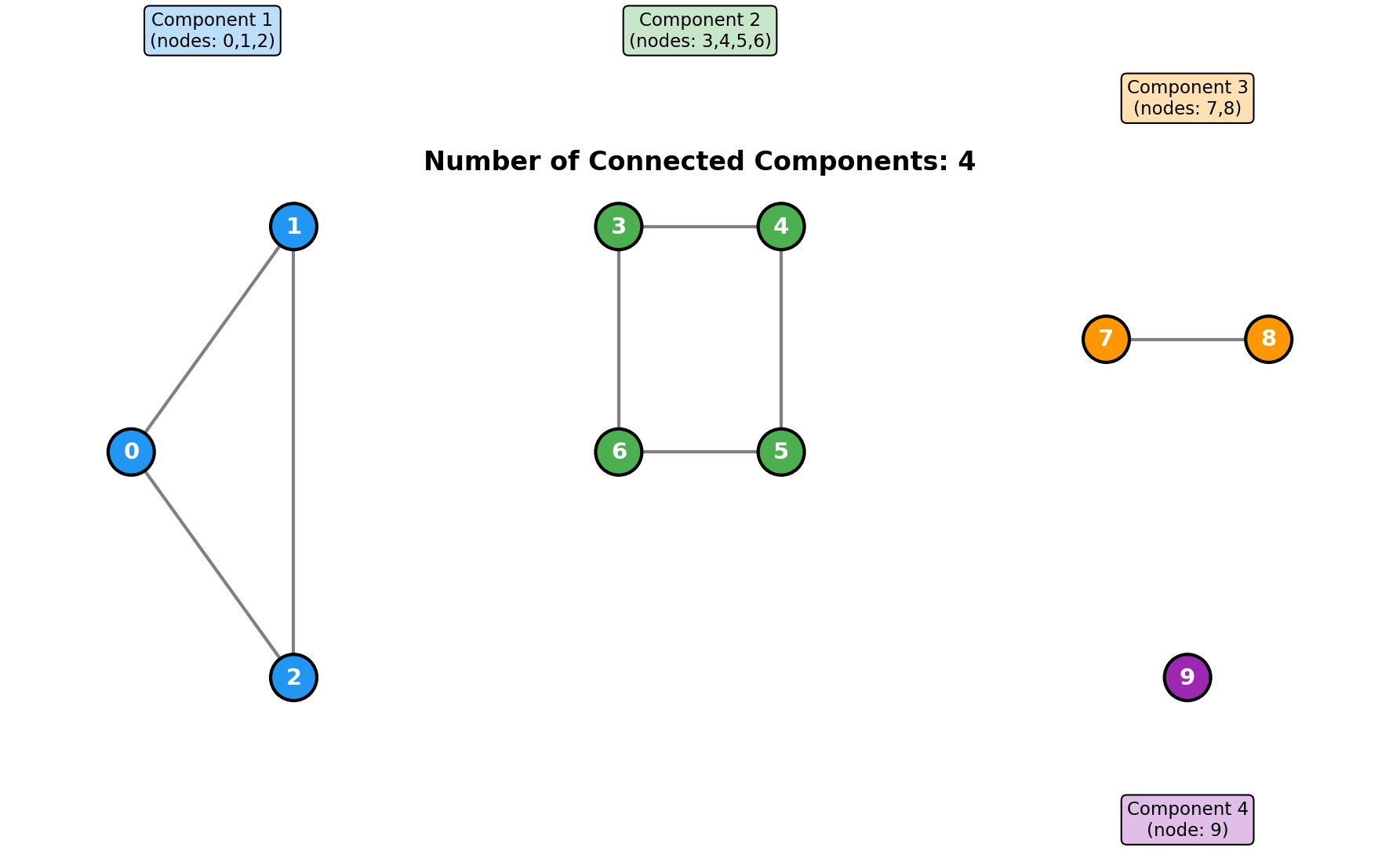
Examples
Example 1
Input: n = 5, edges = [[0,1], [1,2], [3,4]]
Output: 2

  0 - 1 - 2     3 - 4

Component 1: {0, 1, 2}
Component 2: {3, 4}Example 2
Input: n = 5, edges = [[0,1], [1,2], [2,3], [3,4]]
Output: 1

  0 - 1 - 2 - 3 - 4

All nodes connected: 1 componentExample 3
Input: n = 5, edges = []
Output: 5

  0   1   2   3   4

Each node is isolated: 5 componentsSolution 1: Union-Find (Optimal)
class UnionFind:
    def __init__(self, n):
        self.parent = list(range(n))
        self.rank = [0] * n
        self.count = n  # Initially, n separate components

    def find(self, x):
        if self.parent[x] != x:
            self.parent[x] = self.find(self.parent[x])  # Path compression
        return self.parent[x]

    def union(self, x, y):
        px, py = self.find(x), self.find(y)
        if px == py:
            return  # Already in same component

        # Union by rank
        if self.rank[px] < self.rank[py]:
            px, py = py, px
        self.parent[py] = px
        if self.rank[px] == self.rank[py]:
            self.rank[px] += 1

        self.count -= 1  # Merged two components into one

def countComponents(n: int, edges: list[list[int]]) -> int:
    uf = UnionFind(n)

    for u, v in edges:
        uf.union(u, v)

return uf.countpublic int countComponents(int n, int[][] edges) {
int[] parent = new int[n];
int[] rank = new int[n];
for (int i = 0; i < n; i++) parent[i] = i;
int count = n;
for (int[] edge : edges) {
int pu = find(parent, edge[0]), pv = find(parent, edge[1]);
if (pu != pv) {
if (rank[pu] < rank[pv]) { int tmp = pu; pu = pv; pv = tmp; }
parent[pv] = pu;
if (rank[pu] == rank[pv]) rank[pu]++;
count--;
}
}
return count;
}
private int find(int[] parent, int x) {
if (parent[x] != x) parent[x] = find(parent, parent[x]);
return parent[x];
}Complexity: Time O(E * alpha(n)) · Space O(n)
- Time: E union operations, each O(alpha(n)) amortized; count maintained during unions
- Space: Parent and rank arrays O(n), count variable O(1)
How It Works
Initial: 5 nodes, 5 components
  0   1   2   3   4
  [0] [1] [2] [3] [4]  <- each node is its own parent

Edge [0,1]: union(0, 1)
  0   2   3   4         count = 4
  |
  1

Edge [1,2]: union(1, 2)
  0   3   4             count = 3
 / \
1   2

Edge [3,4]: union(3, 4)
  0   3                 count = 2
 / \   \
1   2   4

Final: 2 componentsComplexity
| Aspect | Complexity | Explanation |
|---|---|---|
| Time | O(E * alpha(n)) | Nearly O(E) for E edges |
| Space | O(n) | Parent and rank arrays |
Solution 2: DFS
from collections import defaultdict

def countComponents(n: int, edges: list[list[int]]) -> int:
    # Build adjacency list
    graph = defaultdict(list)
    for u, v in edges:
        graph[u].append(v)
        graph[v].append(u)

    visited = set()
    count = 0

    def dfs(node: int) -> None:
        visited.add(node)
        for neighbor in graph[node]:
            if neighbor not in visited:
                dfs(neighbor)

    for node in range(n):
        if node not in visited:
            dfs(node)
            count += 1

return countComplexity: Time O(V + E) · Space O(V + E)
- Time: Each node visited once when starting new DFS or during recursive exploration; each edge examined twice
- Space: Adjacency list O(E), visited set O(V), recursion stack up to O(V) depth
DFS Process
Complexity
| Aspect | Complexity | Explanation |
|---|---|---|
| Time | O(V + E) | Visit each node and edge once |
| Space | O(V + E) | Adjacency list + visited set + recursion stack |
Solution 3: BFS
from collections import defaultdict, deque

def countComponents(n: int, edges: list[list[int]]) -> int:
    graph = defaultdict(list)
    for u, v in edges:
        graph[u].append(v)
        graph[v].append(u)

    visited = set()
    count = 0

    def bfs(start: int) -> None:
        queue = deque([start])
        visited.add(start)

        while queue:
            node = queue.popleft()
            for neighbor in graph[node]:
                if neighbor not in visited:
                    visited.add(neighbor)
                    queue.append(neighbor)

    for node in range(n):
        if node not in visited:
            bfs(node)
            count += 1

return countComplexity: Time O(V + E) · Space O(V + E)
- Time: BFS visits each node once, processes each edge twice (undirected)
- Space: Adjacency list O(E), visited set O(V), queue up to O(V) nodes
Alternative: Count Unique Roots
After processing all edges with Union-Find, count unique roots:
def countComponents(n: int, edges: list[list[int]]) -> int:
    parent = list(range(n))

    def find(x):
        if parent[x] != x:
            parent[x] = find(parent[x])
        return parent[x]

    def union(x, y):
        parent[find(x)] = find(y)

    for u, v in edges:
        union(u, v)

    # Count unique roots
return len(set(find(i) for i in range(n)))Complexity: Time O(E * alpha(n) + n) · Space O(n)
- Time: E unions during edge processing, then n find operations to count unique roots
- Space: Parent array O(n), set for unique roots O(n) worst case
Comparison of Approaches
| Approach | Time | Space | Pros | Cons |
|---|---|---|---|---|
| Union-Find | O(E * alpha(n)) | O(n) | Efficient, tracks count | More code |
| DFS | O(V + E) | O(V + E) | Intuitive | Stack overflow risk |
| BFS | O(V + E) | O(V + E) | No stack overflow | More memory for queue |
Variations
Get Component Sizes
def getComponentSizes(n: int, edges: list[list[int]]) -> list[int]:
    uf = UnionFind(n)
    for u, v in edges:
        uf.union(u, v)

    # Count nodes per root
    from collections import Counter
    roots = [uf.find(i) for i in range(n)]
    return list(Counter(roots).values())

# Example: n=5, edges=[[0,1],[1,2],[3,4]]
# Returns: [3, 2] (component sizes)Get Nodes in Each Component
def getComponents(n: int, edges: list[list[int]]) -> list[list[int]]:
    from collections import defaultdict

    uf = UnionFind(n)
    for u, v in edges:
        uf.union(u, v)

    components = defaultdict(list)
    for node in range(n):
        root = uf.find(node)
        components[root].append(node)

    return list(components.values())

# Example: n=5, edges=[[0,1],[1,2],[3,4]]
# Returns: [[0, 1, 2], [3, 4]]Dynamic Component Count
Track components as edges are added:
def dynamicComponents(n: int, edges: list[list[int]]) -> list[int]:
    """Return component count after each edge is added."""
    uf = UnionFind(n)
    result = []

    for u, v in edges:
        uf.union(u, v)
        result.append(uf.count)

    return result

# Example: n=5, edges=[[0,1],[1,2],[3,4]]
# Returns: [4, 3, 2] (count after each edge)Edge Cases
- No edges: Each node is its own component, return
n - Fully connected: Return
1 - n = 0: Return
0(no nodes) - Self-loops: Handle or ignore based on problem constraints
- Duplicate edges: Union-Find handles gracefully
Interview Tips
Choose the right approach:
- Union-Find: Best for dynamic graphs or many queries
- DFS/BFS: Fine for single count, easier to explain
Mention optimizations:
- Path compression in find()
- Union by rank in union()
Track the count efficiently:
- Decrement on successful union (Union-Find)
- Increment on new DFS/BFS start
Follow-up Questions
Q: What if edges are added dynamically?
- A: Union-Find is perfect - O(alpha(n)) per edge
Q: What if edges are removed?
- A: Much harder - need decremental connectivity or recompute
Q: What if the graph is directed?
- A: Different problem - need Kosaraju's or Tarjan's algorithm for strongly connected components
Related Problems
Graph Valid Tree (LeetCode 261)
Problem: Determine if an undirected graph with n nodes and edges is a valid tree.
Key Insight: Tree requires exactly n-1 edges AND single connected component (no cycles).
Approach: Union-Find: verify n-1 edges and no cycle (union fails = cycle detected).
Complexity: O(N * alpha(N)) time, O(N) space
Number of Islands (LeetCode 200)
Problem: Count connected components of '1' cells in a 2D grid.
Key Insight: Same as connected components but on implicit grid graph.
Approach: DFS/BFS flood fill from each unvisited '1', or Union-Find on adjacent '1' cells.
Complexity: O(MN) time, O(MN) space
Accounts Merge (LeetCode 721)
Problem: Merge accounts that share at least one email address.
Key Insight: Union-Find on emails - accounts sharing an email belong to same person.
Approach: Union-Find: union emails from same account, then group by representative.
Complexity: O(N * K * alpha(NK)) time where N = accounts, K = emails per account
Number of Provinces (LeetCode 547)
Problem: Count provinces in an n x n adjacency matrix where isConnected[i][j] = 1 means cities i and j are connected.
Key Insight: Same as connected components but with matrix input instead of edge list.
Approach: Union-Find or DFS - process matrix to find connected components.
Complexity: O(N^2 * alpha(N)) time with Union-Find, O(N) space