All O(1) Data Structure
Problem Statement
Design a data structure to store the strings' count with the ability to return the strings with minimum and maximum counts.
Implement the AllOne class:
AllOne()Initializes the object of the data structure.inc(String key)Increments the count of the stringkeyby 1. Ifkeydoes not exist in the data structure, insert it with count 1.dec(String key)Decrements the count of the stringkeyby 1. If the count ofkeyis 0 after the decrement, remove it from the data structure. It is guaranteed thatkeyexists in the data structure before the decrement.getMaxKey()Returns one of the keys with the maximal count. If no element exists, return an empty string"".getMinKey()Returns one of the keys with the minimal count. If no element exists, return an empty string"".
Note: Each function must run in O(1) average time complexity.
LeetCode: 432. All O(1) Data Structure
Examples
Example 1:
Input:
["AllOne", "inc", "inc", "getMaxKey", "getMinKey", "inc", "getMaxKey", "getMinKey"]
[[], ["hello"], ["hello"], [], [], ["leet"], [], []]

Output:
[null, null, null, "hello", "hello", null, "hello", "leet"]

Explanation:
AllOne allOne = new AllOne();
allOne.inc("hello");     // "hello" count = 1
allOne.inc("hello");     // "hello" count = 2
allOne.getMaxKey();      // return "hello"
allOne.getMinKey();      // return "hello"
allOne.inc("leet");      // "leet" count = 1
allOne.getMaxKey();      // return "hello"
allOne.getMinKey(); // return "leet"Constraints
1 <= key.length <= 10keyconsists of lowercase English letters.- It is guaranteed that for each call to
dec,keyis existing in the data structure. - At most
5 * 10^4calls will be made toinc,dec,getMaxKey, andgetMinKey.
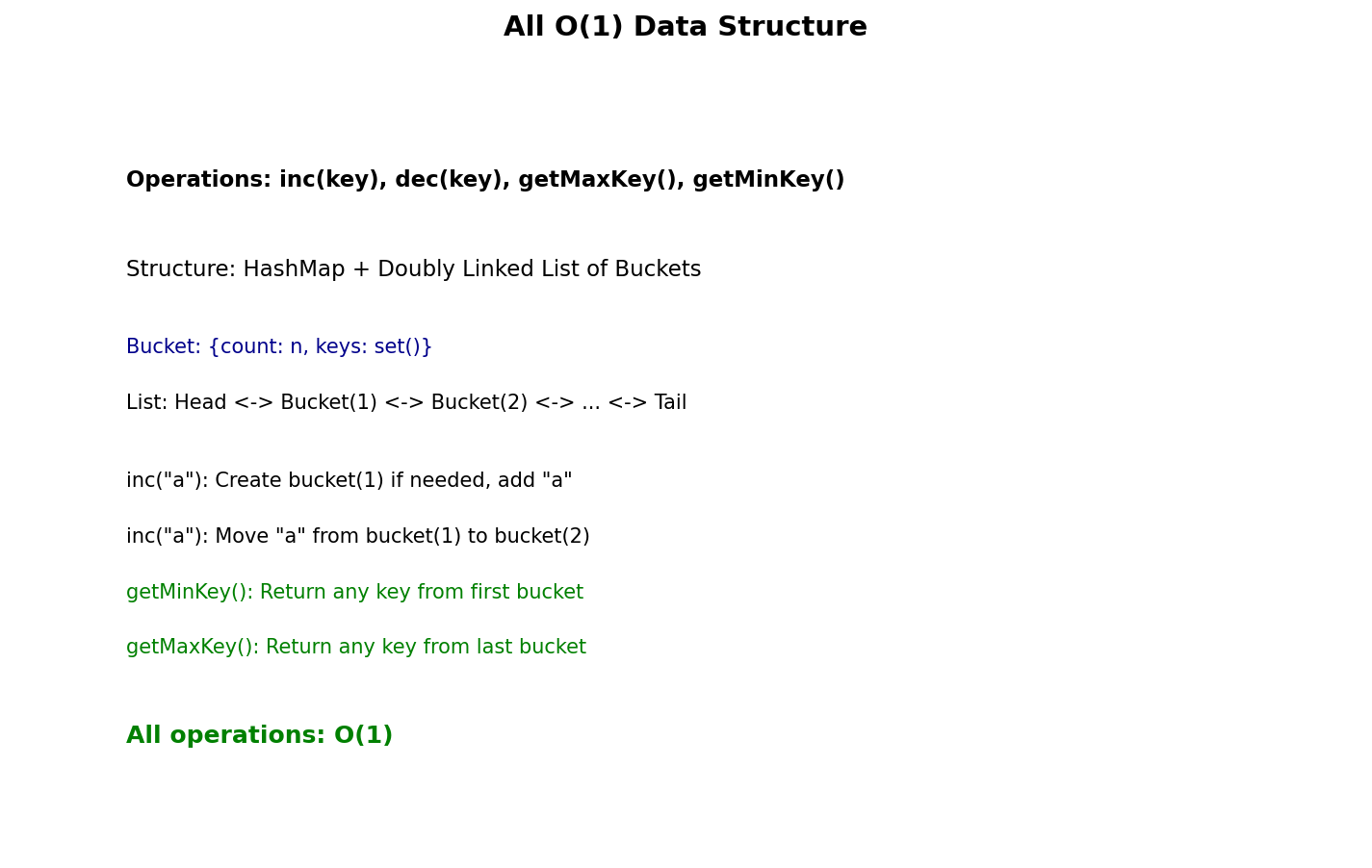
HashMap + Doubly Linked List of Buckets
Key Insight
- HashMap: O(1) key -> bucket lookup
- Doubly Linked List of Buckets: Each bucket contains keys with same count, ordered by count
- Min key: First bucket's key
- Max key: Last bucket's key
Data Structure
HashMap: key -> Bucket pointer

Doubly Linked List of Buckets:
Head <-> Bucket(1) <-> Bucket(2) <-> Bucket(5) <-> Tail
         {a, b}        {c}           {d}

Each bucket has:
- count: the frequency
- keys: set of keys with this count
- prev, next: pointers to adjacent bucketsSolution
class Bucket:
    """Bucket node in doubly linked list."""
    def __init__(self, count: int = 0):
        self.count = count
        self.keys = set()
        self.prev = None
        self.next = None


class AllOne:
    """
    All O(1) data structure.

    Time: O(1) for all operations
    Space: O(n) where n is number of unique keys
    """

    def __init__(self):
        # Dummy head and tail for easier operations
        self.head = Bucket(0)  # Before min count
        self.tail = Bucket(float('inf'))  # After max count
        self.head.next = self.tail
        self.tail.prev = self.head

        # Map: key -> bucket containing this key
        self.key_to_bucket = {}

    def _insert_bucket_after(self, bucket: Bucket, prev_bucket: Bucket) -> None:
        """Insert bucket after prev_bucket."""
        bucket.prev = prev_bucket
        bucket.next = prev_bucket.next
        prev_bucket.next.prev = bucket
        prev_bucket.next = bucket

    def _remove_bucket(self, bucket: Bucket) -> None:
        """Remove bucket from list."""
        bucket.prev.next = bucket.next
        bucket.next.prev = bucket.prev

    def _remove_key_from_bucket(self, key: str, bucket: Bucket) -> None:
        """Remove key from bucket, delete bucket if empty."""
        bucket.keys.remove(key)
        if not bucket.keys:
            self._remove_bucket(bucket)

    def inc(self, key: str) -> None:
        """Increment count of key by 1."""
        if key in self.key_to_bucket:
            # Key exists, move to next count bucket
            current_bucket = self.key_to_bucket[key]
            new_count = current_bucket.count + 1

            # Find or create bucket for new_count
            next_bucket = current_bucket.next
            if next_bucket.count != new_count:
                # Create new bucket
                next_bucket = Bucket(new_count)
                self._insert_bucket_after(next_bucket, current_bucket)

            # Move key to new bucket
            next_bucket.keys.add(key)
            self.key_to_bucket[key] = next_bucket

            # Remove from old bucket
            self._remove_key_from_bucket(key, current_bucket)
        else:
            # New key with count 1
            first_bucket = self.head.next
            if first_bucket.count != 1:
                first_bucket = Bucket(1)
                self._insert_bucket_after(first_bucket, self.head)

            first_bucket.keys.add(key)
            self.key_to_bucket[key] = first_bucket

    def dec(self, key: str) -> None:
        """Decrement count of key by 1."""
        current_bucket = self.key_to_bucket[key]
        new_count = current_bucket.count - 1

        if new_count == 0:
            # Remove key entirely
            del self.key_to_bucket[key]
        else:
            # Move to previous count bucket
            prev_bucket = current_bucket.prev
            if prev_bucket.count != new_count:
                prev_bucket = Bucket(new_count)
                self._insert_bucket_after(prev_bucket, current_bucket.prev)

            prev_bucket.keys.add(key)
            self.key_to_bucket[key] = prev_bucket

        # Remove from old bucket
        self._remove_key_from_bucket(key, current_bucket)

    def getMaxKey(self) -> str:
        """Return any key with maximum count."""
        if self.tail.prev == self.head:
            return ""
        # Return any key from last bucket
        return next(iter(self.tail.prev.keys))

    def getMinKey(self) -> str:
        """Return any key with minimum count."""
        if self.head.next == self.tail:
            return ""
        # Return any key from first bucket
return next(iter(self.head.next.keys))import java.util.*;
class AllOne {
private static class Bucket {
int count;
Set<String> keys = new LinkedHashSet<>();
Bucket prev, next;
Bucket(int count) { this.count = count; }
}
private final Bucket head = new Bucket(0); // sentinel min
private final Bucket tail = new Bucket(Integer.MAX_VALUE); // sentinel max
private final Map<String, Bucket> keyToBucket = new HashMap<>();
public AllOne() {
head.next = tail;
tail.prev = head;
}
private void insertAfter(Bucket newBucket, Bucket prev) {
newBucket.prev = prev;
newBucket.next = prev.next;
prev.next.prev = newBucket;
prev.next = newBucket;
}
private void removeBucket(Bucket b) {
b.prev.next = b.next;
b.next.prev = b.prev;
}
private void removeKeyFromBucket(String key, Bucket b) {
b.keys.remove(key);
if (b.keys.isEmpty()) removeBucket(b);
}
public void inc(String key) {
if (keyToBucket.containsKey(key)) {
Bucket cur = keyToBucket.get(key);
int newCount = cur.count + 1;
Bucket next = cur.next;
if (next.count != newCount) {
next = new Bucket(newCount);
insertAfter(next, cur);
}
next.keys.add(key);
keyToBucket.put(key, next);
removeKeyFromBucket(key, cur);
} else {
Bucket first = head.next;
if (first.count != 1) {
first = new Bucket(1);
insertAfter(first, head);
}
first.keys.add(key);
keyToBucket.put(key, first);
}
}
public void dec(String key) {
Bucket cur = keyToBucket.get(key);
int newCount = cur.count - 1;
if (newCount == 0) {
keyToBucket.remove(key);
} else {
Bucket prev = cur.prev;
if (prev.count != newCount) {
prev = new Bucket(newCount);
insertAfter(prev, cur.prev);
}
prev.keys.add(key);
keyToBucket.put(key, prev);
}
removeKeyFromBucket(key, cur);
}
public String getMaxKey() {
return tail.prev == head ? "" : tail.prev.keys.iterator().next();
}
public String getMinKey() {
return head.next == tail ? "" : head.next.keys.iterator().next();
}
}Complexity: Time O(1) · Space O(n)
- Time: O(1) for all operations - hash map lookup, bucket insertion/deletion with doubly linked list, and set operations within buckets
- Space: O(n) where n is the number of unique keys stored in the data structure
Alternative: Using OrderedDict
from collections import OrderedDict, defaultdict

class AllOneSimpler:
    """
    Simpler implementation using Python's OrderedDict.
    Note: This may not achieve true O(1) for all operations.
    """

    def __init__(self):
        self.key_count = {}
        self.count_keys = defaultdict(OrderedDict)
        self.min_count = 0
        self.max_count = 0

    def _update_min_max(self):
        """Update min and max counts."""
        if not self.key_count:
            self.min_count = 0
            self.max_count = 0
            return

        # Find new min
        self.min_count = min(c for c in self.count_keys if self.count_keys[c])
        self.max_count = max(c for c in self.count_keys if self.count_keys[c])

    def inc(self, key: str) -> None:
        if key in self.key_count:
            old_count = self.key_count[key]
            del self.count_keys[old_count][key]
            self.key_count[key] = old_count + 1
        else:
            self.key_count[key] = 1

        self.count_keys[self.key_count[key]][key] = True
        self._update_min_max()

    def dec(self, key: str) -> None:
        old_count = self.key_count[key]
        del self.count_keys[old_count][key]

        if old_count == 1:
            del self.key_count[key]
        else:
            self.key_count[key] = old_count - 1
            self.count_keys[old_count - 1][key] = True

        self._update_min_max()

    def getMaxKey(self) -> str:
        if not self.key_count:
            return ""
        return next(iter(self.count_keys[self.max_count]))

    def getMinKey(self) -> str:
        if not self.key_count:
            return ""
return next(iter(self.count_keys[self.min_count]))Complexity: Time O(n) worst case · Space O(n)
- Time: O(n) worst case for _update_min_max which scans all counts; individual operations may not achieve true O(1)
- Space: O(n) for storing key counts and OrderedDicts for each frequency level
Complexity Analysis
| Operation | Time | Space |
|---|---|---|
| inc | O(1) | - |
| dec | O(1) | - |
| getMaxKey | O(1) | - |
| getMinKey | O(1) | - |
| Space | - | O(n) |
Why True O(1)?
- HashMap lookup: O(1) to find bucket for a key
- Bucket insertion/deletion: O(1) with doubly linked list
- Key insertion/deletion in bucket: O(1) with hash set
- Get min/max: O(1) - just access first/last bucket
Edge Cases
- Empty structure: Return "" for getMinKey/getMaxKey
- Single key: Same key is both min and max
- Decrement to zero: Remove key from structure
- All same count: Single bucket with all keys
Variations
Track Count for Each Key
class AllOneWithCount(AllOne):
    """Extended to support getCount operation."""

    def getCount(self, key: str) -> int:
        """Return count for a key, 0 if not exists."""
        if key not in self.key_to_bucket:
            return 0
return self.key_to_bucket[key].countGet All Keys with Min/Max Count
class AllOneWithAllKeys(AllOne):
    """Extended to return all keys with min/max count."""

    def getAllMaxKeys(self) -> list:
        """Return all keys with maximum count."""
        if self.tail.prev == self.head:
            return []
        return list(self.tail.prev.keys)

    def getAllMinKeys(self) -> list:
        """Return all keys with minimum count."""
        if self.head.next == self.tail:
            return []
return list(self.head.next.keys)Stream Version with Time Window
This is a conceptual sketch, not a complete implementation. It shows only how expiration is layered on top of the core structure; the inc/dec/getMaxKey/ getMinKey methods would mirror AllOne while calling _cleanup() first.
import time

class AllOneWithTimeWindow:
    """
    All O(1) operations within a time window.
    Old entries automatically expire.

    Conceptual sketch: core operations omitted (see AllOne above).
    """

    def __init__(self, window_seconds: float):
        self.window = window_seconds
        self.events = []  # (timestamp, key, delta)
        self.key_count = {}
        # inc/dec/getMaxKey/getMinKey omitted; mirror AllOne and call
        # self._cleanup() before serving each request.

    def _cleanup(self):
        """Remove expired events."""
        current_time = time.time()
        while self.events and current_time - self.events[0][0] > self.window:
            _, key, delta = self.events.pop(0)
            # Reverse the effect of old event
            self.key_count[key] = self.key_count.get(key, 0) - delta
            if self.key_count[key] <= 0:
del self.key_count[key]Interview Tips
- Explain the data structure: Draw the linked list of buckets
- Discuss why sets: O(1) add/remove for keys in bucket
- Handle edge cases: Empty buckets, single key
- Mention alternatives: Trade-offs with simpler approaches
Common Mistakes
- Not handling empty bucket removal
- Creating duplicate buckets with same count
- Forgetting to update key_to_bucket map
- Off-by-one errors when inserting buckets
Related Problems
LRU Cache (LeetCode 146)
Problem: Design cache that evicts least recently used item.
Key Insight: Hash map for O(1) lookup + doubly linked list for O(1) reordering.
Approach: Map keys to list nodes. Move accessed nodes to front. Evict from back when full.
Complexity: Time O(1) for get/put, Space O(capacity)
LFU Cache (LeetCode 460)
Problem: Design cache that evicts least frequently used item.
Key Insight: Track frequency of each key with multiple doubly linked lists.
Approach: One list per frequency level. Hash map for key lookup. Track minimum frequency.
Complexity: Time O(1) for get/put, Space O(capacity)
Insert Delete GetRandom O(1) (LeetCode 380)
Problem: Design set with O(1) insert, delete, and getRandom.
Key Insight: Array + hash map. Swap-delete trick for O(1) removal.
Approach: Store values in array, indices in hash map. Swap with last element to delete.
Complexity: Time O(1) for all operations, Space O(n)
Insert Delete GetRandom O(1) - Duplicates allowed (LeetCode 381)
Problem: Same as above but allow duplicate elements.
Key Insight: Map values to set of indices instead of single index.
Approach: Track all indices for each value. When deleting, pick any index, swap-delete.
Complexity: Time O(1) average for all operations, Space O(n)