Minimum Window Substring
Problem Statement
Given two strings s and t of lengths m and n respectively, return the minimum window substring of s such that every character in t (including duplicates) is included in the window. If there is no such substring, return the empty string "".
The testcases will be generated such that the answer is unique.
LeetCode: 76. Minimum Window Substring
Examples
Example 1:
Input: s = "ADOBECODEBANC", t = "ABC"
Output: "BANC"
Explanation: The minimum window substring "BANC" includes 'A', 'B', and 'C' from string t.Example 2:
Input: s = "a", t = "a"
Output: "a"
Explanation: The entire string s is the minimum window.Example 3:
Input: s = "a", t = "aa"
Output: ""
Explanation: Both 'a's from t must be included in the window.
Since the largest window of s only has one 'a', return empty string.Constraints
m == s.lengthn == t.length1 <= m, n <= 10^5sandtconsist of uppercase and lowercase English letters.
Sliding Window Approach
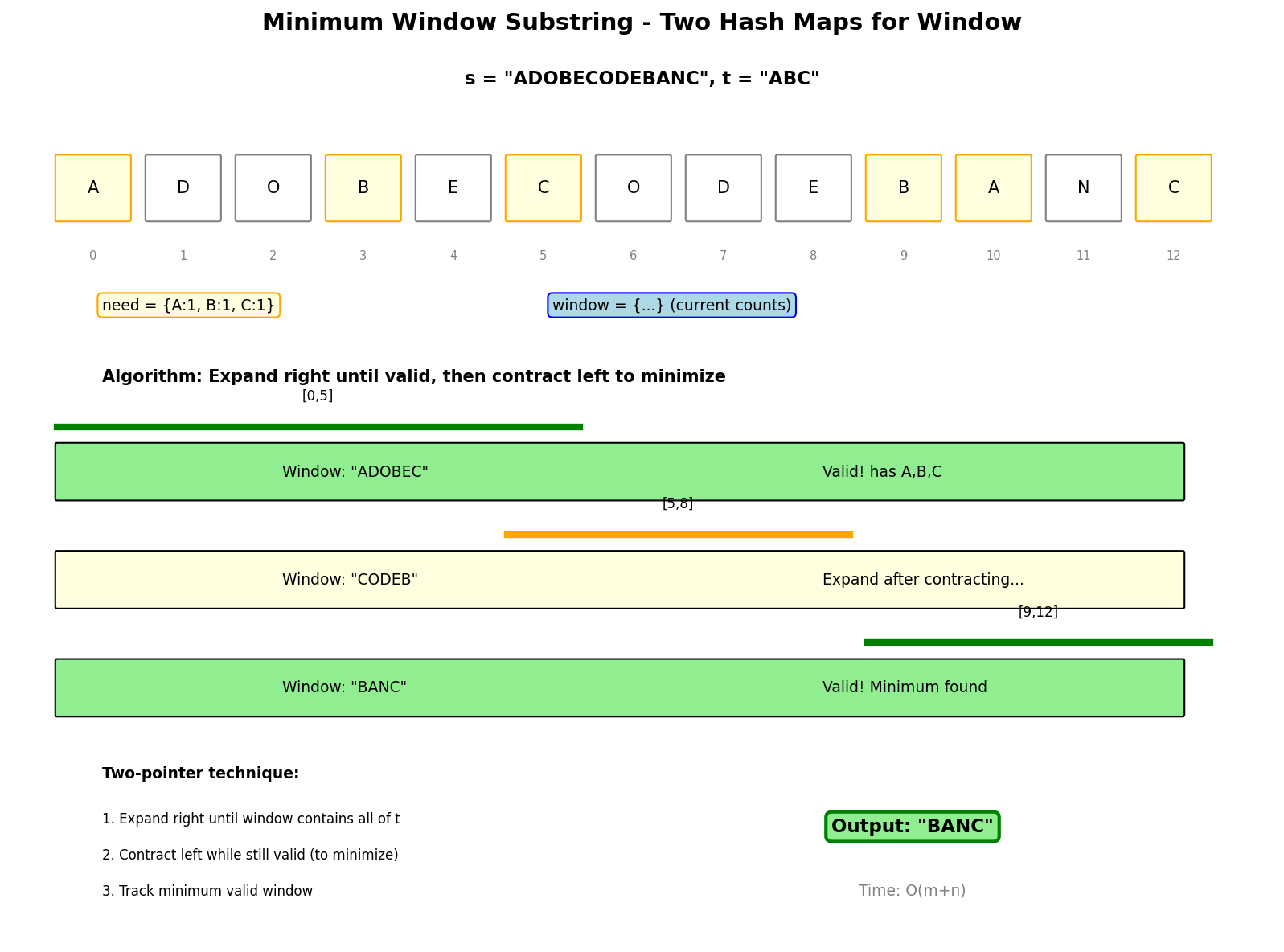
Key Insight
Use two pointers (sliding window) with hash maps to track character counts. Expand window until valid, then contract to find minimum.
Algorithm
- Count characters needed from
t - Expand
rightpointer until window contains all chars fromt - Contract
leftpointer while window is still valid - Track minimum valid window
- Repeat until
rightreaches end
Solution
from collections import Counter

def minWindow(s: str, t: str) -> str:
    """
    Find minimum window substring containing all characters of t.

    Time: O(m + n) where m = len(s), n = len(t)
    Space: O(m + n) for hash maps
    """
    if not s or not t or len(s) < len(t):
        return ""

    # Count characters needed from t
    need = Counter(t)
    required = len(need)  # Number of unique chars needed

    # Current window character counts
    window = {}
    formed = 0  # Number of unique chars with required count

    # Result tracking
    min_len = float('inf')
    result = (0, 0)  # (start, end) indices

    left = 0
    for right, char in enumerate(s):
        # Expand window
        window[char] = window.get(char, 0) + 1

        # Check if current char satisfies requirement
        if char in need and window[char] == need[char]:
            formed += 1

        # Contract window while valid
        while formed == required:
            # Update result if smaller window found
            if right - left + 1 < min_len:
                min_len = right - left + 1
                result = (left, right)

            # Remove leftmost character
            left_char = s[left]
            window[left_char] -= 1

            if left_char in need and window[left_char] < need[left_char]:
                formed -= 1

            left += 1

return "" if min_len == float('inf') else s[result[0]:result[1] + 1]import java.util.*;
class Solution {
public String minWindow(String s, String t) {
if (s.isEmpty() || t.isEmpty() || s.length() < t.length()) return "";
Map<Character, Integer> need = new HashMap<>();
for (char c : t.toCharArray()) need.merge(c, 1, Integer::sum);
int required = need.size();
Map<Character, Integer> window = new HashMap<>();
int formed = 0;
int minLen = Integer.MAX_VALUE;
int resLeft = 0, resRight = 0;
int left = 0;
for (int right = 0; right < s.length(); right++) {
char c = s.charAt(right);
window.merge(c, 1, Integer::sum);
if (need.containsKey(c) && window.get(c).equals(need.get(c))) {
formed++;
}
while (formed == required) {
if (right - left + 1 < minLen) {
minLen = right - left + 1;
resLeft = left;
resRight = right;
}
char leftChar = s.charAt(left);
window.merge(leftChar, -1, Integer::sum);
if (need.containsKey(leftChar) && window.get(leftChar) < need.get(leftChar)) {
formed--;
}
left++;
}
}
return minLen == Integer.MAX_VALUE ? "" : s.substring(resLeft, resRight + 1);
}
}Complexity: Time O(m + n) · Space O(m + n)
- Time: O(m + n) where m = len(s), n = len(t) - each character visited at most twice (once by right, once by left pointer)
- Space: O(m + n) for hash maps storing character counts from both strings
# Alternative: Track have vs need count
def minWindowSimpler(s: str, t: str) -> str:
    """Simpler tracking with have/need counts."""
    if not t or not s:
        return ""

    need = Counter(t)
    have = 0
    need_count = len(need)

    result = ""
    result_len = float('inf')
    left = 0
    window = {}

    for right in range(len(s)):
        char = s[right]
        window[char] = window.get(char, 0) + 1

        if char in need and window[char] == need[char]:
            have += 1

        while have == need_count:
            # Update result
            if (right - left + 1) < result_len:
                result = s[left:right + 1]
                result_len = right - left + 1

            # Shrink window
            window[s[left]] -= 1
            if s[left] in need and window[s[left]] < need[s[left]]:
                have -= 1
            left += 1

return resultComplexity: Time O(m + n) · Space O(m + n)
- Time: O(m + n) where m = len(s), n = len(t) - each character visited at most twice (once by right, once by left pointer)
- Space: O(m + n) for hash maps storing character counts from both strings
Optimized with Filtered Indices
def minWindowOptimized(s: str, t: str) -> str:
    """
    Optimization: Only iterate over relevant characters.
    Useful when s has many characters not in t.

    Time: O(m + n) but with smaller constant
    Space: O(m + n)
    """
    if not s or not t:
        return ""

    need = Counter(t)
    required = len(need)

    # Filter s to only include characters in t
    filtered = [(i, char) for i, char in enumerate(s) if char in need]

    window = {}
    formed = 0
    min_len = float('inf')
    result = (0, 0)
    left = 0

    for right in range(len(filtered)):
        char = filtered[right][1]
        window[char] = window.get(char, 0) + 1

        if window[char] == need[char]:
            formed += 1

        while formed == required:
            start = filtered[left][0]
            end = filtered[right][0]

            if end - start + 1 < min_len:
                min_len = end - start + 1
                result = (start, end)

            left_char = filtered[left][1]
            window[left_char] -= 1
            if window[left_char] < need[left_char]:
                formed -= 1
            left += 1

return "" if min_len == float('inf') else s[result[0]:result[1] + 1]Complexity: Time O(m + n) · Space O(m + n)
- Time: O(m + n) with smaller constant - only iterates over filtered characters that exist in t
- Space: O(m + n) for filtered list plus hash maps for character counts
Complexity Analysis
| Approach | Time | Space |
|---|---|---|
| Basic Sliding Window | O(m + n) | O(m + n) |
| Filtered Indices | O(m + n) | O(m + n) |
Each character is visited at most twice (once by right, once by left).
Visual Walkthrough
For s = "ADOBECODEBANC", t = "ABC":
need = {A:1, B:1, C:1}

Step-by-step trace:
1. A: window={A:1}, formed=1
2. D: window={A:1,D:1}
3. O: window={A:1,D:1,O:1}
4. B: window={A:1,D:1,O:1,B:1}, formed=2
5. E: window={A:1,D:1,O:1,B:1,E:1}
6. C: window={A:1,D:1,O:1,B:1,E:1,C:1}, formed=3 -> VALID!
   Contract: Remove A -> formed=2, invalid
7-12: Continue expanding and contracting
13. C: Finally get "BANC" as minimumEdge Cases
- t longer than s: Return ""
- Exact match:
s = "a", t = "a"-> "a" - Multiple valid windows: Return any minimum
- Case sensitive: 'A' != 'a'
- Duplicate requirements:
t = "aa"needs two 'a's
Variations
Find All Anagrams in a String
from typing import List

def findAnagrams(s: str, p: str) -> List[int]:
    """
    Find all start indices of p's anagrams in s.
    Fixed window size = len(p).

    Time: O(n)
    Space: O(1)
    """
    if len(p) > len(s):
        return []

    result = []
    need = Counter(p)
    window = Counter(s[:len(p)])

    if window == need:
        result.append(0)

    for i in range(len(p), len(s)):
        # Add new character
        window[s[i]] += 1
        # Remove old character
        old = s[i - len(p)]
        window[old] -= 1
        if window[old] == 0:
            del window[old]

        if window == need:
            result.append(i - len(p) + 1)

return resultPermutation in String
def checkInclusion(s1: str, s2: str) -> bool:
    """
    Check if s2 contains any permutation of s1.

    Time: O(n)
    Space: O(1)
    """
    if len(s1) > len(s2):
        return False

    need = Counter(s1)
    window = Counter(s2[:len(s1)])

    if window == need:
        return True

    for i in range(len(s1), len(s2)):
        window[s2[i]] += 1
        old = s2[i - len(s1)]
        window[old] -= 1
        if window[old] == 0:
            del window[old]

        if window == need:
            return True

return FalseMinimum Window Subsequence
def minWindowSubsequence(s: str, t: str) -> str:
    """
    Find minimum window in s that contains t as subsequence.
    Characters must appear in order (but not contiguous).

    Time: O(m * n)
    Space: O(1)
    """
    m, n = len(s), len(t)
    min_len = float('inf')
    result = ""

    i = 0
    while i < m:
        # Find subsequence starting from i
        j = 0
        start = i
        while i < m and j < n:
            if s[i] == t[j]:
                j += 1
            i += 1

        if j < n:
            break

        # Found subsequence ending at i-1, now minimize
        end = i - 1
        j = n - 1
        while j >= 0:
            if s[end] == t[j]:
                j -= 1
            end -= 1
        end += 1

        if i - end < min_len:
            min_len = i - end
            result = s[end:i]

        # Start next search from end + 1
        i = end + 1

return resultInterview Tips
- Clarify requirements: Case sensitive? Duplicates?
- Draw the window: Visualize expand and contract
- Explain formed count: Why track unique chars satisfied
- Discuss optimization: Filtered indices approach
Common Mistakes
- Not handling empty strings
- Off-by-one in window boundaries
- Forgetting to check
window[char] < need[char] - Not handling duplicates in t correctly
Related Problems
Find All Anagrams in a String (LeetCode 438)
Problem: Find all start indices of p's anagrams in s.
Key Insight: Fixed-size sliding window with frequency comparison.
Approach: Slide window of size len(p), compare frequency counts at each position.
Complexity: Time O(n), Space O(1)
Permutation in String (LeetCode 567)
Problem: Return true if s2 contains a permutation of s1.
Key Insight: Same as finding one anagram. Fixed-size window with frequency matching.
Approach: Slide window of size len(s1) over s2, check frequency match.
Complexity: Time O(n), Space O(1)
Minimum Window Subsequence (LeetCode 727)
Problem: Find minimum window in s1 where s2 is a subsequence.
Key Insight: Two-pointer: forward pass finds end, backward pass finds start.
Approach: Find each char of s2 in order (forward), then trace back to find shortest window.
Complexity: Time O(n * m), Space O(1)
Longest Substring Without Repeating Characters (LeetCode 3)
Problem: Find longest substring without duplicate characters.
Key Insight: Variable-size sliding window with set/map tracking characters.
Approach: Expand window, when duplicate found, shrink from left until valid.
Complexity: Time O(n), Space O(min(n, charset_size))
Substring with Concatenation of All Words (LeetCode 30)
Problem: Find all starting indices where concatenation of all words appears.
Key Insight: All words have same length. Use sliding window at word-level granularity.
Approach: Try each starting position mod word_length. Use word frequency matching.
Complexity: Time O(n * m), Space O(k) where k is number of words