Contains Duplicate
Problem Statement
Given an integer array nums, return true if any value appears at least twice in the array, and return false if every element is distinct.
Examples
Example 1
Input: nums = [1, 2, 3, 1]
Output: true
Explanation: The element 1 appears twice.Example 2
Input: nums = [1, 2, 3, 4]
Output: false
Explanation: All elements are distinct.Example 3
Input: nums = [1, 1, 1, 3, 3, 4, 3, 2, 4, 2]
Output: true
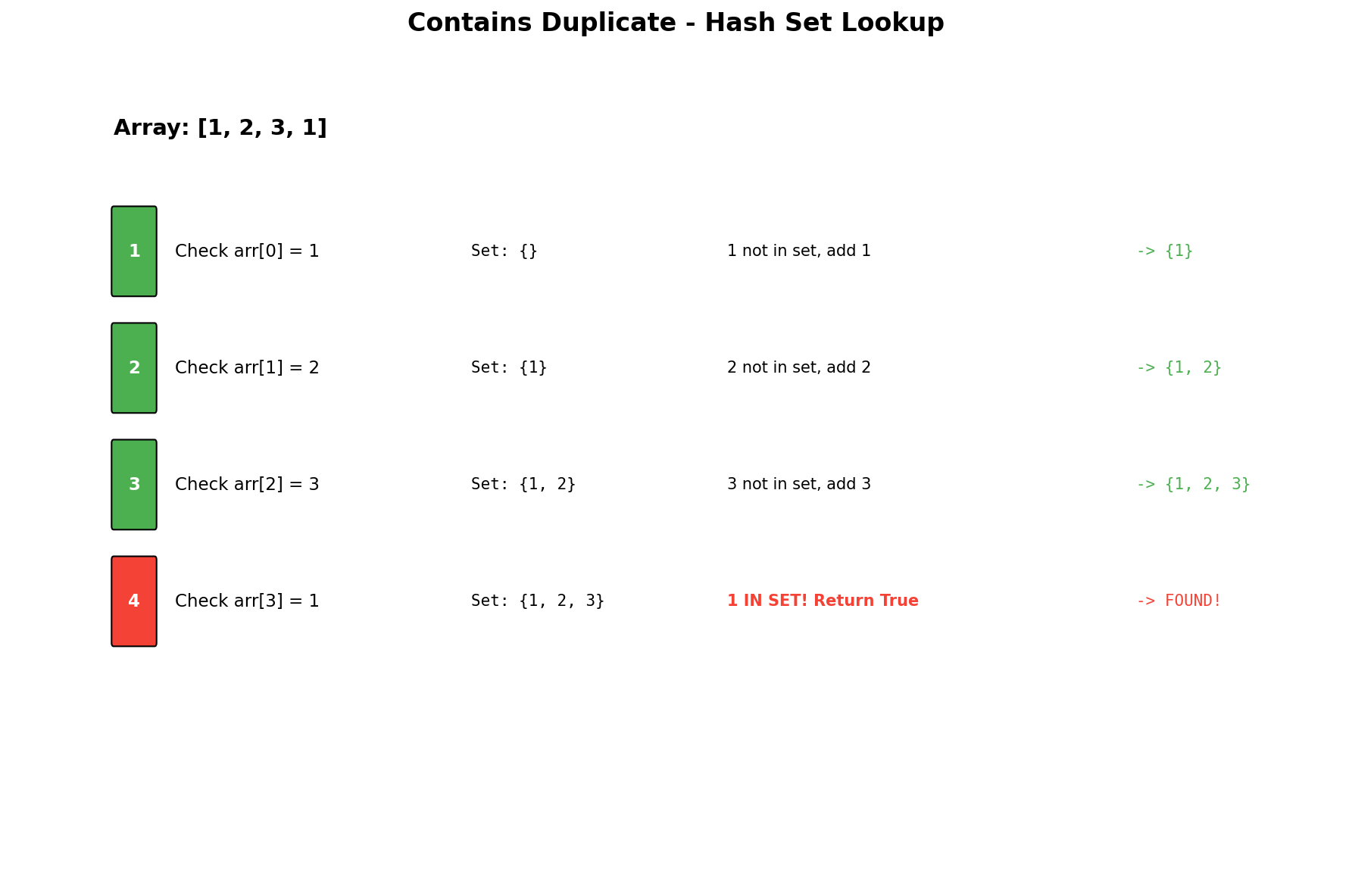
Explanation: Multiple elements appear more than once.Visual Explanation
Multiple Approaches
Approach 1: Hash Set (Optimal)
- Use a set to track seen elements
- O(1) average lookup time
Approach 2: Sorting
- Sort and check adjacent elements
- Modifies the array
Approach 3: Brute Force
- Compare every pair
- O(n^2) time - not recommended
Solution
def containsDuplicate(nums: list[int]) -> bool:
    """
    Check if array contains any duplicates using a hash set.

    Time Complexity: O(n)
    Space Complexity: O(n)
    """
    seen = set()

    for num in nums:
        if num in seen:
            return True
        seen.add(num)

return Falsepublic boolean containsDuplicate(int[] nums) {
Set<Integer> seen = new HashSet<>();
for (int num : nums) {
if (seen.contains(num)) {
return true;
}
seen.add(num);
}
return false;
}Complexity (Hash Set): Time O(n) · Space O(n)
- Time: Single pass with O(1) average hash set lookup/insert operations per element
- Space: Worst case stores all n elements when no duplicates exist
# One-liner using set length comparison
def containsDuplicate_oneliner(nums: list[int]) -> bool:
    """
    If set has fewer elements than array, duplicates exist.

    Time Complexity: O(n)
    Space Complexity: O(n)
    """
    return len(nums) != len(set(nums))


# Sorting approach (modifies array)
def containsDuplicate_sorting(nums: list[int]) -> bool:
    """
    Sort and check adjacent elements.

    Time Complexity: O(n log n)
    Space Complexity: O(1) if in-place sort, O(n) otherwise
    """
    nums.sort()

    for i in range(1, len(nums)):
        if nums[i] == nums[i - 1]:
            return True

    return False


# Brute force (for reference - do not use)
def containsDuplicate_bruteforce(nums: list[int]) -> bool:
    """
    Check every pair - NOT RECOMMENDED.

    Time Complexity: O(n^2)
    Space Complexity: O(1)
    """
    n = len(nums)
    for i in range(n):
        for j in range(i + 1, n):
            if nums[i] == nums[j]:
                return True
return FalseComplexity (One-liner): Time O(n) · Space O(n)
- Time: O(n) to build the set, O(1) for length comparisons
- Space: Creates a complete set of up to n elements; no early termination benefit
Complexity (Sorting): Time O(n log n) · Space O(1) to O(n)
- Time: Dominated by sort operation; linear scan afterward is O(n)
- Space: O(1) if in-place sort allowed (Timsort uses O(n) auxiliary space internally in Python)
Complexity (Brute Force): Time O(n^2) · Space O(1)
- Time: Nested loops compare each pair; n*(n-1)/2 comparisons total
- Space: No additional data structures used
Comparison of Approaches
| Approach | Time | Space | Pros | Cons |
|---|---|---|---|---|
| Hash Set | O(n) | O(n) | Fastest, early termination | Extra space |
| One-liner | O(n) | O(n) | Concise | Builds full set first |
| Sorting | O(n log n) | O(1)* | No extra space | Modifies array |
| Brute Force | O(n^2) | O(1) | Simple | Too slow |
*Note: Python's sort uses O(n) space internally
Step-by-Step Trace (Hash Set)
For nums = [1, 2, 3, 1]:
| Index | Value | seen (before) | In seen? | Action |
|---|---|---|---|---|
| 0 | 1 | {} | No | Add 1 |
| 1 | 2 | {1} | No | Add 2 |
| 2 | 3 | {1, 2} | No | Add 3 |
| 3 | 1 | {1, 2, 3} | Yes | Return True |
Complexity Analysis
Hash Set Approach (Recommended)
| Metric | Complexity |
|---|---|
| Time | O(n) - Single pass, O(1) hash operations |
| Space | O(n) - Worst case stores all elements |
Sorting Approach
| Metric | Complexity |
|---|---|
| Time | O(n log n) - Dominated by sorting |
| Space | O(1) to O(n) - Depends on sort implementation |
Edge Cases
- Empty array:
[]-> Returnfalse - Single element:
[1]-> Returnfalse - Two same elements:
[1, 1]-> Returntrue - Two different elements:
[1, 2]-> Returnfalse - All same elements:
[5, 5, 5, 5]-> Returntrue - Large array, no duplicates:
[1, 2, ..., n]-> Returnfalse - Negative numbers:
[-1, -1]-> Returntrue
Variations
Contains Duplicate II (Within K Distance)
def containsNearbyDuplicate(nums: list[int], k: int) -> bool:
    """
    Return true if nums[i] == nums[j] and abs(i-j) <= k.
    """
    index_map = {}

    for i, num in enumerate(nums):
        if num in index_map and i - index_map[num] <= k:
            return True
        index_map[num] = i

return FalseComplexity: Time O(n) · Space O(min(n, k))
- Time: Single pass with O(1) hash map operations per element
- Space: Map stores at most min(n, k+1) entries since we track indices within distance k
Contains Duplicate III (Within K Distance and T Value Difference)
def containsNearbyAlmostDuplicate(nums: list[int], k: int, t: int) -> bool:
    """
    Return true if nums[i] and nums[j] differ by at most t
    and indices differ by at most k.
    Uses bucket sort concept.
    """
    if t < 0:
        return False

    buckets = {}
    bucket_size = t + 1

    for i, num in enumerate(nums):
        bucket_id = num // bucket_size

        # Check same bucket
        if bucket_id in buckets:
            return True

        # Check adjacent buckets
        if bucket_id - 1 in buckets and num - buckets[bucket_id - 1] <= t:
            return True
        if bucket_id + 1 in buckets and buckets[bucket_id + 1] - num <= t:
            return True

        buckets[bucket_id] = num

        # Remove old buckets outside window
        if i >= k:
            old_bucket = nums[i - k] // bucket_size
            del buckets[old_bucket]

return FalseComplexity: Time O(n) · Space O(min(n, k))
- Time: Single pass; bucket operations (insert, delete, lookup) are O(1)
- Space: At most k+1 buckets maintained due to sliding window cleanup
Common Mistakes
- Using list instead of set - O(n) lookup instead of O(1)
- Not considering empty arrays - Handle edge case
- Modifying input when not allowed - Sorting changes the array
- Using brute force - O(n^2) will fail on large inputs
Related Problems
Contains Duplicate II (LeetCode 219)
Problem: Check if there are two distinct indices i and j where nums[i] == nums[j] AND abs(i - j) <= k.
Key Insight: Use hash map to store most recent index of each number, check distance on duplicates.
Approach: For each number, if already in map and distance <= k, return true. Update map with current index.
Complexity: O(n) time, O(min(n, k)) space
Contains Duplicate III (LeetCode 220)
Problem: Check if there are indices i, j where abs(i - j) <= k AND abs(nums[i] - nums[j]) <= t.
Key Insight: Use bucket sort concept - numbers in same or adjacent buckets could satisfy condition.
Approach: Create buckets of size t+1. Check same bucket and adjacent buckets. Remove old buckets outside window k.
Complexity: O(n) time, O(min(n, k)) space
Find the Duplicate Number (LeetCode 287)
Problem: Find duplicate in array of n+1 integers where each is in [1, n], without modifying array.
Key Insight: Treat array as linked list where value points to next index. Use Floyd's cycle detection.
Approach: Fast/slow pointers to find cycle, then find cycle entrance (the duplicate).
Complexity: O(n) time, O(1) space
Two Sum (LeetCode 1)
Problem: Find two indices whose values sum to target.
Key Insight: Use hash map to check for complement in O(1).
Approach: For each number, check if (target - num) exists in map. If not, add current number to map.
Complexity: O(n) time, O(n) space
Key Takeaways
- Hash sets provide O(1) average lookup for duplicate detection
- The one-liner
len(nums) != len(set(nums))is Pythonic but less efficient for early termination - Consider trade-offs between time, space, and whether input modification is allowed
- This is a fundamental pattern used in many other problems