LRU Cache
Problem Statement
Design a data structure that follows the constraints of a Least Recently Used (LRU) cache.
Implement the LRUCache class:
LRUCache(int capacity)Initialize the LRU cache with positive size capacity.int get(int key)Return the value of the key if the key exists, otherwise return -1.void put(int key, int value)Update the value of the key if the key exists. Otherwise, add the key-value pair to the cache. If the number of keys exceeds the capacity, evict the least recently used key.
The functions get and put must each run in O(1) average time complexity.
LeetCode: 146. LRU Cache
Examples
Example 1:
Input:
["LRUCache", "put", "put", "get", "put", "get", "put", "get", "get", "get"]
[[2], [1, 1], [2, 2], [1], [3, 3], [2], [4, 4], [1], [3], [4]]

Output:
[null, null, null, 1, null, -1, null, -1, 3, 4]

Explanation:
LRUCache lRUCache = new LRUCache(2);
lRUCache.put(1, 1); // cache is {1=1}
lRUCache.put(2, 2); // cache is {1=1, 2=2}
lRUCache.get(1);    // return 1, cache is {2=2, 1=1}
lRUCache.put(3, 3); // evicts key 2, cache is {1=1, 3=3}
lRUCache.get(2);    // returns -1 (not found)
lRUCache.put(4, 4); // evicts key 1, cache is {3=3, 4=4}
lRUCache.get(1);    // return -1 (not found)
lRUCache.get(3);    // return 3, cache is {4=4, 3=3}
lRUCache.get(4); // return 4, cache is {3=3, 4=4}Constraints
1 <= capacity <= 30000 <= key <= 10^40 <= value <= 10^5- At most
2 * 10^5calls will be made togetandput.
Hash Map + Doubly Linked List Approach
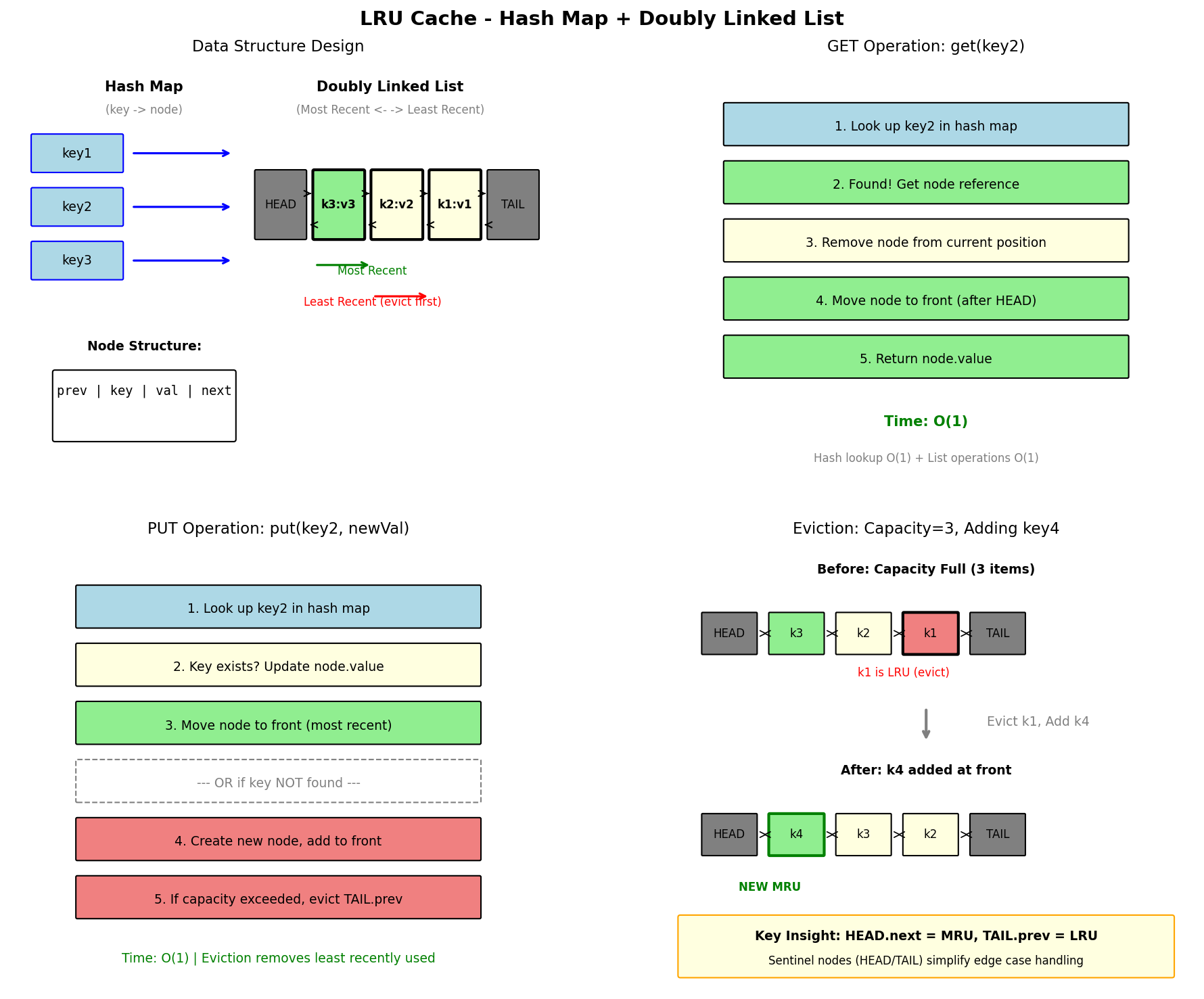
Key Insight
- Hash Map: O(1) key lookup to find nodes
- Doubly Linked List: O(1) insertion/deletion to maintain recency order
Data Structure
HashMap: key -> Node pointer

Doubly Linked List:
Head <-> Node(k1,v1) <-> Node(k2,v2) <-> ... <-> Tail
(LRU) (MRU)Solution
class ListNode:
    """Doubly linked list node."""
    def __init__(self, key: int = 0, val: int = 0):
        self.key = key
        self.val = val
        self.prev = None
        self.next = None


class LRUCache:
    """
    LRU Cache using HashMap + Doubly Linked List.

    Time: O(1) for get and put
    Space: O(capacity)
    """

    def __init__(self, capacity: int):
        self.capacity = capacity
        self.cache = {}  # key -> ListNode

        # Dummy head and tail for easier operations
        self.head = ListNode()
        self.tail = ListNode()
        self.head.next = self.tail
        self.tail.prev = self.head

    def _remove(self, node: ListNode) -> None:
        """Remove node from linked list."""
        node.prev.next = node.next
        node.next.prev = node.prev

    def _add_to_end(self, node: ListNode) -> None:
        """Add node to end (most recently used)."""
        node.prev = self.tail.prev
        node.next = self.tail
        self.tail.prev.next = node
        self.tail.prev = node

    def _move_to_end(self, node: ListNode) -> None:
        """Move existing node to end (mark as recently used)."""
        self._remove(node)
        self._add_to_end(node)

    def get(self, key: int) -> int:
        """Get value and mark as recently used."""
        if key not in self.cache:
            return -1

        node = self.cache[key]
        self._move_to_end(node)
        return node.val

    def put(self, key: int, value: int) -> None:
        """Add or update key-value pair."""
        if key in self.cache:
            # Update existing
            node = self.cache[key]
            node.val = value
            self._move_to_end(node)
        else:
            # Add new
            if len(self.cache) >= self.capacity:
                # Evict LRU (node after head)
                lru = self.head.next
                self._remove(lru)
                del self.cache[lru.key]

            # Add new node
            node = ListNode(key, value)
            self.cache[key] = node
self._add_to_end(node)class LRUCache {
private static class DLLNode {
int key, val;
DLLNode prev, next;
DLLNode() {}
DLLNode(int key, int val) { this.key = key; this.val = val; }
}
private final int capacity;
private final Map<Integer, DLLNode> cache = new HashMap<>();
private final DLLNode head = new DLLNode(), tail = new DLLNode();
public LRUCache(int capacity) {
this.capacity = capacity;
head.next = tail;
tail.prev = head;
}
private void remove(DLLNode node) {
node.prev.next = node.next;
node.next.prev = node.prev;
}
private void addToEnd(DLLNode node) {
node.prev = tail.prev;
node.next = tail;
tail.prev.next = node;
tail.prev = node;
}
public int get(int key) {
if (!cache.containsKey(key)) return -1;
DLLNode node = cache.get(key);
remove(node);
addToEnd(node);
return node.val;
}
public void put(int key, int value) {
if (cache.containsKey(key)) {
DLLNode node = cache.get(key);
node.val = value;
remove(node);
addToEnd(node);
} else {
if (cache.size() >= capacity) {
DLLNode lru = head.next;
remove(lru);
cache.remove(lru.key);
}
DLLNode node = new DLLNode(key, value);
cache.put(key, node);
addToEnd(node);
}
}
}Complexity: Time O(1) · Space O(capacity)
- Time: O(1) for both get and put operations - hash map provides O(1) lookup, doubly linked list provides O(1) insertion/deletion
- Space: O(capacity) for storing at most capacity key-value pairs in the hash map and linked list
Using Python's OrderedDict
from collections import OrderedDict

class LRUCacheOrderedDict(OrderedDict):
    """
    LRU Cache using OrderedDict.
    OrderedDict maintains insertion order and supports move_to_end.
    """

    def __init__(self, capacity: int):
        super().__init__()
        self.capacity = capacity

    def get(self, key: int) -> int:
        if key not in self:
            return -1
        self.move_to_end(key)
        return self[key]

    def put(self, key: int, value: int) -> None:
        if key in self:
            self.move_to_end(key)
        self[key] = value
        if len(self) > self.capacity:
self.popitem(last=False) # Remove first (LRU)Complexity: Time O(1) · Space O(capacity)
- Time: O(1) for get and put - OrderedDict internally uses hash map and doubly linked list
- Space: O(capacity) for storing the key-value pairs in the OrderedDict
Complexity Analysis
| Operation | Time | Space |
|---|---|---|
| get | O(1) | - |
| put | O(1) | - |
| Space | - | O(capacity) |
Why Doubly Linked List?
- Singly Linked List: Deletion requires O(n) to find previous node
- Doubly Linked List: Deletion is O(1) with direct node reference
Edge Cases
- Capacity 1: Only one element, frequent evictions
- Update existing key: Should move to end (recently used)
- Get non-existent key: Return -1, no state change
- Repeated access: Should update recency each time
Variations
LRU Cache with TTL (Time-To-Live)
import time

class LRUCacheWithTTL:
    """LRU Cache with expiration time."""

    def __init__(self, capacity: int, ttl: float):
        self.capacity = capacity
        self.ttl = ttl
        self.cache = OrderedDict()  # key -> (value, timestamp)

    def _is_expired(self, key: int) -> bool:
        if key not in self.cache:
            return True
        _, timestamp = self.cache[key]
        return time.time() - timestamp > self.ttl

    def _cleanup_expired(self) -> None:
        """Remove all expired entries."""
        expired = [k for k in self.cache if self._is_expired(k)]
        for k in expired:
            del self.cache[k]

    def get(self, key: int) -> int:
        if key not in self.cache or self._is_expired(key):
            if key in self.cache:
                del self.cache[key]
            return -1

        value, _ = self.cache[key]
        # Update timestamp and move to end
        self.cache[key] = (value, time.time())
        self.cache.move_to_end(key)
        return value

    def put(self, key: int, value: int) -> None:
        self._cleanup_expired()

        if key in self.cache:
            self.cache.move_to_end(key)

        self.cache[key] = (value, time.time())

        if len(self.cache) > self.capacity:
self.cache.popitem(last=False)LFU Cache (Least Frequently Used)
from collections import defaultdict

class LFUCache:
    """
    Least Frequently Used Cache.
    Evicts least frequently used; ties broken by LRU.
    """

    def __init__(self, capacity: int):
        self.capacity = capacity
        self.min_freq = 0
        self.key_to_val = {}
        self.key_to_freq = {}
        self.freq_to_keys = defaultdict(OrderedDict)

    def _update_freq(self, key: int) -> None:
        """Increment frequency of key."""
        freq = self.key_to_freq[key]
        self.key_to_freq[key] = freq + 1

        # Remove from current frequency list
        del self.freq_to_keys[freq][key]
        if not self.freq_to_keys[freq]:
            del self.freq_to_keys[freq]
            if self.min_freq == freq:
                self.min_freq += 1

        # Add to new frequency list
        self.freq_to_keys[freq + 1][key] = None

    def get(self, key: int) -> int:
        if key not in self.key_to_val:
            return -1

        self._update_freq(key)
        return self.key_to_val[key]

    def put(self, key: int, value: int) -> None:
        if self.capacity <= 0:
            return

        if key in self.key_to_val:
            self.key_to_val[key] = value
            self._update_freq(key)
            return

        if len(self.key_to_val) >= self.capacity:
            # Evict LFU (and LRU among ties)
            evict_key, _ = self.freq_to_keys[self.min_freq].popitem(last=False)
            del self.key_to_val[evict_key]
            del self.key_to_freq[evict_key]

        # Add new key
        self.key_to_val[key] = value
        self.key_to_freq[key] = 1
        self.freq_to_keys[1][key] = None
self.min_freq = 1Thread-Safe LRU Cache
import threading

class ThreadSafeLRUCache:
    """Thread-safe LRU Cache with locks."""

    def __init__(self, capacity: int):
        self.cache = LRUCacheOrderedDict(capacity)
        self.lock = threading.RLock()

    def get(self, key: int) -> int:
        with self.lock:
            return self.cache.get(key)

    def put(self, key: int, value: int) -> None:
        with self.lock:
self.cache.put(key, value)Interview Tips
- Clarify requirements: Thread safety? TTL? Eviction callback?
- Draw the data structure: Visualize HashMap + DLL
- Walk through operations: Show how get/put modify the structure
- Discuss alternatives: OrderedDict, LinkedHashMap (Java)
Common Mistakes
- Not handling key update (should move to end)
- Off-by-one errors with dummy nodes
- Forgetting to update HashMap when evicting
- Not moving node on get (only on put)
Related Problems
LFU Cache (LeetCode 460)
Problem: Least Frequently Used cache with O(1) get/put.
Key Insight: Track frequency of each key. Multiple lists for each frequency level.
Approach: Hash map for key lookup, frequency buckets with doubly linked lists, track min frequency.
Complexity: Time O(1) for get/put, Space O(capacity)
All O(1) Data Structure (LeetCode 432)
Problem: Design data structure for inc/dec/getMaxKey/getMinKey all in O(1).
Key Insight: Doubly linked list of frequency buckets, hash map for O(1) key lookup.
Approach: Each bucket contains keys with same count. Move keys between buckets on inc/dec.
Complexity: Time O(1) for all operations, Space O(n)
Design Twitter (LeetCode 355)
Problem: Design simplified Twitter with post, follow, getNewsFeed.
Key Insight: Merge k sorted lists for news feed. Hash maps for followers and tweets.
Approach: Each user has tweet list with timestamps. Merge-k algorithm for feed.
Complexity: getNewsFeed O(k log k) where k is following count
Insert Delete GetRandom O(1) (LeetCode 380)
Problem: Design data structure with O(1) insert, delete, and getRandom.
Key Insight: Array for O(1) random access, hash map for O(1) lookup. Swap-delete trick.
Approach: Store elements in array, map values to indices. Swap with last element for O(1) delete.
Complexity: Time O(1) for all operations, Space O(n)