LRU Cache Implementation
Combining hash map with doubly linked list for O(1) operations
Overview
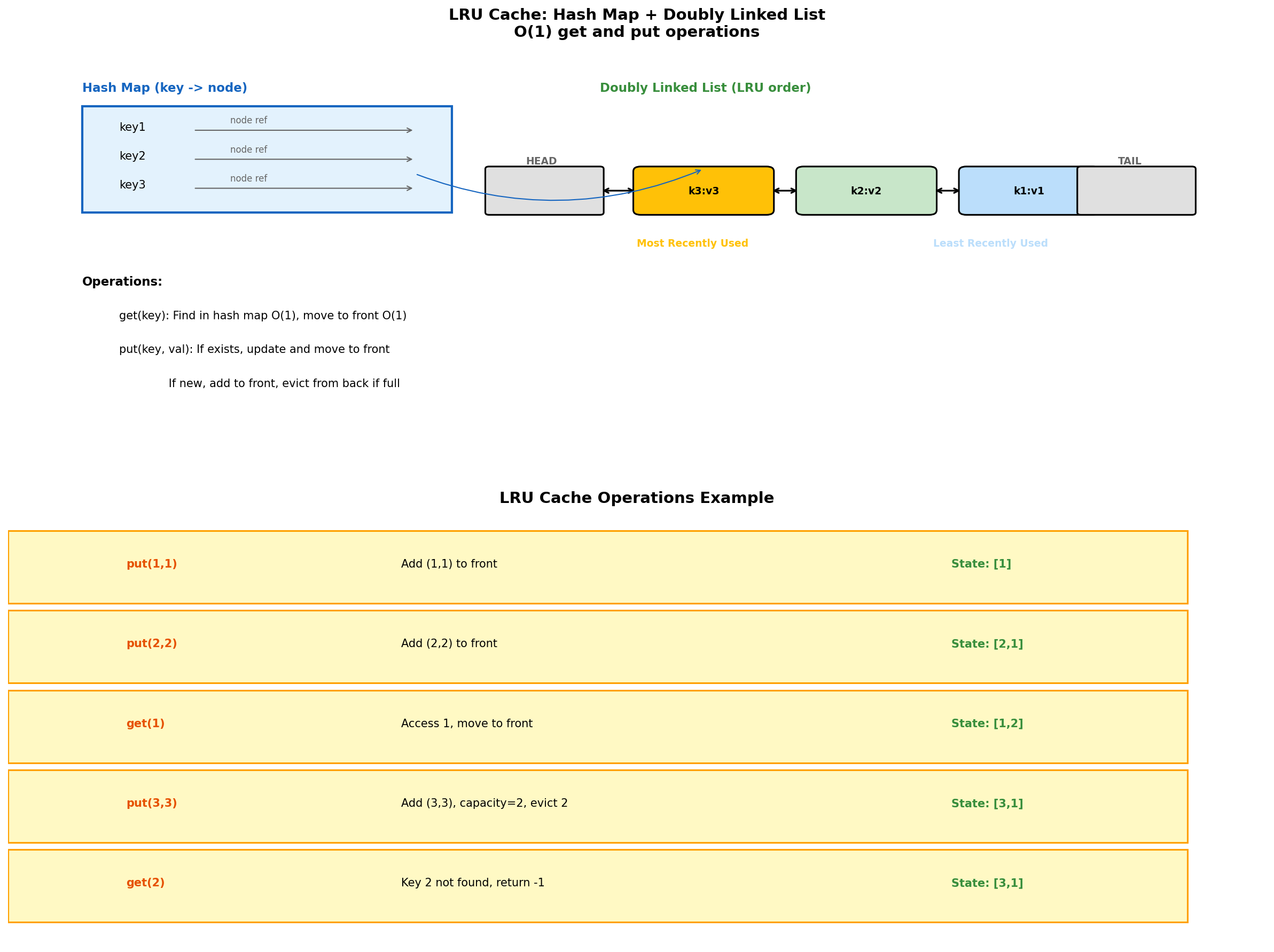
LRU (Least Recently Used) Cache is a classic data structure design problem that combines a hash map with a doubly linked list to achieve O(1) time complexity for both get and put operations. It's frequently asked in technical interviews and tests your understanding of data structure design.
Problem Statement (LeetCode #146)
Design a data structure that follows the constraints of a Least Recently Used (LRU) cache:
LRUCache(int capacity): Initialize the cache with positive size capacityint get(int key): Return the value if key exists, otherwise return -1void put(int key, int value): Update or insert the value. If the number of keys exceeds capacity, evict the least recently used key.
Both operations must run in O(1) average time complexity.
Solution
Data Structure Design
class DLLNode:
    """Doubly linked list node for LRU Cache."""
    def __init__(self, key=0, value=0):
        self.key = key
        self.value = value
        self.prev = None
        self.next = None


class LRUCache:
    """
    LRU Cache using Hash Map + Doubly Linked List.

    Hash Map: key -> node (O(1) lookup)
    Doubly Linked List: maintains access order (O(1) move/remove)

    Structure:
    HEAD <-> node1 <-> node2 <-> ... <-> nodeN <-> TAIL
    (most recent)                        (least recent)
    """

    def __init__(self, capacity: int):
        self.capacity = capacity
        self.cache = {}  # key -> node

        # Sentinel nodes (avoid null checks)
        self.head = DLLNode()  # Most recently used
        self.tail = DLLNode()  # Least recently used
        self.head.next = self.tail
        self.tail.prev = self.head

    def _remove(self, node: DLLNode) -> None:
        """Remove a node from the doubly linked list."""
        node.prev.next = node.next
        node.next.prev = node.prev

    def _add_to_front(self, node: DLLNode) -> None:
        """Add a node right after head (most recent position)."""
        node.next = self.head.next
        node.prev = self.head
        self.head.next.prev = node
        self.head.next = node

    def _move_to_front(self, node: DLLNode) -> None:
        """Move existing node to front (mark as most recently used)."""
        self._remove(node)
        self._add_to_front(node)

    def get(self, key: int) -> int:
        """
        Get value by key.
        If found, move to front (mark as recently used).
        """
        if key not in self.cache:
            return -1

        node = self.cache[key]
        self._move_to_front(node)
        return node.value

    def put(self, key: int, value: int) -> None:
        """
        Insert or update key-value pair.
        If key exists, update value and move to front.
        If new key, add to front and evict LRU if over capacity.
        """
        if key in self.cache:
            # Update existing
            node = self.cache[key]
            node.value = value
            self._move_to_front(node)
        else:
            # Add new
            node = DLLNode(key, value)
            self.cache[key] = node
            self._add_to_front(node)

            # Evict if over capacity
            if len(self.cache) > self.capacity:
                # Remove LRU (node before tail)
                lru = self.tail.prev
                self._remove(lru)
del self.cache[lru.key]class LRUCache {
private static class DLLNode {
int key, value;
DLLNode prev, next;
DLLNode() {}
DLLNode(int key, int value) { this.key = key; this.value = value; }
}
private final int capacity;
private final Map<Integer, DLLNode> cache = new HashMap<>();
private final DLLNode head = new DLLNode(), tail = new DLLNode();
public LRUCache(int capacity) {
this.capacity = capacity;
head.next = tail;
tail.prev = head;
}
private void remove(DLLNode node) {
node.prev.next = node.next;
node.next.prev = node.prev;
}
private void addToFront(DLLNode node) {
node.next = head.next;
node.prev = head;
head.next.prev = node;
head.next = node;
}
public int get(int key) {
if (!cache.containsKey(key)) return -1;
DLLNode node = cache.get(key);
remove(node);
addToFront(node);
return node.value;
}
public void put(int key, int value) {
if (cache.containsKey(key)) {
DLLNode node = cache.get(key);
node.value = value;
remove(node);
addToFront(node);
} else {
DLLNode node = new DLLNode(key, value);
cache.put(key, node);
addToFront(node);
if (cache.size() > capacity) {
DLLNode lru = tail.prev;
remove(lru);
cache.remove(lru.key);
}
}
}
}Complexity: Time O(1) for get/put · Space O(capacity)
- Time: O(1) for both operations because hash map provides O(1) lookup, and doubly linked list provides O(1) insertion/deletion/move
- Space: O(capacity) because we store at most
capacitynodes in both the hash map and doubly linked list
How It Works
Get Operation
1. Check if key exists in hash map -> O(1)
2. If not found, return -1
3. If found:
   a. Get node reference from hash map -> O(1)
   b. Remove node from current position -> O(1)
   c. Add node to front (most recent) -> O(1)
d. Return valuePut Operation
1. If key exists:
   a. Update value in existing node -> O(1)
   b. Move node to front -> O(1)

2. If key doesn't exist:
   a. Create new node -> O(1)
   b. Add to hash map -> O(1)
   c. Add node to front -> O(1)
   d. If over capacity:
      - Get LRU node (before tail) -> O(1)
      - Remove from list -> O(1)
- Remove from hash map -> O(1)Example Walkthrough
# Initialize cache with capacity 2
cache = LRUCache(2)

cache.put(1, 1)    # Cache: {1=1}
                   # List: HEAD <-> [1:1] <-> TAIL

cache.put(2, 2)    # Cache: {1=1, 2=2}
                   # List: HEAD <-> [2:2] <-> [1:1] <-> TAIL

cache.get(1)       # Returns 1, moves key 1 to front
                   # List: HEAD <-> [1:1] <-> [2:2] <-> TAIL

cache.put(3, 3)    # Over capacity! Evict LRU (key 2)
                   # Cache: {1=1, 3=3}
                   # List: HEAD <-> [3:3] <-> [1:1] <-> TAIL

cache.get(2)       # Returns -1 (was evicted)

cache.put(4, 4)    # Evict LRU (key 1)
                   # Cache: {3=3, 4=4}
                   # List: HEAD <-> [4:4] <-> [3:3] <-> TAIL

cache.get(1)       # Returns -1 (was evicted)
cache.get(3)       # Returns 3, moves to front
cache.get(4) # Returns 4, moves to frontAlternative Implementation Using OrderedDict
Python's OrderedDict maintains insertion order and supports moving items to end:
from collections import OrderedDict

class LRUCache_OrderedDict:
    """
    Simplified implementation using OrderedDict.
    Note: move_to_end is O(1) in Python 3.7+
    """

    def __init__(self, capacity: int):
        self.capacity = capacity
        self.cache = OrderedDict()

    def get(self, key: int) -> int:
        if key not in self.cache:
            return -1
        # Move to end (most recent)
        self.cache.move_to_end(key)
        return self.cache[key]

    def put(self, key: int, value: int) -> None:
        if key in self.cache:
            # Update and move to end
            self.cache.move_to_end(key)
        self.cache[key] = value

        # Evict oldest if over capacity
        if len(self.cache) > self.capacity:
self.cache.popitem(last=False)Complexity: Time O(1) for get/put · Space O(capacity)
- Time: O(1) because Python's OrderedDict provides O(1) move_to_end() and popitem() operations
- Space: O(capacity) because the OrderedDict stores at most
capacitykey-value pairs
Note: While OrderedDict is simpler, interviewers usually expect the explicit hash map + doubly linked list implementation to verify you understand the underlying mechanics.
Complexity Analysis
| Operation | Time | Space |
|---|---|---|
| get() | O(1) | - |
| put() | O(1) | - |
| Overall | - | O(capacity) |
Common Variations
LFU Cache (LeetCode #460)
Evict least frequently used item (track access count):
class LFUCache:
    """
    Least Frequently Used Cache.
    Uses hash maps for O(1) operations:
    - key -> (value, frequency)
    - frequency -> doubly linked list of keys
    """
    def __init__(self, capacity: int):
        self.capacity = capacity
        self.cache = {}  # key -> [value, freq]
        self.freq_map = defaultdict(OrderedDict)  # freq -> {key: None}
        self.min_freq = 0

    def get(self, key: int) -> int:
        if key not in self.cache:
            return -1

        value, freq = self.cache[key]
        self._update_freq(key, freq)
        return value

    def put(self, key: int, value: int) -> None:
        if self.capacity == 0:
            return

        if key in self.cache:
            _, freq = self.cache[key]
            self.cache[key] = [value, freq]
            self._update_freq(key, freq)
        else:
            if len(self.cache) >= self.capacity:
                # Evict LFU
                evict_key, _ = self.freq_map[self.min_freq].popitem(last=False)
                del self.cache[evict_key]

            self.cache[key] = [value, 1]
            self.freq_map[1][key] = None
            self.min_freq = 1

    def _update_freq(self, key, freq):
        # Remove from current frequency list
        del self.freq_map[freq][key]
        if not self.freq_map[freq] and self.min_freq == freq:
            self.min_freq += 1

        # Add to next frequency list
        self.cache[key][1] = freq + 1
self.freq_map[freq + 1][key] = NoneComplexity: Time O(1) for get/put · Space O(capacity)
- Time: O(1) because all operations (lookup, update frequency, eviction) use hash maps with O(1) operations
- Space: O(capacity) for storing cache entries plus O(capacity) for frequency tracking structures
TTL Cache
Cache with time-to-live expiration:
import time

class TTLCache:
    """LRU Cache with TTL (time-to-live) expiration."""

    def __init__(self, capacity: int, ttl: int):
        self.capacity = capacity
        self.ttl = ttl  # seconds
        self.cache = OrderedDict()  # key -> (value, timestamp)

    def _is_expired(self, timestamp):
        return time.time() - timestamp > self.ttl

    def get(self, key: int) -> int:
        if key not in self.cache:
            return -1

        value, timestamp = self.cache[key]
        if self._is_expired(timestamp):
            del self.cache[key]
            return -1

        # Refresh timestamp and move to end
        self.cache.move_to_end(key)
        self.cache[key] = (value, time.time())
        return value

    def put(self, key: int, value: int) -> None:
        timestamp = time.time()

        if key in self.cache:
            self.cache.move_to_end(key)
        self.cache[key] = (value, timestamp)

        # Evict expired and over-capacity
        while len(self.cache) > self.capacity:
self.cache.popitem(last=False)Complexity: Time O(1) amortized for get/put · Space O(capacity)
- Time: O(1) amortized; get may do O(1) expiration check, put may evict expired entries but amortizes to O(1)
- Space: O(capacity) because we store at most
capacityentries with their timestamps
Interview Tips
- Start with the design: Explain why hash map + DLL before coding
- Draw the structure: Show sentinel nodes, pointers
- Explain trade-offs: Why DLL over singly linked
- Handle edge cases: Empty cache, capacity 0, repeated keys
- Know complexities: Both operations must be O(1)
Common Follow-up Questions
- "What if we need thread safety?" (Use locks)
- "What if capacity is very large?" (Consider sharding)
- "Can you implement LFU instead?" (Track frequencies)
- "How would you add TTL?" (Store timestamps)
Why This Design?
| Requirement | Data Structure | Why |
|---|---|---|
| O(1) lookup | Hash Map | Direct key access |
| O(1) ordering | Doubly Linked List | Move nodes without traversal |
| Track recency | List order | Head = recent, Tail = LRU |
| O(1) eviction | DLL tail | Immediate access to oldest |
Why not just a hash map? Cannot track access order. Why not just a list? O(n) lookup by key. Why doubly linked? Need O(1) removal without knowing previous node.
Related Problems
LRU Cache (LeetCode 146)
Problem: Design a data structure for Least Recently Used cache with O(1) get and put operations.
Key Insight: Combine hash map (O(1) lookup) with doubly linked list (O(1) insertion/deletion).
Approach: Hash map stores key->node. DLL maintains recency order. On access, move node to front. On eviction, remove from tail.
Complexity: O(1) time for get/put, O(capacity) space
LFU Cache (LeetCode 460)
Problem: Design Least Frequently Used cache. Evict least frequently used item; if tie, evict least recently used.
Key Insight: Track frequency counts with hash maps. Each frequency maps to a list of keys in access order.
Approach: Maintain key->(value,freq), freq->OrderedDict of keys, and min_freq tracker.
Complexity: O(1) time for get/put, O(capacity) space
All O'One Data Structure (LeetCode 432)
Problem: Design a data structure to increment/decrement string counts and return max/min key strings in O(1).
Key Insight: Use hash map with doubly linked list of count buckets, each bucket contains all keys with that count.
Approach: Buckets DLL sorted by count. Keys move between adjacent buckets on inc/dec.
Complexity: O(1) time for all operations
Design Twitter (LeetCode 355)
Problem: Design simplified Twitter with postTweet, getNewsFeed (10 most recent), follow, and unfollow.
Key Insight: Use hash maps for user->tweets and user->followees. Merge k sorted lists for news feed.
Approach: Store tweets with timestamps. For feed, collect all followees' tweets and use heap to get top 10.
Complexity: O(k log k) for getNewsFeed where k = number of followees