Tier 5: HashMap + Heap + Binary Search
6 problems | Priority: Medium | Time estimate: 2-3 hours
Three Tools, One Tier
HashMap, Heap, and Binary Search are your optimization swiss army knives. They rarely define a problem category on their own -- instead, they show up as the key ingredient that takes a brute-force solution from O(n^2) down to O(n) or O(n log n). If graphs and trees test your ability to model problems, this tier tests your ability to recognize which tool shaves off a factor of n.
- HashMap turns "find something" from O(n) to O(1). Grouping, counting, caching -- it is the workhorse of optimization.
- Heap answers "give me the best/worst K" without fully sorting. Any time you hear "top K", "Kth largest", or "merge sorted things", reach for a heap.
- Binary Search halves the search space every step. It works on sorted arrays, but also on answer spaces -- any monotonic function can be binary searched.
Master these three and you will have a tool for nearly every optimization question interviewers throw at you.
Problem Table
| # | Problem | LC # | Pattern | Why |
|---|---|---|---|---|
| 24 | Group Anagrams | 49 | HashMap | "Group rotations" variant |
| 25 | Top K Frequent Elements | 347 | Heap / Bucket sort | "Most talkative users" variant |
| 26 | Merge K Sorted Lists | 23 | Min-heap | Classic |
| 27 | Search in Rotated Sorted Array | 33 | Binary search | Tricky edge cases |
| 28 | Find Peak Element | 162 | Binary search | Quick pattern |
| 29 | Kth Largest Element in an Array | 215 | Quickselect / Heap | Common |
HashMap Patterns
HashMaps solve three families of problems in interviews:
1. Grouping
Given a collection of items, group them by some computed key. The trick is choosing the right key function.
# Grouping pattern
from collections import defaultdict

def group_by_key(items):
    groups = defaultdict(list)
    for item in items:
        key = compute_key(item)  # the creative part
        groups[key].append(item)
return list(groups.values())// Grouping pattern
List<List<String>> groupByKey(List<String> items) {
Map<String, List<String>> groups = new HashMap<>();
for (String item : items) {
String key = computeKey(item); // the creative part
groups.computeIfAbsent(key, k -> new ArrayList<>()).add(item);
}
return new ArrayList<>(groups.values());
}Group Anagrams uses tuple(sorted(word)) or a character-count tuple as the key. Interviewers have asked variants like "group rotations" (cyclic permutations of a string) -- same pattern, different key function.
2. Frequency Counting
Count occurrences, then act on the counts. Often paired with a heap or bucket sort for "top K" style questions.
from collections import Counter
freq = Counter(nums)
# Now you can sort by frequency, filter, bucket, etc.3. Two-Sum Style (Complement Lookup)
Store what you have seen so far, and for each new element check if its complement exists.
def two_sum(nums, target):
    seen = {}
    for i, num in enumerate(nums):
        complement = target - num
        if complement in seen:
            return [seen[complement], i]
seen[num] = iint[] twoSum(int[] nums, int target) {
Map<Integer, Integer> seen = new HashMap<>();
for (int i = 0; i < nums.length; i++) {
int complement = target - nums[i];
if (seen.containsKey(complement)) {
return new int[]{seen.get(complement), i};
}
seen.put(nums[i], i);
}
return new int[]{};
}Interview Insight
Interviewers often disguise grouping problems. "Group rotations", "group shifted strings", "group by frequency signature" -- they all reduce to: pick a canonical key, dump into a defaultdict(list).
Heap Patterns
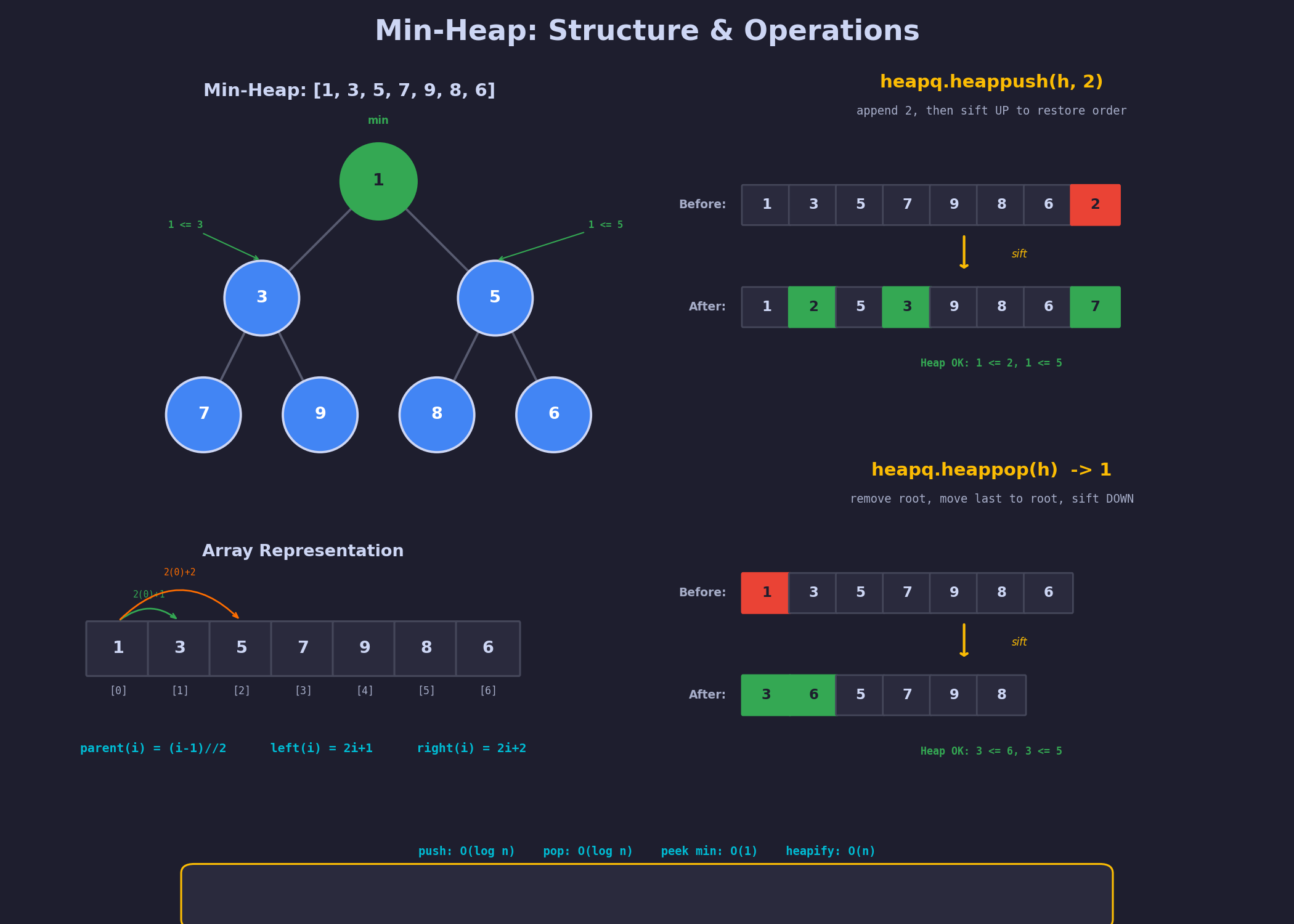
Python's heapq module gives you a min-heap only. This is the single most common source of bugs in interviews.
Python heapq Gotchas
import heapq

# MIN-HEAP (default) -- smallest element comes out first
heap = []
heapq.heappush(heap, 5)
heapq.heappush(heap, 2)
heapq.heappush(heap, 8)
print(heapq.heappop(heap))  # 2 (smallest)

# MAX-HEAP trick -- negate all values
max_heap = []
heapq.heappush(max_heap, -5)
heapq.heappush(max_heap, -2)
heapq.heappush(max_heap, -8)
print(-heapq.heappop(max_heap))  # 8 (largest)

# TUPLE COMPARISON -- heapq compares by first element, then second
# Use this for (priority, value) pairs
heapq.heappush(heap, (priority, tiebreaker, value))HEAPQ IS MIN-HEAP ONLY
Every year, candidates lose points by forgetting to negate values when they need a max-heap. If you need the K largest, either:
- Use a min-heap of size K (pop when size exceeds K -- the smallest falls out, leaving K largest), or
- Negate all values and use min-heap as max-heap.
Option 1 is cleaner. Option 2 is simpler when you need to repeatedly extract the max.
Pattern: Top-K Elements
import heapq

def top_k(nums, k):
    """Keep a min-heap of size k. The root is the kth largest."""
    heap = []
    for num in nums:
        heapq.heappush(heap, num)
        if len(heap) > k:
            heapq.heappop(heap)  # remove smallest -- not in top K
return heapList<Integer> topK(int[] nums, int k) {
// min-heap of size k: the root is the kth largest
PriorityQueue<Integer> heap = new PriorityQueue<>();
for (int num : nums) {
heap.offer(num);
if (heap.size() > k) heap.poll(); // remove smallest -- not in top K
}
return new ArrayList<>(heap);
}Pattern: Merge K Sorted Things
import heapq

def merge_k_sorted(lists):
    """Push the head of each list, pop smallest, push its successor."""
    heap = []
    for i, lst in enumerate(lists):
        if lst:
            heapq.heappush(heap, (lst[0], i, 0))  # (value, list_idx, elem_idx)

    result = []
    while heap:
        val, list_idx, elem_idx = heapq.heappop(heap)
        result.append(val)
        if elem_idx + 1 < len(lists[list_idx]):
            next_val = lists[list_idx][elem_idx + 1]
            heapq.heappush(heap, (next_val, list_idx, elem_idx + 1))
return resultList<Integer> mergeKSorted(List<List<Integer>> lists) {
// heap: [value, listIdx, elemIdx]
PriorityQueue<int[]> heap = new PriorityQueue<>(Comparator.comparingInt(a -> a[0]));
for (int i = 0; i < lists.size(); i++) {
if (!lists.get(i).isEmpty()) {
heap.offer(new int[]{lists.get(i).get(0), i, 0});
}
}
List<Integer> result = new ArrayList<>();
while (!heap.isEmpty()) {
int[] cur = heap.poll();
int val = cur[0], listIdx = cur[1], elemIdx = cur[2];
result.add(val);
if (elemIdx + 1 < lists.get(listIdx).size()) {
heap.offer(new int[]{lists.get(listIdx).get(elemIdx + 1), listIdx, elemIdx + 1});
}
}
return result;
}Pattern: Kth Element
Two approaches:
- Min-heap of size K -- O(n log k) time, O(k) space. Push all, pop when size > k. Root is the answer.
- Quickselect -- O(n) average, O(n^2) worst. Partition like quicksort, recurse on the side containing index k.
Binary Search Patterns
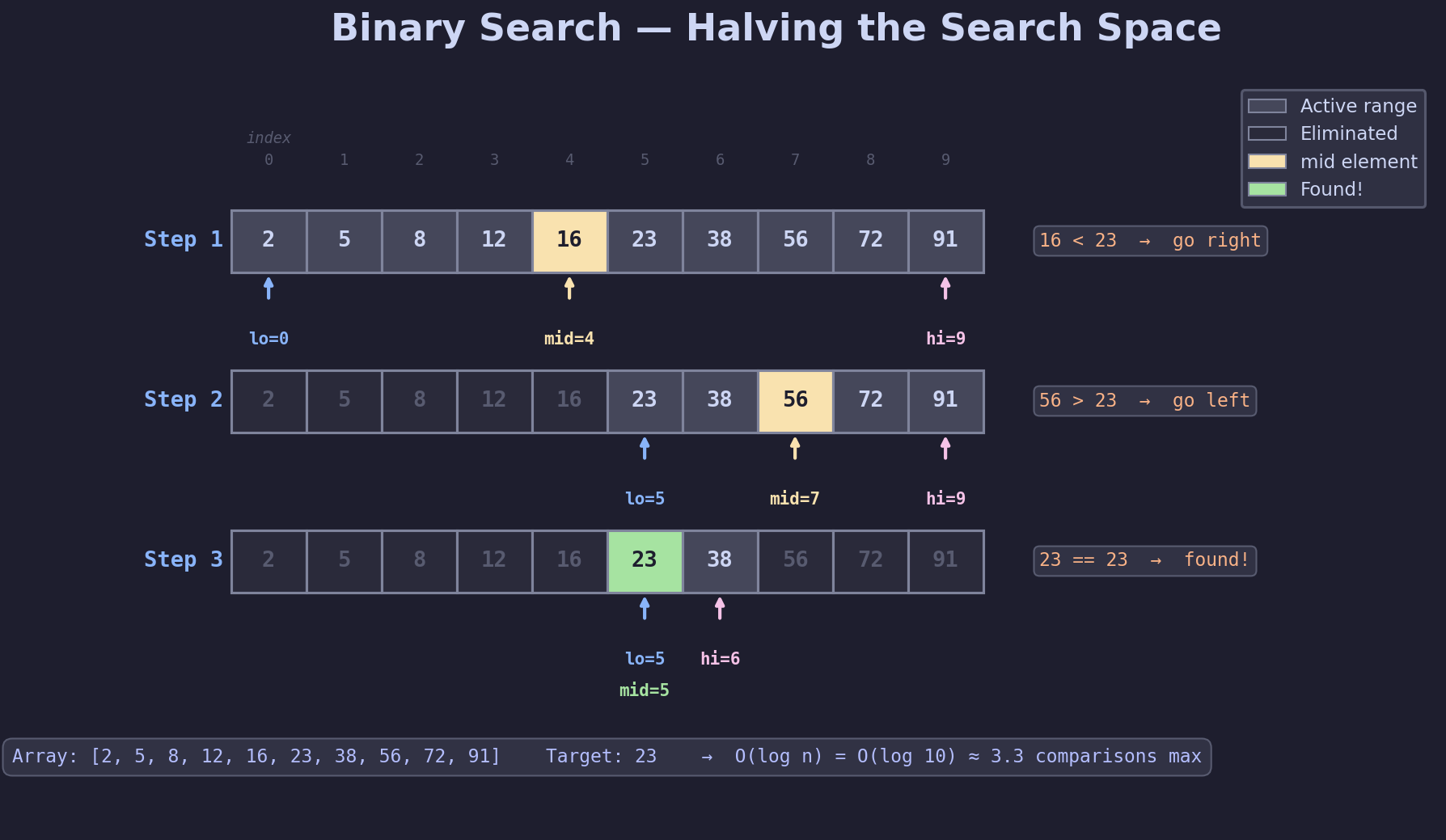
Binary search is not just "find element in sorted array." It is a general technique for any scenario where you can split a search space in half.
The Template
def binary_search(nums, target):
    lo, hi = 0, len(nums) - 1
    while lo <= hi:
        mid = lo + (hi - lo) // 2  # avoid overflow (matters in Java/C++)
        if nums[mid] == target:
            return mid
        elif nums[mid] < target:
            lo = mid + 1
        else:
            hi = mid - 1
return -1 # not found (lo is insertion point)int binarySearch(int[] nums, int target) {
int lo = 0, hi = nums.length - 1;
while (lo <= hi) {
int mid = lo + (hi - lo) / 2; // avoid overflow
if (nums[mid] == target) return mid;
else if (nums[mid] < target) lo = mid + 1;
else hi = mid - 1;
}
return -1; // not found (lo is insertion point)
}OFF-BY-ONE
The lo <= hi vs lo < hi distinction is critical:
lo <= hi: use when searching for an exact value. Loop ends whenlo > hi(empty range).lo < hi: use when narrowing to a single candidate. Loop ends whenlo == hi(one element left).
Pick one convention and stick with it.
Pattern: Rotated Sorted Array
The array has two sorted halves. At each step, determine which half is sorted and whether the target is in that half.
def search_rotated(nums, target):
    lo, hi = 0, len(nums) - 1
    while lo <= hi:
        mid = lo + (hi - lo) // 2
        if nums[mid] == target:
            return mid
        # Left half is sorted
        if nums[lo] <= nums[mid]:
            if nums[lo] <= target < nums[mid]:
                hi = mid - 1
            else:
                lo = mid + 1
        # Right half is sorted
        else:
            if nums[mid] < target <= nums[hi]:
                lo = mid + 1
            else:
                hi = mid - 1
return -1int searchRotated(int[] nums, int target) {
int lo = 0, hi = nums.length - 1;
while (lo <= hi) {
int mid = lo + (hi - lo) / 2;
if (nums[mid] == target) return mid;
// Left half is sorted
if (nums[lo] <= nums[mid]) {
if (nums[lo] <= target && target < nums[mid]) hi = mid - 1;
else lo = mid + 1;
}
// Right half is sorted
else {
if (nums[mid] < target && target <= nums[hi]) lo = mid + 1;
else hi = mid - 1;
}
}
return -1;
}Pattern: Answer Space Binary Search
When the answer itself can be binary searched (the function is monotonic):
def answer_space_bs():
    lo, hi = MIN_ANSWER, MAX_ANSWER
    while lo < hi:
        mid = lo + (hi - lo) // 2
        if feasible(mid):
            hi = mid       # mid might be the answer, search left
        else:
            lo = mid + 1   # mid is not feasible, search right
return lo # lo == hi, the smallest feasible answerint answerSpaceBS(int minAnswer, int maxAnswer) {
int lo = minAnswer, hi = maxAnswer;
while (lo < hi) {
int mid = lo + (hi - lo) / 2;
if (feasible(mid)) hi = mid; // mid might be the answer, search left
else lo = mid + 1; // mid is not feasible, search right
}
return lo; // lo == hi, the smallest feasible answer
}Pattern: Find Peak Element
If nums[mid] < nums[mid+1], a peak must exist to the right. Otherwise, a peak exists at mid or to its left. This works even on unsorted arrays.
Problem Walkthroughs
Problem 24: Group Anagrams (LC 49) -- HashMap
Key Insight: Two strings are anagrams if and only if they have the same character frequency. Use a canonical form as the hash key.
from collections import defaultdict

def groupAnagrams(strs):
    groups = defaultdict(list)
    for s in strs:
        # Option 1: sorted string as key -- O(k log k) per word
        key = tuple(sorted(s))

        # Option 2: character count tuple as key -- O(k) per word
        # count = [0] * 26
        # for c in s:
        #     count[ord(c) - ord('a')] += 1
        # key = tuple(count)

        groups[key].append(s)
return list(groups.values())List<List<String>> groupAnagrams(String[] strs) {
Map<String, List<String>> groups = new HashMap<>();
for (String s : strs) {
// Option 1: sorted string as key -- O(k log k) per word
char[] chars = s.toCharArray();
Arrays.sort(chars);
String key = new String(chars);
// Option 2: character count array as key -- O(k) per word
// int[] count = new int[26];
// for (char c : s.toCharArray()) count[c - 'a']++;
// String key = Arrays.toString(count);
groups.computeIfAbsent(key, k -> new ArrayList<>()).add(s);
}
return new ArrayList<>(groups.values());
}Complexity:
- Time: O(n * k log k) where n = number of strings, k = max string length. O(n * k) with the count-tuple approach.
- Space: O(n * k) for storing all strings in the hashmap.
Variant -- "Group Rotations": Given strings, group those that are cyclic rotations of each other (e.g., "abc", "bca", "cab"). Key function: find the lexicographically smallest rotation and use that as the key. Alternatively, double the string (s + s) and check if one is a substring of the doubled version of another. :::
Problem 25: Top K Frequent Elements (LC 347) -- Heap / Bucket Sort
Key Insight: Count frequencies, then extract the top K. Three approaches, each with different trade-offs.
from collections import Counter
import heapq

def topKFrequent(nums, k):
    freq = Counter(nums)

    # Approach 1: Min-heap of size k -- O(n log k)
    return heapq.nlargest(k, freq.keys(), key=freq.get)

    # Approach 2: Bucket sort -- O(n) time, O(n) space
    # buckets = [[] for _ in range(len(nums) + 1)]
    # for num, count in freq.items():
    #     buckets[count].append(num)
    # result = []
    # for i in range(len(buckets) - 1, -1, -1):
    #     for num in buckets[i]:
    #         result.append(num)
    #         if len(result) == k:
    #             return result

def topKFrequent_bucket(nums, k):
    """Bucket sort approach -- O(n) time."""
    freq = Counter(nums)
    buckets = [[] for _ in range(len(nums) + 1)]
    for num, count in freq.items():
        buckets[count].append(num)

    result = []
    for i in range(len(buckets) - 1, -1, -1):
        for num in buckets[i]:
            result.append(num)
            if len(result) == k:
                return result
return result// Approach 1: Min-heap of size k -- O(n log k)
List<Integer> topKFrequent(int[] nums, int k) {
Map<Integer, Integer> freq = new HashMap<>();
for (int num : nums) freq.merge(num, 1, Integer::sum);
PriorityQueue<Integer> heap = new PriorityQueue<>(Comparator.comparingInt(freq::get));
for (int num : freq.keySet()) {
heap.offer(num);
if (heap.size() > k) heap.poll(); // remove smallest frequency
}
return new ArrayList<>(heap);
}
// Approach 2: Bucket sort -- O(n) time
List<Integer> topKFrequentBucket(int[] nums, int k) {
Map<Integer, Integer> freq = new HashMap<>();
for (int num : nums) freq.merge(num, 1, Integer::sum);
List<List<Integer>> buckets = new ArrayList<>();
for (int i = 0; i <= nums.length; i++) buckets.add(new ArrayList<>());
for (Map.Entry<Integer, Integer> e : freq.entrySet()) {
buckets.get(e.getValue()).add(e.getKey());
}
List<Integer> result = new ArrayList<>();
for (int i = buckets.size() - 1; i >= 0 && result.size() < k; i--) {
result.addAll(buckets.get(i));
}
return result.subList(0, k);
}Complexity:
- Heap approach: O(n log k) time, O(n) space.
- Bucket sort approach: O(n) time, O(n) space.
When to use which: Bucket sort is O(n) but uses more memory. In an interview, mention both and let the interviewer pick. The bucket sort approach impresses because it avoids the heap entirely. :::
Problem 26: Merge K Sorted Lists (LC 23) -- Min-Heap
Key Insight: Maintain a min-heap of size K holding one node from each list. Pop the smallest, push its successor. The heap ensures you always pick the globally smallest element.
import heapq

class ListNode:
    def __init__(self, val=0, next=None):
        self.val = val
        self.next = next

def mergeKLists(lists):
    heap = []
    # Push the head of each non-empty list
    for i, node in enumerate(lists):
        if node:
            heapq.heappush(heap, (node.val, i, node))

    dummy = ListNode(0)
    curr = dummy

    while heap:
        val, i, node = heapq.heappop(heap)
        curr.next = node
        curr = curr.next
        if node.next:
            heapq.heappush(heap, (node.next.val, i, node.next))

return dummy.next// ListNode class provided by LeetCode
ListNode mergeKLists(ListNode[] lists) {
// heap: [val, listIdx, node] -- listIdx is tiebreaker to avoid comparing ListNodes
PriorityQueue<int[]> heap = new PriorityQueue<>(Comparator.comparingInt(a -> a[0]));
ListNode[] refs = new ListNode[lists.length];
for (int i = 0; i < lists.length; i++) {
if (lists[i] != null) {
refs[i] = lists[i];
heap.offer(new int[]{lists[i].val, i});
}
}
ListNode dummy = new ListNode(0);
ListNode curr = dummy;
while (!heap.isEmpty()) {
int[] top = heap.poll();
int idx = top[1];
curr.next = refs[idx];
curr = curr.next;
refs[idx] = refs[idx].next;
if (refs[idx] != null) {
heap.offer(new int[]{refs[idx].val, idx});
}
}
return dummy.next;
}Complexity:
- Time: O(N log K) where N = total number of nodes, K = number of lists.
- Space: O(K) for the heap.
Why the index i in the tuple? Python's heapq compares tuples element by element. If two nodes have the same value, it tries to compare the ListNode objects, which will crash. The index i serves as a guaranteed-unique tiebreaker.
TIP
If the interviewer asks "can you do this without a heap?" -- yes, divide and conquer. Merge pairs of lists recursively, like merge sort. Same O(N log K) time, O(log K) space for recursion stack.
:::
Problem 27: Search in Rotated Sorted Array (LC 33) -- Binary Search
Key Insight: At every midpoint, at least one half of the array is sorted. Determine which half is sorted, then check if the target falls within that sorted half.
def search(nums, target):
    lo, hi = 0, len(nums) - 1

    while lo <= hi:
        mid = lo + (hi - lo) // 2

        if nums[mid] == target:
            return mid

        # Left half [lo..mid] is sorted
        if nums[lo] <= nums[mid]:
            if nums[lo] <= target < nums[mid]:
                hi = mid - 1   # target is in the sorted left half
            else:
                lo = mid + 1   # target is in the right half
        # Right half [mid..hi] is sorted
        else:
            if nums[mid] < target <= nums[hi]:
                lo = mid + 1   # target is in the sorted right half
            else:
                hi = mid - 1   # target is in the left half

return -1int search(int[] nums, int target) {
int lo = 0, hi = nums.length - 1;
while (lo <= hi) {
int mid = lo + (hi - lo) / 2;
if (nums[mid] == target) return mid;
// Left half [lo..mid] is sorted
if (nums[lo] <= nums[mid]) {
if (nums[lo] <= target && target < nums[mid]) hi = mid - 1;
else lo = mid + 1;
}
// Right half [mid..hi] is sorted
else {
if (nums[mid] < target && target <= nums[hi]) lo = mid + 1;
else hi = mid - 1;
}
}
return -1;
}Complexity:
- Time: O(log n)
- Space: O(1)
Edge Case: nums[lo] <= nums[mid] uses <= (not <) because when lo == mid (two-element subarray), the left "half" is a single element and it is trivially sorted. Getting this comparison wrong is the #1 source of bugs.
Follow-up -- with duplicates (LC 81): When nums[lo] == nums[mid] == nums[hi], you cannot determine which half is sorted. Fall back to lo += 1 and hi -= 1. Worst case becomes O(n). :::
Problem 28: Find Peak Element (LC 162) -- Binary Search
Key Insight: If nums[mid] < nums[mid + 1], then a peak must exist somewhere to the right (including mid + 1). Otherwise, a peak exists at mid or to its left. This gives us a binary search on an unsorted array.
def findPeakElement(nums):
    lo, hi = 0, len(nums) - 1

    while lo < hi:
        mid = lo + (hi - lo) // 2
        if nums[mid] < nums[mid + 1]:
            lo = mid + 1    # peak is to the right
        else:
            hi = mid        # peak is at mid or to the left

return lo # lo == hi, this is a peakint findPeakElement(int[] nums) {
int lo = 0, hi = nums.length - 1;
while (lo < hi) {
int mid = lo + (hi - lo) / 2;
if (nums[mid] < nums[mid + 1]) lo = mid + 1; // peak is to the right
else hi = mid; // peak is at mid or to the left
}
return lo; // lo == hi, this is a peak
}Complexity:
- Time: O(log n)
- Space: O(1)
Why this works: The problem states nums[-1] = nums[n] = -infinity. So if you are climbing uphill (going right), you must eventually hit a peak before falling off the right edge. Same logic in reverse for going left.
Note the template difference: This uses lo < hi (not lo <= hi) and hi = mid (not hi = mid - 1). This is the "narrow to one candidate" template -- the loop exits when lo == hi, which is the answer. :::
Problem 29: Kth Largest Element in an Array (LC 215) -- Quickselect / Heap
Key Insight: You do not need to fully sort the array. Quickselect partitions the array so that the pivot is in its final sorted position, then recurses only on the side that contains index k.
Approach 1: Min-heap of size K
import heapq

def findKthLargest_heap(nums, k):
    """O(n log k) time, O(k) space."""
    heap = []
    for num in nums:
        heapq.heappush(heap, num)
        if len(heap) > k:
            heapq.heappop(heap)  # remove smallest
return heap[0] # root is the kth largestint findKthLargestHeap(int[] nums, int k) {
// min-heap of size k
PriorityQueue<Integer> heap = new PriorityQueue<>();
for (int num : nums) {
heap.offer(num);
if (heap.size() > k) heap.poll(); // remove smallest
}
return heap.peek(); // root is the kth largest
}Approach 2: Quickselect
import random

def findKthLargest(nums, k):
    """O(n) average time, O(1) extra space."""
    target = len(nums) - k  # kth largest = (n-k)th smallest

    def quickselect(lo, hi):
        # Randomize pivot to avoid O(n^2) worst case
        pivot_idx = random.randint(lo, hi)
        nums[pivot_idx], nums[hi] = nums[hi], nums[pivot_idx]
        pivot = nums[hi]

        # Partition: elements < pivot go to the left
        store = lo
        for i in range(lo, hi):
            if nums[i] < pivot:
                nums[store], nums[i] = nums[i], nums[store]
                store += 1
        nums[store], nums[hi] = nums[hi], nums[store]

        if store == target:
            return nums[store]
        elif store < target:
            return quickselect(store + 1, hi)
        else:
            return quickselect(lo, store - 1)

return quickselect(0, len(nums) - 1)int findKthLargest(int[] nums, int k) {
int target = nums.length - k; // kth largest = (n-k)th smallest
return quickselect(nums, 0, nums.length - 1, target);
}
private int quickselect(int[] nums, int lo, int hi, int target) {
// Randomize pivot to avoid O(n^2) worst case
int pivotIdx = lo + (int)(Math.random() * (hi - lo + 1));
int tmp = nums[pivotIdx]; nums[pivotIdx] = nums[hi]; nums[hi] = tmp;
int pivot = nums[hi];
// Partition: elements < pivot go to the left
int store = lo;
for (int i = lo; i < hi; i++) {
if (nums[i] < pivot) {
tmp = nums[store]; nums[store] = nums[i]; nums[i] = tmp;
store++;
}
}
tmp = nums[store]; nums[store] = nums[hi]; nums[hi] = tmp;
if (store == target) return nums[store];
else if (store < target) return quickselect(nums, store + 1, hi, target);
else return quickselect(nums, lo, store - 1, target);
}Complexity:
- Heap: O(n log k) time, O(k) space.
- Quickselect: O(n) average time, O(n^2) worst case, O(1) extra space (in-place).
Which to use in an interview? Start with the heap approach -- it is clean, correct, and takes 5 lines. Then mention Quickselect as the O(n) optimization. If the interviewer wants to see it, code it up. Randomizing the pivot is essential to avoid worst-case behavior on sorted input. :::
Common Mistakes
MISTAKES THAT COST OFFERS
1. Forgetting heapq is min-heap
You want the K largest elements and you write:
# WRONG -- this keeps the K smallest!
heap = nums[:k]
heapq.heapify(heap)
for num in nums[k:]:
    if num > heap[0]:
heapq.heapreplace(heap, num)Wait -- this is actually correct! The min-heap's root is the smallest of the K largest. heapreplace swaps out the smallest when something bigger comes along. The confusion arises when you try to negate values unnecessarily. Think carefully about what the heap root represents before negating.
2. Off-by-one in binary search
The classic bug: using hi = mid - 1 when you should use hi = mid, or lo <= hi when you should use lo < hi. The rule of thumb:
- Searching for exact match? Use
lo <= hiwithhi = mid - 1andlo = mid + 1. - Narrowing to one candidate? Use
lo < hiwithhi = midandlo = mid + 1.
Never mix conventions -- that is where infinite loops come from.
3. Not handling duplicates in HashMap grouping
When using sorted(s) as a key, remember that sorted() returns a list, which is unhashable. You must convert to tuple(sorted(s)).
4. Comparing non-comparable objects in heapq
If two heap elements have the same priority, Python tries to compare the next tuple element. If that element is a ListNode or some other non-comparable object, you get a TypeError. Always include a unique tiebreaker (like an index) in your heap tuples:
heapq.heappush(heap, (priority, unique_index, actual_object))5. Integer overflow in mid calculation
In Python this does not matter (arbitrary precision integers), but if you are asked to code in Java or C++:
# Safe in all languages:
mid = lo + (hi - lo) // 2
# Unsafe in Java/C++ for large values:
mid = (lo + hi) // 2 # can overflow!Mention this in your interview even if coding in Python -- it shows awareness.
Practice Checklist
Use this to track your progress. Each problem should be solvable in under 20 minutes without looking at the solution.
- Group Anagrams (LC 49) -- Can you write the
defaultdict+ sorted-key approach in 5 minutes? - Top K Frequent Elements (LC 347) -- Can you explain both the heap and bucket sort approaches?
- Merge K Sorted Lists (LC 23) -- Can you handle the tiebreaker tuple correctly without looking it up?
- Search in Rotated Sorted Array (LC 33) -- Can you get the
<=edge case right on the first try? - Find Peak Element (LC 162) -- Can you explain WHY binary search works on an unsorted array?
- Kth Largest Element (LC 215) -- Can you write Quickselect from scratch with a random pivot?
SELF-TEST
For each problem, close the solution panel and rewrite it on paper or in a plain text editor. If you cannot write it cleanly without referencing anything, you do not know it well enough for a plain text editor interview.