Best Time to Buy and Sell Stock
Problem Statement
You are given an array prices where prices[i] is the price of a given stock on the ith day.
You want to maximize your profit by choosing a single day to buy one stock and choosing a different day in the future to sell that stock.
Return the maximum profit you can achieve from this transaction. If you cannot achieve any profit, return 0.
LeetCode: 121. Best Time to Buy and Sell Stock
Examples
Example 1:
Input: prices = [7,1,5,3,6,4]
Output: 5
Explanation: Buy on day 2 (price = 1) and sell on day 5 (price = 6), profit = 6-1 = 5.
Note that buying on day 2 and selling on day 1 is not allowed because you must buy before you sell.Example 2:
Input: prices = [7,6,4,3,1]
Output: 0
Explanation: In this case, no transactions are done and the max profit = 0.Constraints
1 <= prices.length <= 10^50 <= prices[i] <= 10^4
One Pass Approach
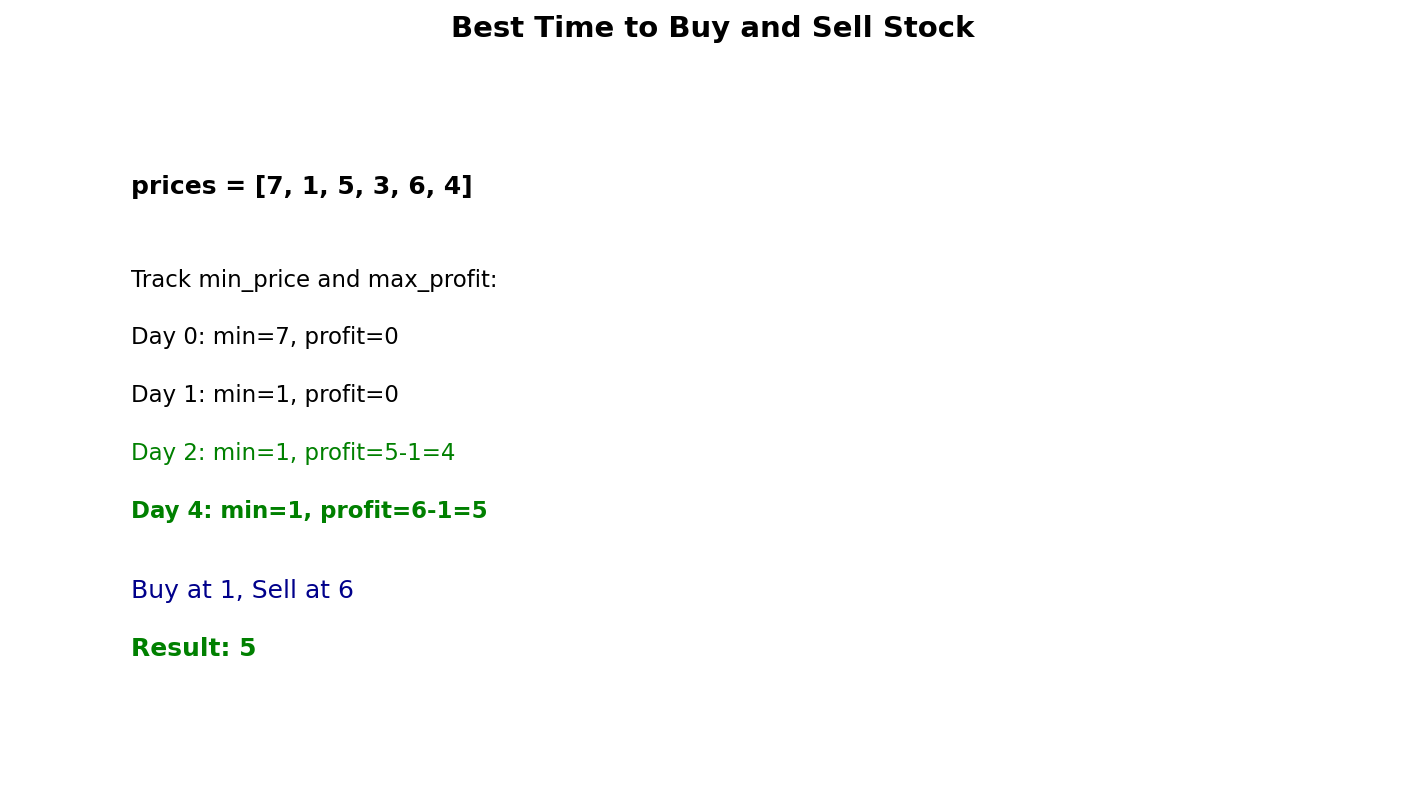
Key Insight
Track the minimum price seen so far. At each day, calculate potential profit if we sold today, and update max profit.
Algorithm
- Initialize
min_priceto infinity,max_profitto 0 - For each price:
- Update
min_priceif current price is lower - Calculate profit if selling today:
price - min_price - Update
max_profitif this profit is higher
- Update
- Return
max_profit
Solution
from typing import List

def maxProfit(prices: List[int]) -> int:
    """
    Find maximum profit from single buy and sell.

    Time: O(n) - single pass
    Space: O(1) - constant space
    """
    min_price = float('inf')
    max_profit = 0

    for price in prices:
        if price < min_price:
            min_price = price
        elif price - min_price > max_profit:
            max_profit = price - min_price

return max_profitimport java.util.*;
class Solution {
public int maxProfit(int[] prices) {
int minPrice = Integer.MAX_VALUE;
int maxProfit = 0;
for (int price : prices) {
if (price < minPrice) {
minPrice = price;
} else if (price - minPrice > maxProfit) {
maxProfit = price - minPrice;
}
}
return maxProfit;
}
}Complexity: Time O(n) · Space O(1)
- Time: O(n) for single pass through the prices array, tracking minimum and calculating profit at each step
- Space: O(1) using only constant extra variables regardless of input size
# Alternative: More explicit
def maxProfitExplicit(prices: List[int]) -> int:
    """Clearer variable naming."""
    if not prices:
        return 0

    min_price_so_far = prices[0]
    max_profit_so_far = 0

    for price in prices[1:]:
        # Could we have bought cheaper before?
        min_price_so_far = min(min_price_so_far, price)

        # What's the profit if we sell today?
        profit_if_sold_today = price - min_price_so_far

        # Update max profit
        max_profit_so_far = max(max_profit_so_far, profit_if_sold_today)

    return max_profit_so_far


# With buy/sell day tracking
def maxProfitWithDays(prices: List[int]) -> tuple:
    """
    Return (max_profit, buy_day, sell_day).

    Time: O(n)
    Space: O(1)
    """
    if len(prices) < 2:
        return (0, -1, -1)

    min_price = prices[0]
    min_day = 0
    max_profit = 0
    buy_day = -1
    sell_day = -1

    for i in range(1, len(prices)):
        if prices[i] < min_price:
            min_price = prices[i]
            min_day = i
        elif prices[i] - min_price > max_profit:
            max_profit = prices[i] - min_price
            buy_day = min_day
            sell_day = i

return (max_profit, buy_day, sell_day)Complexity: Time O(n) · Space O(1)
- Time: O(n) for single pass through the prices array, tracking minimum and calculating profit at each step
- Space: O(1) using only constant extra variables regardless of input size
Complexity Analysis
| Approach | Time | Space |
|---|---|---|
| One Pass | O(n) | O(1) |
| Brute Force | O(n^2) | O(1) |
Why This Works
The key observation is that we want to find:
- The minimum price before any given day (potential buy point)
- The maximum difference between a price and the minimum before it
By tracking min_price as we go, we ensure we're always considering the best possible buy point for any sell day.
Edge Cases
- Single price:
[5]- Cannot make any transaction, return 0 - Decreasing prices:
[5,4,3,2,1]- No profit possible, return 0 - All same prices:
[3,3,3,3]- No profit, return 0 - Min at end:
[5,4,3,2,1,10]- Wait for price at end
Variations
Best Time to Buy and Sell Stock II (Multiple Transactions)
def maxProfitII(prices: List[int]) -> int:
    """
    Multiple transactions allowed (but not simultaneous).
    Greedy: capture all upward movements.

    Time: O(n)
    Space: O(1)
    """
    max_profit = 0

    for i in range(1, len(prices)):
        if prices[i] > prices[i - 1]:
            max_profit += prices[i] - prices[i - 1]

return max_profitBest Time to Buy and Sell Stock III (At Most 2 Transactions)
def maxProfitIII(prices: List[int]) -> int:
    """
    At most 2 transactions.

    Time: O(n)
    Space: O(1)
    """
    buy1 = buy2 = float('inf')
    profit1 = profit2 = 0

    for price in prices:
        # First transaction
        buy1 = min(buy1, price)
        profit1 = max(profit1, price - buy1)

        # Second transaction (buy2 uses profit from first)
        buy2 = min(buy2, price - profit1)
        profit2 = max(profit2, price - buy2)

return profit2Best Time to Buy and Sell Stock IV (At Most K Transactions)
def maxProfitIV(k: int, prices: List[int]) -> int:
    """
    At most k transactions.

    Time: O(n*k)
    Space: O(k)
    """
    if not prices or k == 0:
        return 0

    n = len(prices)

    # If k >= n/2, it's like unlimited transactions
    if k >= n // 2:
        return sum(max(0, prices[i] - prices[i-1])
                   for i in range(1, n))

    # DP approach
    buy = [float('inf')] * (k + 1)
    profit = [0] * (k + 1)

    for price in prices:
        for i in range(1, k + 1):
            buy[i] = min(buy[i], price - profit[i - 1])
            profit[i] = max(profit[i], price - buy[i])

return profit[k]With Cooldown
def maxProfitWithCooldown(prices: List[int]) -> int:
    """
    After selling, must wait one day before buying again.

    Time: O(n)
    Space: O(1)
    """
    if len(prices) < 2:
        return 0

    sold = 0           # Max profit ending with sell
    held = -prices[0]  # Max profit holding stock
    rest = 0           # Max profit in cooldown

    for i in range(1, len(prices)):
        prev_sold = sold
        sold = held + prices[i]
        held = max(held, rest - prices[i])
        rest = max(rest, prev_sold)

return max(sold, rest)With Transaction Fee
def maxProfitWithFee(prices: List[int], fee: int) -> int:
    """
    Each transaction has a fee.

    Time: O(n)
    Space: O(1)
    """
    cash = 0            # Max profit not holding stock
    hold = -prices[0]   # Max profit holding stock

    for i in range(1, len(prices)):
        cash = max(cash, hold + prices[i] - fee)
        hold = max(hold, cash - prices[i])

return cashRelated Problems
Best Time to Buy and Sell Stock II (LeetCode 122)
Problem: Maximum profit with unlimited transactions.
Key Insight: Collect every upward movement. Buy every valley, sell every peak.
Approach: Sum all positive differences between consecutive days.
Complexity: Time O(n), Space O(1)
Best Time to Buy and Sell Stock III (LeetCode 123)
Problem: Maximum profit with at most 2 transactions.
Key Insight: Track best profit from left and right separately, find optimal split point.
Approach: DP with states: buy1, sell1, buy2, sell2. Or split array approach.
Complexity: Time O(n), Space O(1)
Best Time to Buy and Sell Stock IV (LeetCode 188)
Problem: Maximum profit with at most k transactions.
Key Insight: Generalization of Stock III. DP with k transaction states.
Approach: dp[i][j] = max profit with i transactions on first j days. Use buy/sell states.
Complexity: Time O(nk), Space O(k)
Best Time to Buy and Sell Stock with Cooldown (LeetCode 309)
Problem: Maximum profit with cooldown day after selling.
Key Insight: Three states: hold, sold (cooldown), rest. State machine DP.
Approach: Track max profit in each state. sold -> rest, rest -> hold or rest, hold -> sold or hold.
Complexity: Time O(n), Space O(1)
Best Time to Buy and Sell Stock with Transaction Fee (LeetCode 714)
Problem: Maximum profit with transaction fee on each complete transaction.
Key Insight: Two states: cash (not holding) and hold (holding stock).
Approach: cash = max(cash, hold + price - fee), hold = max(hold, cash - price).
Complexity: Time O(n), Space O(1)