Tier 1: Graphs
HIGHEST FREQUENCY 8 Problems ~3 hours prepGraphs appeared in nearly every SDE onsite in 2024-2025. If you only study one topic, make it this one.
Why Graphs?
Modern tech infrastructure is a graph. Maps, search ranking, network routing, dependency resolution, knowledge graphs -- every core product touches graph algorithms daily. Interviewers pick graph problems because they:
- Test multiple skills at once -- data structure choice, traversal strategy, complexity analysis, and edge-case handling.
- Have natural follow-ups -- "Now what if the graph is weighted?" or "What if we need the shortest path?" lets interviewers calibrate depth.
- Expose weak fundamentals quickly -- if you cannot reason about BFS vs DFS in the first 5 minutes, the round is effectively over.
Interview Insight
Candidates who received offers report that graph questions often come disguised as grid problems (islands, mazes, rotten oranges) or as dependency problems (course scheduling, build systems). Recognizing the underlying graph is half the battle.
Problem Table
| # | Problem | LC | Pattern | Why This Problem |
|---|---|---|---|---|
| 1 | Number of Islands | 200 | BFS/DFS grid | Frequently asked in SDE interviews (Jan 2025) |
| 2 | Course Schedule | 207 | Topological Sort | Multiple SDE onsites |
| 3 | Course Schedule II | 210 | Topo Sort (return order) | Follow-up pattern |
| 4 | Word Ladder | 127 | BFS shortest path | Frequently asked in SDE interviews |
| 5 | Clone Graph | 133 | DFS + HashMap | Classic pattern |
| 6 | Network Delay Time | 743 | Dijkstra's | Teleporter variant asked |
| 7 | Rotting Oranges | 994 | Multi-source BFS | Common follow-up |
| 8 | Pacific Atlantic Water Flow | 417 | Multi-source DFS | Tests reverse thinking |
Pattern Recognition
Choosing the right algorithm in the first 2 minutes is what separates "Strong Hire" from "Lean No Hire." Use this decision framework:
Algorithm Decision Flowchart
| Question to Ask Yourself | If YES | If NO |
|---|---|---|
| Is the graph unweighted and I need the shortest path? | BFS | Keep going |
| Is the graph weighted with positive edges and I need shortest path? | Dijkstra's | Keep going |
| Do I need to detect cycles or find a valid ordering of dependencies? | Topological Sort (Kahn's BFS) | Keep going |
| Am I counting connected components or flood-filling a grid? | BFS or DFS (either works) | Keep going |
| Do I need to explore all paths or do backtracking? | DFS (recursive) | Keep going |
| Are there multiple starting points simultaneously? | Multi-source BFS (enqueue all sources first) | Single-source BFS/DFS |
When BFS vs DFS doesn't matter
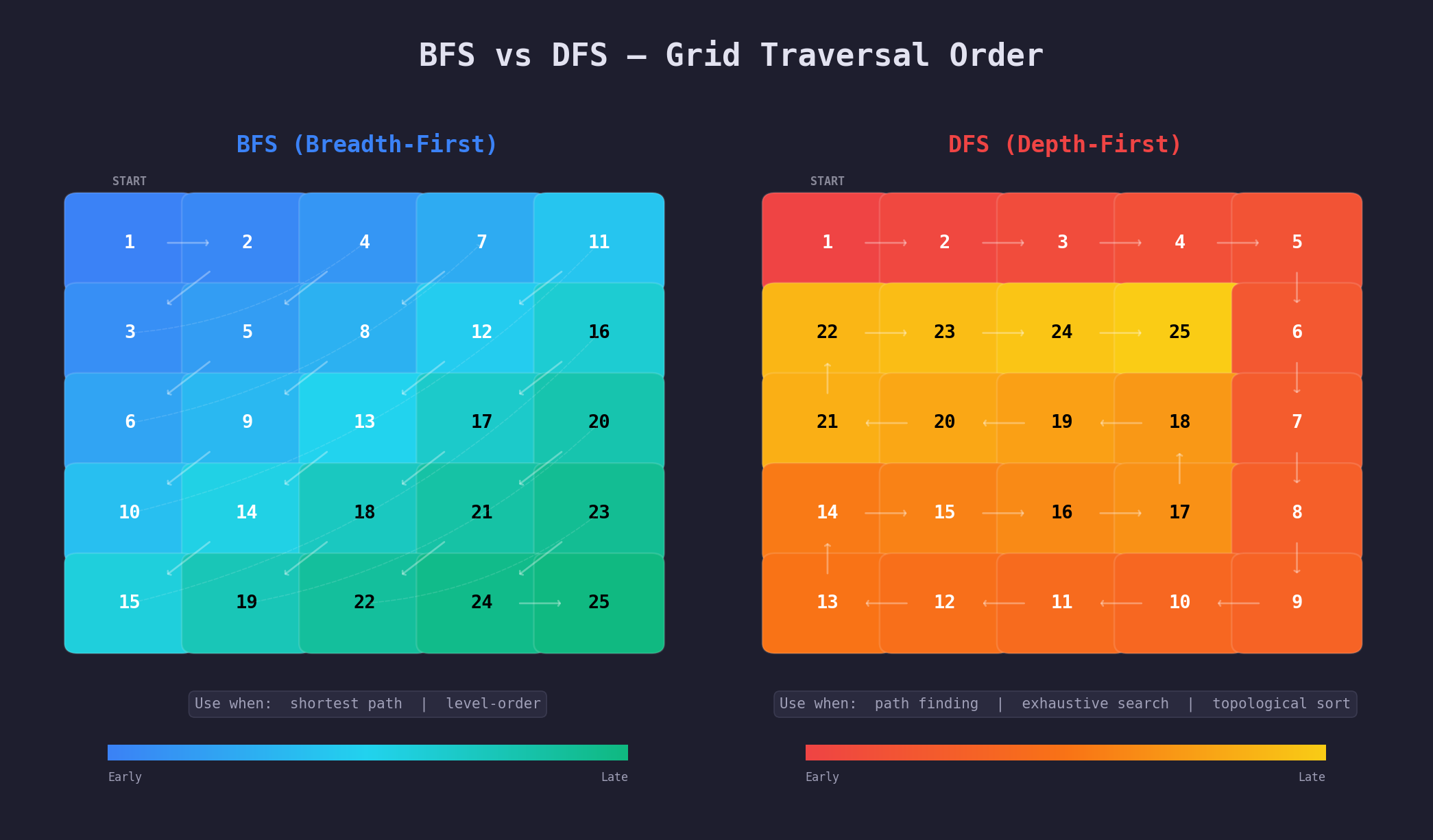
For problems like Number of Islands where you just need to visit all connected cells, BFS and DFS produce the same result. Pick whichever you can write faster in a plain text editor. BFS is generally safer (no stack overflow on large grids), but DFS recursive is fewer lines of code.
When it DOES matter
- Shortest path in unweighted graph --> Must use BFS (DFS does NOT guarantee shortest path).
- Topological ordering --> Use BFS-based Kahn's algorithm (easier to code than DFS-based).
- Dijkstra's --> Only for weighted graphs with non-negative edges.
Core Templates
These four templates cover every graph problem in this tier. Memorize them well enough to write them in a plain text editor without hesitation.
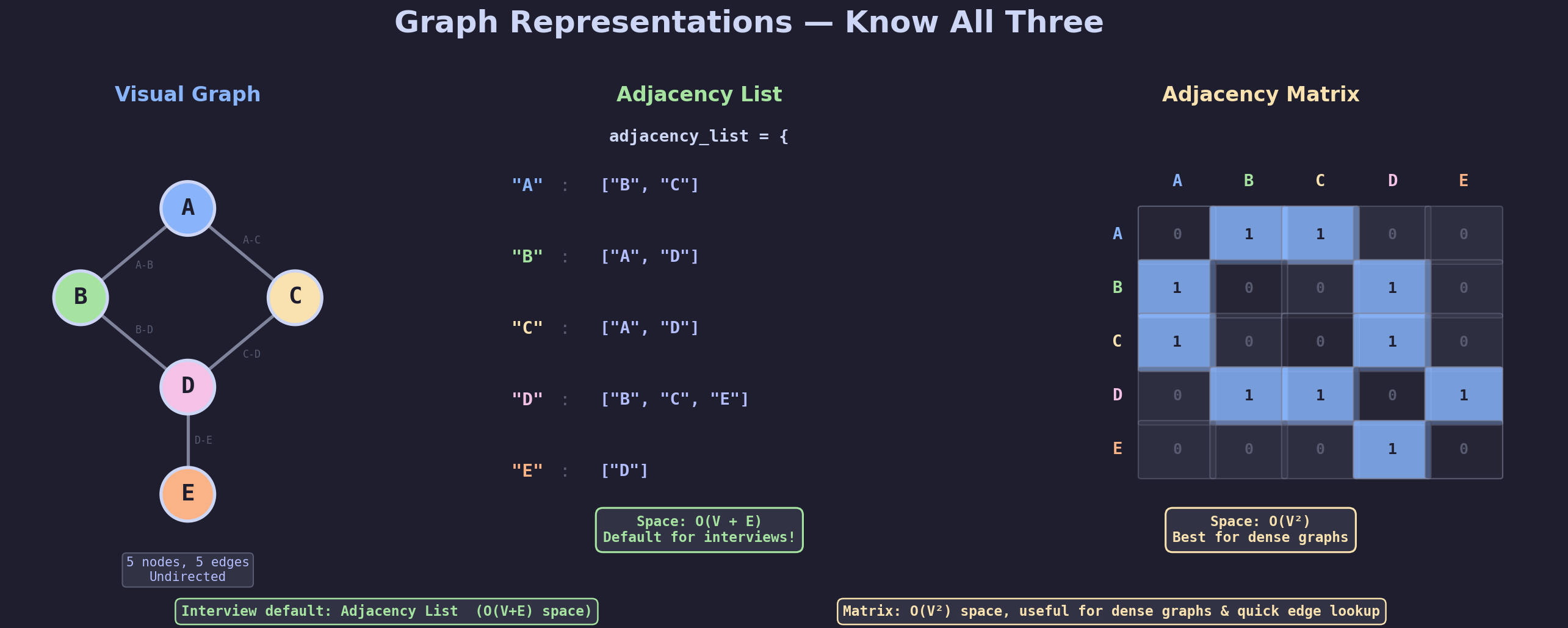
BFS Template (Adjacency List)
from collections import deque

def bfs(graph, start):
    queue = deque([start])       # FIFO queue
    visited = {start}
    while queue:
        node = queue.popleft()   # O(1) pop from left
        for neighbor in graph[node]:
            if neighbor not in visited:
                visited.add(neighbor)  # mark BEFORE enqueue
                queue.append(neighbor)
return visitedimport java.util.*;
Set<Integer> bfs(Map<Integer, List<Integer>> graph, int start) {
Deque<Integer> queue = new ArrayDeque<>();
Set<Integer> visited = new HashSet<>();
queue.offer(start);
visited.add(start);
while (!queue.isEmpty()) {
int node = queue.poll(); // O(1) poll from front
for (int neighbor : graph.get(node)) {
if (visited.add(neighbor)) { // mark BEFORE enqueue
queue.offer(neighbor);
}
}
}
return visited;
}Critical Detail
Always add to visited before enqueueing, not after dequeueing. Adding after dequeueing causes duplicate processing and can turn O(V+E) into O(V^2) or worse.
BFS on a Grid
from collections import deque

def bfs_grid(grid, start_r, start_c):
    rows, cols = len(grid), len(grid[0])
    queue = deque([(start_r, start_c)])
    visited = {(start_r, start_c)}

    while queue:
        r, c = queue.popleft()
        for dr, dc in [(0, 1), (0, -1), (1, 0), (-1, 0)]:
            nr, nc = r + dr, c + dc
            if (0 <= nr < rows and 0 <= nc < cols
                    and (nr, nc) not in visited
                    and grid[nr][nc] == "1"):  # condition varies
                visited.add((nr, nc))
                queue.append((nr, nc))
return visitedSet<String> bfsGrid(char[][] grid, int startR, int startC) {
int rows = grid.length, cols = grid[0].length;
Deque<int[]> queue = new ArrayDeque<>();
Set<String> visited = new HashSet<>();
queue.offer(new int[]{startR, startC});
visited.add(startR + "," + startC);
int[][] dirs = {{0,1},{0,-1},{1,0},{-1,0}};
while (!queue.isEmpty()) {
int[] cur = queue.poll();
int r = cur[0], c = cur[1];
for (int[] d : dirs) {
int nr = r + d[0], nc = c + d[1];
if (nr >= 0 && nr < rows && nc >= 0 && nc < cols
&& !visited.contains(nr + "," + nc)
&& grid[nr][nc] == '1') { // condition varies
visited.add(nr + "," + nc);
queue.offer(new int[]{nr, nc});
}
}
}
return visited;
}DFS Template (Recursive + Iterative)
# ---- Recursive DFS ----
def dfs_recursive(graph, node, visited):
    visited.add(node)
    for neighbor in graph[node]:
        if neighbor not in visited:
            dfs_recursive(graph, neighbor, visited)

# ---- Iterative DFS (uses a stack) ----
def dfs_iterative(graph, start):
    stack = [start]
    visited = set()
    while stack:
        node = stack.pop()        # LIFO -- last in, first out
        if node in visited:
            continue
        visited.add(node)
        for neighbor in graph[node]:
            if neighbor not in visited:
                stack.append(neighbor)
return visited// ---- Recursive DFS ----
void dfsRecursive(Map<Integer, List<Integer>> graph, int node, Set<Integer> visited) {
visited.add(node);
for (int neighbor : graph.get(node)) {
if (!visited.contains(neighbor)) {
dfsRecursive(graph, neighbor, visited);
}
}
}
// ---- Iterative DFS (uses a stack) ----
Set<Integer> dfsIterative(Map<Integer, List<Integer>> graph, int start) {
Deque<Integer> stack = new ArrayDeque<>();
Set<Integer> visited = new HashSet<>();
stack.push(start);
while (!stack.isEmpty()) {
int node = stack.pop(); // LIFO -- last in, first out
if (!visited.add(node)) continue;
for (int neighbor : graph.get(node)) {
if (!visited.contains(neighbor)) {
stack.push(neighbor);
}
}
}
return visited;
}Recursive vs Iterative
Recursive DFS is cleaner for interviews (fewer lines), but iterative DFS avoids stack overflow on large inputs. For plain text editor interviews, recursive is usually fine -- just mention the stack overflow risk if asked.
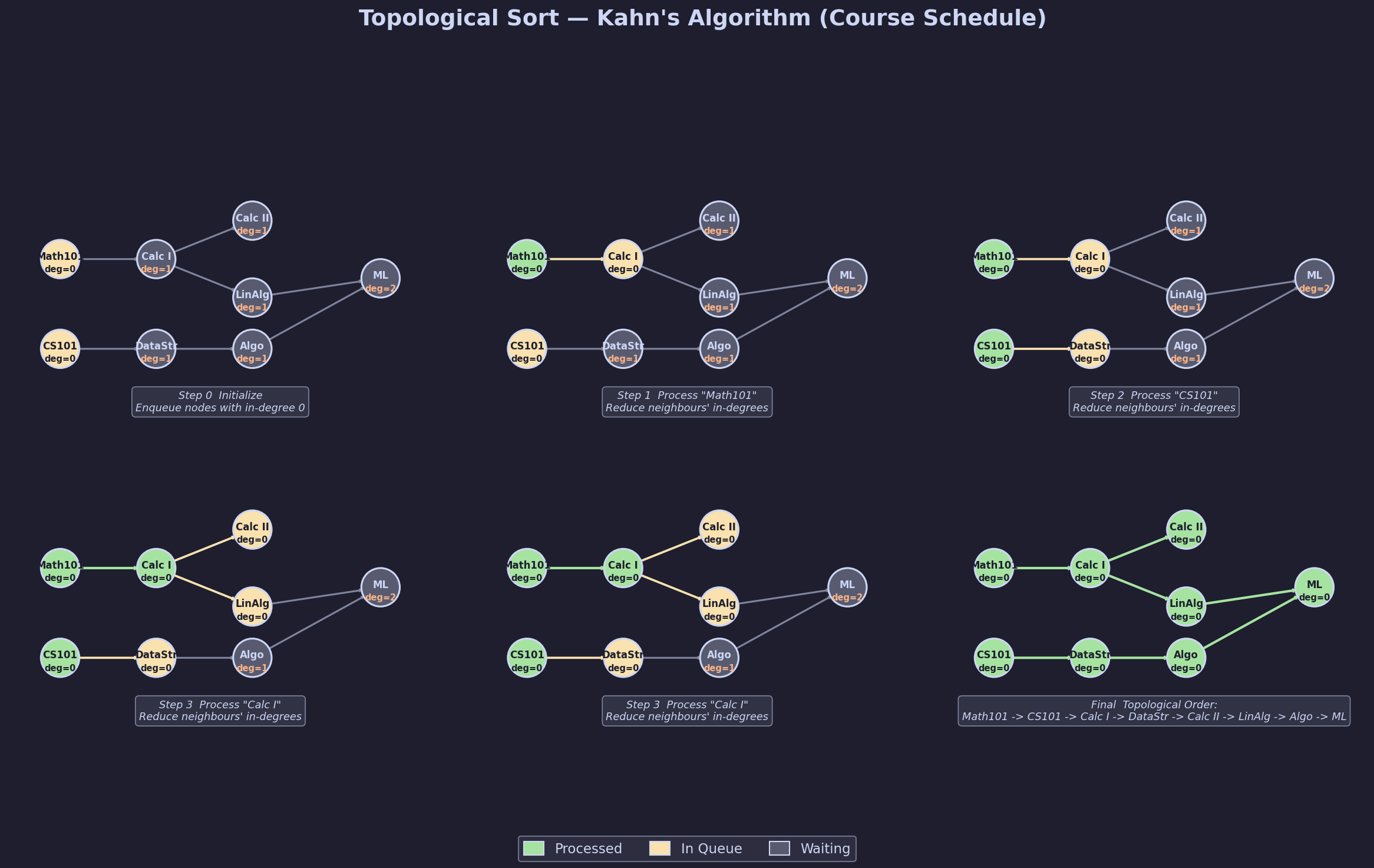
Topological Sort (Kahn's Algorithm -- BFS-based)
from collections import deque, defaultdict
def topo_sort(num_courses, prerequisites):
indegree = [0] * num_courses
adj = defaultdict(list)
for course, prereq in prerequisites:
adj[prereq].append(course)
indegree[course] += 1 # build indegree
queue = deque(i for i in range(num_courses)
if indegree[i] == 0) # start with 0-indegree
order = []
List<Integer> topoSort(int numCourses, int[][] prerequisites) {
    int[] indegree = new int[numCourses];
    List<List<Integer>> adj = new ArrayList<>();
    for (int i = 0; i < numCourses; i++) adj.add(new ArrayList<>());

    for (int[] p : prerequisites) {
        adj.get(p[1]).add(p[0]);
        indegree[p[0]]++;                       // build indegree
    }

    Deque<Integer> queue = new ArrayDeque<>();
    for (int i = 0; i < numCourses; i++) {
        if (indegree[i] == 0) queue.offer(i);  // start with 0-indegree
    }
    List<Integer> order = new ArrayList<>();

    while (!queue.isEmpty()) {
        int node = queue.poll();
        order.add(node);
        for (int neighbor : adj.get(node)) {
            if (--indegree[neighbor] == 0) {    // newly free
                queue.offer(neighbor);
            }
        }
    }

    return order.size() == numCourses ? order : new ArrayList<>();  // cycle check
}
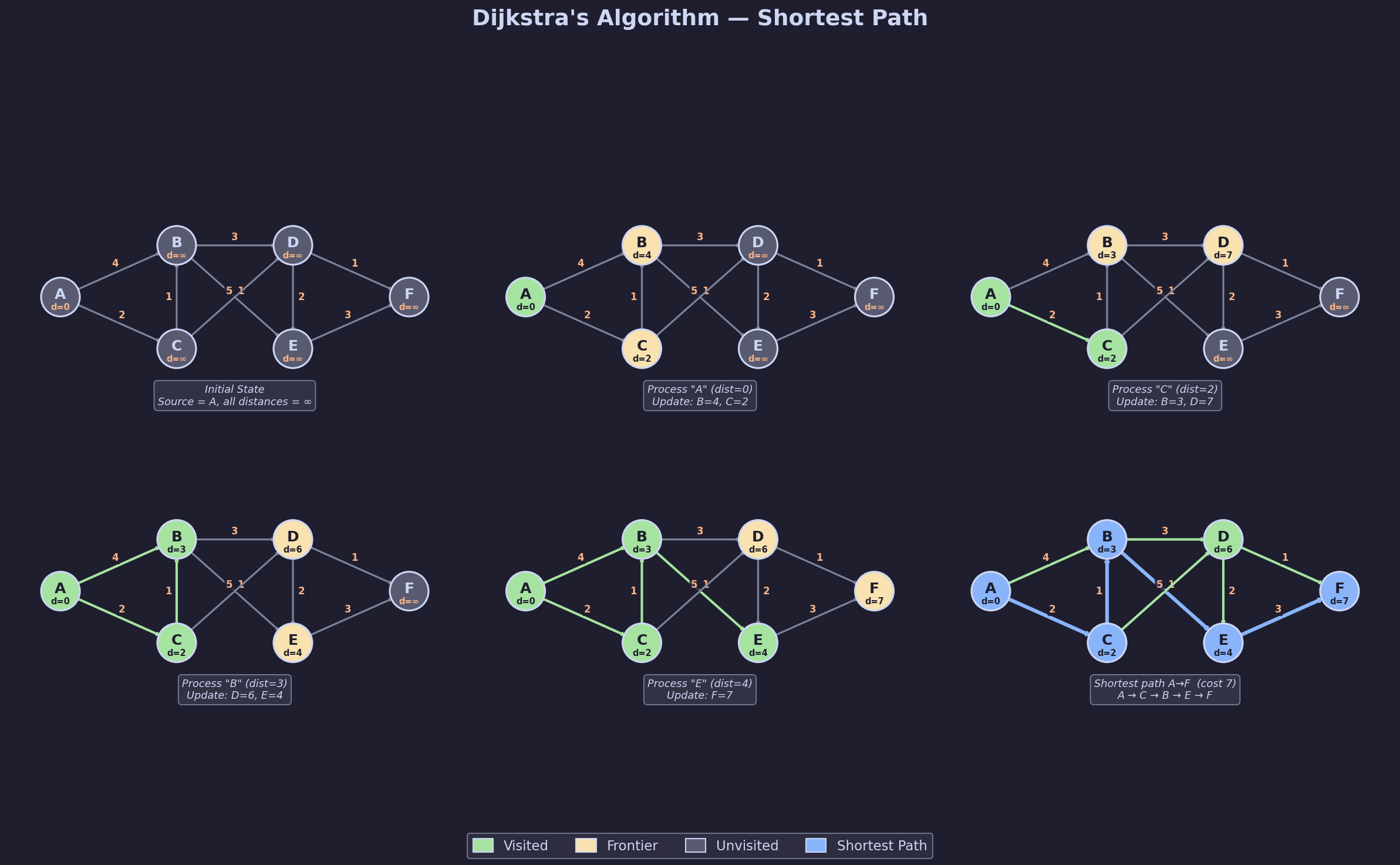
Dijkstra's Algorithm (Min-Heap)
import heapq
from collections import defaultdict

def dijkstra(n, edges, source):
    adj = defaultdict(list)
    for u, v, w in edges:
        adj[u].append((v, w))

    dist = [float('inf')] * (n + 1)
    dist[source] = 0
    heap = [(0, source)]         # (distance, node)

    while heap:
        d, u = heapq.heappop(heap)
        if d > dist[u]:          # skip stale entries
            continue
        for v, w in adj[u]:
            if dist[u] + w < dist[v]:
                dist[v] = dist[u] + w
                heapq.heappush(heap, (dist[v], v))

return distint[] dijkstra(int n, int[][] edges, int source) {
List<int[]>[] adj = new List[n + 1];
for (int i = 0; i <= n; i++) adj[i] = new ArrayList<>();
for (int[] e : edges) {
adj[e[0]].add(new int[]{e[1], e[2]});
}
int[] dist = new int[n + 1];
Arrays.fill(dist, Integer.MAX_VALUE);
dist[source] = 0;
PriorityQueue<int[]> heap = new PriorityQueue<>(Comparator.comparingInt(a -> a[0]));
heap.offer(new int[]{0, source}); // (distance, node)
while (!heap.isEmpty()) {
int[] cur = heap.poll();
int d = cur[0], u = cur[1];
if (d > dist[u]) continue; // skip stale entries
for (int[] edge : adj[u]) {
int v = edge[0], w = edge[1];
if (dist[u] + w < dist[v]) {
dist[v] = dist[u] + w;
heap.offer(new int[]{dist[v], v});
}
}
}
return dist;
}Dijkstra Pitfall
The if d > dist[u]: continue line is essential. Without it, you process stale heap entries and the algorithm degrades from O(E log V) to much worse. This is the #1 Dijkstra bug in interviews.
Problem Walkthroughs
Work through each problem in order. For each one, try solving it yourself for 20 minutes before expanding the solution.
Problem 1: Number of Islands (LC 200)
Click to expand solution
Pattern: BFS/DFS grid traversal -- count connected components.
Approach: Scan the grid cell by cell. When you find a '1' that hasn't been visited, that's a new island. Run BFS/DFS from that cell to mark all connected land cells as visited. Increment your island count.
from collections import deque

def numIslands(grid):
    if not grid:
        return 0

    rows, cols = len(grid), len(grid[0])
    visited = set()
    islands = 0

    def bfs(r, c):
        queue = deque([(r, c)])
        visited.add((r, c))
        while queue:
            row, col = queue.popleft()
            for dr, dc in [(0, 1), (0, -1), (1, 0), (-1, 0)]:
                nr, nc = row + dr, col + dc
                if (0 <= nr < rows and 0 <= nc < cols
                        and (nr, nc) not in visited
                        and grid[nr][nc] == "1"):
                    visited.add((nr, nc))
                    queue.append((nr, nc))

    for r in range(rows):
        for c in range(cols):
            if grid[r][c] == "1" and (r, c) not in visited:
                bfs(r, c)
                islands += 1

return islandsint numIslands(char[][] grid) {
if (grid == null || grid.length == 0) return 0;
int rows = grid.length, cols = grid[0].length;
boolean[][] visited = new boolean[rows][cols];
int islands = 0;
int[][] dirs = {{0,1},{0,-1},{1,0},{-1,0}};
for (int r = 0; r < rows; r++) {
for (int c = 0; c < cols; c++) {
if (grid[r][c] == '1' && !visited[r][c]) {
// BFS from this unvisited land cell
Deque<int[]> queue = new ArrayDeque<>();
queue.offer(new int[]{r, c});
visited[r][c] = true;
while (!queue.isEmpty()) {
int[] cur = queue.poll();
for (int[] d : dirs) {
int nr = cur[0] + d[0], nc = cur[1] + d[1];
if (nr >= 0 && nr < rows && nc >= 0 && nc < cols
&& !visited[nr][nc] && grid[nr][nc] == '1') {
visited[nr][nc] = true;
queue.offer(new int[]{nr, nc});
}
}
}
islands++;
}
}
}
return islands;
}Complexity:
- Time: O(M x N) -- every cell visited at most once.
- Space: O(M x N) -- visited set in worst case (all land).
Key Insight: You can also modify the grid in-place (set '1' to '0' after visiting) to avoid the visited set entirely, but mention the trade-off: mutating input data. In an interview, ask the interviewer if modifying the input is acceptable.
:::
Problem 2: Course Schedule (LC 207)
Click to expand solution
Pattern: Topological Sort -- cycle detection in a directed graph.
Approach: Model courses as nodes and prerequisites as directed edges. If we can produce a valid topological ordering that includes all courses, there is no cycle and we can finish all courses. Use Kahn's algorithm (BFS-based topo sort).
from collections import deque, defaultdict

def canFinish(numCourses, prerequisites):
    indegree = [0] * numCourses
    adj = defaultdict(list)

    for course, prereq in prerequisites:
        adj[prereq].append(course)
        indegree[course] += 1

    queue = deque(i for i in range(numCourses) if indegree[i] == 0)
    completed = 0

    while queue:
        node = queue.popleft()
        completed += 1
        for neighbor in adj[node]:
            indegree[neighbor] -= 1
            if indegree[neighbor] == 0:
                queue.append(neighbor)

return completed == numCoursesboolean canFinish(int numCourses, int[][] prerequisites) {
int[] indegree = new int[numCourses];
List<List<Integer>> adj = new ArrayList<>();
for (int i = 0; i < numCourses; i++) adj.add(new ArrayList<>());
for (int[] p : prerequisites) {
adj.get(p[1]).add(p[0]);
indegree[p[0]]++;
}
Deque<Integer> queue = new ArrayDeque<>();
for (int i = 0; i < numCourses; i++) {
if (indegree[i] == 0) queue.offer(i);
}
int completed = 0;
while (!queue.isEmpty()) {
int node = queue.poll();
completed++;
for (int neighbor : adj.get(node)) {
if (--indegree[neighbor] == 0) {
queue.offer(neighbor);
}
}
}
return completed == numCourses;
}Complexity:
- Time: O(V + E) where V = numCourses, E = len(prerequisites).
- Space: O(V + E) for adjacency list and indegree array.
Key Insight: If there's a cycle, some nodes will never reach indegree 0, so completed will be less than numCourses. This is cleaner than DFS-based cycle detection with three-color marking.
:::
Problem 3: Course Schedule II (LC 210)
Click to expand solution
Pattern: Topological Sort -- same as Course Schedule but return the actual ordering.
Approach: Identical to Course Schedule, but instead of just counting, collect the order in a list. If the list length doesn't equal numCourses, return an empty list (cycle exists).
from collections import deque, defaultdict

def findOrder(numCourses, prerequisites):
    indegree = [0] * numCourses
    adj = defaultdict(list)

    for course, prereq in prerequisites:
        adj[prereq].append(course)
        indegree[course] += 1

    queue = deque(i for i in range(numCourses) if indegree[i] == 0)
    order = []

    while queue:
        node = queue.popleft()
        order.append(node)
        for neighbor in adj[node]:
            indegree[neighbor] -= 1
            if indegree[neighbor] == 0:
                queue.append(neighbor)

return order if len(order) == numCourses else []int[] findOrder(int numCourses, int[][] prerequisites) {
int[] indegree = new int[numCourses];
List<List<Integer>> adj = new ArrayList<>();
for (int i = 0; i < numCourses; i++) adj.add(new ArrayList<>());
for (int[] p : prerequisites) {
adj.get(p[1]).add(p[0]);
indegree[p[0]]++;
}
Deque<Integer> queue = new ArrayDeque<>();
for (int i = 0; i < numCourses; i++) {
if (indegree[i] == 0) queue.offer(i);
}
List<Integer> order = new ArrayList<>();
while (!queue.isEmpty()) {
int node = queue.poll();
order.add(node);
for (int neighbor : adj.get(node)) {
if (--indegree[neighbor] == 0) {
queue.offer(neighbor);
}
}
}
if (order.size() != numCourses) return new int[0];
return order.stream().mapToInt(Integer::intValue).toArray();
}Complexity:
- Time: O(V + E).
- Space: O(V + E).
Key Insight: This is the natural follow-up to LC 207. In an interview, if you solve Course Schedule quickly, expect the interviewer to ask "Now return the actual order." Having Kahn's memorized makes this a 2-line change.
:::
Problem 4: Word Ladder (LC 127)
Click to expand solution
Pattern: BFS shortest path in an unweighted implicit graph.
Approach: Each word is a node. Two words are connected if they differ by exactly one character. BFS from beginWord finds the shortest transformation sequence. The key optimization: instead of comparing all word pairs O(N^2), for each word generate all possible one-character mutations and check if they exist in the word set.
from collections import deque
def ladderLength(beginWord, endWord, wordList):
word_set = set(wordList)
if endWord not in word_set:
return 0
queue = deque([(beginWord, 1)]) # (word, depth)
visited = {beginWord}
int ladderLength(String beginWord, String endWord, List<String> wordList) {
    Set<String> wordSet = new HashSet<>(wordList);
    if (!wordSet.contains(endWord)) return 0;

    Deque<String[]> queue = new ArrayDeque<>();
    queue.offer(new String[]{beginWord, "1"});   // (word, depth)
    Set<String> visited = new HashSet<>();
    visited.add(beginWord);

    while (!queue.isEmpty()) {
        String[] cur = queue.poll();
        String word = cur[0];
        int depth = Integer.parseInt(cur[1]);
        if (word.equals(endWord)) return depth;

        char[] chars = word.toCharArray();
        for (int i = 0; i < chars.length; i++) {
            char original = chars[i];
            for (char c = 'a'; c <= 'z'; c++) {
                chars[i] = c;
                String nextWord = new String(chars);
                if (wordSet.contains(nextWord) && visited.add(nextWord)) {
                    queue.offer(new String[]{nextWord, String.valueOf(depth + 1)});
                }
            }
            chars[i] = original;
        }
    }

    return 0;
}Complexity:
- Time: O(M^2 x N) where M = word length, N = number of words. For each word, we try 26 x M mutations, and string slicing is O(M).
- Space: O(M x N) for the word set and visited set.
Key Insight: The implicit graph construction is what makes this tricky. Do NOT build an explicit adjacency list by comparing all pairs -- that's O(N^2 x M). The wildcard pattern approach (generating *ot, h*t, ho* for "hot") is an alternative that uses a dictionary mapping patterns to words, which can be faster for very large word lists.
:::
Problem 5: Clone Graph (LC 133)
Click to expand solution
Pattern: DFS + HashMap for deep copying a graph structure.
Approach: Use a hashmap to map each original node to its clone. DFS through the graph: for each node, create a clone if it doesn't exist yet, then recursively clone all neighbors. The hashmap serves double duty as both a visited set and a lookup table.
class Node:
def __init__(self, val=0, neighbors=None):
self.val = val
self.neighbors = neighbors if neighbors is not None else []
def cloneGraph(node):
if not node:
return None
cloned = {} # original node -> cloned node
// Node class provided by LeetCode: class Node { int val; List<Node> neighbors; }
Map<Node, Node> cloned = new HashMap<>();

Node cloneGraph(Node node) {
    if (node == null) return null;
    return dfs(node);
}

private Node dfs(Node n) {
    if (cloned.containsKey(n)) return cloned.get(n);
    Node clone = new Node(n.val);
    cloned.put(n, clone);           // map BEFORE recursing (handles cycles)
    for (Node neighbor : n.neighbors) {
        clone.neighbors.add(dfs(neighbor));
    }
    return clone;
}Complexity:
- Time: O(V + E) -- visit each node and edge once.
- Space: O(V) for the hashmap and recursion stack.
Key Insight: You MUST add the clone to the hashmap BEFORE recursing into neighbors. Otherwise, cycles in the graph cause infinite recursion. This is the single most common bug in this problem.
:::
Problem 6: Network Delay Time (LC 743)
Click to expand solution
Pattern: Dijkstra's algorithm -- single-source shortest path in a weighted directed graph.
Approach: Run Dijkstra's from the source node k. After processing, the answer is the maximum distance among all nodes (the time for the signal to reach the farthest node). If any node is unreachable (inf), return -1.
import heapq
from collections import defaultdict
def networkDelayTime(times, n, k):
adj = defaultdict(list)
for u, v, w in times:
adj[u].append((v, w))
dist = [float('inf')] * (n + 1)
dist[k] = 0
heap = [(0, k)]
while heap:
d, u = heapq.heappop(heap)
if d > dist[u]:
continue # skip stale entries
for v, w in adj[u]:
new_dist = dist[u] + w
if new_dist < dist[v]:
dist[v] = new_dist
heapq.heappush(heap, (new_dist, v))
int networkDelayTime(int[][] times, int n, int k) {
    List<int[]>[] adj = new List[n + 1];
    for (int i = 1; i <= n; i++) adj[i] = new ArrayList<>();
    for (int[] t : times) adj[t[0]].add(new int[]{t[1], t[2]});

    int[] dist = new int[n + 1];
    Arrays.fill(dist, Integer.MAX_VALUE);
    dist[k] = 0;
    PriorityQueue<int[]> heap = new PriorityQueue<>(Comparator.comparingInt(a -> a[0]));
    heap.offer(new int[]{0, k});

    while (!heap.isEmpty()) {
        int[] cur = heap.poll();
        int d = cur[0], u = cur[1];
        if (d > dist[u]) continue;      // skip stale entries
        for (int[] edge : adj[u]) {
            int v = edge[0], w = edge[1];
            int newDist = dist[u] + w;
            if (newDist < dist[v]) {
                dist[v] = newDist;
                heap.offer(new int[]{newDist, v});
            }
        }
    }

    int result = 0;
    for (int i = 1; i <= n; i++) {
        if (dist[i] == Integer.MAX_VALUE) return -1;
        result = Math.max(result, dist[i]);
    }
    return result;
}Complexity:
- Time: O(E log V) with a binary heap.
- Space: O(V + E).
Key Insight: The "teleporter" variant interviewers ask is essentially: "what if certain edges have weight 0?" This is a 0-1 BFS problem (use a deque, push weight-0 edges to front, weight-1 edges to back). Mentioning this optimization unprompted shows depth.
:::
Problem 7: Rotting Oranges (LC 994)
Click to expand solution
Pattern: Multi-source BFS -- BFS from multiple starting points simultaneously.
Approach: Enqueue ALL rotten oranges at the start (not just one). Each BFS "level" represents one minute passing. After BFS completes, check if any fresh oranges remain.
from collections import deque
def orangesRotting(grid):
rows, cols = len(grid), len(grid[0])
queue = deque()
fresh = 0
int orangesRotting(int[][] grid) {
    int rows = grid.length, cols = grid[0].length;
    Deque<int[]> queue = new ArrayDeque<>();
    int fresh = 0;

    // Enqueue ALL rotten oranges as starting points
    for (int r = 0; r < rows; r++) {
        for (int c = 0; c < cols; c++) {
            if (grid[r][c] == 2) queue.offer(new int[]{r, c});
            else if (grid[r][c] == 1) fresh++;
        }
    }

    if (fresh == 0) return 0;

    int minutes = 0;
    int[][] dirs = {{0,1},{0,-1},{1,0},{-1,0}};
    while (!queue.isEmpty()) {
        minutes++;
        int size = queue.size();
        for (int i = 0; i < size; i++) {    // process level by level
            int[] cur = queue.poll();
            for (int[] d : dirs) {
                int nr = cur[0] + d[0], nc = cur[1] + d[1];
                if (nr >= 0 && nr < rows && nc >= 0 && nc < cols
                        && grid[nr][nc] == 1) {
                    grid[nr][nc] = 2;           // mark rotten (acts as visited)
                    fresh--;
                    queue.offer(new int[]{nr, nc});
                }
            }
        }
    }

    return fresh == 0 ? minutes - 1 : -1;
}Complexity:
- Time: O(M x N) -- each cell processed at most once.
- Space: O(M x N) -- queue size in worst case.
Key Insight: The "minus 1" at the end (minutes - 1) trips up many candidates. The last BFS level finds no new oranges to rot, so it over-counts by 1. Alternatively, initialize minutes = -1 before the while loop. Also, note we modify the grid in-place (setting fresh to 2) to avoid a separate visited set -- ask the interviewer if this is acceptable.
:::
Problem 8: Pacific Atlantic Water Flow (LC 417)
Click to expand solution
Pattern: Multi-source DFS -- reverse the problem direction.
Approach: Instead of asking "can water flow FROM this cell TO the ocean?" (hard), ask "can water flow FROM the ocean TO this cell?" (easier). Run DFS from all Pacific-border cells and all Atlantic-border cells separately. The answer is the intersection of cells reachable from both oceans.
class Solution:
    def pacificAtlantic(self, heights: List[List[int]]) -> List[List[int]]:
        if not heights:
            return []
        m, n = len(heights), len(heights[0])
        directions = [(1,0), (-1,0), (0,1), (0,-1)]

        def dfs(i, j, visited):
            visited.add((i, j))
            for dx, dy in directions:
                x, y = i + dx, j + dy
                if 0 <= x < m and 0 <= y < n:
                    if (x, y) not in visited and heights[x][y] >= heights[i][j]:
                        dfs(x, y, visited)

        pacific, atlantic = set(), set()
        for j in range(n): dfs(0, j, pacific)
        for i in range(m): dfs(i, 0, pacific)
        for j in range(n): dfs(m-1, j, atlantic)
        for i in range(m): dfs(i, n-1, atlantic)
return list(pacific & atlantic)List<List<Integer>> pacificAtlantic(int[][] heights) {
if (heights == null || heights.length == 0) return new ArrayList<>();
int m = heights.length, n = heights[0].length;
boolean[][] pacific = new boolean[m][n];
boolean[][] atlantic = new boolean[m][n];
int[][] dirs = {{1,0},{-1,0},{0,1},{0,-1}};
for (int j = 0; j < n; j++) { dfs(heights, 0, j, pacific, dirs); }
for (int i = 0; i < m; i++) { dfs(heights, i, 0, pacific, dirs); }
for (int j = 0; j < n; j++) { dfs(heights, m-1, j, atlantic, dirs); }
for (int i = 0; i < m; i++) { dfs(heights, i, n-1, atlantic, dirs); }
List<List<Integer>> result = new ArrayList<>();
for (int i = 0; i < m; i++) {
for (int j = 0; j < n; j++) {
if (pacific[i][j] && atlantic[i][j]) {
result.add(Arrays.asList(i, j));
}
}
}
return result;
}
private void dfs(int[][] heights, int i, int j, boolean[][] visited, int[][] dirs) {
visited[i][j] = true;
for (int[] d : dirs) {
int x = i + d[0], y = j + d[1];
if (x >= 0 && x < heights.length && y >= 0 && y < heights[0].length
&& !visited[x][y] && heights[x][y] >= heights[i][j]) {
dfs(heights, x, y, visited, dirs);
}
}
}Complexity:
- Time: O(M x N) -- each cell visited at most twice (once per ocean).
- Space: O(M x N) for the two reachable sets and recursion stack.
Key Insight: The "reverse thinking" is the entire difficulty. Water flows from high to low, but we DFS from the ocean uphill (we only move to cells with height >= current). This transforms a problem with M x N starting points into one with only 2(M + N) starting points. Mention this inversion technique in the interview -- it shows algorithmic maturity.
:::
Common Mistakes
Mistakes That Cost Offers
1. Forgetting to mark visited BEFORE enqueueing in BFS
# WRONG -- causes duplicates in queue
node = queue.popleft()
visited.add(node)        # too late! other paths already enqueued this node

# CORRECT -- mark when adding to queue
if neighbor not in visited:
    visited.add(neighbor)    # mark immediately
queue.append(neighbor)2. Using DFS for shortest path problems
DFS does NOT guarantee shortest path in an unweighted graph. If the problem says "minimum number of steps/moves/transformations," you MUST use BFS.
3. Off-by-one in level-order BFS
When counting levels (minutes, steps), remember that the last BFS iteration where nothing new is discovered still increments your counter. Either start at -1 or subtract 1 at the end.
4. Wrong edge direction in topological sort
For Course Schedule, [a, b] means "b is a prerequisite for a" (b -> a). Many candidates reverse this and get wrong answers. Always clarify edge direction with the interviewer.
5. Skipping the stale-entry check in Dijkstra's
d, u = heapq.heappop(heap)
if d > dist[u]:
continue # THIS LINE IS ESSENTIALWithout this, you reprocess nodes with outdated distances, which is both slower and can cause incorrect results in certain variants.
6. Not handling disconnected components
For "Number of Islands" or any connected-component problem, you need an outer loop that starts BFS/DFS from every unvisited node -- not just the first one you find.
7. Mutating input without permission
Some solutions mark visited cells by modifying the grid (e.g., setting '1' to '0'). In an interview, always ask: "Is it okay to modify the input?" Some interviewers specifically disallow it.
Practice Checklist
Track your progress. Solve each problem in a plain text editor (no IDE) without running the code.
| Done | # | Problem | Solved Clean? | Under 25 min? |
|---|---|---|---|---|
| 1 | Number of Islands | |||
| 2 | Course Schedule | |||
| 3 | Course Schedule II | |||
| 4 | Word Ladder | |||
| 5 | Clone Graph | |||
| 6 | Network Delay Time | |||
| 7 | Rotting Oranges | |||
| 8 | Pacific Atlantic Water Flow |
Definition of "Done"
A problem is truly done when you can:
- Write the full solution from memory in a plain text editor.
- Explain the pattern and complexity out loud in under 60 seconds.
- Handle at least one follow-up variant (e.g., "What if the grid wraps around?" or "What if edges have weights?").
8 problems. 4 patterns. You've got this.