Word Break
Problem Statement
Given a string s and a dictionary of strings wordDict, return true if s can be segmented into a space-separated sequence of one or more dictionary words.
Note: The same word in the dictionary may be reused multiple times in the segmentation.
Input/Output Format
Input:
s(str): The string to segmentwordDict(List[str]): Dictionary of valid words
Output:
- (bool): True if s can be segmented using dictionary words
Constraints
1 <= s.length <= 3001 <= wordDict.length <= 10001 <= wordDict[i].length <= 20sandwordDict[i]consist of only lowercase English letters- All strings in
wordDictare unique
Examples
Example 1: Basic Segmentation
Input: s = "leetcode", wordDict = ["leet", "code"]
Output: true
Explanation:
s = "leetcode"
     ----++++
     leet|code

The string can be segmented as "leet code".
Both "leet" and "code" are in the dictionary.Example 2: Reusing Words
Input: s = "applepenapple", wordDict = ["apple", "pen"]
Output: true
Explanation:
s = "applepenapple"
     -----+++ -----
     apple|pen|apple

The string can be segmented as "apple pen apple".
"apple" is used twice, which is allowed.Example 3: Impossible Segmentation
Input: s = "catsandog", wordDict = ["cats", "dog", "sand", "and", "cat"]
Output: false
Explanation:
Possible attempts:
- "cat" + "sandog"  -> "sandog" cannot be segmented
- "cats" + "andog"  -> "andog" cannot be segmented

No valid segmentation exists.

Note: "cats" + "and" + "og" fails because "og" is not in dict
"cat" + "sand" + "og" fails because "og" is not in dictExample 4: Single Character Words
Input: s = "aaaaaaa", wordDict = ["a", "aa", "aaa"]
Output: true
Explanation: Multiple valid segmentations:
- "a a a a a a a"
- "aa aa aaa"
- "aaa aa aa"
- etc.
Visual Explanation
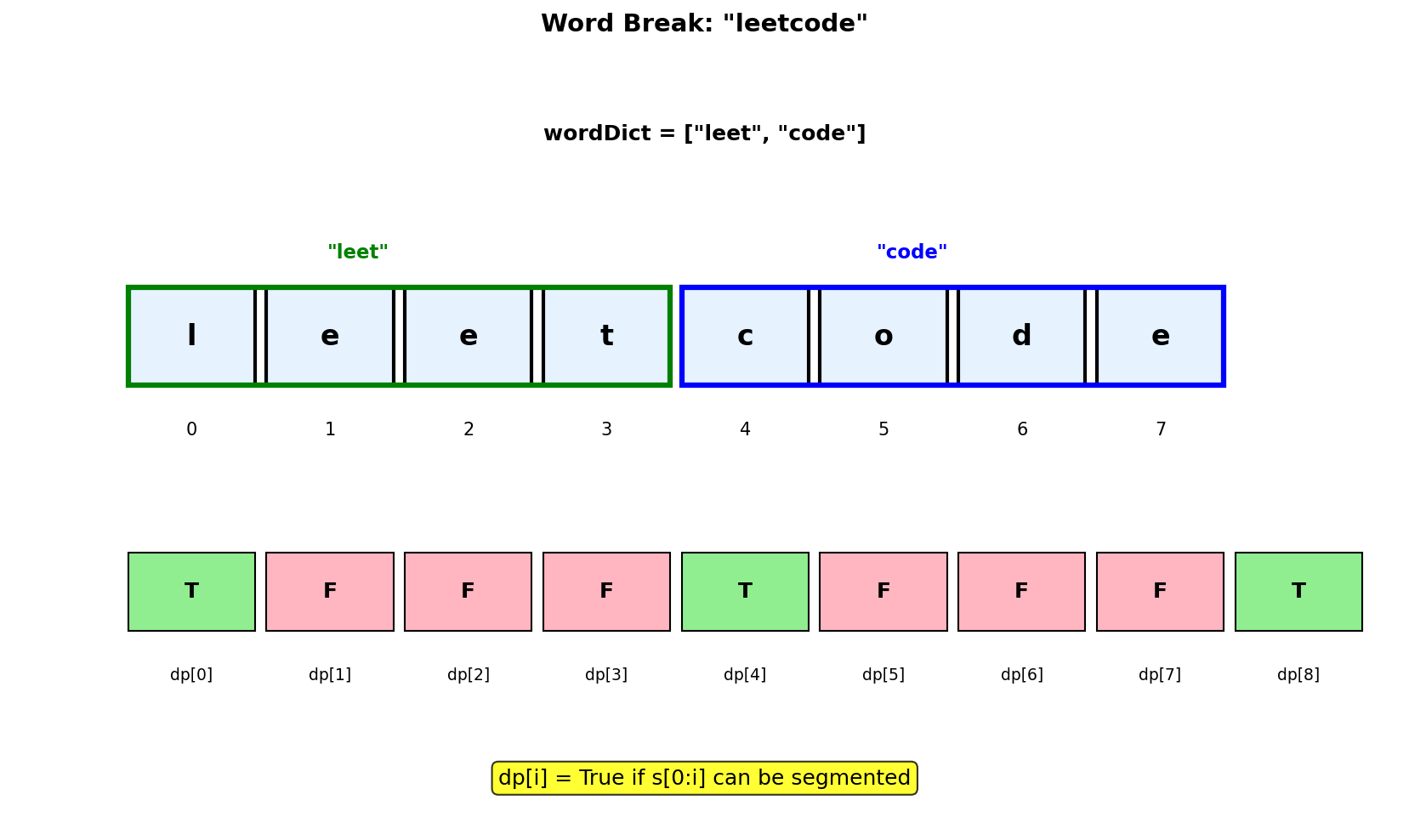
ASCII Art: DP Table Building
s = "leetcode", wordDict = ["leet", "code"]

DP Array: dp[i] = true if s[0:i] can be segmented

Index:    0    1    2    3    4    5    6    7    8
Char:     _    l    e    e    t    c    o    d    e
        +----+----+----+----+----+----+----+----+----+
dp[]:   | T  | F  | F  | F  | T  | F  | F  | F  | T  |
        +----+----+----+----+----+----+----+----+----+
          ^                   ^                   ^
          |                   |                   |
    base case          "leet" ends         "code" ends
                       here                here

Building dp[8]:
===============
For j = 0 to 7, check if dp[j] is True and s[j:8] is in dict:
- j=0: dp[0]=T, s[0:8]="leetcode" not in dict
- j=1: dp[1]=F, skip
- j=2: dp[2]=F, skip
- j=3: dp[3]=F, skip
- j=4: dp[4]=T, s[4:8]="code" IN DICT! -> dp[8] = True

Answer: dp[8] = TrueSolution Code
Approach 1: Top-Down (Memoization)
from typing import List
from functools import lru_cache

def wordBreak(s: str, wordDict: List[str]) -> bool:
    """
    Check if string can be segmented using memoization.

    Try each prefix - if it's a word, recursively check the suffix.

    Args:
        s: String to segment
        wordDict: Dictionary of valid words

    Returns:
        True if s can be segmented

    Time Complexity: O(n^3) - n states, O(n) work per state
    Space Complexity: O(n)
    """
    word_set = set(wordDict)

    @lru_cache(maxsize=None)
    def dp(start: int) -> bool:
        """Check if s[start:] can be segmented."""
        if start == len(s):
            return True

        for end in range(start + 1, len(s) + 1):
            if s[start:end] in word_set and dp(end):
                return True

        return False

return dp(0)Complexity: Time O(n^3) · Space O(n)
- Time: O(n) unique starting positions, and for each we try O(n) ending positions. Each substring check/creation is O(n), giving O(n^3).
- Space: The memoization cache stores O(n) boolean values, plus O(n) recursion stack depth.
Approach 2: Bottom-Up (Tabulation)
from typing import List

def wordBreak(s: str, wordDict: List[str]) -> bool:
    """
    Check if string can be segmented using bottom-up DP.

    dp[i] = True if s[0:i] can be segmented.

    Args:
        s: String to segment
        wordDict: Dictionary of valid words

    Returns:
        True if s can be segmented

    Time Complexity: O(n^3)
    Space Complexity: O(n)
    """
    word_set = set(wordDict)
    n = len(s)

    # dp[i] = True if s[0:i] can be segmented
    dp = [False] * (n + 1)
    dp[0] = True  # Empty string is valid

    for i in range(1, n + 1):
        for j in range(i):
            if dp[j] and s[j:i] in word_set:
                dp[i] = True
                break

return dp[n]public boolean wordBreak(String s, List<String> wordDict) {
Set<String> dict = new HashSet<>(wordDict);
int n = s.length();
// dp[i] = true if s[0..i) can be segmented
boolean[] dp = new boolean[n + 1];
dp[0] = true; // empty string is valid
for (int i = 1; i <= n; i++) {
for (int j = 0; j < i; j++) {
if (dp[j] && dict.contains(s.substring(j, i))) {
dp[i] = true;
break;
}
}
}
return dp[n];
}Complexity: Time O(n^3) · Space O(n)
- Time: Two nested loops give O(n^2) state pairs, and each substring check is O(n) for creation and hashing.
- Space: The dp array of size n+1 stores boolean segmentation results for each prefix.
Approach 3: Optimized with Word Length Bounds
from typing import List

def wordBreak(s: str, wordDict: List[str]) -> bool:
    """
    Optimized solution using word length bounds.

    Only check substrings that could match dictionary word lengths.

    Args:
        s: String to segment
        wordDict: Dictionary of valid words

    Returns:
        True if s can be segmented

    Time Complexity: O(n * m * k) where m = max word length, k = avg word length
    Space Complexity: O(n + total dict chars)
    """
    word_set = set(wordDict)
    max_len = max(len(w) for w in wordDict) if wordDict else 0
    n = len(s)

    dp = [False] * (n + 1)
    dp[0] = True

    for i in range(1, n + 1):
        # Only check substrings up to max word length
        for j in range(max(0, i - max_len), i):
            if dp[j] and s[j:i] in word_set:
                dp[i] = True
                break

return dp[n]Complexity: Time O(n * m * k) · Space O(n + dict)
- Time: For each position, we only check substrings up to max word length m. Each substring check averages O(k) for average word length.
- Space: O(n) for the dp array plus O(total dictionary characters) for the word set.
Approach 4: BFS Solution
from typing import List
from collections import deque

def wordBreak(s: str, wordDict: List[str]) -> bool:
    """
    Check if string can be segmented using BFS.

    Each state is a starting index. Try all words from that index.

    Args:
        s: String to segment
        wordDict: Dictionary of valid words

    Returns:
        True if s can be segmented

    Time Complexity: O(n^3)
    Space Complexity: O(n)
    """
    word_set = set(wordDict)
    n = len(s)

    visited = [False] * n
    queue = deque([0])

    while queue:
        start = queue.popleft()

        if start == n:
            return True

        if visited[start]:
            continue
        visited[start] = True

        for end in range(start + 1, n + 1):
            if s[start:end] in word_set:
                queue.append(end)

return FalseComplexity: Time O(n^3) · Space O(n)
- Time: BFS visits each starting index at most once (via visited array). For each, we try O(n) endings with O(n) substring work.
- Space: The visited array and queue each use O(n) space for tracking reachable positions.
Approach 5: Return All Segmentations
from typing import List

def wordBreak_all(s: str, wordDict: List[str]) -> List[str]:
    """
    Return all possible segmentations of the string.

    Args:
        s: String to segment
        wordDict: Dictionary of valid words

    Returns:
        List of all valid segmentations

    Time Complexity: O(n^2 * 2^n) worst case
    Space Complexity: O(n * 2^n)
    """
    word_set = set(wordDict)
    n = len(s)
    memo = {}

    def backtrack(start: int) -> List[List[str]]:
        """Return all segmentations for s[start:]."""
        if start == n:
            return [[]]

        if start in memo:
            return memo[start]

        results = []
        for end in range(start + 1, n + 1):
            word = s[start:end]
            if word in word_set:
                for rest in backtrack(end):
                    results.append([word] + rest)

        memo[start] = results
        return results

return [' '.join(words) for words in backtrack(0)]Complexity: Time O(n^2 * 2^n) worst case · Space O(n * 2^n)
- Time: In the worst case (e.g., "aaa...a" with dict {"a", "aa", ...}), there can be 2^n valid segmentations, each taking O(n) to build.
- Space: We store all segmentations, which can be O(2^n) paths each of length O(n) in the worst case.
Complexity Analysis
| Approach | Time Complexity | Space Complexity |
|---|---|---|
| Top-Down | O(n^3) | O(n) |
| Bottom-Up | O(n^3) | O(n) |
| Length-Optimized | O(n * m * k) | O(n) |
| BFS | O(n^3) | O(n) |
Where n = len(s), m = max word length, k = average word length.
The O(n^3) comes from: O(n) states, O(n) transitions per state, O(n) for substring comparison/creation.
Edge Cases
Empty string:
pythonwordBreak("", ["a", "b"]) # Returns True (empty is trivially segmentable)Single character:
pythonwordBreak("a", ["a"]) # Returns True wordBreak("a", ["b"]) # Returns FalseDictionary word equals string:
pythonwordBreak("hello", ["hello"]) # Returns TrueNo valid segmentation:
pythonwordBreak("abcd", ["a", "bc"]) # Returns FalseMultiple valid segmentations:
pythonwordBreak("pineapplepenapple", ["apple", "pen", "applepen", "pine", "pineapple"]) # Returns True (multiple ways)
Understanding the DP Transition
s = "catsanddog", wordDict = ["cat", "cats", "and", "sand", "dog"]

Index:  0   1   2   3   4   5   6   7   8   9   10
Char:   c   a   t   s   a   n   d   d   o   g
        |-------|
            cat
        |-----------|
            cats

dp[0] = True (base case)
dp[3] = True ("cat")
dp[4] = True ("cats")
dp[7] = True? Let's check:
  - dp[4] && "and" -> True (cats + and)
  - dp[3] && "sand" -> True (cat + sand)
dp[10] = True? Let's check:
  - dp[7] && "dog" -> True!

Final: dp[10] = True

Segmentation: "cats and dog" or "cat sand dog"Key Insights
State Definition:
dp[i]= True ifs[0:i]can be segmented into dictionary words.Transition:
dp[i] = Trueif there exists somej < iwheredp[j] = TrueANDs[j:i]is in dictionary.Base Case:
dp[0] = Truebecause empty string is trivially segmentable.Optimization: Limit
jrange based on min/max word lengths in dictionary.Use HashSet: Convert wordDict to set for O(1) lookup.
Related Problems
Word Break II (LeetCode 140)
Problem: Return all possible valid segmentations of the string as a list of sentences.
Key Insight: Same DP structure but track all paths instead of just boolean. Use backtracking with memoization.
Approach: dp(start) returns list of all segmentations for s[start:]. For each valid prefix, recursively get suffix segmentations and combine.
Complexity: O(n^2 * 2^n) worst case time, O(2^n) space (exponential due to all solutions)
Concatenated Words (LeetCode 472)
Problem: Given list of words, find all words that can be formed by concatenating other words from the list.
Key Insight: For each word, apply Word Break using other words as dictionary. Requires at least 2 words to concatenate.
Approach: Sort words by length. For each word, check if it can be formed by previously seen shorter words. Add word to dictionary after checking.
Complexity: O(n * L^3) time where L = max word length, O(n * L) space
Extra Characters in a String (LeetCode 2707)
Problem: Given string s and dictionary, segment s to minimize leftover (extra) characters not part of any dictionary word.
Key Insight: Modified Word Break. Track count of unmatched characters instead of boolean reachability.
Approach: dp[i] = min(dp[i-1] + 1, min(dp[j] for all j where s[j:i] in dict)). Either current char is extra, or end a dictionary word here.
Complexity: O(n^2 * m) time where m = max word length, O(n) space
Palindrome Partitioning (LeetCode 131)
Problem: Partition string so every substring is a palindrome. Return all such partitionings.
Key Insight: Similar structure to Word Break II but checking palindrome instead of dictionary membership.
Approach: Precompute isPalin[i][j] for all substrings. Then backtrack: for each palindromic prefix, recursively partition suffix.
Complexity: O(n * 2^n) time, O(n^2) space for palindrome precomputation