Find Peak Element
Problem Statement
A peak element is an element that is strictly greater than its neighbors.
Given a 0-indexed integer array nums, find a peak element, and return its index. If the array contains multiple peaks, return the index to any of the peaks.
You may imagine that nums[-1] = nums[n] = -infinity. In other words, an element is always considered to be strictly greater than a neighbor that is outside the array.
You must write an algorithm that runs in O(log n) time.
Examples
Example 1
Input: nums = [1, 2, 3, 1]
Output: 2
Explanation: 3 is a peak element and your function should return index 2.Example 2
Input: nums = [1, 2, 1, 3, 5, 6, 4]
Output: 5
Explanation: Your function can return either index 1 (peak value 2)
or index 5 (peak value 6).Example 3
Input: nums = [1]
Output: 0
Explanation: Single element is always a peak.Visual Explanation
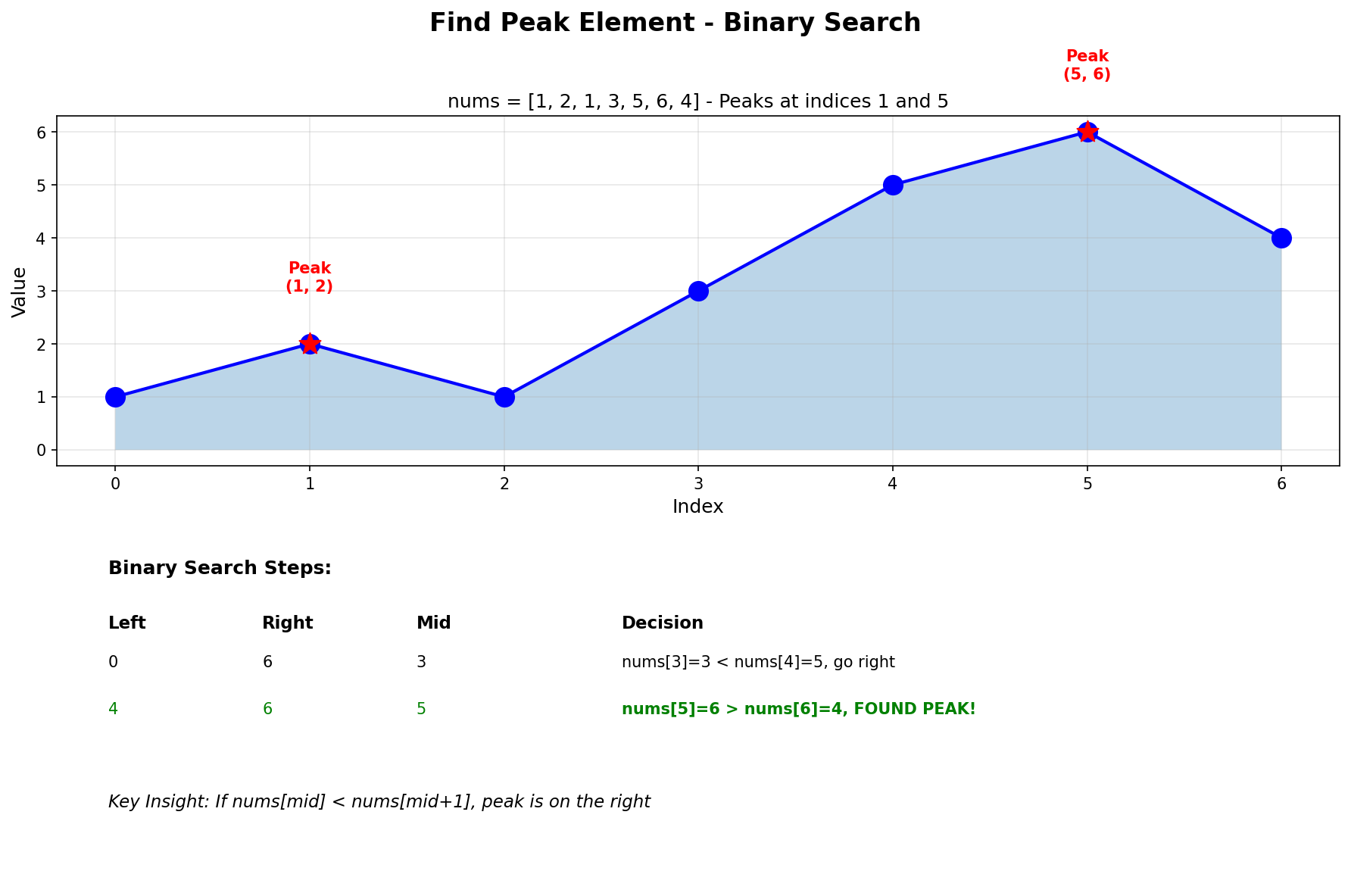
Key Insight: Binary Search
Even though the array is not sorted, we can use binary search because:
- Boundary condition: nums[-1] = nums[n] = -infinity
- If
nums[mid] < nums[mid + 1], there must be a peak on the right side - If
nums[mid] < nums[mid - 1], there must be a peak on the left side - We're guaranteed to find a peak because we're "climbing" toward it
Think of it like climbing a hill - if you always go upward, you'll reach a peak.
Solution
def findPeakElement(nums: list[int]) -> int:
    """
    Find a peak element using binary search.

    Time Complexity: O(log n)
    Space Complexity: O(1)
    """
    left, right = 0, len(nums) - 1

    while left < right:
        mid = (left + right) // 2

        if nums[mid] < nums[mid + 1]:
            # Peak must be on the right side
            left = mid + 1
        else:
            # Peak is at mid or on the left side
            right = mid

return leftpublic int findPeakElement(int[] nums) {
int left = 0;
int right = nums.length - 1;
while (left < right) {
int mid = left + (right - left) / 2;
if (nums[mid] < nums[mid + 1]) {
// Peak must be on the right side
left = mid + 1;
} else {
// Peak is at mid or on the left side
right = mid;
}
}
return left;
}Complexity (Binary Search Iterative): Time O(log n) · Space O(1)
- Time: Search space halves each iteration; at most log2(n) iterations
- Space: Only three variables (
left,right,mid) used regardless of input size
# Recursive version
def findPeakElement_recursive(nums: list[int]) -> int:
    """
    Recursive binary search approach.
    """
    def search(left: int, right: int) -> int:
        if left == right:
            return left

        mid = (left + right) // 2

        if nums[mid] < nums[mid + 1]:
            return search(mid + 1, right)
        else:
            return search(left, mid)

    return search(0, len(nums) - 1)


# Linear scan (for comparison - O(n))
def findPeakElement_linear(nums: list[int]) -> int:
    """
    Linear scan - O(n) time.
    """
    for i in range(len(nums) - 1):
        if nums[i] > nums[i + 1]:
            return i
return len(nums) - 1Complexity (Binary Search Recursive): Time O(log n) · Space O(log n)
- Time: Same halving logic as iterative; log2(n) recursive calls
- Space: Recursion stack depth is O(log n) due to binary division
Complexity (Linear Scan): Time O(n) · Space O(1)
- Time: Worst case traverses entire array when peak is at the end
- Space: No additional data structures used
Step-by-Step Trace
For nums = [1, 2, 1, 3, 5, 6, 4]:
| Step | left | right | mid | nums[mid] | nums[mid+1] | Comparison | Action |
|---|---|---|---|---|---|---|---|
| 1 | 0 | 6 | 3 | 3 | 5 | 3 < 5 | left = 4 |
| 2 | 4 | 6 | 5 | 6 | 4 | 6 > 4 | right = 5 |
| 3 | 4 | 5 | 4 | 5 | 6 | 5 < 6 | left = 5 |
| 4 | 5 | 5 | - | - | - | left == right | return 5 |
Result: Peak at index 5 (value 6)
Why Binary Search Works
Case 1: nums[mid] < nums[mid + 1]
        We're on an "upward slope" going right
        A peak must exist to the right (including mid+1)

              ?
             /
            /
           mid  mid+1

Case 2: nums[mid] > nums[mid + 1]
        We're on a "downward slope" or at a peak
        A peak exists at mid or to the left

        mid
         \
          \
           mid+1

Because nums[-1] = nums[n] = -infinity, we're guaranteed to find a peak.Complexity Analysis
| Approach | Time | Space |
|---|---|---|
| Binary Search | O(log n) | O(1) |
| Recursive BS | O(log n) | O(log n) |
| Linear Scan | O(n) | O(1) |
Edge Cases
- Single element:
[1]-> Return 0 (always a peak) - Two elements, ascending:
[1, 2]-> Return 1 - Two elements, descending:
[2, 1]-> Return 0 - Strictly increasing:
[1, 2, 3, 4]-> Return 3 (last element) - Strictly decreasing:
[4, 3, 2, 1]-> Return 0 (first element) - All same: Not possible per problem (no two adjacent elements are equal)
- Peak in middle:
[1, 3, 1]-> Return 1
Variations
Find Peak Element in 2D Matrix (Kth Peak)
def findPeakGrid(mat: list[list[int]]) -> list[int]:
    """
    Find peak in 2D matrix where peak is greater than all 4 neighbors.
    """
    def findMaxInColumn(col: int) -> int:
        max_row = 0
        for row in range(len(mat)):
            if mat[row][col] > mat[max_row][col]:
                max_row = row
        return max_row

    left, right = 0, len(mat[0]) - 1

    while left < right:
        mid = (left + right) // 2
        max_row = findMaxInColumn(mid)

        if mat[max_row][mid] < mat[max_row][mid + 1]:
            left = mid + 1
        else:
            right = mid

return [findMaxInColumn(left), left]Complexity: Time O(m log n) · Space O(1)
- Time: Binary search on columns (log n iterations), each finding column max in O(m) time
- Space: Only constant variables used for pointers and indices
Find All Peaks
def findAllPeaks(nums: list[int]) -> list[int]:
    """
    Find all peak elements - O(n).
    """
    if len(nums) == 1:
        return [0]

    peaks = []

    # Check first element
    if nums[0] > nums[1]:
        peaks.append(0)

    # Check middle elements
    for i in range(1, len(nums) - 1):
        if nums[i] > nums[i - 1] and nums[i] > nums[i + 1]:
            peaks.append(i)

    # Check last element
    if nums[-1] > nums[-2]:
        peaks.append(len(nums) - 1)

return peaksComplexity: Time O(n) · Space O(k)
- Time: Single pass checking each element against its neighbors
- Space: Output list stores k peaks; worst case k = O(n/2) for alternating arrays
Common Mistakes
- Using
left <= right- Should beleft < rightto avoid infinite loop - Checking
nums[mid-1]- Can cause index out of bounds; focus on mid+1 - Not handling edge elements - Problem guarantees -infinity at boundaries
- Returning wrong value - Return left (or right) when they converge
Related Problems
Find Minimum in Rotated Sorted Array (LeetCode 153)
Problem: Find minimum in rotated sorted array.
Key Insight: Similar binary search on non-standard array. Minimum is where rotation occurred.
Approach: If nums[mid] > nums[right], minimum in right half. Otherwise in left half (including mid).
Complexity: O(log n) time, O(1) space
Search in Rotated Sorted Array (LeetCode 33)
Problem: Search for target in rotated sorted array.
Key Insight: Binary search with modified logic - determine which half is sorted, check if target in that range.
Approach: If left half sorted and target in range, search left. Otherwise search right (and vice versa).
Complexity: O(log n) time, O(1) space
Peak Index in a Mountain Array (LeetCode 852)
Problem: Find peak in array that strictly increases then strictly decreases (guaranteed mountain).
Key Insight: Simpler than Find Peak Element - guaranteed single peak, strictly monotonic.
Approach: Binary search - if nums[mid] < nums[mid+1], on ascending side, go right. Otherwise go left.
Complexity: O(log n) time, O(1) space
Key Takeaways
- Binary search can work on non-sorted arrays if there's a decidable condition
- The key insight: following the "upward slope" guarantees finding a peak
- The -infinity boundary condition ensures a peak always exists
- This is a template for "binary search on answer" problems
- Both iterative and recursive approaches work; iterative is more space-efficient