Factorial
LeetCode: N/A (Fundamental recursion problem) Difficulty: Easy Pattern: Basic Recursion
Problem Statement
Calculate the factorial of a non-negative integer n.
The factorial of n (denoted as n!) is the product of all positive integers less than or equal to n.
Mathematical Definition:
n! = n * (n-1) * (n-2) * ... * 2 * 10! = 1(by definition)1! = 1
Examples
Example 1
Input: n = 5
Output: 120
Explanation: 5! = 5 * 4 * 3 * 2 * 1 = 120Example 2
Input: n = 0
Output: 1
Explanation: 0! = 1 by definitionExample 3
Input: n = 3
Output: 6
Explanation: 3! = 3 * 2 * 1 = 6Constraints
0 <= n <= 12(to avoid integer overflow in 32-bit systems)- For larger values, use 64-bit integers or arbitrary precision libraries
Recursion Tree Visualization
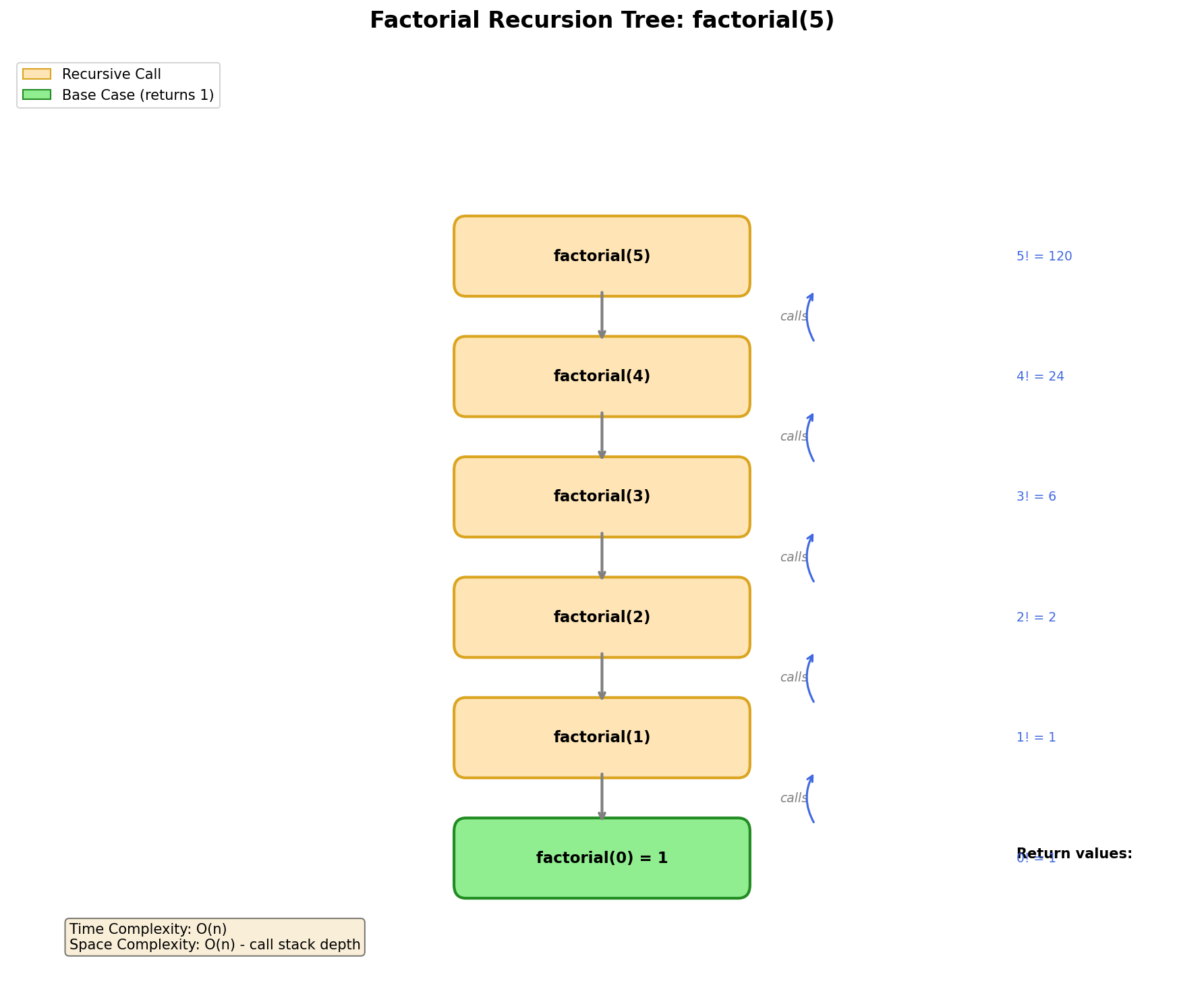
Call Stack Trace
factorial(5) called
|
+-- factorial(4) called
|   |
|   +-- factorial(3) called
|   |   |
|   |   +-- factorial(2) called
|   |   |   |
|   |   |   +-- factorial(1) called
|   |   |   |   |
|   |   |   |   +-- factorial(0) called
|   |   |   |   |   |
|   |   |   |   |   +-- return 1  (BASE CASE)
|   |   |   |   |
|   |   |   |   +-- return 1 * 1 = 1
|   |   |   |
|   |   |   +-- return 2 * 1 = 2
|   |   |
|   |   +-- return 3 * 2 = 6
|   |
|   +-- return 4 * 6 = 24
|
+-- return 5 * 24 = 120

RESULT: factorial(5) = 120Recursive Template
def factorial(n):
    """
    Recursive factorial template.

    Components:
    1. BASE CASE: Stop condition (n <= 1)
    2. RECURSIVE CASE: n * factorial(n-1)
    """
    # BASE CASE
    if n <= 1:
        return 1

    # RECURSIVE CASE
return n * factorial(n - 1)Solutions
Solution
def factorial(n: int) -> int:
    """
    Calculate factorial using basic recursion.

    Time Complexity: O(n) - n recursive calls
    Space Complexity: O(n) - call stack depth

    Args:
        n: Non-negative integer

    Returns:
        n! (factorial of n)
    """
    # Base case: 0! = 1! = 1
    if n <= 1:
        return 1

    # Recursive case: n! = n * (n-1)!
    return n * factorial(n - 1)


# Test
print(factorial(5))  # Output: 120
print(factorial(0))  # Output: 1
print(factorial(10)) # Output: 3628800public long factorial(int n) {
// Base case: 0! = 1! = 1
if (n <= 1) return 1;
// Recursive case: n! = n * (n-1)!
return n * factorial(n - 1);
}Complexity: Time O(n) · Space O(n)
- Time: Exactly n recursive calls, each performing one multiplication operation.
- Space: Call stack grows to depth n, with each frame storing the return address and local variable n.
Solution 2: Tail Recursion (Optimized for some languages)
def factorial_tail(n: int, accumulator: int = 1) -> int:
    """
    Tail-recursive factorial.

    Note: Python doesn't optimize tail recursion, but this pattern
    is useful in languages that do (Scheme, Scala, etc.)

    Time Complexity: O(n)
    Space Complexity: O(n) in Python, O(1) in tail-call optimized languages
    """
    if n <= 1:
        return accumulator
    return factorial_tail(n - 1, n * accumulator)


# Test
print(factorial_tail(5)) # Output: 120Complexity: Time O(n) · Space O(n) in Python, O(1) with TCO
- Time: Still makes n recursive calls with one multiplication each.
- Space: Python does not optimize tail calls, so stack still grows to depth n. Languages with tail-call optimization (Scheme, Scala) can reuse the same stack frame, achieving O(1) space.
Solution 3: Iterative (Best for Python)
def factorial_iterative(n: int) -> int:
    """
    Iterative factorial - most efficient for Python.

    Time Complexity: O(n)
    Space Complexity: O(1)
    """
    result = 1
    for i in range(2, n + 1):
        result *= i
    return result


# Test
print(factorial_iterative(5)) # Output: 120Complexity: Time O(n) · Space O(1)
- Time: Single loop from 2 to n, performing n-1 multiplications.
- Space: Only one variable (result) is used, no recursion stack needed.
Solution 4: Using math library
import math

def factorial_builtin(n: int) -> int:
    """
    Using Python's built-in factorial.

    Time Complexity: O(n)
    Space Complexity: O(1)
    """
    return math.factorial(n)


# Test
print(factorial_builtin(5)) # Output: 120Complexity: Time O(n) · Space O(1)
- Time: Built-in implementation uses optimized iterative approach with n multiplications.
- Space: Internally uses constant extra space for the computation.
Solution 5: Using reduce
from functools import reduce

def factorial_reduce(n: int) -> int:
    """
    Factorial using reduce.

    Time Complexity: O(n)
    Space Complexity: O(1)
    """
    if n <= 1:
        return 1
    return reduce(lambda x, y: x * y, range(1, n + 1))


# Test
print(factorial_reduce(5)) # Output: 120Complexity: Time O(n) · Space O(1)
- Time: Reduce applies the lambda function n-1 times across the range, performing n-1 multiplications.
- Space: Reduce processes elements sequentially, accumulating the result without storing intermediate values.
Complexity Analysis
| Approach | Time Complexity | Space Complexity | Notes |
|---|---|---|---|
| Basic Recursion | O(n) | O(n) | Call stack depth |
| Tail Recursion | O(n) | O(n)* | *O(1) with TCO |
| Iterative | O(n) | O(1) | Most efficient |
| Built-in (math) | O(n) | O(1) | Recommended |
Why O(n) Time?
- We perform exactly
nmultiplications - Each multiplication is O(1) for bounded integers
Why O(n) Space for Recursion?
- Maximum call stack depth is
n - Each stack frame stores local variables and return address
Common Mistakes
1. Missing Base Case
# WRONG - infinite recursion!
def factorial_wrong(n):
    return n * factorial_wrong(n - 1)

# CORRECT
def factorial_correct(n):
    if n <= 1:  # BASE CASE is essential!
        return 1
return n * factorial_correct(n - 1)2. Wrong Base Case Value
# WRONG - returns 0 for any input
def factorial_wrong(n):
    if n == 0:
        return 0  # Should be 1!
return n * factorial_wrong(n - 1)3. Not Handling Negative Input
def factorial_safe(n: int) -> int:
    """Handle edge cases properly."""
    if n < 0:
        raise ValueError("Factorial not defined for negative numbers")
    if n <= 1:
        return 1
return n * factorial_safe(n - 1)Related Problems
Fibonacci Number (LeetCode 509)
Problem: Calculate F(n), where F(0)=0, F(1)=1, and F(n)=F(n-1)+F(n-2) for n>1.
Key Insight: Unlike factorial's single recursive call, Fibonacci has two calls - introducing overlapping subproblems.
Approach: Requires memoization for efficiency due to overlapping subproblems.
Complexity: O(n) with memoization, O(2^n) without
Link: Local Solution
Climbing Stairs (LeetCode 70)
Problem: Count distinct ways to climb n stairs taking 1 or 2 steps at a time.
Key Insight: Same recurrence as Fibonacci but with different base cases.
Approach: ways(n) = ways(n-1) + ways(n-2), where ways(1)=1, ways(2)=2.
Complexity: O(n) time, O(1) space with optimization
Link: Local Solution
Pow(x, n) (LeetCode 50)
Problem: Implement pow(x, n), which calculates x raised to the power n.
Key Insight: Use divide and conquer - x^n = (x^(n/2))^2, reducing O(n) to O(log n).
Approach: Binary exponentiation - square the half result.
Complexity: O(log n) time, O(log n) space
Link: LeetCode 50
Interview Tips
- Start with the recurrence relation:
n! = n * (n-1)! - Identify the base case:
0! = 1! = 1 - Discuss time/space complexity: Both O(n) for recursion
- Mention iterative alternative: More efficient in Python
- Handle edge cases: Negative numbers, large inputs
Key Takeaways
- Factorial is the simplest recursion example - perfect for understanding the pattern
- Base case is essential - prevents infinite recursion
- Each recursive call reduces the problem size - n becomes n-1
- Call stack grows linearly - O(n) space
- Iterative is often better - avoid stack overflow for large inputs
Last updated: January 2026