Trapping Rain Water
Problem Statement
Given n non-negative integers representing an elevation map where the width of each bar is 1, compute how much water it can trap after raining.
Examples
Example 1
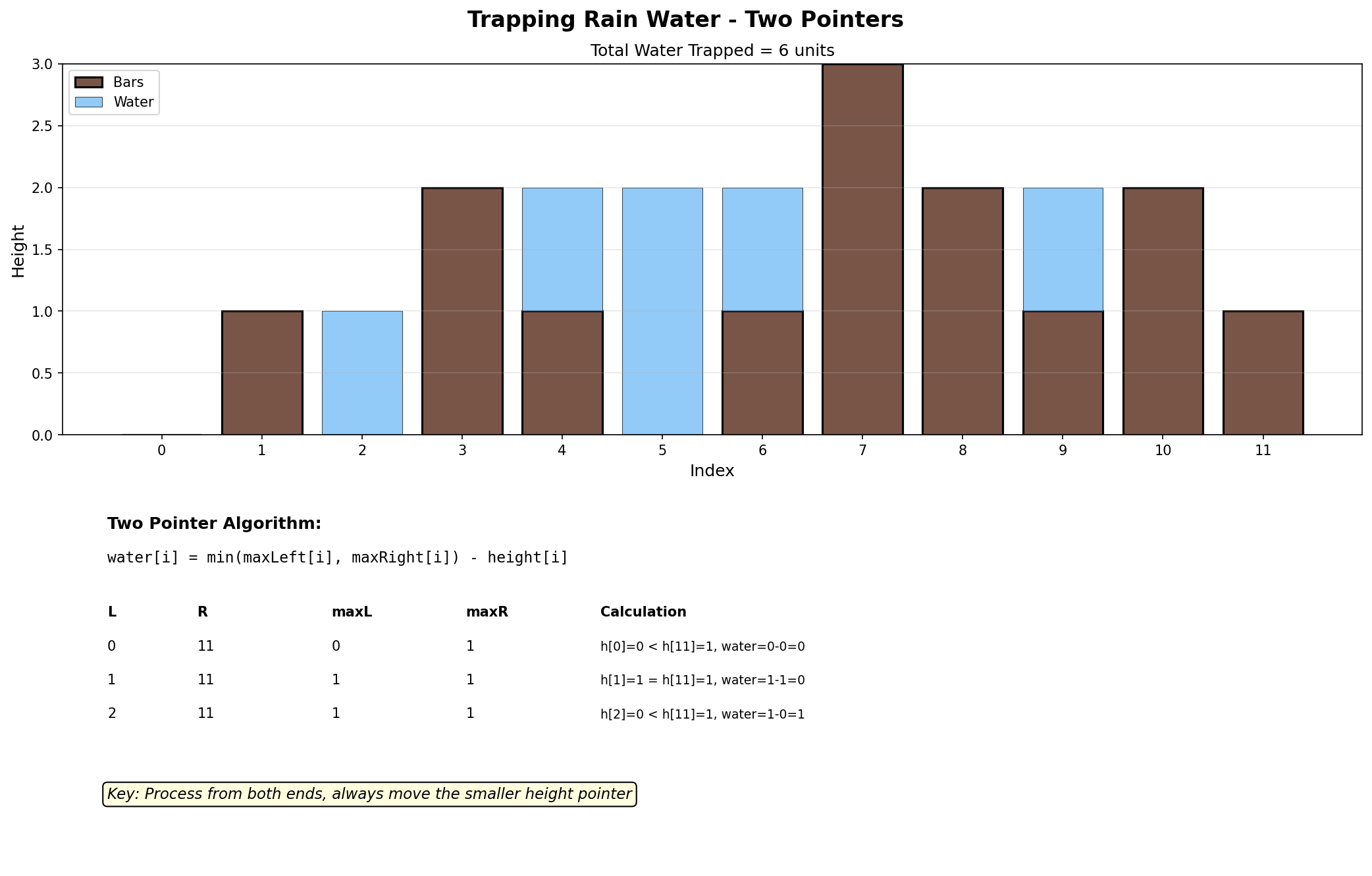
Input: height = [0, 1, 0, 2, 1, 0, 1, 3, 2, 1, 2, 1]
Output: 6
Explanation: The elevation map (black) and water (blue) are shown below.Example 2
Input: height = [4, 2, 0, 3, 2, 5]
Output: 9Visual Explanation
Key Insight
For each position i, the water trapped is determined by:
- The tallest bar to the left (maxLeft)
- The tallest bar to the right (maxRight)
- Water level = min(maxLeft, maxRight)
- Water trapped = max(0, water_level - height[i])
Multiple Approaches
Approach 1: Two Pointers (Optimal)
- O(n) time, O(1) space
- Process from both ends simultaneously
Approach 2: Prefix/Suffix Arrays
- O(n) time, O(n) space
- Pre-compute maxLeft and maxRight arrays
Approach 3: Monotonic Stack
- O(n) time, O(n) space
- Process "horizontal layers" of water
Solution
def trap(height: list[int]) -> int:
    """
    Calculate trapped rain water using two pointers.

    Time Complexity: O(n)
    Space Complexity: O(1)
    """
    if not height:
        return 0

    left, right = 0, len(height) - 1
    left_max, right_max = 0, 0
    water = 0

    while left < right:
        if height[left] < height[right]:
            # Left side is the limiting factor
            if height[left] >= left_max:
                left_max = height[left]
            else:
                water += left_max - height[left]
            left += 1
        else:
            # Right side is the limiting factor
            if height[right] >= right_max:
                right_max = height[right]
            else:
                water += right_max - height[right]
            right -= 1

return waterpublic int trap(int[] height) {
if (height == null || height.length == 0) return 0;
int left = 0, right = height.length - 1;
int leftMax = 0, rightMax = 0;
int water = 0;
while (left < right) {
if (height[left] < height[right]) {
// Left side is the limiting factor
if (height[left] >= leftMax) {
leftMax = height[left];
} else {
water += leftMax - height[left];
}
left++;
} else {
// Right side is the limiting factor
if (height[right] >= rightMax) {
rightMax = height[right];
} else {
water += rightMax - height[right];
}
right--;
}
}
return water;
}Complexity: Time O(n) · Space O(1)
- Time: Single pass through array; each position is visited exactly once as left and right pointers converge
- Space: Only uses constant extra variables (left, right, left_max, right_max, water)
# Prefix/Suffix Arrays approach (easier to understand)
def trap_arrays(height: list[int]) -> int:
    """
    Using prefix and suffix max arrays.

    Time Complexity: O(n)
    Space Complexity: O(n)
    """
    if not height:
        return 0

    n = len(height)
    max_left = [0] * n
    max_right = [0] * n

    # Fill max_left: max height to the left of each index
    max_left[0] = height[0]
    for i in range(1, n):
        max_left[i] = max(max_left[i - 1], height[i])

    # Fill max_right: max height to the right of each index
    max_right[n - 1] = height[n - 1]
    for i in range(n - 2, -1, -1):
        max_right[i] = max(max_right[i + 1], height[i])

    # Calculate water at each position
    water = 0
    for i in range(n):
        water_level = min(max_left[i], max_right[i])
        water += water_level - height[i]

return waterComplexity: Time O(n) · Space O(n)
- Time: Three separate O(n) passes: building max_left array, building max_right array, and computing water at each position
- Space: Two auxiliary arrays of size n store precomputed maximum heights from left and right
# Monotonic stack approach
def trap_stack(height: list[int]) -> int:
    """
    Using monotonic decreasing stack.
    Process water layer by layer (horizontal).

    Time Complexity: O(n)
    Space Complexity: O(n)
    """
    stack = []  # Stores indices
    water = 0

    for i, h in enumerate(height):
        # Process water trapped between stack top and current bar
        while stack and height[stack[-1]] < h:
            bottom = stack.pop()
            if not stack:
                break

            # Calculate water above 'bottom', bounded by left and current
            left_idx = stack[-1]
            width = i - left_idx - 1
            bounded_height = min(height[left_idx], h) - height[bottom]
            water += width * bounded_height

        stack.append(i)

return waterComplexity: Time O(n) · Space O(n)
- Time: Each index is pushed onto stack once and popped at most once, giving O(2n) = O(n) total operations
- Space: Stack stores indices; in worst case (monotonically decreasing heights), all n indices are stored
Step-by-Step Trace (Two Pointers)
For height = [0, 1, 0, 2, 1, 0, 1, 3, 2, 1, 2, 1]:
| Step | left | right | left_max | right_max | Condition | Action | Water |
|---|---|---|---|---|---|---|---|
| 1 | 0 | 11 | 0 | 0 | h[0]=0 < h[11]=1 | l_max=0, left++ | 0 |
| 2 | 1 | 11 | 0 | 0 | h[1]=1 < h[11]=1 | l_max=1, left++ | 0 |
| 3 | 2 | 11 | 1 | 0 | h[2]=0 < h[11]=1 | water+=1-0, left++ | 1 |
| 4 | 3 | 11 | 1 | 0 | h[3]=2 >= h[11]=1 | r_max=1, right-- | 1 |
| 5 | 3 | 10 | 1 | 1 | h[3]=2 >= h[10]=2 | r_max=2, right-- | 1 |
| ... | ... | ... | ... | ... | ... | ... | ... |
Final result: 6
Why Two Pointers Work
Key insight: Water at position i depends on:
- left_max: maximum height to the left
- right_max: maximum height to the right
- Water level = min(left_max, right_max)

At any step:
- If height[left] < height[right]:
  - The water at 'left' is bounded by left_max (since right side is taller)
  - We can safely calculate water at 'left' and move on

- If height[right] <= height[left]:
  - The water at 'right' is bounded by right_max (since left side is taller)
  - We can safely calculate water at 'right' and move on

We always process the side with the smaller bar because that's the limiting factor.Complexity Analysis
| Approach | Time | Space |
|---|---|---|
| Two Pointers | O(n) | O(1) |
| Prefix/Suffix Arrays | O(n) | O(n) |
| Monotonic Stack | O(n) | O(n) |
Edge Cases
- Empty array:
[]-> 0 - No trapping possible:
[1, 2, 3, 4]or[4, 3, 2, 1]-> 0 - Single bar:
[5]-> 0 - Two bars:
[5, 5]-> 0 - All same height:
[3, 3, 3, 3]-> 0 - Valley:
[3, 0, 3]-> 3
Comparison with Container With Most Water
| Trapping Rain Water | Container With Most Water |
|---|---|
| Water trapped ON/BETWEEN bars | Water held BY two bars |
| Consider all bars | Only consider two bars |
| Sum of water at each position | Area between two lines |
| Need to know both max_left and max_right | Only min of two heights matters |
Trapping Rain Water:        Container With Most Water:
   |                            |
   |~~|                         |~~~~~~~~|
   |~~|~~|              vs      |        |
-+--+--+- -+--------+-Related Problems
Container With Most Water (LeetCode 11)
Problem: Find two lines that form container holding most water.
Key Insight: Different problem - only care about TWO lines forming container, not water trapped at all positions.
Approach: Two pointers from ends. Area = min(heights) * width. Move pointer at shorter line.
Complexity: O(n) time, O(1) space
Product of Array Except Self (LeetCode 238)
Problem: Return array where each element is product of all other elements.
Key Insight: Same prefix/suffix pattern - compute from both directions.
Approach: First pass builds prefix products, second pass multiplies by suffix products.
Complexity: O(n) time, O(1) space (excluding output)
Largest Rectangle in Histogram (LeetCode 84)
Problem: Find largest rectangle area in histogram.
Key Insight: For each bar, find extent it can be the minimum height. Use monotonic stack.
Approach: Monotonic increasing stack. When smaller bar found, calculate areas for taller bars that must end.
Complexity: O(n) time, O(n) space
Pour Water (LeetCode 755)
Problem: Simulate water pouring at index K, water flows to lowest adjacent position.
Key Insight: Simulation problem - water seeks lowest point, prefers left, then right.
Approach: For each water unit: try flowing left to find lower position, then right, then stay at K.
Complexity: O(V * n) time where V = water volume
Key Takeaways
- The two pointer approach is optimal: O(1) space
- Water at each position = min(maxLeft, maxRight) - height
- The limiting factor is always the smaller of the two maximums
- This is a classic example where the prefix/suffix pattern applies
- Three different approaches (two pointers, arrays, stack) each have their intuition
- Understanding WHY each approach works is crucial for similar problems