Sliding Window Pattern
Process contiguous subarrays/substrings efficiently
Pattern Overview
The Sliding Window technique is a powerful algorithmic pattern used to solve problems involving contiguous subarrays or substrings. Instead of repeatedly iterating over the same elements with nested loops, the sliding window maintains a range (or "window") that moves step-by-step through the data, updating results incrementally.
Why Sliding Window?
| Approach | Time Complexity | Description |
|---|---|---|
| Brute Force | O(n²) or O(n³) | Check every possible subarray |
| Sliding Window | O(n) | Process each element at most twice |
The key insight is that when the window slides, we only need to:
- Add the new element entering the window
- Remove the element leaving the window
- Update our result based on the new window state
This converts two nested loops into a single pass, dramatically improving efficiency.
When to Use Sliding Window
- Problems involving contiguous sequences (subarrays, substrings)
- Finding maximum/minimum values in subarrays
- Counting subarrays that satisfy certain conditions
- String pattern matching and anagram detection
- Running averages or sums over fixed intervals
Visual Guides
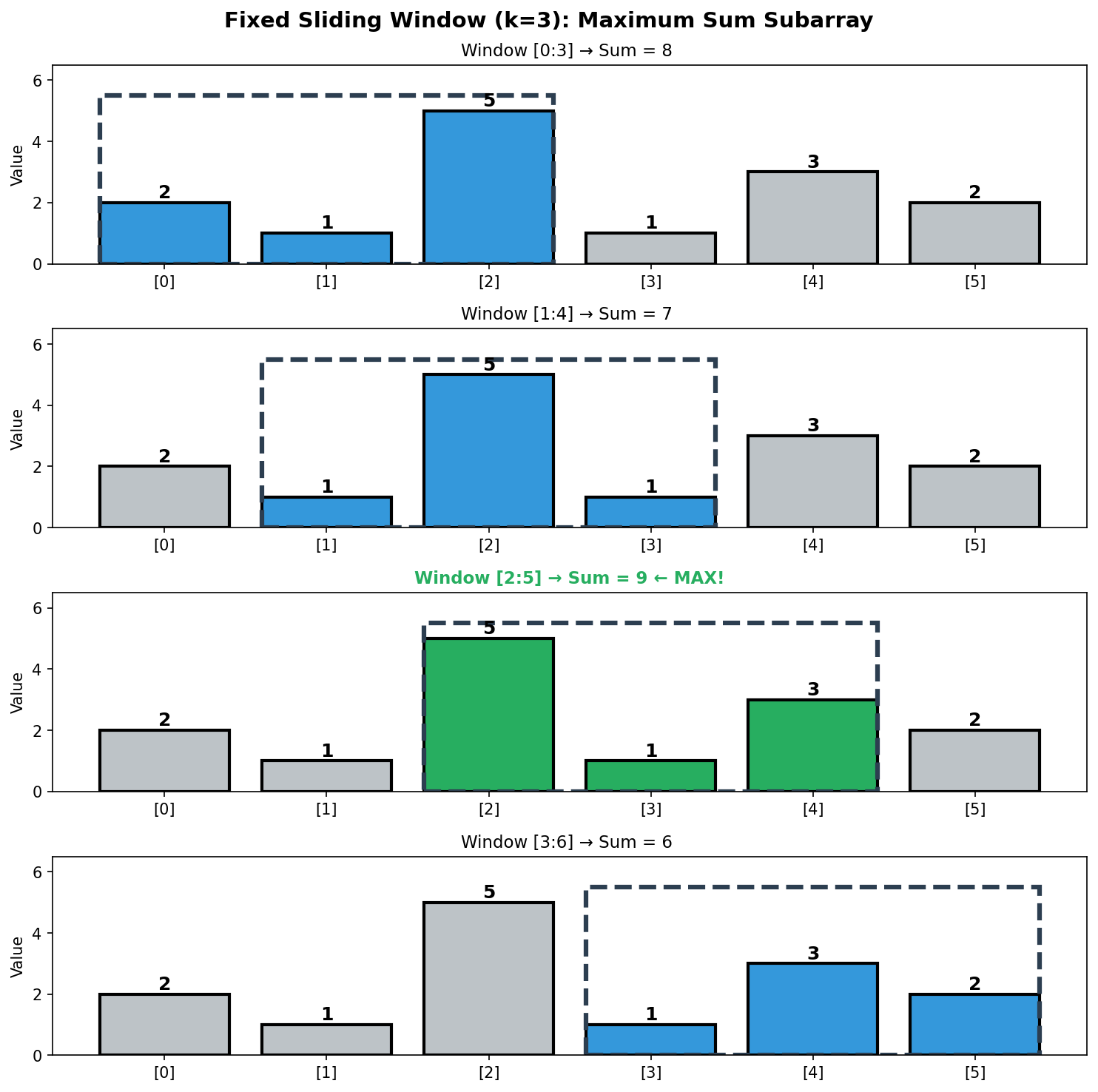
Fixed Size Window
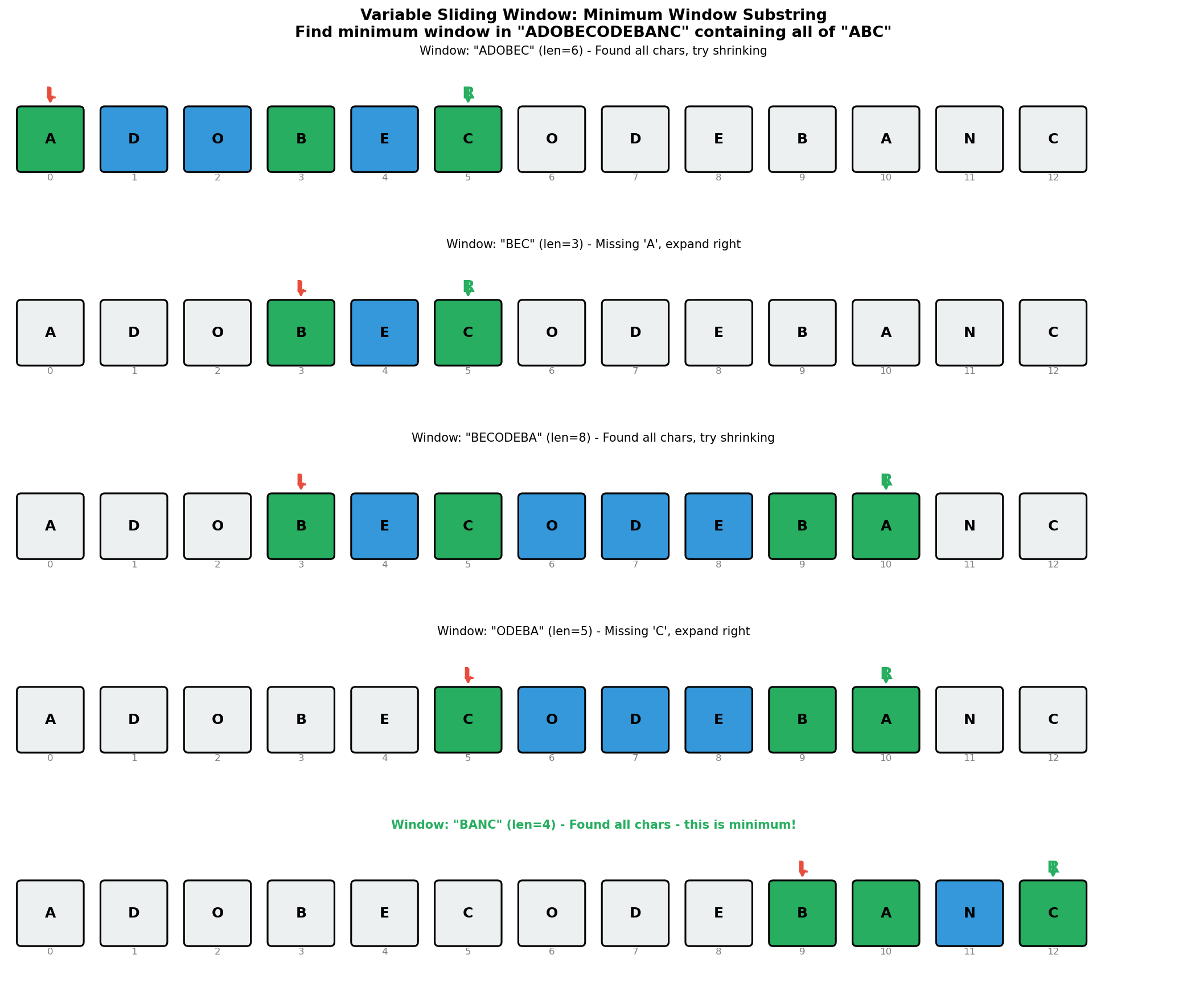
Variable Window (Expand/Contract)
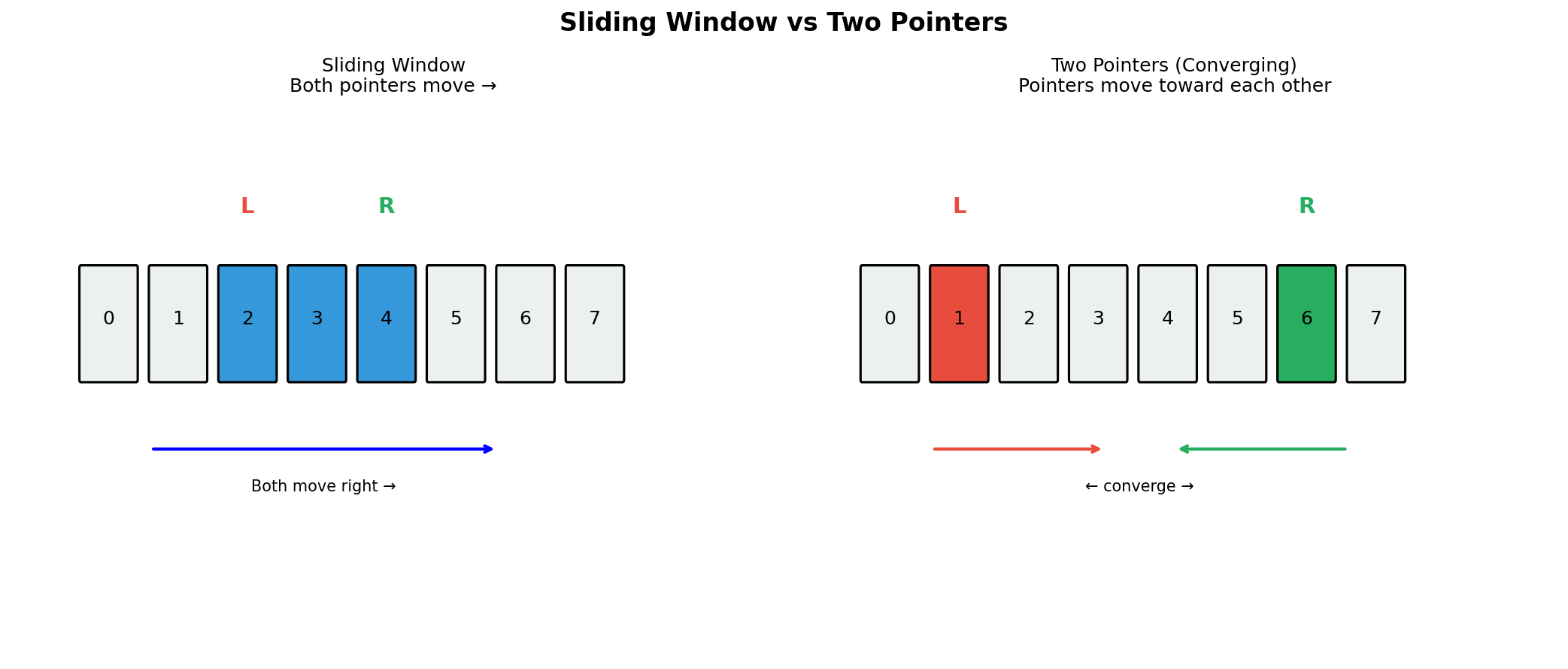
Sliding Window vs Two Pointers
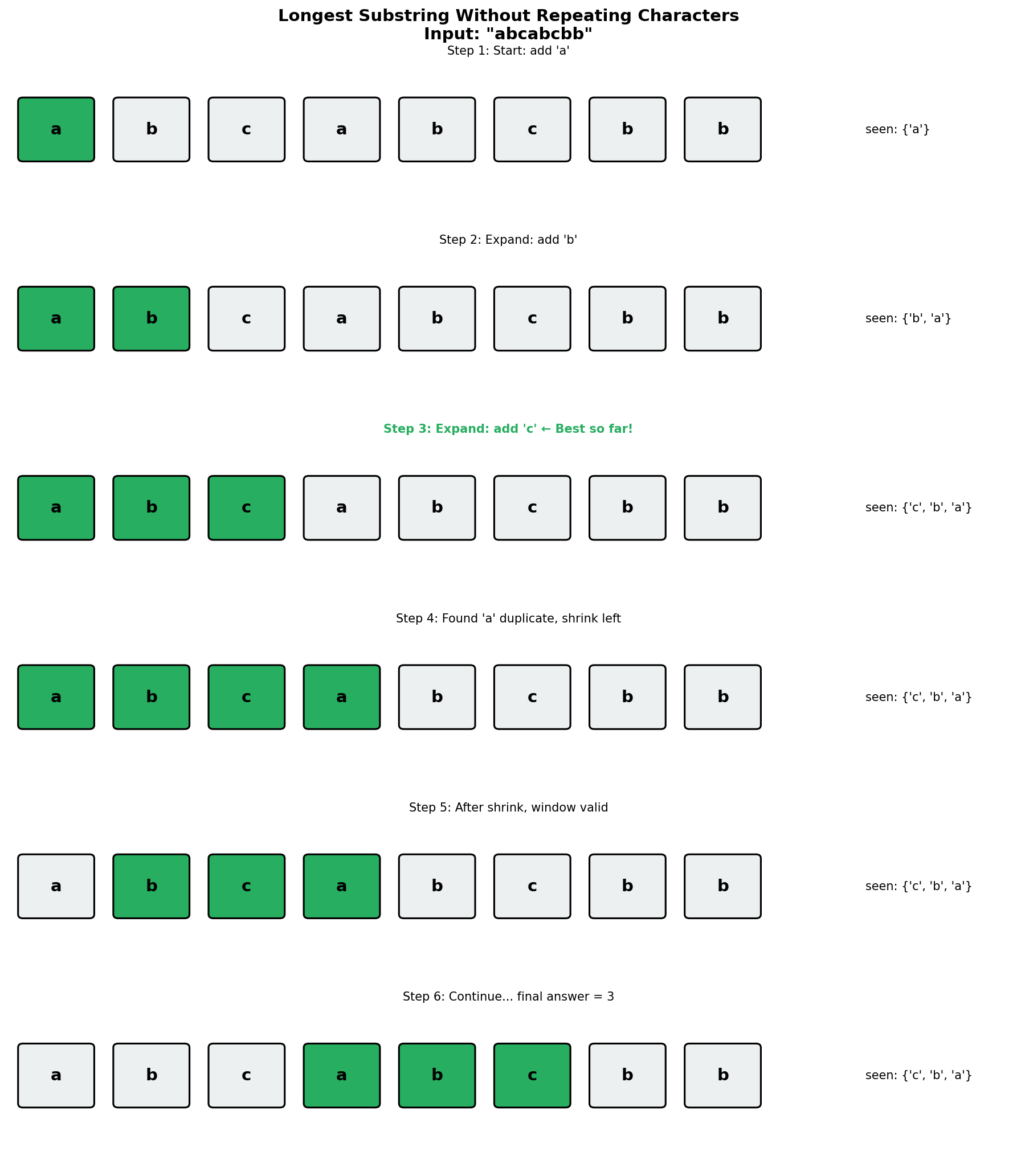
Longest Substring Without Repeating
Types of Sliding Window
1. Fixed Size Window
Use when the window size k is explicitly given in the problem.
Characteristics:
- Window size remains constant throughout
- Simpler to implement
- Typically involves sum, average, or max/min in each window
Example Problems:
- Maximum sum of subarray of size k
- Maximum average subarray of size k
- Find all anagrams in a string (window = pattern length)
- Sliding window maximum/minimum
Algorithm Flow:
- Initialize window with first k elements
- Slide window one position at a time
- Add new element, remove old element
- Update result
2. Variable Size Window
Use when finding the optimal window size that satisfies a condition.
Characteristics:
- Window expands and shrinks dynamically
- Uses two pointers:
left(start) andright(end) - More complex but handles optimization problems
Two Sub-types:
a) Shrinkable Window (Find Maximum)
- Expand right pointer to grow window
- Shrink from left when condition is violated
- Track maximum valid window size
b) Non-shrinkable Window (Find Minimum)
- Expand right pointer to grow window
- Shrink from left when condition is satisfied
- Track minimum valid window size
Example Problems:
- Longest substring without repeating characters
- Minimum window substring
- Longest substring with at most k distinct characters
- Smallest subarray with sum >= target
Mermaid Diagram
Fixed Window Sliding Animation
Variable Window Mechanism
Window State Visualization
Template Code
Fixed Window Template
def fixed_sliding_window(arr, k):
    """
    Template for fixed-size sliding window problems.

    Args:
        arr: Input array
        k: Fixed window size

    Returns:
        Result based on problem (max sum, count, etc.)
    """
    n = len(arr)
    if n < k:
        return None  # Handle edge case

    # Initialize first window
    window_sum = sum(arr[:k])
    max_sum = window_sum

    # Slide the window
    for i in range(k, n):
        # Add new element, remove old element
        window_sum += arr[i] - arr[i - k]
        max_sum = max(max_sum, window_sum)

    return max_sum


def fixed_window_with_hashmap(s, k):
    """
    Fixed window with frequency counting (for strings).

    Args:
        s: Input string
        k: Fixed window size

    Returns:
        Result based on problem requirements
    """
    from collections import Counter

    if len(s) < k:
        return None

    # Initialize first window
    window = Counter(s[:k])
    result = []

    # Process first window
    # ... (problem-specific logic)

    # Slide the window
    for i in range(k, len(s)):
        # Add new character
        window[s[i]] += 1

        # Remove old character
        window[s[i - k]] -= 1
        if window[s[i - k]] == 0:
            del window[s[i - k]]

        # Process current window
        # ... (problem-specific logic)

return resultint fixedSlidingWindow(int[] arr, int k) {
// Fixed-size window max sum. Time: O(n), Space: O(1)
int n = arr.length;
if (n < k) return Integer.MIN_VALUE;
int windowSum = 0;
for (int i = 0; i < k; i++) windowSum += arr[i];
int maxSum = windowSum;
for (int i = k; i < n; i++) {
windowSum += arr[i] - arr[i - k];
maxSum = Math.max(maxSum, windowSum);
}
return maxSum;
}
List<Integer> fixedWindowWithHashmap(String s, int k) {
// Fixed window with char-frequency tracking. Time: O(n), Space: O(k)
List<Integer> result = new ArrayList<>();
if (s.length() < k) return result;
Map<Character, Integer> window = new HashMap<>();
for (int i = 0; i < k; i++)
window.merge(s.charAt(i), 1, Integer::sum);
// ... (problem-specific check on first window)
for (int i = k; i < s.length(); i++) {
// Add new character
window.merge(s.charAt(i), 1, Integer::sum);
// Remove old character
char out = s.charAt(i - k);
window.merge(out, -1, Integer::sum);
if (window.get(out) == 0) window.remove(out);
// ... (problem-specific check)
}
return result;
}Complexity: Time O(n) · Space O(1) or O(k)
- Time: O(n) - Single pass through array; each element added and removed exactly once
- Space: O(1) for sum tracking, O(k) for hashmap variant where k is window size or character set size
Variable Window Template (Shrinkable - Find Maximum)
def variable_sliding_window_max(s):
    """
    Template for variable-size sliding window (finding maximum).
    Use when: Finding longest/largest valid window.

    Args:
        s: Input string or array

    Returns:
        Maximum window size satisfying condition
    """
    left = 0
    window = {}  # or set, counter, etc.
    result = 0

    for right in range(len(s)):
        # EXPAND: Add element at right pointer to window
        window[s[right]] = window.get(s[right], 0) + 1

        # SHRINK: Contract window while invalid
        while is_invalid(window):  # Define based on problem
            window[s[left]] -= 1
            if window[s[left]] == 0:
                del window[s[left]]
            left += 1

        # UPDATE: Current window is valid, update result
        result = max(result, right - left + 1)

    return result


def is_invalid(window):
    """
    Define invalidity condition based on problem.
    Examples:
    - Repeating characters: any count > 1
    - More than k distinct: len(window) > k
    - Sum exceeds target: sum > target
    """
pass # Implement based on problemint variableSlidingWindowMax(String s) {
// Template: find longest valid window. Time: O(n), Space: O(k)
int left = 0, result = 0;
Map<Character, Integer> window = new HashMap<>();
for (int right = 0; right < s.length(); right++) {
// EXPAND: add right element
window.merge(s.charAt(right), 1, Integer::sum);
// SHRINK: contract while invalid (replace with problem condition)
while (isInvalid(window)) {
char lc = s.charAt(left);
window.merge(lc, -1, Integer::sum);
if (window.get(lc) == 0) window.remove(lc);
left++;
}
// UPDATE result
result = Math.max(result, right - left + 1);
}
return result;
}
boolean isInvalid(Map<Character, Integer> window) {
// Replace with problem-specific invalidity condition
return false;
}Complexity: Time O(n) · Space O(k)
- Time: O(n) - Each element added once (right pointer) and removed at most once (left pointer)
- Space: O(k) - HashMap stores at most k distinct elements where k depends on problem constraints
Variable Window Template (Find Minimum)
def variable_sliding_window_min(s, target):
    """
    Template for variable-size sliding window (finding minimum).
    Use when: Finding shortest/smallest valid window.

    Args:
        s: Input string or array
        target: Target condition to satisfy

    Returns:
        Minimum window size satisfying condition
    """
    left = 0
    window = {}
    result = float('inf')

    for right in range(len(s)):
        # EXPAND: Add element at right pointer
        window[s[right]] = window.get(s[right], 0) + 1

        # SHRINK: Contract window while VALID (to find minimum)
        while is_valid(window, target):  # Define based on problem
            # Update result with current valid window
            result = min(result, right - left + 1)

            # Try to shrink
            window[s[left]] -= 1
            if window[s[left]] == 0:
                del window[s[left]]
            left += 1

return result if result != float('inf') else 0int variableSlidingWindowMin(String s, int target) {
// Template: find shortest valid window. Time: O(n), Space: O(k)
int left = 0, result = Integer.MAX_VALUE;
Map<Character, Integer> window = new HashMap<>();
for (int right = 0; right < s.length(); right++) {
// EXPAND: add right element
window.merge(s.charAt(right), 1, Integer::sum);
// SHRINK: while valid, try to minimize window
while (isValid(window, target)) {
result = Math.min(result, right - left + 1);
char lc = s.charAt(left);
window.merge(lc, -1, Integer::sum);
if (window.get(lc) == 0) window.remove(lc);
left++;
}
}
return result == Integer.MAX_VALUE ? 0 : result;
}
boolean isValid(Map<Character, Integer> window, int target) {
// Replace with problem-specific validity condition
return false;
}Complexity: Time O(n) · Space O(k)
- Time: O(n) - Each element enters window once and leaves at most once
- Space: O(k) - HashMap stores elements in current window; k is constraint-dependent
Sliding Window with Deque (for Max/Min in Window)
from collections import deque

def sliding_window_maximum(nums, k):
    """
    Find maximum in each window of size k.
    Uses monotonic deque for O(n) complexity.

    Args:
        nums: Input array
        k: Window size

    Returns:
        List of maximums for each window position
    """
    result = []
    dq = deque()  # Stores indices, monotonically decreasing values

    for i in range(len(nums)):
        # Remove indices outside current window
        while dq and dq[0] <= i - k:
            dq.popleft()

        # Remove smaller elements (maintain decreasing order)
        while dq and nums[dq[-1]] < nums[i]:
            dq.pop()

        dq.append(i)

        # Window is complete, record maximum
        if i >= k - 1:
            result.append(nums[dq[0]])

return resultint[] slidingWindowMaximum(int[] nums, int k) {
// LeetCode 239. Monotonic deque. Time: O(n), Space: O(k)
int n = nums.length;
int[] result = new int[n - k + 1];
Deque<Integer> dq = new ArrayDeque<>(); // stores indices
for (int i = 0; i < n; i++) {
// Remove indices outside current window
while (!dq.isEmpty() && dq.peekFirst() <= i - k) dq.pollFirst();
// Remove smaller elements (maintain decreasing order)
while (!dq.isEmpty() && nums[dq.peekLast()] < nums[i]) dq.pollLast();
dq.offerLast(i);
if (i >= k - 1) result[i - k + 1] = nums[dq.peekFirst()];
}
return result;
}Complexity: Time O(n) · Space O(k)
- Time: O(n) - Each element added and removed from deque at most once (amortized O(1) per element)
- Space: O(k) - Deque stores at most k indices at any time
Classic Problems
1. Maximum Sum Subarray of Size K (Fixed)
LeetCode Reference: Maximum Average Subarray I (643)
Problem: Given an array of integers and a number k, find the maximum sum of any contiguous subarray of size k.
def max_sum_subarray(arr, k):
    """
    Find maximum sum of subarray of size k.

    Time: O(n), Space: O(1)

    Example:
        arr = [2, 1, 5, 1, 3, 2], k = 3
        Subarrays: [2,1,5]=8, [1,5,1]=7, [5,1,3]=9, [1,3,2]=6
        Output: 9
    """
    if len(arr) < k:
        return None

    # Calculate sum of first window
    window_sum = sum(arr[:k])
    max_sum = window_sum

    # Slide window and track maximum
    for i in range(k, len(arr)):
        # Slide: add new element, remove leftmost
        window_sum += arr[i] - arr[i - k]
        max_sum = max(max_sum, window_sum)

    return max_sum


# Test
arr = [2, 1, 5, 1, 3, 2]
k = 3
print(max_sum_subarray(arr, k)) # Output: 9int maxSumSubarray(int[] arr, int k) {
// Maximum sum of any subarray of size k. Time: O(n), Space: O(1)
if (arr.length < k) return Integer.MIN_VALUE;
int windowSum = 0;
for (int i = 0; i < k; i++) windowSum += arr[i];
int maxSum = windowSum;
for (int i = k; i < arr.length; i++) {
windowSum += arr[i] - arr[i - k];
maxSum = Math.max(maxSum, windowSum);
}
return maxSum;
}Complexity: Time O(n) · Space O(1)
- Time: O(n) - Single pass through array after O(k) initialization; each slide is O(1)
- Space: O(1) - Only two variables (window_sum, max_sum) regardless of input size
2. Longest Substring Without Repeating Characters (Variable)
LeetCode 3 - Classic Google/FAANG interview question
Problem: Given a string s, find the length of the longest substring without repeating characters.
def length_of_longest_substring(s):
    """
    Find longest substring without repeating characters.

    Time: O(n), Space: O(min(m, n)) where m is charset size

    Example:
        s = "abcabcbb"
        "abc" is the longest substring -> length 3
    """
    char_index = {}  # Character -> last seen index
    left = 0
    max_length = 0

    for right, char in enumerate(s):
        # If character seen and within current window
        if char in char_index and char_index[char] >= left:
            # Move left pointer past the duplicate
            left = char_index[char] + 1

        # Update last seen index
        char_index[char] = right

        # Update maximum length
        max_length = max(max_length, right - left + 1)

    return max_length


# Alternative using set
def length_of_longest_substring_set(s):
    """Using set to track characters in window."""
    char_set = set()
    left = 0
    max_length = 0

    for right in range(len(s)):
        # Shrink window while duplicate exists
        while s[right] in char_set:
            char_set.remove(s[left])
            left += 1

        # Add current character
        char_set.add(s[right])
        max_length = max(max_length, right - left + 1)

    return max_length


# Test cases
print(length_of_longest_substring("abcabcbb"))  # 3 ("abc")
print(length_of_longest_substring("bbbbb"))      # 1 ("b")
print(length_of_longest_substring("pwwkew")) # 3 ("wke")int lengthOfLongestSubstring(String s) {
// LeetCode 3. Time: O(n), Space: O(min(m,n))
Map<Character, Integer> charIndex = new HashMap<>();
int left = 0, maxLen = 0;
for (int right = 0; right < s.length(); right++) {
char c = s.charAt(right);
if (charIndex.containsKey(c) && charIndex.get(c) >= left)
left = charIndex.get(c) + 1;
charIndex.put(c, right);
maxLen = Math.max(maxLen, right - left + 1);
}
return maxLen;
}Complexity: Time O(n) · Space O(min(m, n))
- Time: O(n) - Each character visited at most twice (once by right pointer, once when left jumps past it)
- Space: O(min(m, n)) - HashMap stores at most min(character set size, string length) entries
3. Minimum Window Substring (Variable)
LeetCode 76 - Hard, frequently asked in interviews
Problem: Given strings s and t, find the minimum window substring of s that contains all characters of t (including duplicates).
from collections import Counter

def min_window(s, t):
    """
    Find minimum window in s containing all characters of t.

    Time: O(|s| + |t|), Space: O(|s| + |t|)

    Example:
        s = "ADOBECODEBANC", t = "ABC"
        Output: "BANC" (minimum window containing A, B, C)
    """
    if not t or not s:
        return ""

    # Count characters needed from t
    need = Counter(t)
    have = {}

    # Track how many unique characters we've satisfied
    required = len(need)
    formed = 0

    # Result: (window_length, left, right)
    result = (float('inf'), 0, 0)
    left = 0

    for right in range(len(s)):
        char = s[right]

        # Add character to current window
        have[char] = have.get(char, 0) + 1

        # Check if current character satisfies requirement
        if char in need and have[char] == need[char]:
            formed += 1

        # Try to shrink window while all requirements met
        while formed == required:
            # Update result if current window is smaller
            if right - left + 1 < result[0]:
                result = (right - left + 1, left, right)

            # Remove leftmost character
            left_char = s[left]
            have[left_char] -= 1

            # Check if removal breaks requirement
            if left_char in need and have[left_char] < need[left_char]:
                formed -= 1

            left += 1

    # Return result
    length, start, end = result
    return s[start:end + 1] if length != float('inf') else ""


# Test
s = "ADOBECODEBANC"
t = "ABC"
print(min_window(s, t)) # Output: "BANC"String minWindow(String s, String t) {
// LeetCode 76. Time: O(|s|+|t|), Space: O(|s|+|t|)
if (s.isEmpty() || t.isEmpty()) return "";
Map<Character, Integer> need = new HashMap<>();
for (char c : t.toCharArray()) need.merge(c, 1, Integer::sum);
Map<Character, Integer> have = new HashMap<>();
int required = need.size(), formed = 0;
int left = 0, minLen = Integer.MAX_VALUE, start = 0;
for (int right = 0; right < s.length(); right++) {
char c = s.charAt(right);
have.merge(c, 1, Integer::sum);
if (need.containsKey(c) && have.get(c).equals(need.get(c))) formed++;
while (formed == required) {
if (right - left + 1 < minLen) { minLen = right - left + 1; start = left; }
char lc = s.charAt(left);
have.merge(lc, -1, Integer::sum);
if (need.containsKey(lc) && have.get(lc) < need.get(lc)) formed--;
left++;
}
}
return minLen == Integer.MAX_VALUE ? "" : s.substring(start, start + minLen);
}Complexity: Time O(|s| + |t|) · Space O(|s| + |t|)
- Time: O(|s| + |t|) - Build Counter for t is O(|t|); each character in s visited at most twice
- Space: O(|s| + |t|) - Two hashmaps storing character frequencies; worst case stores all unique characters
4. Longest Repeating Character Replacement
LeetCode 424 - Medium, commonly asked at FAANG
Problem: Given a string s and an integer k, find the length of the longest substring that can be obtained by replacing at most k characters.
def character_replacement(s, k):
    """
    Longest substring with same characters after at most k replacements.

    Time: O(n), Space: O(26) = O(1)

    Example:
        s = "AABABBA", k = 1
        Replace one 'B' in "AABA" to get "AAAA" -> length 4
    """
    count = {}
    max_count = 0  # Count of most frequent character in window
    max_length = 0
    left = 0

    for right in range(len(s)):
        # Add character to window
        count[s[right]] = count.get(s[right], 0) + 1

        # Track the most frequent character count
        max_count = max(max_count, count[s[right]])

        # Window is invalid if we need more than k replacements
        # (window_size - max_count) = characters to replace
        while (right - left + 1) - max_count > k:
            count[s[left]] -= 1
            left += 1

        max_length = max(max_length, right - left + 1)

    return max_length


# Optimized version (no shrinking, just don't expand result)
def character_replacement_optimized(s, k):
    """
    Optimized: Never shrink window, just don't update result when invalid.

    Key insight: We only care about finding a LONGER valid window,
    so we can keep window size and slide it forward.
    """
    count = {}
    max_count = 0
    left = 0

    for right in range(len(s)):
        count[s[right]] = count.get(s[right], 0) + 1
        max_count = max(max_count, count[s[right]])

        # If invalid, slide window (don't shrink, maintain size)
        if (right - left + 1) - max_count > k:
            count[s[left]] -= 1
            left += 1

    # Final window size is the answer
    return len(s) - left


# Test
print(character_replacement("ABAB", 2))     # 4 (replace 2 A's or 2 B's)
print(character_replacement("AABABBA", 1)) # 4 (AABA -> AAAA)int characterReplacement(String s, int k) {
// LeetCode 424. Time: O(n), Space: O(1)
int[] count = new int[26];
int maxCount = 0, maxLen = 0, left = 0;
for (int right = 0; right < s.length(); right++) {
count[s.charAt(right) - 'A']++;
maxCount = Math.max(maxCount, count[s.charAt(right) - 'A']);
// Slide window if replacements needed exceed k
if ((right - left + 1) - maxCount > k) {
count[s.charAt(left) - 'A']--;
left++;
}
maxLen = Math.max(maxLen, right - left + 1);
}
return maxLen;
}Complexity: Time O(n) · Space O(1)
- Time: O(n) - Single pass through string; each character processed once
- Space: O(26) = O(1) - HashMap stores at most 26 uppercase English letters
5. Sliding Window Maximum
LeetCode 239 - Hard, interview favorite
Problem: Given an array nums and window size k, return the maximum element in each sliding window.
from collections import deque

def max_sliding_window(nums, k):
    """
    Find maximum in each sliding window of size k.

    Time: O(n), Space: O(k)

    Example:
        nums = [1,3,-1,-3,5,3,6,7], k = 3
        Windows: [1,3,-1], [3,-1,-3], [-1,-3,5], [-3,5,3], [5,3,6], [3,6,7]
        Output: [3, 3, 5, 5, 6, 7]
    """
    if not nums:
        return []

    result = []
    dq = deque()  # Stores indices in decreasing order of values

    for i in range(len(nums)):
        # Remove indices outside current window
        while dq and dq[0] <= i - k:
            dq.popleft()

        # Remove smaller elements (they can never be maximum)
        while dq and nums[dq[-1]] < nums[i]:
            dq.pop()

        dq.append(i)

        # Start recording results once first window is complete
        if i >= k - 1:
            result.append(nums[dq[0]])

    return result


# Test
nums = [1, 3, -1, -3, 5, 3, 6, 7]
k = 3
print(max_sliding_window(nums, k)) # [3, 3, 5, 5, 6, 7]int[] maxSlidingWindow(int[] nums, int k) {
// LeetCode 239. Monotonic deque. Time: O(n), Space: O(k)
int n = nums.length;
int[] result = new int[n - k + 1];
Deque<Integer> dq = new ArrayDeque<>();
for (int i = 0; i < n; i++) {
while (!dq.isEmpty() && dq.peekFirst() <= i - k) dq.pollFirst();
while (!dq.isEmpty() && nums[dq.peekLast()] < nums[i]) dq.pollLast();
dq.offerLast(i);
if (i >= k - 1) result[i - k + 1] = nums[dq.peekFirst()];
}
return result;
}Complexity: Time O(n) · Space O(k)
- Time: O(n) - Each element added and removed from deque at most once (amortized O(1) per operation)
- Space: O(k) - Monotonic deque stores at most k indices representing the current window
6. Permutation in String
LeetCode 567 - Check if s1's permutation is substring of s2
from collections import Counter

def check_inclusion(s1, s2):
    """
    Check if any permutation of s1 exists in s2.

    Time: O(n), Space: O(26) = O(1)

    Example:
        s1 = "ab", s2 = "eidbaooo"
        "ba" is permutation of "ab" and exists in s2 -> True
    """
    if len(s1) > len(s2):
        return False

    need = Counter(s1)
    have = Counter(s2[:len(s1)])

    if have == need:
        return True

    for i in range(len(s1), len(s2)):
        # Add new character
        have[s2[i]] += 1

        # Remove old character
        old_char = s2[i - len(s1)]
        have[old_char] -= 1
        if have[old_char] == 0:
            del have[old_char]

        if have == need:
            return True

    return False


# Test
print(check_inclusion("ab", "eidbaooo"))  # True
print(check_inclusion("ab", "eidboaoo")) # Falseboolean checkInclusion(String s1, String s2) {
// LeetCode 567. Time: O(n), Space: O(1)
if (s1.length() > s2.length()) return false;
int[] need = new int[26], have = new int[26];
for (char c : s1.toCharArray()) need[c - 'a']++;
for (int i = 0; i < s1.length(); i++) have[s2.charAt(i) - 'a']++;
if (Arrays.equals(need, have)) return true;
for (int i = s1.length(); i < s2.length(); i++) {
have[s2.charAt(i) - 'a']++;
have[s2.charAt(i - s1.length()) - 'a']--;
if (Arrays.equals(need, have)) return true;
}
return false;
}Complexity: Time O(n) · Space O(1)
- Time: O(n) - Single pass through s2 with fixed-size window; Counter comparison is O(26) = O(1)
- Space: O(26) = O(1) - Both Counters store at most 26 lowercase English letters
7. Find All Anagrams in a String
LeetCode 438 - Return all starting indices of anagrams
from collections import Counter

def find_anagrams(s, p):
    """
    Find all start indices of p's anagrams in s.

    Time: O(n), Space: O(1)

    Example:
        s = "cbaebabacd", p = "abc"
        Output: [0, 6] (anagrams at indices 0 and 6)
    """
    result = []
    if len(p) > len(s):
        return result

    need = Counter(p)
    have = Counter(s[:len(p)])

    if have == need:
        result.append(0)

    for i in range(len(p), len(s)):
        # Slide window
        have[s[i]] += 1
        have[s[i - len(p)]] -= 1

        if have[s[i - len(p)]] == 0:
            del have[s[i - len(p)]]

        if have == need:
            result.append(i - len(p) + 1)

    return result


# Test
print(find_anagrams("cbaebabacd", "abc")) # [0, 6]List<Integer> findAnagrams(String s, String p) {
// LeetCode 438. Time: O(n), Space: O(1)
List<Integer> result = new ArrayList<>();
if (p.length() > s.length()) return result;
int[] need = new int[26], have = new int[26];
for (char c : p.toCharArray()) need[c - 'a']++;
for (int i = 0; i < p.length(); i++) have[s.charAt(i) - 'a']++;
if (Arrays.equals(need, have)) result.add(0);
for (int i = p.length(); i < s.length(); i++) {
have[s.charAt(i) - 'a']++;
have[s.charAt(i - p.length()) - 'a']--;
if (Arrays.equals(need, have)) result.add(i - p.length() + 1);
}
return result;
}Complexity: Time O(n) · Space O(1)
- Time: O(n) - Single pass through s with fixed-size window equal to pattern length
- Space: O(26) = O(1) - Counters store at most 26 lowercase letters; result array not counted
Pattern Recognition Signs
Keywords That Suggest Sliding Window
| Keyword | Example Problem |
|---|---|
| "contiguous" | Find contiguous subarray with maximum sum |
| "subarray" | Minimum size subarray sum >= target |
| "substring" | Longest substring without repeating characters |
| "window" | Sliding window maximum |
| "consecutive" | Max consecutive ones |
| "k elements" | Maximum average subarray of size k |
| "at most k" | Longest substring with at most k distinct chars |
| "exactly k" | Subarrays with exactly k distinct integers |
Decision Framework
Is it about contiguous elements (subarray/substring)?
├── YES
│   ├── Is window size fixed (k given)?
│   │   ├── YES → Use FIXED sliding window
│   │   └── NO
│   │       ├── Finding MAXIMUM valid window? → Variable window (shrink when invalid)
│   │       └── Finding MINIMUM valid window? → Variable window (shrink when valid)
│   └── Need max/min in each window? → Use DEQUE
└── NO → Consider other patterns (Two Pointers, DP, etc.)Common Constraints
- Fixed Window: Window size k is explicitly given
- Variable Window (Max): "longest", "maximum length", "at most k"
- Variable Window (Min): "shortest", "minimum length", "at least k"
Interview Applications
Frequently Asked
Based on interview reports, these sliding window problems are commonly asked in interviews:
Sliding Window Maximum (LeetCode 239)
- Given window size K and array of size N, find maximum/minimum of each window
- Requires understanding of monotonic deque
Minimum Window Substring (LeetCode 76)
- Classic string manipulation with hashmaps
- Tests understanding of variable window shrinking
Longest Substring with K Distinct Characters
- Variable window with constraint tracking
- Often extended with follow-up questions
Permutation in String (LeetCode 567)
- Fixed window with character frequency matching
- Tests efficient comparison techniques
Interview Tips from Senior Engineers
Clarify the Problem
- Ask about edge cases: empty input, k > array length
- Confirm if window size is fixed or variable
- Ask about constraints on values
Start with Brute Force
- Explain the O(n²) approach first
- Then optimize to O(n) with sliding window
- Shows problem-solving process
Verbalize Your Approach
- "I'll use a sliding window because we need contiguous elements..."
- "The window needs to shrink when [condition]..."
- "I'll track [what] to know when the window is valid..."
Handle Edge Cases
- Empty arrays/strings
- k = 0 or k > n
- All same elements
- No valid window exists
Real-World Applications
- Network Traffic Monitoring: Track data rates over time intervals
- Stock Price Analysis: Calculate moving averages
- Text Processing: Find patterns in documents
- Performance Monitoring: Track CPU/memory usage
- Rate Limiting: Count requests in time windows
Complexity Summary
| Problem Type | Time | Space | Key Data Structure |
|---|---|---|---|
| Fixed Sum/Avg | O(n) | O(1) | Variables |
| Fixed with Frequency | O(n) | O(k) | HashMap/Counter |
| Variable (Max/Min) | O(n) | O(n) | HashMap + Two Pointers |
| Window Max/Min | O(n) | O(k) | Monotonic Deque |
| Pattern Matching | O(n) | O(1) | Counter (fixed 26 chars) |
Practice Problems by Difficulty
Easy
Maximum Average Subarray I (LeetCode 643)
Problem: Find a contiguous subarray of length k that has the maximum average value.
Key Insight: Use a fixed-size sliding window to compute sums efficiently.
Approach: Calculate sum of first k elements, then slide window by adding new element and removing old element. Track maximum sum and divide by k at the end.
Complexity: Time O(n), Space O(1)
Contains Duplicate II (LeetCode 219)
Problem: Return true if there are two distinct indices i and j such that nums[i] == nums[j] and abs(i - j) <= k.
Key Insight: Maintain a sliding window of size k+1 using a hash set for O(1) duplicate detection.
Approach: Use a set to track elements in current window. When window exceeds k elements, remove the oldest element. Check for duplicates as you add each element.
Complexity: Time O(n), Space O(min(n, k))
Minimum Difference Between Highest and Lowest of K Scores (LeetCode 1984)
Problem: Pick k students' scores to minimize the difference between highest and lowest scores.
Key Insight: After sorting, the minimum difference will be between consecutive elements in a window of size k.
Approach: Sort the array, then use a sliding window of size k. The difference is simply window[right] - window[left].
Complexity: Time O(n log n) for sorting, Space O(1)
Medium
Longest Substring Without Repeating Characters (LeetCode 3)
Problem: Find the length of the longest substring without duplicate characters.
Key Insight: Use a variable sliding window with a hash map/set to track characters in current window.
Approach: Expand window by moving right pointer. When duplicate found, shrink from left until no duplicates. Track maximum window size.
Complexity: Time O(n), Space O(min(m, n)) where m is charset size
Permutation in String (LeetCode 567)
Problem: Return true if s2 contains a permutation of s1 as a substring.
Key Insight: A permutation has the same character frequency. Use fixed-size window equal to s1's length.
Approach: Count character frequencies in s1. Slide a window of same length over s2, comparing frequency counts at each position.
Complexity: Time O(n), Space O(1) - only 26 lowercase letters
Find All Anagrams in a String (LeetCode 438)
Problem: Return all start indices of p's anagrams in s.
Key Insight: Similar to permutation check, but collect all matching indices.
Approach: Use fixed-size sliding window with frequency counting. Compare window frequency with pattern frequency at each position.
Complexity: Time O(n), Space O(1)
Longest Repeating Character Replacement (LeetCode 424)
Problem: Find longest substring with same characters after at most k replacements.
Key Insight: Window is valid if (window_size - max_frequency) <= k.
Approach: Track frequency of each character in window. If replacements needed exceed k, shrink window. The characters to replace are those that aren't the most frequent.
Complexity: Time O(n), Space O(1)
Max Consecutive Ones III (LeetCode 1004)
Problem: Return maximum consecutive 1's if you can flip at most k 0's.
Key Insight: Reframe as finding longest subarray with at most k zeros.
Approach: Use sliding window tracking zero count. Expand right, count zeros. When zeros exceed k, shrink from left until zeros <= k.
Complexity: Time O(n), Space O(1)
Fruit Into Baskets (LeetCode 904)
Problem: Find the maximum number of fruits you can collect with only 2 baskets (2 types).
Key Insight: Find longest contiguous subarray with at most 2 distinct elements.
Approach: Use sliding window with hash map tracking fruit types. When third type appears, shrink window until only 2 types remain.
Complexity: Time O(n), Space O(1)
Subarray Product Less Than K (LeetCode 713)
Problem: Count contiguous subarrays where product of all elements is less than k.
Key Insight: For each valid window ending at right, there are (right - left + 1) new subarrays.
Approach: Expand window multiplying product. When product >= k, divide by left element and shrink. Add (right - left + 1) to count for each position.
Complexity: Time O(n), Space O(1)
Hard
Minimum Window Substring (LeetCode 76)
Problem: Find the minimum window substring of s containing all characters of t.
Key Insight: Use variable window with two hash maps: one for required characters, one for current window.
Approach: Expand window until all required characters are present. Then shrink from left to find minimum while maintaining validity. Track minimum window found.
Complexity: Time O(n), Space O(k) where k is charset size
Sliding Window Maximum (LeetCode 239)
Problem: Return the maximum element in each sliding window of size k.
Key Insight: Use monotonic decreasing deque to track potential maximums.
Approach: Maintain deque of indices where values are in decreasing order. Remove indices outside window and smaller values. Front of deque is always the maximum.
Complexity: Time O(n), Space O(k)
Substring with Concatenation of All Words (LeetCode 30)
Problem: Find all starting indices where the concatenation of all words in any order appears.
Key Insight: Each word has same length, so use sliding window with word-level granularity.
Approach: Use hash map for word counts. Slide window of total words length, checking if all words are present exactly once. Start from each of the first word_length positions.
Complexity: Time O(n * m) where m is word length, Space O(k) for word counts
Minimum Window Subsequence (LeetCode 727)
Problem: Find minimum contiguous substring of S where T is a subsequence.
Key Insight: Use two-pointer technique with forward and backward passes.
Approach: Find each character of T in order (forward pass), then trace back to find the start of minimum window. Continue searching for potentially shorter windows.
Complexity: Time O(n * m), Space O(1)
Subarrays with K Different Integers (LeetCode 992)
Problem: Count subarrays with exactly k different integers.
Key Insight: exactly(k) = atMost(k) - atMost(k-1).
Approach: Write helper function to count subarrays with at most k distinct elements using sliding window. Subtract results to get exactly k.
Complexity: Time O(n), Space O(k)
Sources
- LeetCode Sliding Window Problem List
- Sliding Window Technique: A Comprehensive Guide - LeetCode Discuss
- GeeksforGeeks - Sliding Window Technique
- Top Problems on Sliding Window Technique for Interviews - GeeksforGeeks
- Sliding Window Interview Questions & Tips - interviewing.io
- Sliding Window Maximum Interview Question for Google - Taro
- 10 Sliding Window Patterns For Coding Interviews - LeetCode Discuss