Merge Linked Lists & LRU Cache
Advanced linked list applications
Visual Guides
Merge Two Sorted Lists
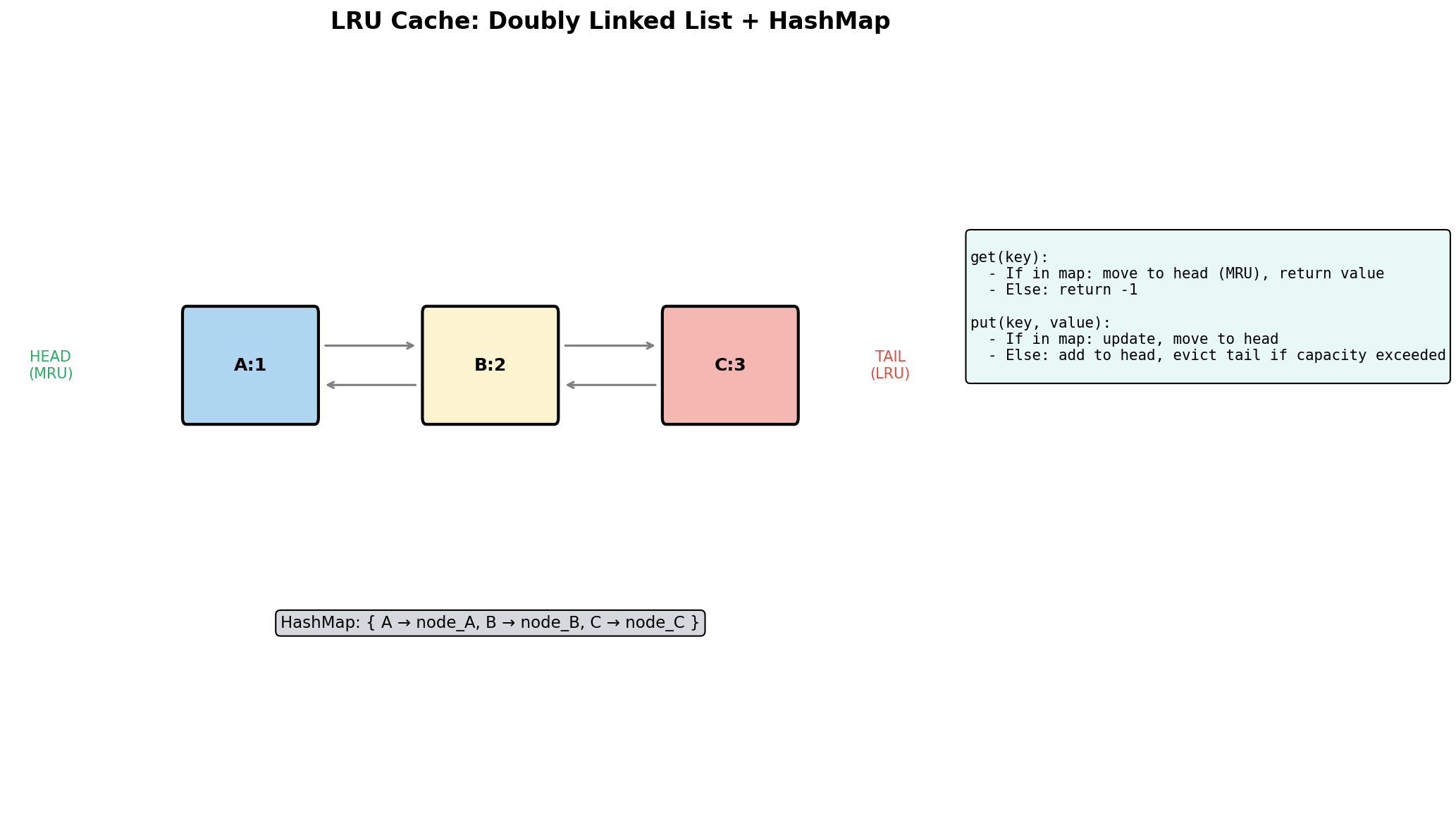
LRU Cache Structure
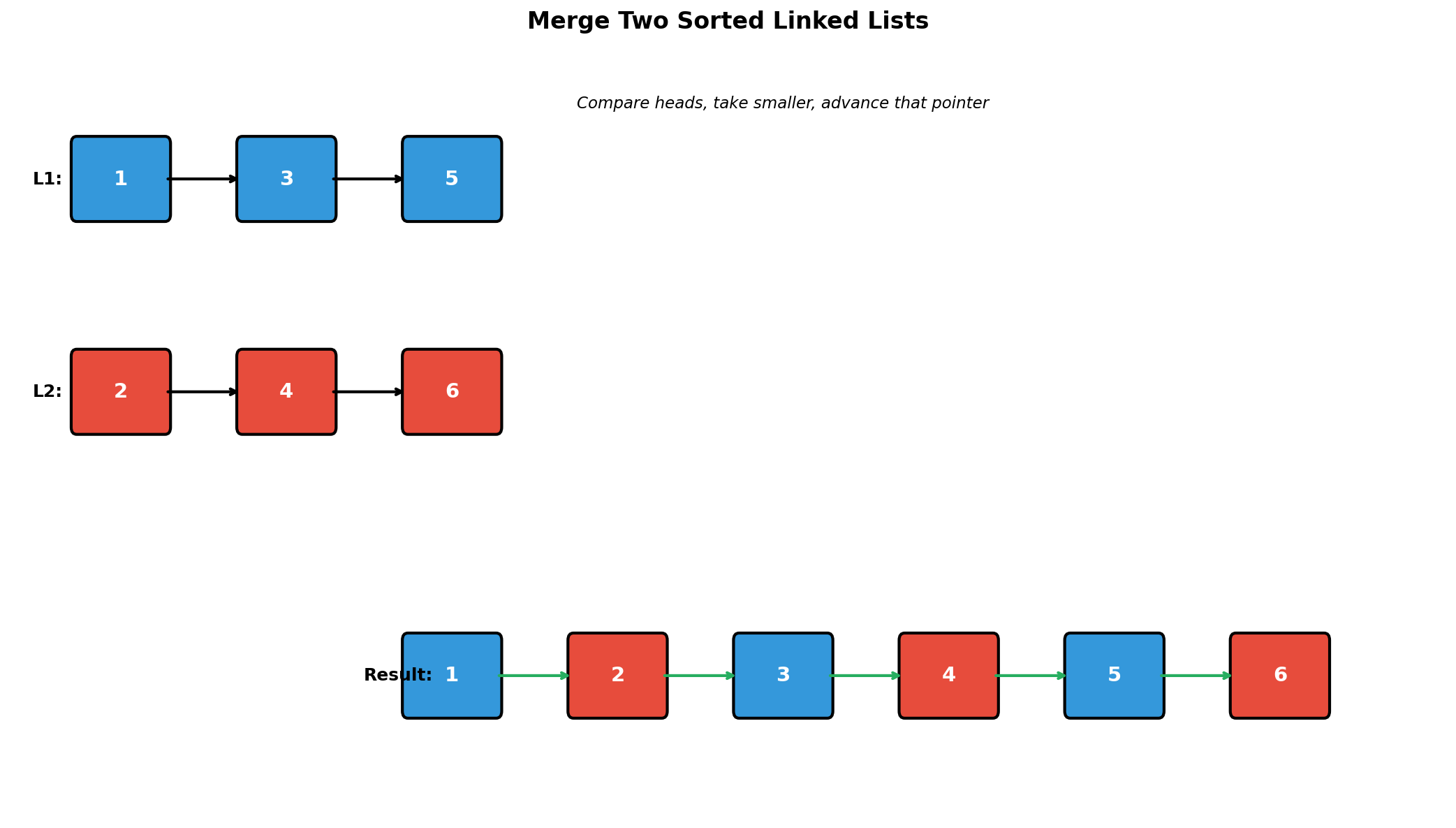
Merge Two Sorted Lists
Problem Statement
Given the heads of two sorted linked lists, merge them into one sorted list by splicing together the nodes of the first two lists.
Solution
def mergeTwoLists(l1, l2):
    dummy = ListNode(0)
    curr = dummy

    while l1 and l2:
        if l1.val <= l2.val:
            curr.next = l1
            l1 = l1.next
        else:
            curr.next = l2
            l2 = l2.next
        curr = curr.next

    curr.next = l1 or l2
return dummy.nextpublic ListNode mergeTwoLists(ListNode l1, ListNode l2) {
ListNode dummy = new ListNode(0);
ListNode curr = dummy;
while (l1 != null && l2 != null) {
if (l1.val <= l2.val) {
curr.next = l1;
l1 = l1.next;
} else {
curr.next = l2;
l2 = l2.next;
}
curr = curr.next;
}
curr.next = (l1 != null) ? l1 : l2;
return dummy.next;
}Complexity: Time O(n + m) · Space O(1)
- Time: O(n + m) because we traverse each node in both lists exactly once, comparing and linking at each step
- Space: O(1) because we only use a constant number of pointers (dummy, curr) and rearrange existing nodes in-place
Complexity
- Time: O(n + m) where n and m are the lengths of the two lists
- Space: O(1) - only pointer manipulation, no extra space
Merge K Sorted Lists
Problem Statement
You are given an array of k linked lists, where each linked list is sorted in ascending order. Merge all the linked lists into one sorted linked list and return its head.
Example:
- Input: lists = [[1,4,5], [1,3,4], [2,6]]
- Output: [1,1,2,3,4,4,5,6]
Approach 1: Divide and Conquer
This approach uses the Merge Sort paradigm - divide the problem into smaller units, solve them, then merge the results.
How it works:
- Split k lists into two halves: lists[0...mid] and lists[mid+1...end]
- Recursively merge the left half to get first sorted list
- Recursively merge the right half to get second sorted list
- Merge the two sorted lists using two-pointer approach
def mergeKLists(lists: list) -> ListNode:
    if not lists:
        return None

    while len(lists) > 1:
        merged = []
        for i in range(0, len(lists), 2):
            l1 = lists[i]
            l2 = lists[i + 1] if i + 1 < len(lists) else None
            merged.append(mergeTwoLists(l1, l2))
        lists = merged

return lists[0]public ListNode mergeKLists(ListNode[] lists) {
if (lists == null || lists.length == 0) return null;
List<ListNode> listArr = new ArrayList<>(Arrays.asList(lists));
while (listArr.size() > 1) {
List<ListNode> merged = new ArrayList<>();
for (int i = 0; i < listArr.size(); i += 2) {
ListNode l1 = listArr.get(i);
ListNode l2 = (i + 1 < listArr.size()) ? listArr.get(i + 1) : null;
merged.add(mergeTwoLists(l1, l2));
}
listArr = merged;
}
return listArr.get(0);
}Complexity: Time O(N log k) · Space O(1)
- Time: O(N log k) where N is total nodes across all lists; we perform log k merge rounds, each processing all N nodes
- Space: O(1) because we only store the merged list array and rearrange pointers in-place (not counting output)
Approach 2: Min Heap
A min heap (priority queue) keeps the smallest node at the top, allowing efficient extraction of the next smallest element across all lists.
How it works:
- Push the head of each non-null linked list into the heap
- Pop the smallest node, append to result list
- If the popped node has a next, push that next node into the heap
- Repeat until heap is empty
import heapq

def mergeKLists_heap(lists: list) -> ListNode:
    heap = []

    # Add first node from each list
    for i, lst in enumerate(lists):
        if lst:
            heapq.heappush(heap, (lst.val, i, lst))

    dummy = ListNode(0)
    curr = dummy

    while heap:
        val, i, node = heapq.heappop(heap)
        curr.next = node
        curr = curr.next

        if node.next:
            heapq.heappush(heap, (node.next.val, i, node.next))

return dummy.nextComplexity: Time O(N log k) · Space O(k)
- Time: O(N log k) because each of the N nodes is pushed and popped from the heap once, and heap operations are O(log k)
- Space: O(k) because the heap maintains at most k nodes (one from each list) at any time
Complexity Comparison
| Approach | Time Complexity | Space Complexity |
|---|---|---|
| Divide & Conquer | O(N log k) | O(1) |
| Min Heap | O(N log k) | O(k) |
Where N is the total number of nodes across all lists, and k is the number of lists.
LRU Cache
Problem Statement
Design a data structure that follows the constraints of a Least Recently Used (LRU) cache with O(1) average time complexity for both get and put operations.
Operations:
LRUCache(int capacity)- Initialize the cache with positive size capacityint get(int key)- Return the value if key exists, otherwise return -1void put(int key, int value)- Update value if key exists, otherwise add the key-value pair. If capacity is exceeded, evict the least recently used key.
Approach
The optimal solution combines a Hash Map and a Doubly Linked List:
- Hash Map: O(1) lookup of key to node location
- Doubly Linked List: Maintains access order - most recently used at head, least recently used at tail
Key Insight: When accessing a node, remove it from its current position and reinsert at the head. The tail always contains the LRU item for eviction.
Mermaid Diagram
Solution
class DLLNode:
    def __init__(self, key=0, val=0):
        self.key = key
        self.val = val
        self.prev = None
        self.next = None

class LRUCache:
    def __init__(self, capacity: int):
        self.capacity = capacity
        self.cache = {}  # key -> node

        # Dummy head and tail
        self.head = DLLNode()
        self.tail = DLLNode()
        self.head.next = self.tail
        self.tail.prev = self.head

    def _remove(self, node):
        node.prev.next = node.next
        node.next.prev = node.prev

    def _add_to_front(self, node):
        node.next = self.head.next
        node.prev = self.head
        self.head.next.prev = node
        self.head.next = node

    def get(self, key: int) -> int:
        if key not in self.cache:
            return -1

        node = self.cache[key]
        self._remove(node)
        self._add_to_front(node)
        return node.val

    def put(self, key: int, value: int) -> None:
        if key in self.cache:
            self._remove(self.cache[key])

        node = DLLNode(key, value)
        self.cache[key] = node
        self._add_to_front(node)

        if len(self.cache) > self.capacity:
            # Remove LRU (node before tail)
            lru = self.tail.prev
            self._remove(lru)
del self.cache[lru.key]class LRUCache {
private static class DLLNode {
int key, value;
DLLNode prev, next;
DLLNode() {}
DLLNode(int key, int value) { this.key = key; this.value = value; }
}
private final int capacity;
private final Map<Integer, DLLNode> cache = new HashMap<>();
private final DLLNode head = new DLLNode(), tail = new DLLNode();
public LRUCache(int capacity) {
this.capacity = capacity;
head.next = tail;
tail.prev = head;
}
private void remove(DLLNode node) {
node.prev.next = node.next;
node.next.prev = node.prev;
}
private void addToFront(DLLNode node) {
node.next = head.next;
node.prev = head;
head.next.prev = node;
head.next = node;
}
public int get(int key) {
if (!cache.containsKey(key)) return -1;
DLLNode node = cache.get(key);
remove(node);
addToFront(node);
return node.value;
}
public void put(int key, int value) {
if (cache.containsKey(key)) {
DLLNode node = cache.get(key);
node.value = value;
remove(node);
addToFront(node);
} else {
DLLNode node = new DLLNode(key, value);
cache.put(key, node);
addToFront(node);
if (cache.size() > capacity) {
DLLNode lru = tail.prev;
remove(lru);
cache.remove(lru.key);
}
}
}
}Complexity: Time O(1) for get/put · Space O(capacity)
- Time: O(1) for both operations because hash map provides O(1) lookup, and doubly linked list provides O(1) insertion/deletion
- Space: O(capacity) because we store at most
capacitynodes in the hash map and doubly linked list
Using OrderedDict (Simpler)
Python's OrderedDict maintains insertion order and provides move_to_end() for O(1) reordering.
from collections import OrderedDict

class LRUCache:
    def __init__(self, capacity: int):
        self.capacity = capacity
        self.cache = OrderedDict()

    def get(self, key: int) -> int:
        if key not in self.cache:
            return -1
        self.cache.move_to_end(key)
        return self.cache[key]

    def put(self, key: int, value: int) -> None:
        if key in self.cache:
            self.cache.move_to_end(key)
        self.cache[key] = value
        if len(self.cache) > self.capacity:
self.cache.popitem(last=False)Complexity: Time O(1) for get/put · Space O(capacity)
- Time: O(1) because OrderedDict's move_to_end() and popitem() are O(1) operations in Python 3.7+
- Space: O(capacity) because the OrderedDict stores at most
capacitykey-value pairs
Complexity
- Time: O(1) for both
getandput - Space: O(capacity)
Interview Applications
These problems are frequently asked in technical interviews because they test:
Merge K Sorted Lists
- System Design: Merging sorted data streams in distributed systems
- External Sorting: Merging sorted chunks that don't fit in memory
- Real-world: Merging search results from multiple servers
- Follow-ups: What if lists are on different machines? Handle duplicates?
LRU Cache
- Memory Management: Page replacement in operating systems
- Database Systems: Buffer pool management
- Web Services: API response caching, session management
- CDN Design: Content caching at edge servers
- Follow-ups:
- How to make it thread-safe?
- How to handle distributed LRU cache?
- What about TTL (time-to-live) for entries?
Common Interview Variations
| Problem | Variation | Key Difference |
|---|---|---|
| Merge K Lists | Merge K Sorted Arrays | Use arrays instead of linked lists |
| LRU Cache | LFU Cache | Evict least frequently used |
| LRU Cache | TTL Cache | Entries expire after time limit |
| LRU Cache | Multi-level Cache | L1/L2 cache hierarchy |