Letter Combinations of a Phone Number
LeetCode: 17. Letter Combinations of a Phone NumberDifficulty: Medium Pattern: Backtracking
Problem Statement
Given a string containing digits from 2-9 inclusive, return all possible letter combinations that the number could represent. Return the answer in any order.
A mapping of digits to letters (just like on the telephone buttons) is given below. Note that 1 does not map to any letters.
2 -> abc    3 -> def    4 -> ghi    5 -> jkl
6 -> mno 7 -> pqrs 8 -> tuv 9 -> wxyzExamples
Example 1
Input: digits = "23"
Output: ["ad", "ae", "af", "bd", "be", "bf", "cd", "ce", "cf"]Example 2
Input: digits = ""
Output: []Example 3
Input: digits = "2"
Output: ["a", "b", "c"]Constraints
0 <= digits.length <= 4digits[i]is a digit in the range['2', '9']
Backtracking Tree Visualization
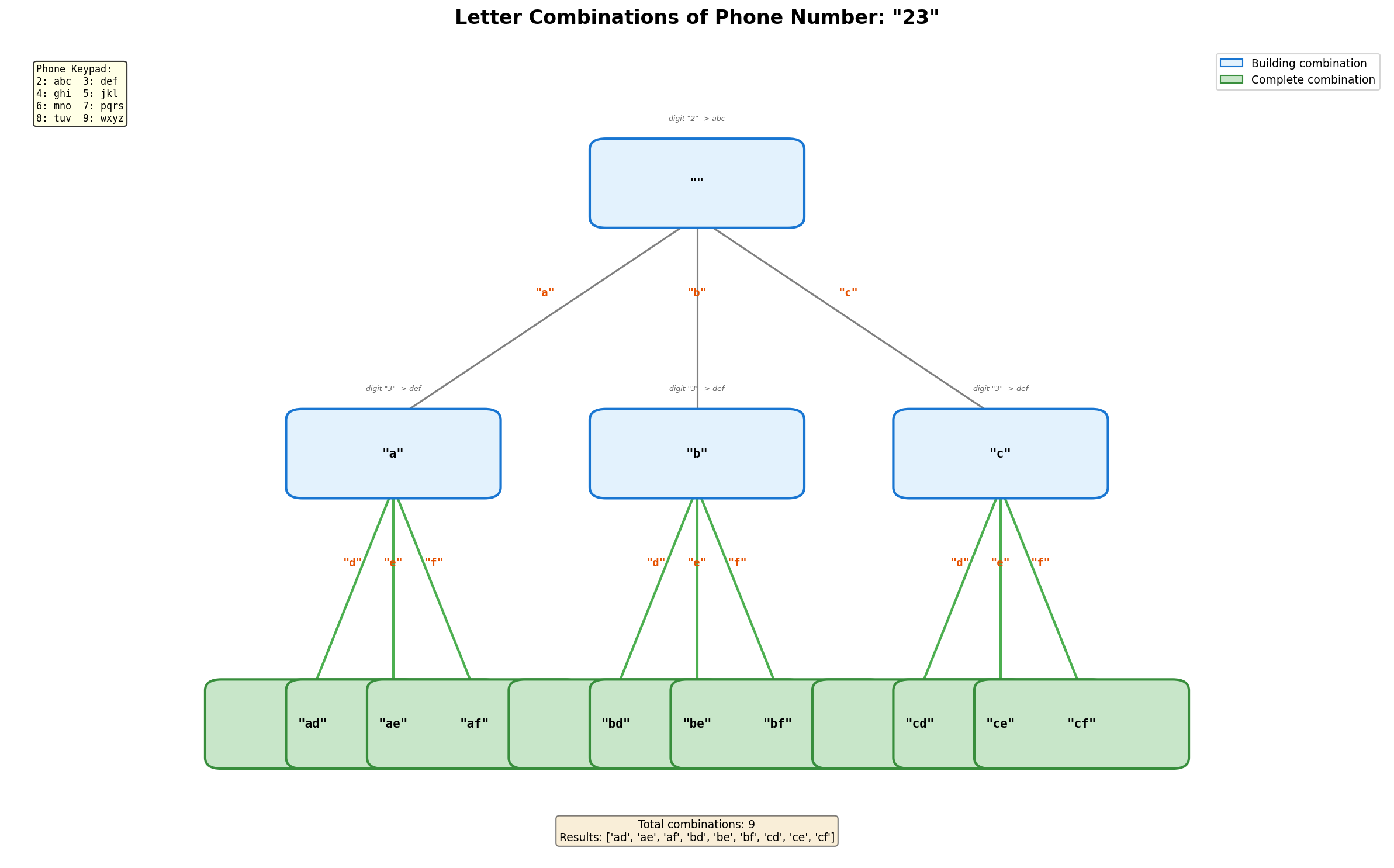
Decision Tree for "23"
                   ""
            /      |      \
          "a"     "b"     "c"       <- digit 2 (abc)
         /|\     /|\     /|\
        d e f   d e f   d e f       <- digit 3 (def)

Result: ["ad", "ae", "af", "bd", "be", "bf", "cd", "ce", "cf"]Backtracking Template
def letterCombinations(digits):
    """
    Template for letter combinations.

    At each level, iterate through all letters for that digit.
    """
    if not digits:
        return []

    phone_map = {
        '2': 'abc', '3': 'def', '4': 'ghi', '5': 'jkl',
        '6': 'mno', '7': 'pqrs', '8': 'tuv', '9': 'wxyz'
    }

    result = []

    def backtrack(index, path):
        # BASE CASE: processed all digits
        if index == len(digits):
            result.append(''.join(path))
            return

        # Get letters for current digit
        letters = phone_map[digits[index]]

        # Try each letter
        for letter in letters:
            path.append(letter)          # CHOOSE
            backtrack(index + 1, path)   # EXPLORE
            path.pop()                   # UNCHOOSE

    backtrack(0, [])
return resultSolutions
Solution
def letterCombinations(digits: str) -> list:
    """
    Generate all letter combinations using backtracking.

    Time Complexity: O(4^n * n) where n = len(digits)
        - At most 4 choices per digit (for 7 and 9)
        - n to build each string
    Space Complexity: O(n) for recursion depth
    """
    if not digits:
        return []

    phone_map = {
        '2': 'abc', '3': 'def', '4': 'ghi', '5': 'jkl',
        '6': 'mno', '7': 'pqrs', '8': 'tuv', '9': 'wxyz'
    }

    result = []

    def backtrack(index, path):
        if index == len(digits):
            result.append(''.join(path))
            return

        for letter in phone_map[digits[index]]:
            path.append(letter)
            backtrack(index + 1, path)
            path.pop()

    backtrack(0, [])
    return result


# Test
print(letterCombinations("23"))
# Output: ['ad', 'ae', 'af', 'bd', 'be', 'bf', 'cd', 'ce', 'cf']private static final String[] LETTERS =
{"", "", "abc", "def", "ghi", "jkl", "mno", "pqrs", "tuv", "wxyz"};
public List<String> letterCombinations(String digits) {
List<String> result = new ArrayList<>();
if (digits == null || digits.isEmpty()) return result;
backtrack(result, new StringBuilder(), digits, 0);
return result;
}
private void backtrack(List<String> result, StringBuilder path,
String digits, int index) {
if (index == digits.length()) {
result.add(path.toString());
return;
}
String letters = LETTERS[digits.charAt(index) - '0'];
for (char c : letters.toCharArray()) {
path.append(c);
backtrack(result, path, digits, index + 1);
path.deleteCharAt(path.length() - 1);
}
}Complexity: Time O(4^n * n) · Space O(n)
- Time: Each digit maps to 3-4 letters (7 and 9 have 4). In the worst case, all digits are 7 or 9, giving 4^n combinations. Building each combination string takes O(n).
- Space: Recursion depth equals the number of digits (n), plus the path list stores at most n characters.
Solution 2: Iterative (BFS-like)
def letterCombinations_iterative(digits: str) -> list:
    """
    Build combinations iteratively.

    Start with empty combination, then extend with each digit.

    Time Complexity: O(4^n * n)
    Space Complexity: O(4^n * n) for storing intermediate results
    """
    if not digits:
        return []

    phone_map = {
        '2': 'abc', '3': 'def', '4': 'ghi', '5': 'jkl',
        '6': 'mno', '7': 'pqrs', '8': 'tuv', '9': 'wxyz'
    }

    result = ['']

    for digit in digits:
        temp = []
        for combination in result:
            for letter in phone_map[digit]:
                temp.append(combination + letter)
        result = temp

    return result


# Test
print(letterCombinations_iterative("23"))
# Output: ['ad', 'ae', 'af', 'bd', 'be', 'bf', 'cd', 'ce', 'cf']Complexity: Time O(4^n * n) · Space O(4^n * n)
- Time: For each digit, we extend every existing combination with each letter for that digit, multiplying the number of combinations.
- Space: Stores all intermediate combinations; after processing all digits, stores up to 4^n strings of length n.
Solution 3: Using itertools.product
from itertools import product

def letterCombinations_product(digits: str) -> list:
    """
    Use itertools.product for Cartesian product.

    Time Complexity: O(4^n * n)
    Space Complexity: O(4^n * n)
    """
    if not digits:
        return []

    phone_map = {
        '2': 'abc', '3': 'def', '4': 'ghi', '5': 'jkl',
        '6': 'mno', '7': 'pqrs', '8': 'tuv', '9': 'wxyz'
    }

    letter_groups = [phone_map[d] for d in digits]
    return [''.join(combo) for combo in product(*letter_groups)]


# Test
print(letterCombinations_product("23"))Complexity: Time O(4^n * n) · Space O(4^n * n)
- Time: itertools.product computes the Cartesian product of all letter groups, yielding 4^n tuples, each joined into a string of length n.
- Space: The product generator is lazy, but the list comprehension materializes all combinations.
Solution 4: Using functools.reduce
from functools import reduce

def letterCombinations_reduce(digits: str) -> list:
    """
    Functional approach using reduce.

    Time Complexity: O(4^n * n)
    Space Complexity: O(4^n * n)
    """
    if not digits:
        return []

    phone_map = {
        '2': 'abc', '3': 'def', '4': 'ghi', '5': 'jkl',
        '6': 'mno', '7': 'pqrs', '8': 'tuv', '9': 'wxyz'
    }

    return reduce(
        lambda acc, digit: [a + c for a in acc for c in phone_map[digit]],
        digits,
        ['']
    )


# Test
print(letterCombinations_reduce("23"))Complexity: Time O(4^n * n) · Space O(4^n * n)
- Time: Reduce processes digits left to right, extending the accumulator with all combinations at each step.
- Space: The accumulator list grows to hold all combinations; intermediate results are stored at each reduction step.
Solution 5: BFS with Queue
from collections import deque

def letterCombinations_bfs(digits: str) -> list:
    """
    BFS approach with explicit queue.

    Time Complexity: O(4^n * n)
    Space Complexity: O(4^n * n)
    """
    if not digits:
        return []

    phone_map = {
        '2': 'abc', '3': 'def', '4': 'ghi', '5': 'jkl',
        '6': 'mno', '7': 'pqrs', '8': 'tuv', '9': 'wxyz'
    }

    queue = deque([''])

    for digit in digits:
        for _ in range(len(queue)):
            current = queue.popleft()
            for letter in phone_map[digit]:
                queue.append(current + letter)

    return list(queue)


# Test
print(letterCombinations_bfs("23"))Complexity: Time O(4^n * n) · Space O(4^n * n)
- Time: BFS processes level by level (one digit per level), generating all combinations by the final level.
- Space: The queue holds all partial combinations at the current level; after all digits, it contains all 4^n final combinations.
Complexity Analysis
| Approach | Time | Space | Notes |
|---|---|---|---|
| Backtracking | O(4^n * n) | O(n) | Most memory efficient |
| Iterative | O(4^n * n) | O(4^n * n) | Stores all intermediate |
| itertools.product | O(4^n * n) | O(4^n * n) | Pythonic |
| BFS | O(4^n * n) | O(4^n * n) | Queue overhead |
Why O(4^n)?
- Digits 7 and 9 have 4 letters
- In worst case, all digits are 7 or 9
- Total combinations: 4 * 4 * ... * 4 = 4^n
For typical input:
- Average ~3.25 letters per digit
- ~3.25^n combinations
Iterative Process Visualization
digits = "23"
phone_map: 2->"abc", 3->"def"

Initial: result = ['']

After digit '2':
  For '' in result:
    '' + 'a' = 'a'
    '' + 'b' = 'b'
    '' + 'c' = 'c'
  result = ['a', 'b', 'c']

After digit '3':
  For 'a' in result:
    'a' + 'd' = 'ad'
    'a' + 'e' = 'ae'
    'a' + 'f' = 'af'
  For 'b' in result:
    'b' + 'd' = 'bd'
    'b' + 'e' = 'be'
    'b' + 'f' = 'bf'
  For 'c' in result:
    'c' + 'd' = 'cd'
    'c' + 'e' = 'ce'
    'c' + 'f' = 'cf'
result = ['ad', 'ae', 'af', 'bd', 'be', 'bf', 'cd', 'ce', 'cf']Common Mistakes
1. Forgetting Empty Input Case
# WRONG - fails on empty string
def wrong(digits):
    phone_map = {...}
    result = ['']  # Would return [''] instead of []
    for digit in digits:
        # ...
    return result

# CORRECT - check for empty input
def correct(digits):
    if not digits:  # Handle empty string!
        return []
# ...2. Using Wrong Index
# WRONG - using digit value instead of digit character
phone_map[int(digits[index])]  # Error: dict key is string

# CORRECT - use the character directly
phone_map[digits[index]] # '2' -> 'abc'3. Not Copying Path
# WRONG for list-based approach
result.append(path)  # All entries point to same list!

# CORRECT
result.append(''.join(path))  # Create new string
# or
result.append(path[:]) # Create copy of listPattern Recognition
This problem is a Cartesian Product problem:
- For "23":
{a,b,c} x {d,e,f} - Each digit provides a set of choices
- Result is all combinations, one from each set
Similar to:
- Password cracking (all combinations)
- Menu combinations (one item from each category)
- Configuration generation
Related Problems
Generate Parentheses (LeetCode 22)
Problem: Generate all valid combinations of n pairs of parentheses.
Key Insight: Constrained generation - can only add ) if count < open count.
Approach: Track open/close counts, add characters based on validity constraints.
Complexity: O(4^n / sqrt(n)) - Catalan number
Link: Local Solution
Combination Sum (LeetCode 39)
Problem: Find all combinations that sum to target, elements can be reused.
Key Insight: Different constraint - sum target instead of fixed positions.
Approach: Backtrack with remaining sum, prune when remaining < 0.
Complexity: O(n^(target/min)) time
Link: Local Solution
Subsets (LeetCode 78)
Problem: Return all possible subsets of distinct integers.
Key Insight: Binary choice (include/exclude) vs multiple choice (pick one letter).
Approach: At each element, choose to include or exclude, generating 2^n subsets.
Complexity: O(n * 2^n) time
Link: Local Solution
Word Break II (LeetCode 140)
Problem: Given a string and dictionary, return all sentences where string can be segmented into dictionary words.
Key Insight: Similar Cartesian product structure - all combinations of valid word segmentations.
Approach: Backtrack trying each valid prefix, recurse on remaining suffix.
Complexity: O(2^n * n) worst case
Link: LeetCode 140
Interview Tips
- Clarify mapping: Make sure you know the phone keypad mapping
- Handle edge case: Empty input returns empty list
- Discuss tradeoffs: Backtracking (O(n) space) vs iterative (O(4^n) space)
- Mention product: Show familiarity with itertools
- Walk through example: Use "23" to demonstrate algorithm
Key Takeaways
- Classic Cartesian product problem using backtracking
- Variable branching factor: Different digits have different letter counts
- Index-based recursion: Process one digit at a time
- Multiple valid approaches: Backtracking, iterative, reduce, product
- Empty input edge case is important to handle
Last updated: January 2026