QuickSelect Algorithm
average time selection of the k-th smallest/largest element
Overview
QuickSelect is a selection algorithm to find the k-th smallest (or largest) element in an unordered list. It's based on the same partitioning scheme as QuickSort but only recurses into one partition, giving it an average time complexity of
Visual Representation
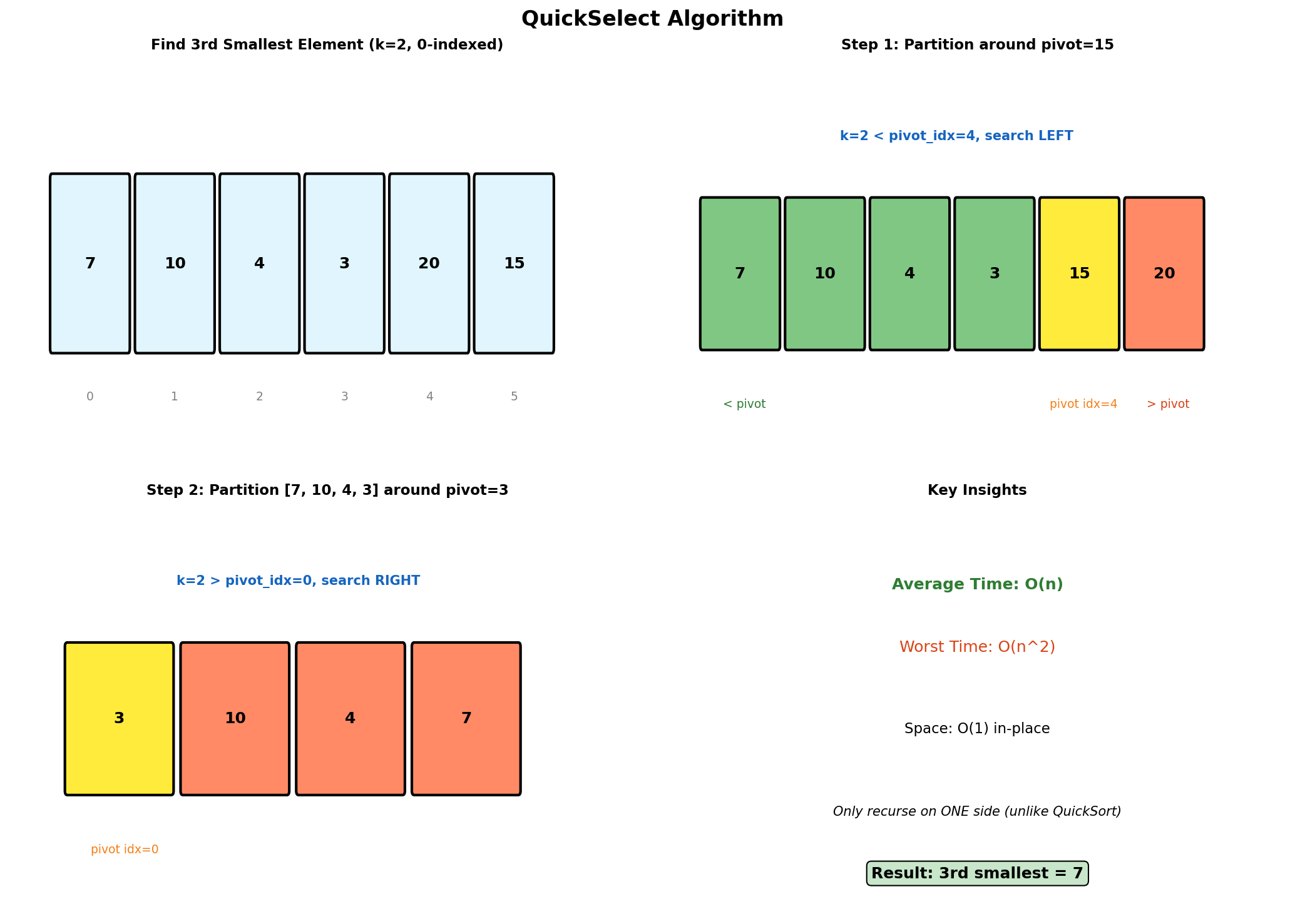
Key Insight
Unlike QuickSort which recursively sorts both partitions, QuickSelect only needs to recurse into the partition that contains the k-th element. This reduces the work from
| Algorithm | Recursion | Average Time | Worst Time |
|---|---|---|---|
| QuickSort | Both partitions | ||
| QuickSelect | One partition |
Algorithm Steps
- Choose a Pivot: Select a pivot element (random selection helps avoid worst case)
- Partition: Rearrange so elements less than pivot are left, greater are right
- Compare Pivot Position with k:
- If
pivot_idx == k: Found the k-th element - If
pivot_idx > k: Recurse on left partition - If
pivot_idx < k: Recurse on right partition
- If
Implementation
Basic QuickSelect
def quickselect(arr: list[int], k: int) -> int:
    """
    Find the k-th smallest element (0-indexed).

    Args:
        arr: Unsorted array
        k: Index of element to find (0-indexed, 0 = smallest)

    Returns:
        The k-th smallest element

    Time: O(n) average, O(n^2) worst
    Space: O(1) iterative, O(log n) recursive
    """
    if k < 0 or k >= len(arr):
        raise ValueError("k is out of bounds")

    return quickselect_helper(arr, 0, len(arr) - 1, k)


def quickselect_helper(arr: list[int], left: int, right: int, k: int) -> int:
    """Recursive helper for quickselect."""
    if left == right:
        return arr[left]

    # Partition and get pivot's final position
    pivot_idx = partition(arr, left, right)

    if pivot_idx == k:
        return arr[pivot_idx]
    elif pivot_idx > k:
        return quickselect_helper(arr, left, pivot_idx - 1, k)
    else:
        return quickselect_helper(arr, pivot_idx + 1, right, k)


def partition(arr: list[int], left: int, right: int) -> int:
    """
    Lomuto partition scheme.
    Places pivot in correct position and returns its index.
    """
    pivot = arr[right]
    i = left - 1

    for j in range(left, right):
        if arr[j] <= pivot:
            i += 1
            arr[i], arr[j] = arr[j], arr[i]

    arr[i + 1], arr[right] = arr[right], arr[i + 1]
    return i + 1


# Example usage
arr = [3, 2, 1, 5, 6, 4]
print(quickselect(arr.copy(), 0))  # 1 (smallest)
print(quickselect(arr.copy(), 2))  # 3 (3rd smallest)
print(quickselect(arr.copy(), 5)) # 6 (largest)public int quickselect(int[] arr, int k) {
if (k < 0 || k >= arr.length) throw new IllegalArgumentException("k out of bounds");
return quickselectHelper(arr, 0, arr.length - 1, k);
}
private int quickselectHelper(int[] arr, int left, int right, int k) {
if (left == right) return arr[left];
int pivotIdx = partition(arr, left, right);
if (pivotIdx == k) return arr[pivotIdx];
else if (pivotIdx > k) return quickselectHelper(arr, left, pivotIdx - 1, k);
else return quickselectHelper(arr, pivotIdx + 1, right, k);
}
private int partition(int[] arr, int left, int right) {
int pivot = arr[right];
int i = left - 1;
for (int j = left; j < right; j++) {
if (arr[j] <= pivot) {
i++;
int tmp = arr[i]; arr[i] = arr[j]; arr[j] = tmp;
}
}
int tmp = arr[i + 1]; arr[i + 1] = arr[right]; arr[right] = tmp;
return i + 1;
}Complexity: Time O(n) average, O(n^2) worst · Space O(log n) average
- Time: Average case partitions reduce search space by half each time: n + n/2 + n/4 + ... = O(n); worst case always picks extreme pivot: n + (n-1) + ... = O(n^2)
- Space: Recursive call stack depth is O(log n) average, O(n) worst case
QuickSelect with Random Pivot
import random

def quickselect_random(arr: list[int], k: int) -> int:
    """
    QuickSelect with randomized pivot selection.

    Random pivot avoids worst-case O(n^2) on sorted/reverse-sorted input.

    Time: O(n) expected, Space: O(1)
    """
    def partition_random(left: int, right: int) -> int:
        # Choose random pivot and swap to end
        pivot_idx = random.randint(left, right)
        arr[pivot_idx], arr[right] = arr[right], arr[pivot_idx]

        pivot = arr[right]
        i = left - 1

        for j in range(left, right):
            if arr[j] <= pivot:
                i += 1
                arr[i], arr[j] = arr[j], arr[i]

        arr[i + 1], arr[right] = arr[right], arr[i + 1]
        return i + 1

    left, right = 0, len(arr) - 1

    while left <= right:
        pivot_idx = partition_random(left, right)

        if pivot_idx == k:
            return arr[pivot_idx]
        elif pivot_idx > k:
            right = pivot_idx - 1
        else:
            left = pivot_idx + 1

    return arr[left]


# Example usage
arr = [7, 10, 4, 3, 20, 15]
print(quickselect_random(arr.copy(), 2)) # 7 (3rd smallest)public int quickselectRandom(int[] arr, int k) {
Random rand = new Random();
int left = 0, right = arr.length - 1;
while (left <= right) {
// Random pivot swap to end
int pivotIdx = left + rand.nextInt(right - left + 1);
int tmp = arr[pivotIdx]; arr[pivotIdx] = arr[right]; arr[right] = tmp;
int pivot = arr[right];
int i = left - 1;
for (int j = left; j < right; j++) {
if (arr[j] <= pivot) {
i++;
tmp = arr[i]; arr[i] = arr[j]; arr[j] = tmp;
}
}
tmp = arr[i + 1]; arr[i + 1] = arr[right]; arr[right] = tmp;
pivotIdx = i + 1;
if (pivotIdx == k) return arr[pivotIdx];
else if (pivotIdx > k) right = pivotIdx - 1;
else left = pivotIdx + 1;
}
return arr[left];
}Complexity: Time O(n) expected · Space O(1)
- Time: Random pivot selection ensures expected balanced partitions, achieving O(n) expected time
- Space: Iterative implementation uses only constant space for pointers and loop variables
Median of Medians (Guaranteed O(n))
def quickselect_mom(arr: list[int], k: int) -> int:
    """
    QuickSelect with Median of Medians pivot selection.

    Guarantees O(n) worst-case by choosing a good pivot.

    Time: O(n) guaranteed, Space: O(log n)
    """
    if len(arr) == 1:
        return arr[0]

    def median_of_medians(arr: list[int]) -> int:
        """Find a good pivot using median of medians."""
        # Divide into groups of 5
        sublists = [arr[i:i + 5] for i in range(0, len(arr), 5)]

        # Find median of each group
        medians = [sorted(sublist)[len(sublist) // 2] for sublist in sublists]

        # Recursively find median of medians
        if len(medians) <= 5:
            return sorted(medians)[len(medians) // 2]
        return quickselect_mom(medians, len(medians) // 2)

    def partition_with_pivot(arr: list[int], pivot: int) -> tuple[list, list, list]:
        """Three-way partition around pivot."""
        less = [x for x in arr if x < pivot]
        equal = [x for x in arr if x == pivot]
        greater = [x for x in arr if x > pivot]
        return less, equal, greater

    pivot = median_of_medians(arr)
    less, equal, greater = partition_with_pivot(arr, pivot)

    if k < len(less):
        return quickselect_mom(less, k)
    elif k < len(less) + len(equal):
        return equal[0]
    else:
        return quickselect_mom(greater, k - len(less) - len(equal))


# Example usage
arr = [12, 3, 5, 7, 4, 19, 26]
print(quickselect_mom(arr.copy(), 3)) # 7 (4th smallest)Complexity: Time O(n) guaranteed · Space O(log n)
- Time: Median of medians guarantees pivot eliminates at least 30% of elements; recurrence T(n) = T(n/5) + T(7n/10) + O(n) = O(n)
- Space: Recursive stack depth for median finding and partitioning is O(log n)
Common Applications
Kth Largest Element
def find_kth_largest(nums: list[int], k: int) -> int:
    """
    Find the k-th largest element (1-indexed).

    k=1 returns the largest element.

    Time: O(n) average
    """
    # k-th largest = (n-k)-th smallest (0-indexed)
    return quickselect_random(nums, len(nums) - k)


# Example usage
nums = [3, 2, 1, 5, 6, 4]
print(find_kth_largest(nums.copy(), 2)) # 5 (2nd largest)Complexity: Time O(n) average · Space O(1)
- Time: Single QuickSelect call to find (n-k)th smallest element
- Space: In-place partitioning uses only constant auxiliary space
Top K Elements
def top_k_elements(nums: list[int], k: int) -> list[int]:
    """
    Find the top k largest elements (not necessarily sorted).

    Uses QuickSelect to find the k-th largest, then collects all >= it.

    Time: O(n) average
    """
    if k >= len(nums):
        return nums

    # Find the k-th largest value
    kth_largest = find_kth_largest(nums.copy(), k)

    # Collect all elements >= kth_largest
    result = [x for x in nums if x >= kth_largest]

    # Handle duplicates: ensure exactly k elements
    if len(result) > k:
        count = result.count(kth_largest)
        excess = len(result) - k
        result = [x for x in nums if x > kth_largest]
        result.extend([kth_largest] * (k - len(result)))

    return result


# Example usage
nums = [3, 2, 1, 5, 6, 4]
print(top_k_elements(nums, 3)) # [5, 6, 4] or similarComplexity: Time O(n) average · Space O(k) for output
- Time: QuickSelect O(n) to find kth largest; O(n) to collect all elements >= threshold
- Space: Output list stores k elements; QuickSelect modifies array in-place
Find Median
def find_median(nums: list[int]) -> float:
    """
    Find the median of an array.

    Time: O(n) average
    """
    n = len(nums)

    if n % 2 == 1:
        # Odd length: return middle element
        return float(quickselect_random(nums.copy(), n // 2))
    else:
        # Even length: return average of two middle elements
        lower = quickselect_random(nums.copy(), n // 2 - 1)
        upper = quickselect_random(nums.copy(), n // 2)
        return (lower + upper) / 2


# Example usage
print(find_median([3, 1, 2, 5, 4]))    # 3.0
print(find_median([3, 1, 2, 4])) # 2.5Complexity: Time O(n) average · Space O(n) for array copy
- Time: One or two QuickSelect calls depending on odd/even length
- Space: Creates copy of array to avoid modifying original during selection
Kth Smallest in Matrix
def kth_smallest_matrix(matrix: list[list[int]], k: int) -> int:
    """
    Find k-th smallest element in a sorted matrix.

    Note: Binary search on value range is often better for this problem,
    but QuickSelect works on the flattened array.

    Time: O(n^2) for n x n matrix
    """
    # Flatten the matrix
    flat = [elem for row in matrix for elem in row]
    return quickselect_random(flat, k - 1)


# Example usage
matrix = [
    [1, 5, 9],
    [10, 11, 13],
    [12, 13, 15]
]
print(kth_smallest_matrix(matrix, 8)) # 13Complexity: Time O(n^2) for n x n matrix · Space O(n^2)
- Time: Flattening matrix O(n^2); QuickSelect on flattened array O(n^2) average
- Space: Flattened array stores all n^2 elements
Hoare Partition Scheme
An alternative partitioning method that's slightly faster in practice:
def quickselect_hoare(arr: list[int], k: int) -> int:
    """
    QuickSelect using Hoare partition scheme.

    Hoare partition is faster as it does fewer swaps on average.
    """
    def partition_hoare(left: int, right: int) -> int:
        pivot = arr[left]
        i = left - 1
        j = right + 1

        while True:
            i += 1
            while arr[i] < pivot:
                i += 1

            j -= 1
            while arr[j] > pivot:
                j -= 1

            if i >= j:
                return j

            arr[i], arr[j] = arr[j], arr[i]

    left, right = 0, len(arr) - 1

    while True:
        if left == right:
            return arr[left]

        pivot_idx = partition_hoare(left, right)

        if k <= pivot_idx:
            right = pivot_idx
        else:
            left = pivot_idx + 1


# Example usage
arr = [3, 2, 3, 1, 2, 4, 5, 5, 6]
print(quickselect_hoare(arr.copy(), 4)) # 3public int quickselectHoare(int[] arr, int k) {
int left = 0, right = arr.length - 1;
while (true) {
if (left == right) return arr[left];
int pivotPos = partitionHoare(arr, left, right);
if (k <= pivotPos) {
right = pivotPos;
} else {
left = pivotPos + 1;
}
}
}
private int partitionHoare(int[] arr, int left, int right) {
int pivot = arr[left];
int i = left - 1;
int j = right + 1;
while (true) {
do { i++; } while (arr[i] < pivot);
do { j--; } while (arr[j] > pivot);
if (i >= j) return j;
int tmp = arr[i]; arr[i] = arr[j]; arr[j] = tmp;
}
}Complexity: Time O(n) average · Space O(1)
- Time: Hoare partition does fewer swaps than Lomuto on average; same O(n) average complexity
- Space: Iterative implementation uses only constant space for pointers
Three-Way Partition (Dutch National Flag)
Useful when there are many duplicate elements:
def quickselect_3way(arr: list[int], k: int) -> int:
    """
    QuickSelect with three-way partitioning.

    Better for arrays with many duplicates.

    Time: O(n) average
    """
    def partition_3way(left: int, right: int):
        """
        Three-way partition: < pivot | == pivot | > pivot

        Returns (lt, gt) where:
        - arr[left:lt] < pivot
        - arr[lt:gt+1] == pivot
        - arr[gt+1:right+1] > pivot
        """
        pivot = arr[left]
        lt = left      # arr[left:lt] < pivot
        gt = right     # arr[gt+1:right+1] > pivot
        i = left + 1   # Current element

        while i <= gt:
            if arr[i] < pivot:
                arr[lt], arr[i] = arr[i], arr[lt]
                lt += 1
                i += 1
            elif arr[i] > pivot:
                arr[gt], arr[i] = arr[i], arr[gt]
                gt -= 1
            else:
                i += 1

        return lt, gt

    left, right = 0, len(arr) - 1

    while left <= right:
        lt, gt = partition_3way(left, right)

        if k < lt:
            right = lt - 1
        elif k > gt:
            left = gt + 1
        else:
            return arr[k]

    return arr[left]


# Example usage (many duplicates)
arr = [1, 2, 2, 2, 2, 2, 3, 4, 5]
print(quickselect_3way(arr.copy(), 4)) # 2Complexity: Time O(n) average · Space O(1)
- Time: Three-way partitioning handles duplicates efficiently by grouping equal elements together, avoiding repeated processing
- Space: In-place partitioning with three pointers uses only constant auxiliary space
Complexity Analysis
Time Complexity
| Case | Complexity | When |
|---|---|---|
| Best | Pivot splits evenly | |
| Average | Random pivot | |
| Worst | Pivot always at extreme |
Average case recurrence:
Worst case recurrence:
Space Complexity
| Implementation | Space |
|---|---|
| Recursive | |
| Iterative | |
| Median of Medians |
QuickSelect vs Alternatives
| Method | Time | Space | Notes |
|---|---|---|---|
| QuickSelect | Best for single k | ||
| Heap (size k) | Good when | ||
| Full Sort | Needed if multiple queries | ||
| Counting Sort | If range |
Common Mistakes
1. Off-by-One with k Index
# WRONG: Confusing 0-indexed vs 1-indexed
def kth_largest(nums, k):
    return quickselect(nums, k)  # Should be len(nums) - k

# CORRECT
def kth_largest(nums, k):
return quickselect(nums, len(nums) - k) # 0-indexed2. Modifying Original Array
# WRONG: QuickSelect modifies in-place
result = quickselect(nums, k)  # nums is now modified!

# CORRECT: Copy if original needed
result = quickselect(nums.copy(), k)3. Not Handling Equal Elements
# WRONG: Can loop infinitely with duplicates
while arr[left] < pivot:
    left += 1
while arr[right] > pivot:
    right -= 1

# CORRECT: Use <= and >= or three-way partition
# Or ensure progress even with duplicatesRelated LeetCode Problems
| Problem | Difficulty | Notes |
|---|---|---|
| Kth Largest Element in an Array | Medium | Classic QuickSelect |
| Top K Frequent Elements | Medium | QuickSelect + Count |
| K Closest Points to Origin | Medium | QuickSelect on distances |
| Kth Smallest Element in a Sorted Matrix | Medium | Binary Search better |
| Find Median from Data Stream | Hard | Two Heaps better |
| Wiggle Sort II | Medium | QuickSelect + 3-way |
Interview Tips
- Know when to use: Single query for k-th element -> QuickSelect; multiple queries -> sort or heap
- Mention randomization: Always use random pivot to avoid
- Clarify k indexing: Is k 0-indexed or 1-indexed? Smallest or largest?
- Handle duplicates: Mention three-way partition if relevant
- Space consideration: QuickSelect is in-place, which is often preferred