Search in Rotated Sorted Array
search in a rotated sorted array using modified binary search
Overview
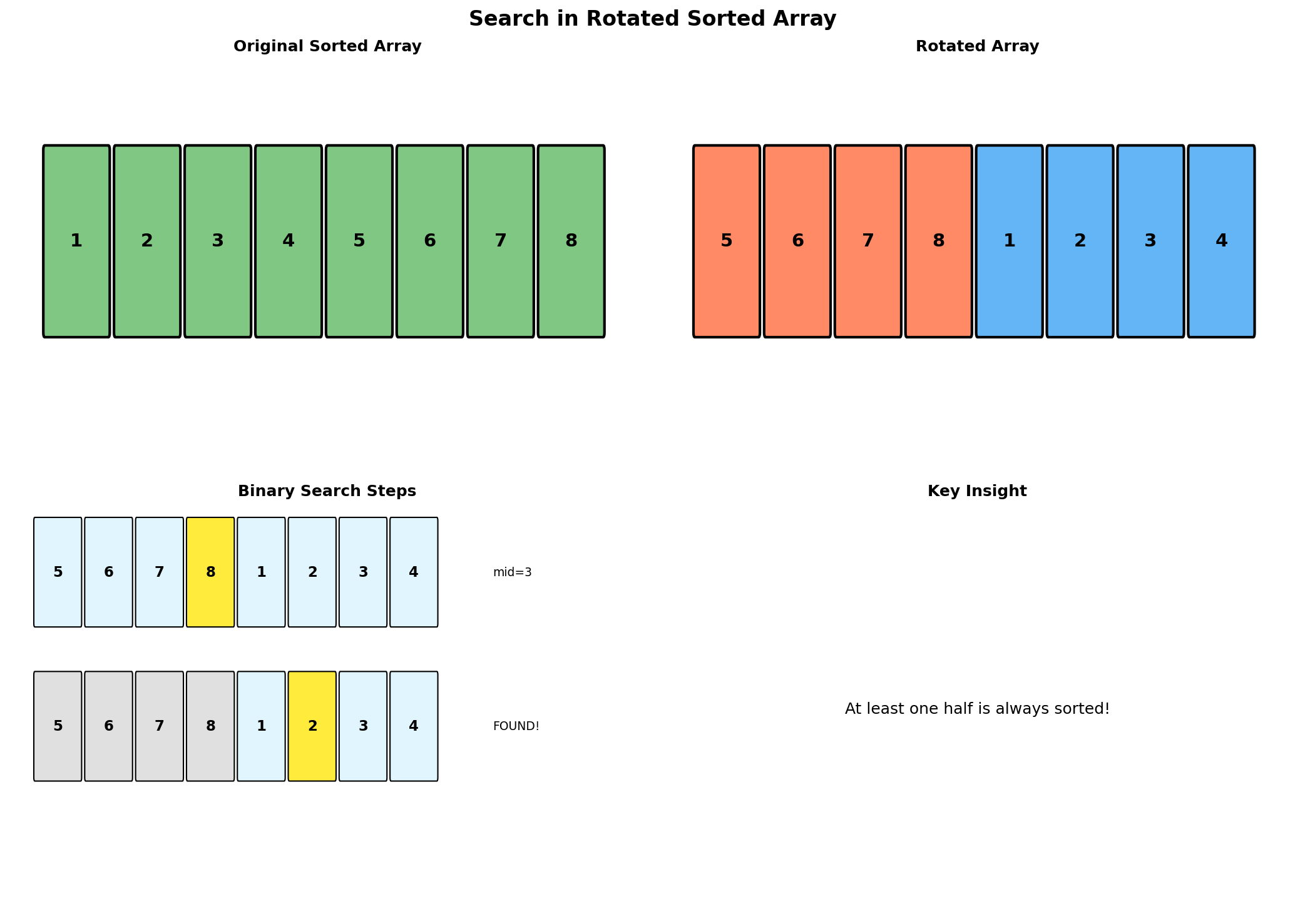
A rotated sorted array is a sorted array that has been rotated at some pivot point. For example, [1, 2, 3, 4, 5, 6, 7] might become [4, 5, 6, 7, 1, 2, 3] after being rotated at index 3. The challenge is to search for an element in this rotated array while maintaining
Visual Representation
Key Insight
At least one half of the array is always sorted! This property allows us to determine which half to search in using binary search.
When we pick a mid element:
- If
nums[left] <= nums[mid]: The left half[left, mid]is sorted - Otherwise: The right half
[mid, right]is sorted
Problem Variants
| Variant | Description | Key Consideration |
|---|---|---|
| Basic | No duplicates, find target | Standard modified binary search |
| With Duplicates | Contains duplicates | May degrade to |
| Find Minimum | Find the smallest element | Find the rotation point |
| Find Rotation Count | How many times was it rotated? | Index of minimum element |
Implementation
Variant 1: Search in Rotated Array (No Duplicates)
python
def search_rotated(nums: list[int], target: int) -> int:
    """
    Search for target in rotated sorted array without duplicates.

    Args:
        nums: Rotated sorted array (no duplicates)
        target: Value to search for

    Returns:
        Index of target if found, -1 otherwise

    Time: O(log n), Space: O(1)
    """
    if not nums:
        return -1

    left, right = 0, len(nums) - 1

    while left <= right:
        mid = left + (right - left) // 2

        if nums[mid] == target:
            return mid

        # Determine which half is sorted
        if nums[left] <= nums[mid]:
            # Left half is sorted
            if nums[left] <= target < nums[mid]:
                # Target is in the sorted left half
                right = mid - 1
            else:
                # Target is in the unsorted right half
                left = mid + 1
        else:
            # Right half is sorted
            if nums[mid] < target <= nums[right]:
                # Target is in the sorted right half
                left = mid + 1
            else:
                # Target is in the unsorted left half
                right = mid - 1

    return -1


# Example usage
nums = [4, 5, 6, 7, 0, 1, 2]
print(search_rotated(nums, 0))   # Output: 4
print(search_rotated(nums, 3))   # Output: -1
print(search_rotated(nums, 5)) # Output: 1java
public int search(int[] nums, int target) {
    if (nums == null || nums.length == 0) return -1;

    int left = 0, right = nums.length - 1;

    while (left <= right) {
        int mid = left + (right - left) / 2;

        if (nums[mid] == target) return mid;

        if (nums[left] <= nums[mid]) {
            // Left half sorted
            if (nums[left] <= target && target < nums[mid]) {
                right = mid - 1;
            } else {
                left = mid + 1;
            }
        } else {
            // Right half sorted
            if (nums[mid] < target && target <= nums[right]) {
                left = mid + 1;
            } else {
                right = mid - 1;
            }
        }
    }
    return -1;
}Complexity: Time O(log n) · Space O(1)
- Time: Each iteration halves the search space by determining which half is sorted and whether target lies within that range
- Space: Uses only constant variables for left, right, and mid pointers
Variant 2: Search with Duplicates
python
def search_rotated_duplicates(nums: list[int], target: int) -> bool:
    """
    Search for target in rotated sorted array that may contain duplicates.

    Key difference: When nums[left] == nums[mid] == nums[right],
    we cannot determine which half is sorted, so we shrink from both ends.

    Args:
        nums: Rotated sorted array (may have duplicates)
        target: Value to search for

    Returns:
        True if target exists, False otherwise

    Time: O(n) worst case (all duplicates), O(log n) average
    Space: O(1)
    """
    if not nums:
        return False

    left, right = 0, len(nums) - 1

    while left <= right:
        mid = left + (right - left) // 2

        if nums[mid] == target:
            return True

        # Handle duplicates: cannot determine sorted half
        if nums[left] == nums[mid] == nums[right]:
            left += 1
            right -= 1
        elif nums[left] <= nums[mid]:
            # Left half is sorted
            if nums[left] <= target < nums[mid]:
                right = mid - 1
            else:
                left = mid + 1
        else:
            # Right half is sorted
            if nums[mid] < target <= nums[right]:
                left = mid + 1
            else:
                right = mid - 1

    return False


# Example usage
nums = [2, 5, 6, 0, 0, 1, 2]
print(search_rotated_duplicates(nums, 0))   # Output: True
print(search_rotated_duplicates(nums, 3)) # Output: Falsejava
public boolean searchWithDuplicates(int[] nums, int target) {
    if (nums == null || nums.length == 0) return false;

    int left = 0, right = nums.length - 1;

    while (left <= right) {
        int mid = left + (right - left) / 2;

        if (nums[mid] == target) return true;

        if (nums[left] == nums[mid] && nums[mid] == nums[right]) {
            left++;
            right--;
        } else if (nums[left] <= nums[mid]) {
            if (nums[left] <= target && target < nums[mid]) {
                right = mid - 1;
            } else {
                left = mid + 1;
            }
        } else {
            if (nums[mid] < target && target <= nums[right]) {
                left = mid + 1;
            } else {
                right = mid - 1;
            }
        }
    }
    return false;
}Complexity: Time O(n) worst case, O(log n) average · Space O(1)
- Time: When nums[left] == nums[mid] == nums[right], we can only shrink bounds by 1 each side, causing O(n) in worst case (all duplicates); average case remains O(log n)
- Space: Only constant space for pointer variables
Variant 3: Find Minimum Element
python
def find_min(nums: list[int]) -> int:
    """
    Find the minimum element in a rotated sorted array (no duplicates).

    The minimum is at the rotation point where the sequence breaks.

    Args:
        nums: Rotated sorted array (no duplicates)

    Returns:
        The minimum element

    Time: O(log n), Space: O(1)
    """
    left, right = 0, len(nums) - 1

    # If array is not rotated (or rotated n times)
    if nums[left] < nums[right]:
        return nums[left]

    while left < right:
        mid = left + (right - left) // 2

        if nums[mid] > nums[right]:
            # Minimum is in the right half
            left = mid + 1
        else:
            # Minimum is in the left half (including mid)
            right = mid

    return nums[left]


def find_min_with_duplicates(nums: list[int]) -> int:
    """
    Find minimum in rotated sorted array with duplicates.

    Time: O(n) worst case, O(log n) average
    Space: O(1)
    """
    left, right = 0, len(nums) - 1

    while left < right:
        mid = left + (right - left) // 2

        if nums[mid] > nums[right]:
            left = mid + 1
        elif nums[mid] < nums[right]:
            right = mid
        else:
            # nums[mid] == nums[right], can't determine
            right -= 1

    return nums[left]


# Example usage
print(find_min([3, 4, 5, 1, 2]))           # Output: 1
print(find_min([4, 5, 6, 7, 0, 1, 2]))     # Output: 0
print(find_min_with_duplicates([2, 2, 2, 0, 1])) # Output: 0java
public int findMin(int[] nums) {
    int left = 0, right = nums.length - 1;

    if (nums[left] < nums[right]) return nums[left];

    while (left < right) {
        int mid = left + (right - left) / 2;

        if (nums[mid] > nums[right]) {
            left = mid + 1;
        } else {
            right = mid;
        }
    }
    return nums[left];
}

public int findMinWithDuplicates(int[] nums) {
    int left = 0, right = nums.length - 1;

    while (left < right) {
        int mid = left + (right - left) / 2;

        if (nums[mid] > nums[right]) {
            left = mid + 1;
        } else if (nums[mid] < nums[right]) {
            right = mid;
        } else {
            right--;
        }
    }
    return nums[left];
}Complexity: Time O(log n) for no duplicates, O(n) worst case with duplicates · Space O(1)
- Time: find_min uses standard binary search O(log n); find_min_with_duplicates degrades to O(n) when duplicates prevent determining sorted half
- Space: Constant space for pointer variables in both implementations
Variant 4: Find Rotation Count
python
def find_rotation_count(nums: list[int]) -> int:
    """
    Find how many times the array was rotated.

    The rotation count equals the index of the minimum element.

    Args:
        nums: Rotated sorted array (no duplicates)

    Returns:
        Number of rotations (0 to n-1)

    Time: O(log n), Space: O(1)
    """
    left, right = 0, len(nums) - 1

    # Not rotated
    if nums[left] <= nums[right]:
        return 0

    while left < right:
        mid = left + (right - left) // 2

        if nums[mid] > nums[right]:
            left = mid + 1
        else:
            right = mid

    return left


# Example usage
print(find_rotation_count([7, 9, 11, 12, 5]))      # Output: 4
print(find_rotation_count([3, 4, 5, 1, 2]))        # Output: 3
print(find_rotation_count([1, 2, 3, 4, 5])) # Output: 0 (not rotated)java
public int findRotationCount(int[] nums) {
    int left = 0, right = nums.length - 1;

    if (nums[left] <= nums[right]) return 0;

    while (left < right) {
        int mid = left + (right - left) / 2;

        if (nums[mid] > nums[right]) {
            left = mid + 1;
        } else {
            right = mid;
        }
    }
    return left;
}Complexity: Time O(log n) · Space O(1)
- Time: Identical to find_min - binary search finds the rotation point (minimum element index) in logarithmic time
- Space: Only constant space for left, right, and mid pointers
Algorithm Walkthrough
Example: Search for 0 in [4, 5, 6, 7, 0, 1, 2]
| Step | Left | Right | Mid | nums[mid] | Analysis |
|---|---|---|---|---|---|
| 1 | 0 | 6 | 3 | 7 | Left sorted [4,5,6,7]. 0 not in [4,7), go right |
| 2 | 4 | 6 | 5 | 1 | Left sorted [0,1]. 0 in [0,1), go left |
| 3 | 4 | 4 | 4 | 0 | Found! Return 4 |
Decision Tree
Edge Cases
python
def test_edge_cases():
    # Empty array
    assert search_rotated([], 5) == -1

    # Single element
    assert search_rotated([1], 1) == 0
    assert search_rotated([1], 0) == -1

    # Two elements
    assert search_rotated([2, 1], 1) == 1
    assert search_rotated([2, 1], 2) == 0

    # Not rotated (or rotated n times)
    assert search_rotated([1, 2, 3, 4, 5], 3) == 2

    # Target at boundaries
    assert search_rotated([4, 5, 6, 7, 0, 1, 2], 4) == 0
    assert search_rotated([4, 5, 6, 7, 0, 1, 2], 2) == 6

    # Target at rotation point
    assert search_rotated([4, 5, 6, 7, 0, 1, 2], 0) == 4

    print("All edge cases passed!")

test_edge_cases()Common Mistakes
1. Incorrect Boundary Comparison
python
# WRONG: Using < instead of <=
if nums[left] < nums[mid]:  # Fails when left == mid

# CORRECT: Use <=
if nums[left] <= nums[mid]:2. Forgetting to Handle Duplicates
python
# WRONG: Treating duplicates like non-duplicates
# When nums[left] == nums[mid] == nums[right], we can't determine sorted half

# CORRECT: Shrink from both ends
if nums[left] == nums[mid] == nums[right]:
    left += 1
right -= 13. Off-by-One in Range Checks
python
# WRONG: Incorrect range boundaries
if nums[left] <= target <= nums[mid]:  # Should not include mid

# CORRECT: Exclude mid (already checked)
if nums[left] <= target < nums[mid]:Complexity Analysis
| Variant | Time Complexity | Space Complexity | Notes |
|---|---|---|---|
| No duplicates | Standard binary search | ||
| With duplicates | Degrades when all same | ||
| Find minimum | Binary search variant | ||
| With duplicates min | Same degradation |
Related LeetCode Problems
| Problem | Difficulty | Link |
|---|---|---|
| Search in Rotated Sorted Array | Medium | LC 33 |
| Search in Rotated Sorted Array II | Medium | LC 81 |
| Find Minimum in Rotated Sorted Array | Medium | LC 153 |
| Find Minimum in Rotated Sorted Array II | Hard | LC 154 |
Interview Tips
- Clarify first: Ask if there are duplicates - this significantly changes the approach
- Draw it out: Visualize the rotation to understand which half is sorted
- Handle edge cases: Empty array, single element, not rotated
- Explain the key insight: One half is always sorted
- Mention complexity tradeoff: Duplicates can degrade to