Neural Network (MLP) Implementation
Understand neural networks by building one from scratch
Multi-Layer Perceptrons (MLPs) are the foundation of deep learning. Understanding how to implement one from scratch - including forward propagation, backpropagation, and gradient descent - is essential for ML interviews at top tech companies.
Network Architecture Overview
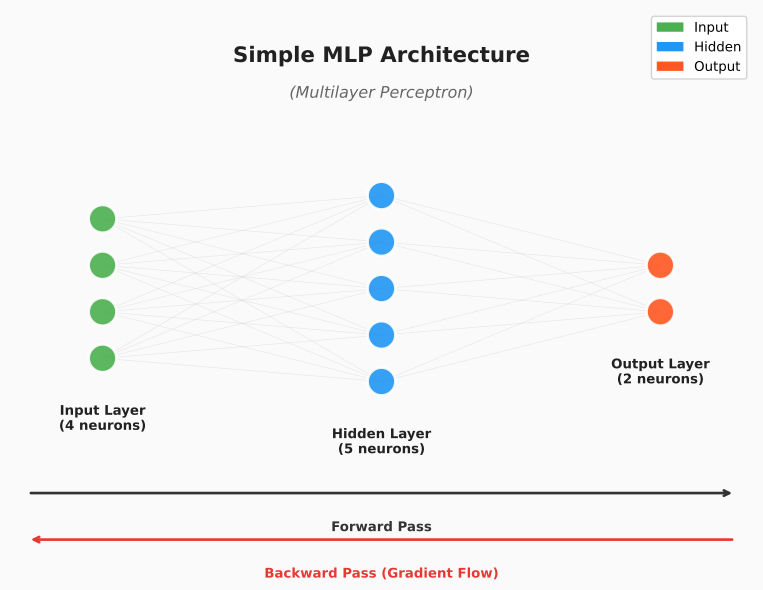
The MLP consists of fully-connected layers where each neuron connects to all neurons in adjacent layers. Data flows forward through linear transformations followed by non-linear activations.
Mathematical Foundation
Forward Propagation
For each layer
Backpropagation
Gradients via chain rule:
Forward Pass Data Flow
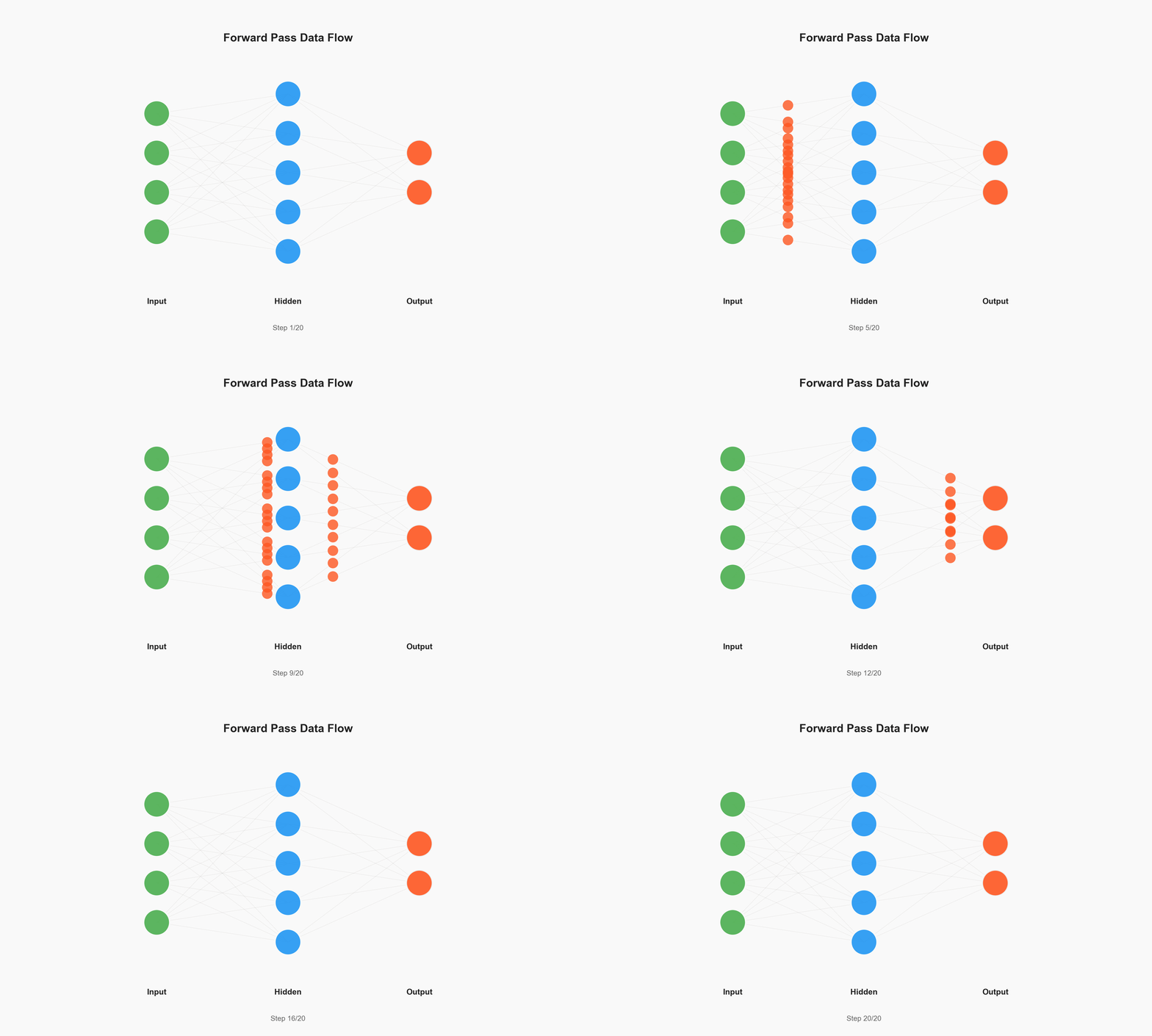
The animation shows data packets flowing through the network layers during forward propagation.
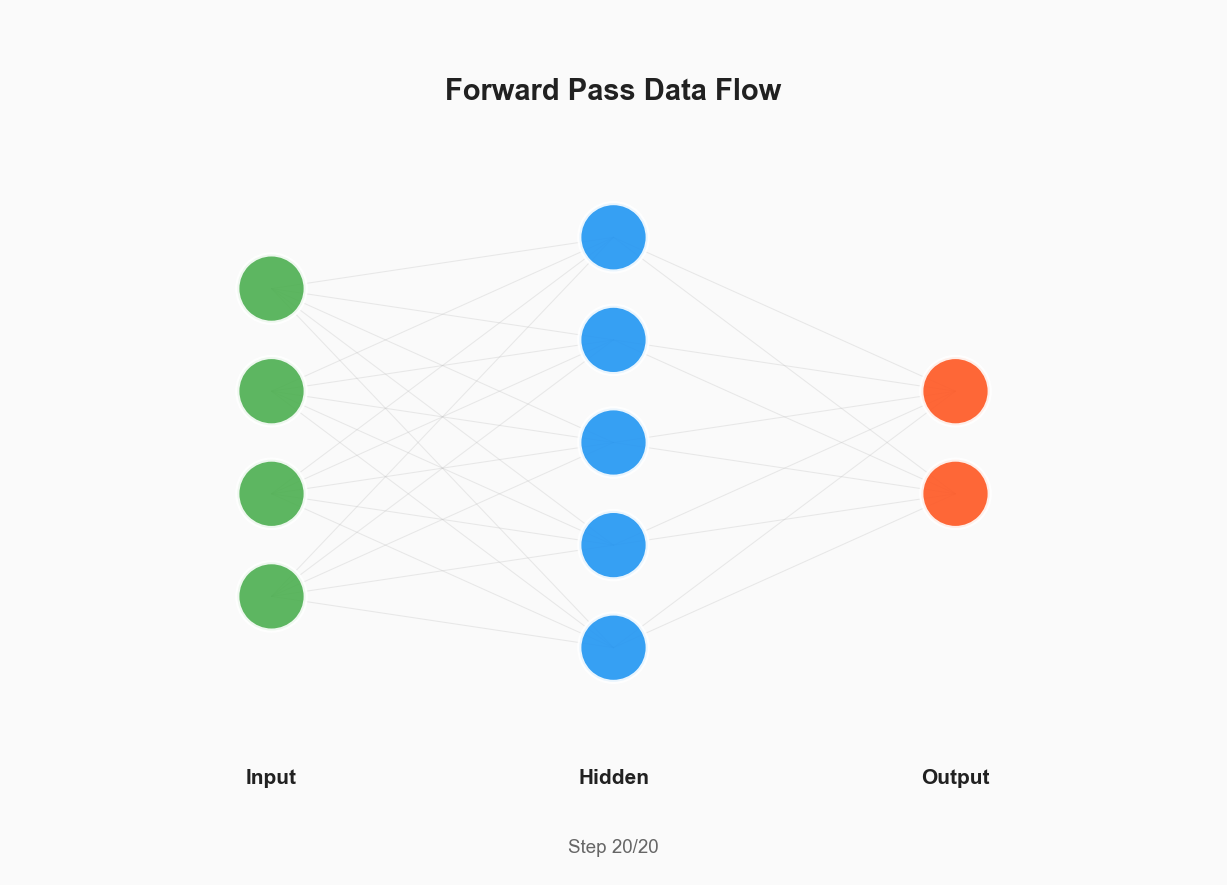
Static diagram showing the complete forward pass architecture with layer transformations.
Activation Functions
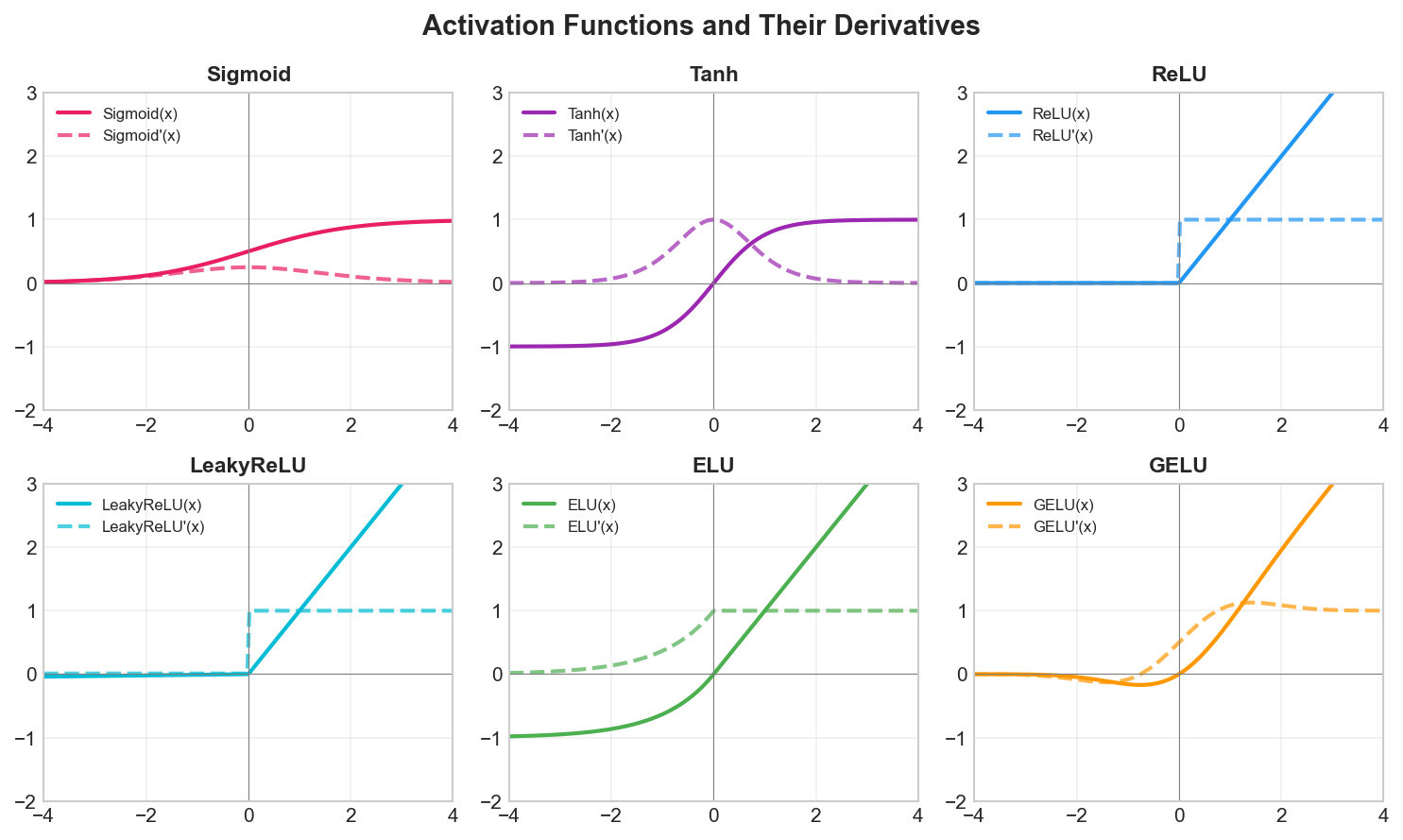
The figure shows six common activation functions (Sigmoid, Tanh, ReLU, LeakyReLU, ELU, GELU) with their derivatives. ReLU is most common for hidden layers; softmax for classification outputs.
Complete Implementation from Scratch
import numpy as np
from typing import List, Tuple, Dict, Callable, Optional
import pickle

class ActivationFunction:
    """Collection of activation functions and their derivatives."""

    @staticmethod
    def sigmoid(z: np.ndarray) -> np.ndarray:
        """Sigmoid: σ(z) = 1/(1+e^(-z)), output in (0,1)"""
        z_clipped = np.clip(z, -500, 500)
        return 1 / (1 + np.exp(-z_clipped))

    @staticmethod
    def sigmoid_derivative(a: np.ndarray) -> np.ndarray:
        """σ'(z) = σ(z)*(1-σ(z))"""
        return a * (1 - a)

    @staticmethod
    def relu(z: np.ndarray) -> np.ndarray:
        """ReLU: f(z) = max(0, z)"""
        return np.maximum(0, z)

    @staticmethod
    def relu_derivative(z: np.ndarray) -> np.ndarray:
        """ReLU': 1 if z > 0, else 0"""
        return (z > 0).astype(float)

    @staticmethod
    def leaky_relu(z: np.ndarray, alpha: float = 0.01) -> np.ndarray:
        """Leaky ReLU: z if z > 0, else alpha*z"""
        return np.where(z > 0, z, alpha * z)

    @staticmethod
    def leaky_relu_derivative(z: np.ndarray, alpha: float = 0.01) -> np.ndarray:
        """Leaky ReLU': 1 if z > 0, else alpha"""
        return np.where(z > 0, 1, alpha)

    @staticmethod
    def tanh(z: np.ndarray) -> np.ndarray:
        """Tanh: output in (-1, 1), zero-centered"""
        return np.tanh(z)

    @staticmethod
    def tanh_derivative(a: np.ndarray) -> np.ndarray:
        """tanh'(z) = 1 - tanh²(z)"""
        return 1 - a ** 2

    @staticmethod
    def softmax(z: np.ndarray) -> np.ndarray:
        """Softmax: probability distribution for multi-class output"""
        z_shifted = z - np.max(z, axis=0, keepdims=True)
        exp_z = np.exp(z_shifted)
        return exp_z / np.sum(exp_z, axis=0, keepdims=True)

    @staticmethod
    def linear(z: np.ndarray) -> np.ndarray:
        """Linear (identity): f(z) = z, for regression outputs"""
        return z

    @staticmethod
    def linear_derivative(z: np.ndarray) -> np.ndarray:
        """Linear': always 1"""
        return np.ones_like(z)

    @staticmethod
    def elu(z: np.ndarray, alpha: float = 1.0) -> np.ndarray:
        """ELU: z if z > 0, else alpha*(e^z - 1)"""
        return np.where(z > 0, z, alpha * (np.exp(z) - 1))

    @staticmethod
    def elu_derivative(z: np.ndarray, alpha: float = 1.0) -> np.ndarray:
        """ELU': 1 if z > 0, else alpha*e^z"""
        return np.where(z > 0, 1, alpha * np.exp(z))

    @staticmethod
    def swish(z: np.ndarray) -> np.ndarray:
        """Swish: f(z) = z * sigmoid(z), self-gated activation"""
        return z * ActivationFunction.sigmoid(z)

    @staticmethod
    def swish_derivative(z: np.ndarray) -> np.ndarray:
        """Swish derivative"""
        sig = ActivationFunction.sigmoid(z)
        return sig + z * sig * (1 - sig)


class WeightInitializer:
    """Weight initialization strategies - see visualization below."""

    @staticmethod
    def zeros(shape: Tuple[int, int]) -> np.ndarray:
        """Zeros: only for biases (breaks symmetry for weights)"""
        return np.zeros(shape)

    @staticmethod
    def random_normal(shape: Tuple[int, int], mean: float = 0.0, std: float = 0.01) -> np.ndarray:
        """Random normal: simple but can cause gradient issues in deep nets"""
        return np.random.randn(*shape) * std + mean

    @staticmethod
    def xavier_uniform(shape: Tuple[int, int]) -> np.ndarray:
        """Xavier uniform: W ~ U(-sqrt(6/(n_in+n_out)), sqrt(6/(n_in+n_out))), for tanh/sigmoid"""
        n_out, n_in = shape
        limit = np.sqrt(6.0 / (n_in + n_out))
        return np.random.uniform(-limit, limit, shape)

    @staticmethod
    def xavier_normal(shape: Tuple[int, int]) -> np.ndarray:
        """Xavier normal: W ~ N(0, sqrt(2/(n_in+n_out))), for tanh/sigmoid"""
        n_out, n_in = shape
        std = np.sqrt(2.0 / (n_in + n_out))
        return np.random.randn(*shape) * std

    @staticmethod
    def he_uniform(shape: Tuple[int, int]) -> np.ndarray:
        """He uniform: W ~ U(-sqrt(6/n_in), sqrt(6/n_in)), for ReLU"""
        n_out, n_in = shape
        limit = np.sqrt(6.0 / n_in)
        return np.random.uniform(-limit, limit, shape)

    @staticmethod
    def he_normal(shape: Tuple[int, int]) -> np.ndarray:
        """He normal: W ~ N(0, sqrt(2/n_in)), most common for ReLU networks"""
        n_out, n_in = shape
        std = np.sqrt(2.0 / n_in)
        return np.random.randn(*shape) * std

    @staticmethod
    def lecun_normal(shape: Tuple[int, int]) -> np.ndarray:
        """LeCun normal: W ~ N(0, sqrt(1/n_in)), for SELU activations"""
        n_out, n_in = shape
        std = np.sqrt(1.0 / n_in)
        return np.random.randn(*shape) * std

    @staticmethod
    def orthogonal(shape: Tuple[int, int], gain: float = 1.0) -> np.ndarray:
        """Orthogonal: uses QR decomposition, useful for RNNs"""
        n_out, n_in = shape
        flat_shape = (n_out, n_in) if n_out > n_in else (n_in, n_out)
        a = np.random.randn(*flat_shape)
        q, r = np.linalg.qr(a)
        d = np.diag(r)
        ph = np.sign(d)
        q *= ph
        if n_out < n_in:
            q = q.T
return gain * q[:n_out, :n_in]Weight Initialization Distributions
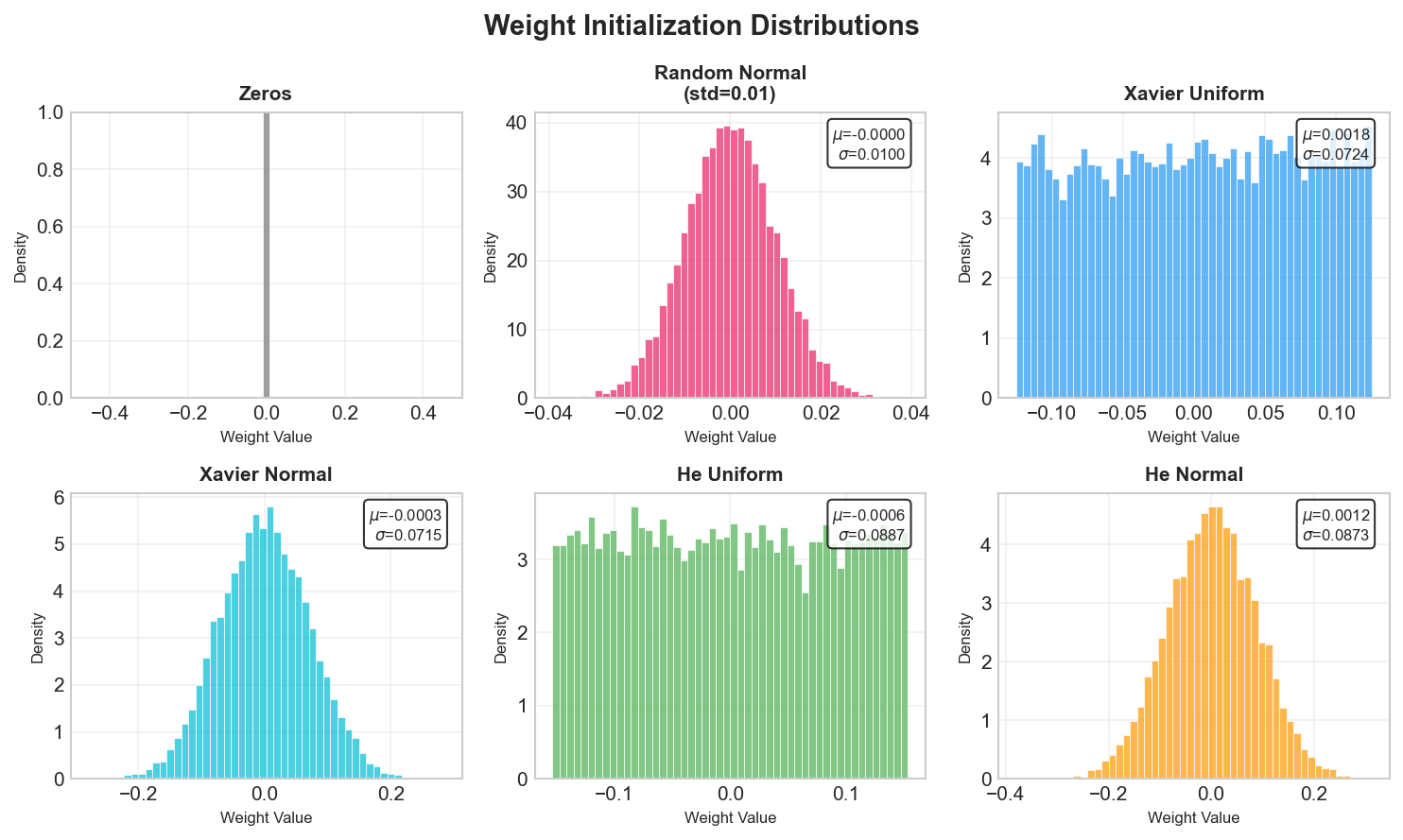
The figure compares different initialization strategies. Xavier is best for tanh/sigmoid; He is best for ReLU.
class LossFunction:
    """Collection of loss functions and their derivatives.

    Loss functions measure the discrepancy between predictions
    and true labels, guiding the optimization process.
    """

    @staticmethod
    def mse(y_pred: np.ndarray, y_true: np.ndarray) -> float:
        """
        Mean Squared Error loss.

        L = (1/n) * Σ(y_pred - y_true)²

        Used for regression tasks.

        Args:
            y_pred: Predictions, shape (n_features, n_samples)
            y_true: True values, same shape

        Returns:
            Scalar loss value
        """
        n_samples = y_true.shape[1]
        return np.sum((y_pred - y_true) ** 2) / (2 * n_samples)

    @staticmethod
    def mse_derivative(y_pred: np.ndarray, y_true: np.ndarray) -> np.ndarray:
        """
        Derivative of MSE loss with respect to predictions.

        dL/dy_pred = (y_pred - y_true) / n

        Args:
            y_pred: Predictions
            y_true: True values

        Returns:
            Gradient with respect to predictions
        """
        n_samples = y_true.shape[1]
        return (y_pred - y_true) / n_samples

    @staticmethod
    def binary_cross_entropy(y_pred: np.ndarray,
                             y_true: np.ndarray,
                             epsilon: float = 1e-15) -> float:
        """
        Binary Cross-Entropy loss.

        L = -(1/n) * Σ[y*log(p) + (1-y)*log(1-p)]

        Used for binary classification.

        Args:
            y_pred: Predicted probabilities (0, 1)
            y_true: True labels {0, 1}
            epsilon: Small value for numerical stability

        Returns:
            Scalar loss value
        """
        n_samples = y_true.shape[1]

        # Clip predictions for numerical stability
        y_pred_clipped = np.clip(y_pred, epsilon, 1 - epsilon)

        loss = -np.sum(
            y_true * np.log(y_pred_clipped) +
            (1 - y_true) * np.log(1 - y_pred_clipped)
        ) / n_samples

        return loss

    @staticmethod
    def binary_cross_entropy_derivative(y_pred: np.ndarray,
                                        y_true: np.ndarray,
                                        epsilon: float = 1e-15) -> np.ndarray:
        """
        Derivative of Binary Cross-Entropy.

        dL/dy_pred = -(y/p - (1-y)/(1-p)) / n

        Args:
            y_pred: Predicted probabilities
            y_true: True labels
            epsilon: Numerical stability constant

        Returns:
            Gradient with respect to predictions
        """
        n_samples = y_true.shape[1]
        y_pred_clipped = np.clip(y_pred, epsilon, 1 - epsilon)

        return (-(y_true / y_pred_clipped) +
                ((1 - y_true) / (1 - y_pred_clipped))) / n_samples

    @staticmethod
    def categorical_cross_entropy(y_pred: np.ndarray,
                                  y_true: np.ndarray,
                                  epsilon: float = 1e-15) -> float:
        """
        Categorical Cross-Entropy loss.

        L = -(1/n) * ΣΣ y_true * log(y_pred)

        Used for multi-class classification with softmax output.

        Args:
            y_pred: Predicted probabilities, shape (n_classes, n_samples)
            y_true: One-hot encoded labels, same shape
            epsilon: Numerical stability constant

        Returns:
            Scalar loss value
        """
        n_samples = y_true.shape[1]
        y_pred_clipped = np.clip(y_pred, epsilon, 1 - epsilon)

        return -np.sum(y_true * np.log(y_pred_clipped)) / n_samples

    @staticmethod
    def categorical_cross_entropy_derivative(y_pred: np.ndarray,
                                             y_true: np.ndarray) -> np.ndarray:
        """
        Derivative of Categorical Cross-Entropy.

        When combined with softmax, simplifies to: y_pred - y_true

        Args:
            y_pred: Predicted probabilities (after softmax)
            y_true: One-hot encoded labels

        Returns:
            Gradient with respect to pre-softmax values
        """
        n_samples = y_true.shape[1]
        return (y_pred - y_true) / n_samples

    @staticmethod
    def huber_loss(y_pred: np.ndarray,
                   y_true: np.ndarray,
                   delta: float = 1.0) -> float:
        """
        Huber loss (smooth L1 loss).

        Combines MSE and MAE - quadratic for small errors, linear for large.
        Less sensitive to outliers than MSE.

        Args:
            y_pred: Predictions
            y_true: True values
            delta: Threshold for switching between quadratic and linear

        Returns:
            Scalar loss value
        """
        n_samples = y_true.shape[1]
        error = y_pred - y_true

        is_small = np.abs(error) <= delta

        squared_loss = 0.5 * error ** 2
        linear_loss = delta * np.abs(error) - 0.5 * delta ** 2

        loss = np.where(is_small, squared_loss, linear_loss)
        return np.sum(loss) / n_samples

    @staticmethod
    def huber_loss_derivative(y_pred: np.ndarray,
                              y_true: np.ndarray,
                              delta: float = 1.0) -> np.ndarray:
        """
        Derivative of Huber loss.

        Args:
            y_pred: Predictions
            y_true: True values
            delta: Threshold

        Returns:
            Gradient with respect to predictions
        """
        n_samples = y_true.shape[1]
        error = y_pred - y_true

        is_small = np.abs(error) <= delta

        gradient = np.where(is_small, error, delta * np.sign(error))
        return gradient / n_samples


class Layer:
    """
    A single fully-connected (dense) layer in the neural network.

    Stores weights, biases, and intermediate values for backpropagation.
    """

    def __init__(self,
                 n_input: int,
                 n_output: int,
                 activation: str = 'relu',
                 weight_init: str = 'he_normal',
                 use_bias: bool = True):
        """
        Initialize a dense layer.

        Args:
            n_input: Number of input features
            n_output: Number of output features (neurons)
            activation: Activation function name
            weight_init: Weight initialization strategy
            use_bias: Whether to use bias terms
        """
        self.n_input = n_input
        self.n_output = n_output
        self.activation_name = activation
        self.use_bias = use_bias

        # Initialize weights
        self.W = self._init_weights((n_output, n_input), weight_init)
        self.b = np.zeros((n_output, 1)) if use_bias else None

        # Storage for forward/backward pass
        self.z = None  # Pre-activation
        self.a = None  # Post-activation
        self.a_prev = None  # Input from previous layer

        # Gradients
        self.dW = None
        self.db = None

        # For momentum/Adam
        self.vW = np.zeros_like(self.W)
        self.vb = np.zeros_like(self.b) if use_bias else None
        self.sW = np.zeros_like(self.W)
        self.sb = np.zeros_like(self.b) if use_bias else None

        # Set activation function
        self._set_activation(activation)

    def _init_weights(self, shape: Tuple[int, int], method: str) -> np.ndarray:
        """Initialize weights using specified method."""
        initializers = {
            'zeros': WeightInitializer.zeros,
            'random': WeightInitializer.random_normal,
            'xavier_uniform': WeightInitializer.xavier_uniform,
            'xavier_normal': WeightInitializer.xavier_normal,
            'glorot_uniform': WeightInitializer.xavier_uniform,
            'glorot_normal': WeightInitializer.xavier_normal,
            'he_uniform': WeightInitializer.he_uniform,
            'he_normal': WeightInitializer.he_normal,
            'lecun_normal': WeightInitializer.lecun_normal,
            'orthogonal': WeightInitializer.orthogonal,
        }

        if method not in initializers:
            raise ValueError(f"Unknown initialization: {method}")

        return initializers[method](shape)

    def _set_activation(self, name: str):
        """Set activation function and its derivative."""
        activations = {
            'sigmoid': (ActivationFunction.sigmoid,
                       ActivationFunction.sigmoid_derivative),
            'relu': (ActivationFunction.relu,
                    ActivationFunction.relu_derivative),
            'leaky_relu': (ActivationFunction.leaky_relu,
                          ActivationFunction.leaky_relu_derivative),
            'tanh': (ActivationFunction.tanh,
                    ActivationFunction.tanh_derivative),
            'softmax': (ActivationFunction.softmax, None),
            'linear': (ActivationFunction.linear,
                      ActivationFunction.linear_derivative),
            'elu': (ActivationFunction.elu,
                   ActivationFunction.elu_derivative),
            'swish': (ActivationFunction.swish,
                     ActivationFunction.swish_derivative),
        }

        if name not in activations:
            raise ValueError(f"Unknown activation: {name}")

        self.activation, self.activation_derivative = activations[name]

    def forward(self, a_prev: np.ndarray, training: bool = True) -> np.ndarray:
        """
        Forward pass through the layer.

        Computes: z = W * a_prev + b, then a = activation(z)

        Args:
            a_prev: Input from previous layer, shape (n_input, batch_size)
            training: Whether in training mode (store intermediate values)

        Returns:
            Activated output, shape (n_output, batch_size)
        """
        # Linear transformation
        self.z = np.dot(self.W, a_prev)
        if self.use_bias:
            self.z += self.b

        # Activation
        self.a = self.activation(self.z)

        # Store for backprop
        if training:
            self.a_prev = a_prev

        return self.a

    def backward(self, da: np.ndarray) -> np.ndarray:
        """
        Backward pass through the layer.

        Computes gradients dW, db and propagates gradient to previous layer.

        Args:
            da: Gradient of loss with respect to this layer's activation
                Shape: (n_output, batch_size)

        Returns:
            Gradient with respect to previous layer's activation
            Shape: (n_input, batch_size)
        """
        batch_size = da.shape[1]

        # Compute gradient through activation
        if self.activation_name == 'softmax':
            # For softmax + cross-entropy, da is already dz
            dz = da
        elif self.activation_name in ['sigmoid', 'tanh']:
            # These use activation values for derivative
            dz = da * self.activation_derivative(self.a)
        else:
            # ReLU, Leaky ReLU, etc. use pre-activation
            dz = da * self.activation_derivative(self.z)

        # Compute gradients for weights and biases
        self.dW = np.dot(dz, self.a_prev.T) / batch_size
        if self.use_bias:
            self.db = np.sum(dz, axis=1, keepdims=True) / batch_size

        # Compute gradient for previous layer
        da_prev = np.dot(self.W.T, dz)

        return da_prev

    def get_params(self) -> Dict[str, np.ndarray]:
        """Get layer parameters."""
        params = {'W': self.W}
        if self.use_bias:
            params['b'] = self.b
        return params

    def set_params(self, params: Dict[str, np.ndarray]):
        """Set layer parameters."""
        self.W = params['W']
        if self.use_bias and 'b' in params:
            self.b = params['b']

    def get_gradients(self) -> Dict[str, np.ndarray]:
        """Get computed gradients."""
        grads = {'dW': self.dW}
        if self.use_bias:
            grads['db'] = self.db
return gradsLoss Landscape Visualization
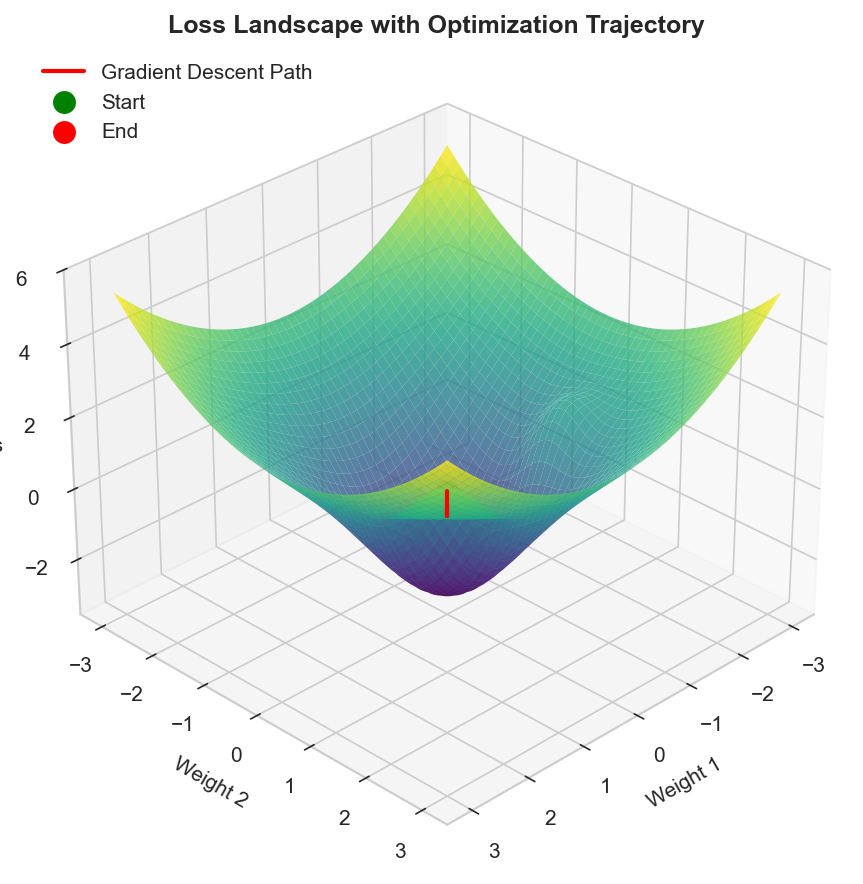
The 3D surface shows a typical loss landscape with local minima. The red trajectory shows gradient descent navigating toward the global minimum.
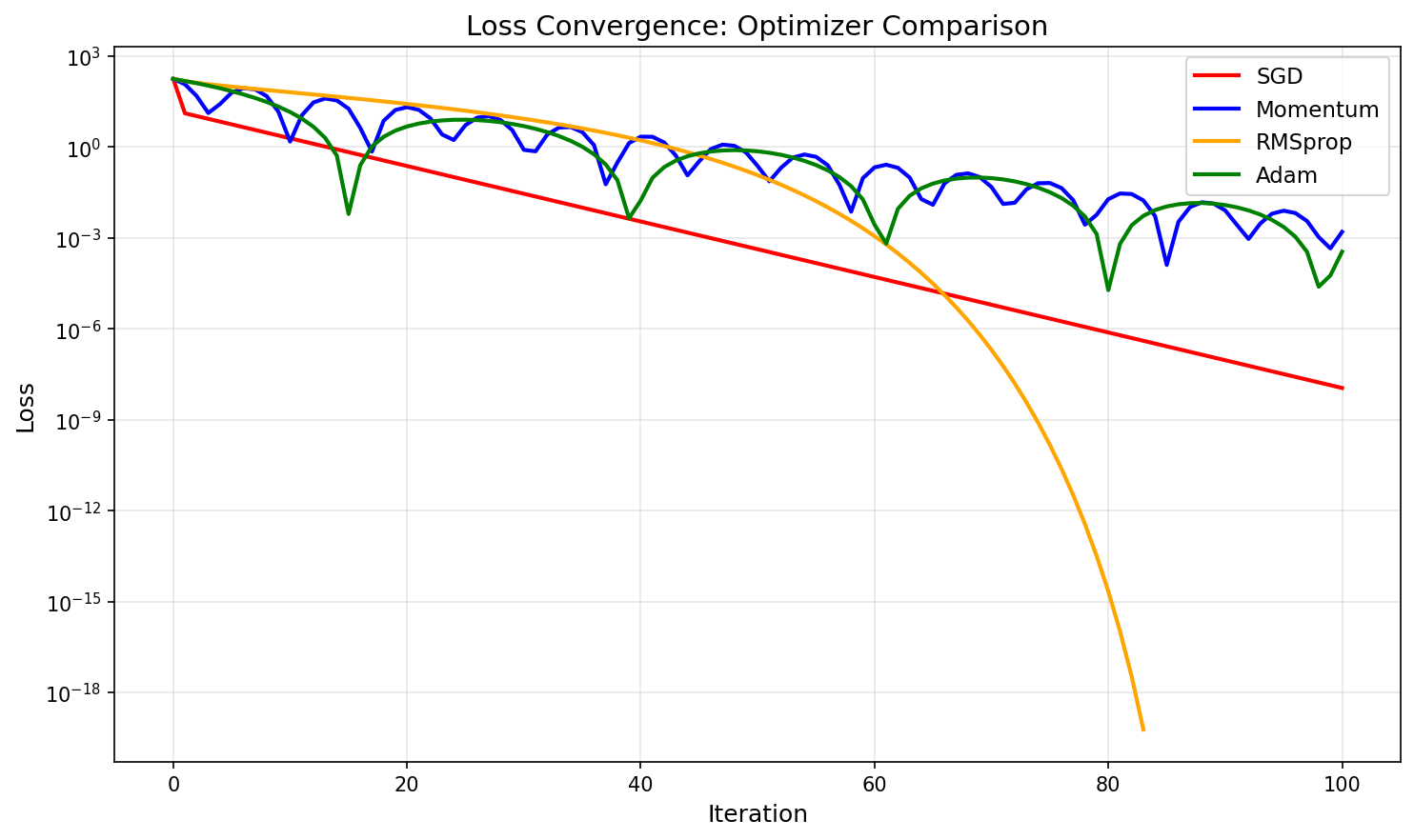
Interpreting training curves: healthy convergence, underfitting, overfitting, and learning rate issues.
Learning Rate Effects
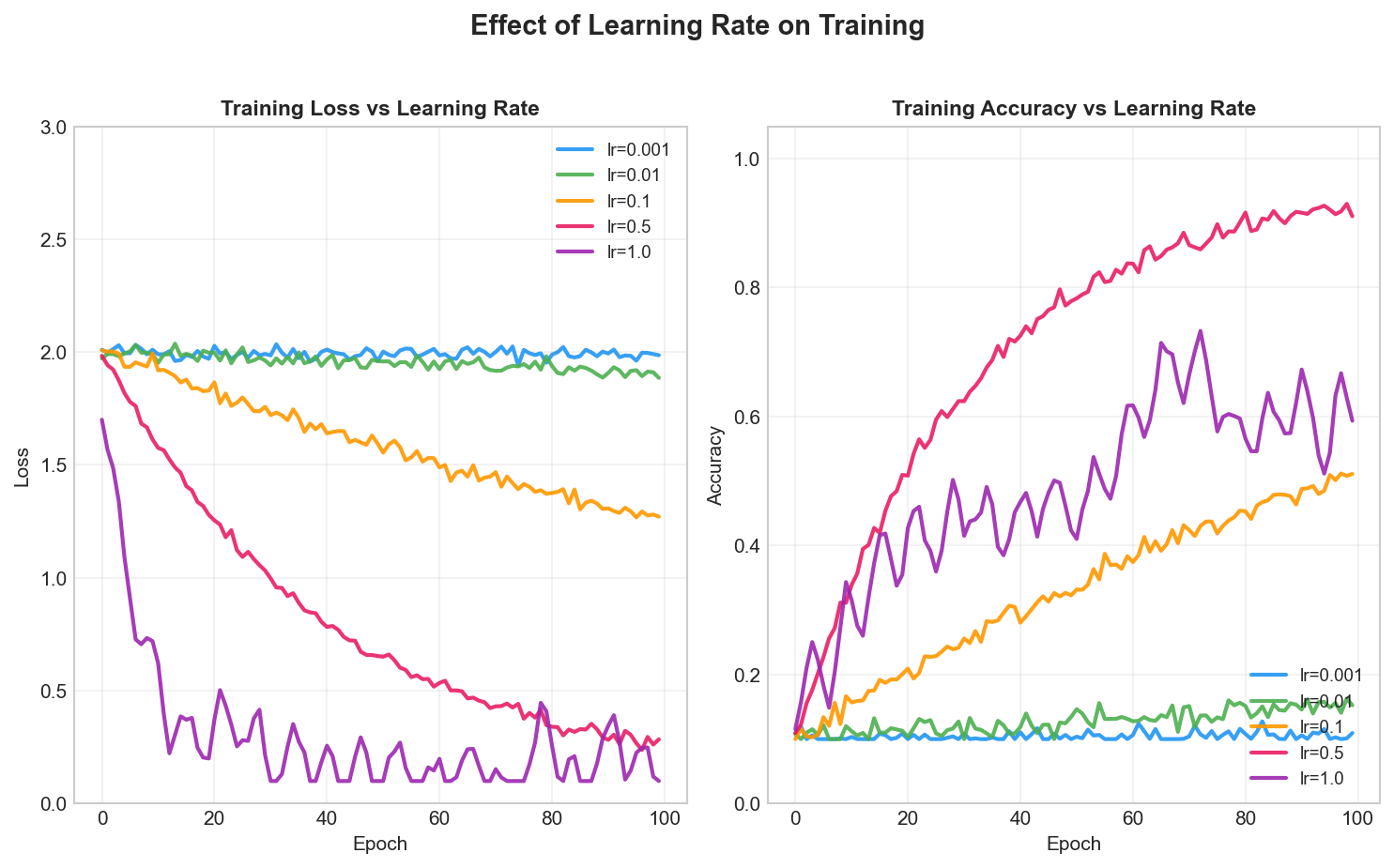
Different learning rates dramatically affect training. Too small (0.001) converges slowly; too large (>0.5) causes instability.
class Optimizer:
"""Base class for optimization algorithms."""
def __init__(self, learning_rate: float = 0.01):
self.learning_rate = learning_rate
self.t = 0
def update(self, layer: Layer):
raise NotImplementedError
class SGD(Optimizer):
"""SGD with optional momentum: W = W - lr*dW (or with velocity)"""
def __init__(self, learning_rate: float = 0.01, momentum: float = 0.0, nesterov: bool = False):
super().__init__(learning_rate)
self.momentum = momentum
self.nesterov = nesterov
def update(self, layer: Layer):
if self.momentum > 0:
layer.vW = self.momentum * layer.vW - self.learning_rate * layer.dW
layer.W += self.momentum * layer.vW - self.learning_rate * layer.dW if self.nesterov else layer.vW
if layer.use_bias:
layer.vb = self.momentum * layer.vb - self.learning_rate * layer.db
layer.b += self.momentum * layer.vb - self.learning_rate * layer.db if self.nesterov else layer.vb
else:
layer.W -= self.learning_rate * layer.dW
if layer.use_bias:
layer.b -= self.learning_rate * layer.db
class Adam(Optimizer):
"""Adam: combines momentum + RMSprop. W = W - lr*m_hat/sqrt(v_hat)"""
def __init__(self, learning_rate: float = 0.001, beta1: float = 0.9, beta2: float = 0.999, epsilon: float = 1e-8):
super().__init__(learning_rate)
self.beta1 = beta1
self.beta2 = beta2
self.epsilon = epsilon
def update(self, layer: Layer):
self.t += 1
layer.vW = self.beta1 * layer.vW + (1 - self.beta1) * layer.dW
layer.sW = self.beta2 * layer.sW + (1 - self.beta2) * (layer.dW ** 2)
vW_corrected = layer.vW / (1 - self.beta1 ** self.t)
sW_corrected = layer.sW / (1 - self.beta2 ** self.t)
layer.W -= self.learning_rate * vW_corrected / (np.sqrt(sW_corrected) + self.epsilon)
if layer.use_bias:
layer.vb = self.beta1 * layer.vb + (1 - self.beta1) * layer.db
layer.sb = self.beta2 * layer.sb + (1 - self.beta2) * (layer.db ** 2)
vb_corrected = layer.vb / (1 - self.beta1 ** self.t)
sb_corrected = layer.sb / (1 - self.beta2 ** self.t)
layer.b -= self.learning_rate * vb_corrected / (np.sqrt(sb_corrected) + self.epsilon)
class RMSprop(Optimizer):
"""RMSprop: adapts LR based on moving average of squared gradients"""
def __init__(self, learning_rate: float = 0.001, rho: float = 0.9, epsilon: float = 1e-8):
super().__init__(learning_rate)
self.rho = rho
self.epsilon = epsilon
def update(self, layer: Layer):
layer.sW = self.rho * layer.sW + (1 - self.rho) * (layer.dW ** 2)
layer.W -= self.learning_rate * layer.dW / (np.sqrt(layer.sW) + self.epsilon)
if layer.use_bias:
layer.sb = self.rho * layer.sb + (1 - self.rho) * (layer.db ** 2)
layer.b -= self.learning_rate * layer.db / (np.sqrt(layer.sb) + self.epsilon)
class AdaGrad(Optimizer):
"""AdaGrad: adapts LR per parameter, LR decreases over time"""
def __init__(self, learning_rate: float = 0.01, epsilon: float = 1e-8):
super().__init__(learning_rate)
self.epsilon = epsilon
def update(self, layer: Layer):
layer.sW += layer.dW ** 2
layer.W -= self.learning_rate * layer.dW / (np.sqrt(layer.sW) + self.epsilon)
if layer.use_bias:
layer.sb += layer.db ** 2
layer.b -= self.learning_rate * layer.db / (np.sqrt(layer.sb) + self.epsilon)
class Regularizer:
"""Regularization techniques to prevent overfitting."""
@staticmethod
def l2_penalty(layers: List[Layer], lambda_: float) -> float:
"""L2 penalty: (lambda/2) * sum(W^2)"""
penalty = 0.0
for layer in layers:
penalty += np.sum(layer.W ** 2)
return (lambda_ / 2) * penalty
@staticmethod
def l2_gradient(layer: Layer, lambda_: float) -> np.ndarray:
"""L2 gradient: lambda * W"""
return lambda_ * layer.W
@staticmethod
def l1_penalty(layers: List[Layer], lambda_: float) -> float:
"""L1 penalty: lambda * sum(|W|)"""
penalty = 0.0
for layer in layers:
penalty += np.sum(np.abs(layer.W))
return lambda_ * penalty
@staticmethod
def l1_gradient(layer: Layer, lambda_: float) -> np.ndarray:
"""L1 gradient: lambda * sign(W)"""
return lambda_ * np.sign(layer.W)
class Dropout:
"""Dropout: randomly zeros activations during training to prevent co-adaptation"""
def __init__(self, rate: float = 0.5):
if not 0 <= rate < 1:
raise ValueError("Dropout rate must be in [0, 1)")
self.rate = rate
self.mask = None
def forward(self, a: np.ndarray, training: bool = True) -> np.ndarray:
"""Apply dropout with inverted scaling"""
if not training or self.rate == 0:
return a
# Create mask (inverted dropout - scale during training)
self.mask = (np.random.rand(*a.shape) > self.rate) / (1 - self.rate)
return a * self.mask
def backward(self, da: np.ndarray) -> np.ndarray:
"""Backward pass: mask with same pattern as forward"""
if self.mask is None:
return da
return da * self.mask
class BatchNormalization:
"""BatchNorm: normalize to zero mean/unit variance, then scale (gamma) and shift (beta)"""
def __init__(self, n_features: int, momentum: float = 0.99, epsilon: float = 1e-8):
self.n_features = n_features
self.momentum = momentum
self.epsilon = epsilon
self.gamma = np.ones((n_features, 1))
self.beta = np.zeros((n_features, 1))
self.running_mean = np.zeros((n_features, 1))
self.running_var = np.ones((n_features, 1))
self.x_norm = self.std = self.mean = self.x = None
self.dgamma = self.dbeta = None
def forward(self, x: np.ndarray, training: bool = True) -> np.ndarray:
"""Forward: normalize, then scale and shift"""
self.x = x
if training:
self.mean = np.mean(x, axis=1, keepdims=True)
self.var = np.var(x, axis=1, keepdims=True)
self.std = np.sqrt(self.var + self.epsilon)
self.x_norm = (x - self.mean) / self.std
self.running_mean = self.momentum * self.running_mean + (1 - self.momentum) * self.mean
self.running_var = self.momentum * self.running_var + (1 - self.momentum) * self.var
else:
self.x_norm = (x - self.running_mean) / np.sqrt(self.running_var + self.epsilon)
return self.gamma * self.x_norm + self.beta
def backward(self, dout: np.ndarray) -> np.ndarray:
"""Backward: compute gradients for gamma, beta, and input"""
batch_size = dout.shape[1]
self.dgamma = np.sum(dout * self.x_norm, axis=1, keepdims=True)
self.dbeta = np.sum(dout, axis=1, keepdims=True)
dx_norm = dout * self.gamma
dvar = np.sum(dx_norm * (self.x - self.mean) * -0.5 * (self.var + self.epsilon) ** (-1.5), axis=1, keepdims=True)
dmean = np.sum(dx_norm * -1 / self.std, axis=1, keepdims=True)
dmean += dvar * np.mean(-2 * (self.x - self.mean), axis=1, keepdims=True)
dx = dx_norm / self.std + dvar * 2 * (self.x - self.mean) / batch_size + dmean / batch_size
return dx
class MLP:
"""Complete MLP with arbitrary architecture, optimizers, regularization, batch norm"""
def __init__(self, layer_sizes: List[int], activations: List[str] = None,
weight_init: str = 'he_normal', use_batch_norm: bool = False,
dropout_rates: List[float] = None):
self.layer_sizes = layer_sizes
self.n_layers = len(layer_sizes) - 1
self.use_batch_norm = use_batch_norm
if activations is None:
activations = ['relu'] * (self.n_layers - 1) + ['softmax']
if len(activations) != self.n_layers:
raise ValueError("Number of activations must match number of layers")
# Create layers
self.layers = []
for i in range(self.n_layers):
layer = Layer(
n_input=layer_sizes[i],
n_output=layer_sizes[i + 1],
activation=activations[i],
weight_init=weight_init
)
self.layers.append(layer)
# Batch normalization layers
self.batch_norms = []
if use_batch_norm:
for i in range(self.n_layers - 1): # Not for output layer
bn = BatchNormalization(layer_sizes[i + 1])
self.batch_norms.append(bn)
# Dropout layers
self.dropouts = []
if dropout_rates is not None:
for rate in dropout_rates:
self.dropouts.append(Dropout(rate))
# Training history
self.history = {
'train_loss': [],
'train_accuracy': [],
'val_loss': [],
'val_accuracy': []
}
def forward(self, X: np.ndarray, training: bool = True) -> np.ndarray:
"""
Forward propagation through the entire network.
Args:
X: Input data, shape (n_features, batch_size)
training: Whether in training mode
Returns:
Network output, shape (n_output, batch_size)
"""
a = X
for i, layer in enumerate(self.layers):
a = layer.forward(a, training)
# Apply batch normalization (except for output layer)
if self.use_batch_norm and i < len(self.batch_norms):
a = self.batch_norms[i].forward(a, training)
# Apply dropout (except for output layer)
if self.dropouts and i < len(self.dropouts):
a = self.dropouts[i].forward(a, training)
return a
def backward(self, y_pred: np.ndarray, y_true: np.ndarray,
lambda_l2: float = 0.0, lambda_l1: float = 0.0) -> float:
"""
Backward propagation through the entire network.
Computes gradients for all parameters using chain rule.
Args:
y_pred: Network predictions
y_true: True labels
lambda_l2: L2 regularization strength
lambda_l1: L1 regularization strength
Returns:
Loss value
"""
# Compute loss
loss = LossFunction.categorical_cross_entropy(y_pred, y_true)
# Add regularization penalty
if lambda_l2 > 0:
loss += Regularizer.l2_penalty(self.layers, lambda_l2)
if lambda_l1 > 0:
loss += Regularizer.l1_penalty(self.layers, lambda_l1)
# Initial gradient (softmax + cross-entropy)
da = LossFunction.categorical_cross_entropy_derivative(y_pred, y_true)
# Backpropagate through layers
for i in reversed(range(self.n_layers)):
# Dropout gradient
if self.dropouts and i < len(self.dropouts):
da = self.dropouts[i].backward(da)
# Batch norm gradient
if self.use_batch_norm and i < len(self.batch_norms):
da = self.batch_norms[i].backward(da)
# Layer gradient
da = self.layers[i].backward(da)
# Add regularization gradient
if lambda_l2 > 0:
self.layers[i].dW += Regularizer.l2_gradient(self.layers[i], lambda_l2)
if lambda_l1 > 0:
self.layers[i].dW += Regularizer.l1_gradient(self.layers[i], lambda_l1)
return loss
def predict(self, X: np.ndarray) -> np.ndarray:
"""
Make predictions on new data.
Args:
X: Input data, shape (n_features, n_samples)
Returns:
Predicted class probabilities
"""
return self.forward(X, training=False)
def predict_classes(self, X: np.ndarray) -> np.ndarray:
"""
Predict class labels.
Args:
X: Input data
Returns:
Predicted class indices
"""
probs = self.predict(X)
return np.argmax(probs, axis=0)
def compute_accuracy(self, X: np.ndarray, y: np.ndarray) -> float:
"""
Compute classification accuracy.
Args:
X: Input data
y: One-hot encoded labels
Returns:
Accuracy as fraction
"""
predictions = self.predict_classes(X)
true_classes = np.argmax(y, axis=0)
return np.mean(predictions == true_classes)
def fit(self,
X_train: np.ndarray,
y_train: np.ndarray,
epochs: int = 100,
batch_size: int = 32,
optimizer: Optimizer = None,
lambda_l2: float = 0.0,
lambda_l1: float = 0.0,
X_val: np.ndarray = None,
y_val: np.ndarray = None,
early_stopping_patience: int = None,
verbose: bool = True,
shuffle: bool = True):
"""
Train the neural network.
Args:
X_train: Training data, shape (n_features, n_samples)
y_train: Training labels (one-hot), shape (n_classes, n_samples)
epochs: Number of training epochs
batch_size: Mini-batch size
optimizer: Optimizer instance (default: Adam)
lambda_l2: L2 regularization strength
lambda_l1: L1 regularization strength
X_val: Validation data
y_val: Validation labels
early_stopping_patience: Stop if val loss doesn't improve
verbose: Print progress
shuffle: Shuffle data each epoch
Returns:
Training history dictionary
"""
if optimizer is None:
optimizer = Adam(learning_rate=0.001)
n_samples = X_train.shape[1]
n_batches = max(1, n_samples // batch_size)
best_val_loss = float('inf')
patience_counter = 0
for epoch in range(epochs):
epoch_loss = 0.0
# Shuffle data
if shuffle:
indices = np.random.permutation(n_samples)
X_shuffled = X_train[:, indices]
y_shuffled = y_train[:, indices]
else:
X_shuffled = X_train
y_shuffled = y_train
# Mini-batch training
for batch_idx in range(n_batches):
start_idx = batch_idx * batch_size
end_idx = min(start_idx + batch_size, n_samples)
X_batch = X_shuffled[:, start_idx:end_idx]
y_batch = y_shuffled[:, start_idx:end_idx]
# Forward pass
y_pred = self.forward(X_batch, training=True)
# Backward pass
batch_loss = self.backward(y_pred, y_batch, lambda_l2, lambda_l1)
epoch_loss += batch_loss
# Update parameters
for layer in self.layers:
optimizer.update(layer)
# Update batch norm parameters
if self.use_batch_norm:
for bn in self.batch_norms:
bn.gamma -= optimizer.learning_rate * bn.dgamma
bn.beta -= optimizer.learning_rate * bn.dbeta
# Compute epoch metrics
avg_loss = epoch_loss / n_batches
train_acc = self.compute_accuracy(X_train, y_train)
self.history['train_loss'].append(avg_loss)
self.history['train_accuracy'].append(train_acc)
# Validation
if X_val is not None and y_val is not None:
val_pred = self.predict(X_val)
val_loss = LossFunction.categorical_cross_entropy(val_pred, y_val)
val_acc = self.compute_accuracy(X_val, y_val)
self.history['val_loss'].append(val_loss)
self.history['val_accuracy'].append(val_acc)
# Early stopping
if early_stopping_patience is not None:
if val_loss < best_val_loss:
best_val_loss = val_loss
patience_counter = 0
else:
patience_counter += 1
if patience_counter >= early_stopping_patience:
if verbose:
print(f"Early stopping at epoch {epoch + 1}")
break
# Print progress
if verbose and (epoch + 1) % max(1, epochs // 10) == 0:
msg = f"Epoch {epoch + 1}/{epochs} - Loss: {avg_loss:.4f} - Acc: {train_acc:.4f}"
if X_val is not None:
msg += f" - Val Loss: {val_loss:.4f} - Val Acc: {val_acc:.4f}"
print(msg)
return self.history
def save(self, filepath: str):
"""Save model to file."""
model_data = {
'layer_sizes': self.layer_sizes,
'weights': [layer.get_params() for layer in self.layers],
'history': self.history
}
with open(filepath, 'wb') as f:
pickle.dump(model_data, f)
def load(self, filepath: str):
"""Load model from file."""
with open(filepath, 'rb') as f:
model_data = pickle.load(f)
for layer, params in zip(self.layers, model_data['weights']):
layer.set_params(params)
self.history = model_data['history']
def summary(self):
"""Print model architecture summary."""
print("=" * 60)
print("Model Summary")
print("=" * 60)
total_params = 0
for i, layer in enumerate(self.layers):
n_params = layer.W.size + (layer.b.size if layer.use_bias else 0)
total_params += n_params
print(f"Layer {i + 1}: {layer.n_input} -> {layer.n_output} "
f"({layer.activation_name}) - {n_params:,} params")
print("=" * 60)
print(f"Total parameters: {total_params:,}")
print("=" * 60)
class LearningRateScheduler:
"""
Learning rate scheduling strategies.
"""
@staticmethod
def step_decay(initial_lr: float, epoch: int,
drop_rate: float = 0.5, drop_every: int = 10) -> float:
"""
Step decay: reduce LR by factor every N epochs.
Args:
initial_lr: Starting learning rate
epoch: Current epoch number
drop_rate: Factor to reduce LR by
drop_every: Reduce every N epochs
Returns:
New learning rate
"""
return initial_lr * (drop_rate ** (epoch // drop_every))
@staticmethod
def exponential_decay(initial_lr: float, epoch: int,
decay_rate: float = 0.95) -> float:
"""
Exponential decay: LR = initial_lr * decay_rate^epoch
Args:
initial_lr: Starting learning rate
epoch: Current epoch number
decay_rate: Decay factor
Returns:
New learning rate
"""
return initial_lr * (decay_rate ** epoch)
@staticmethod
def cosine_annealing(initial_lr: float, epoch: int,
total_epochs: int, min_lr: float = 0.0) -> float:
"""
Cosine annealing: smooth decrease following cosine curve.
Args:
initial_lr: Starting learning rate
epoch: Current epoch number
total_epochs: Total number of epochs
min_lr: Minimum learning rate
Returns:
New learning rate
"""
return min_lr + (initial_lr - min_lr) * (1 + np.cos(np.pi * epoch / total_epochs)) / 2
@staticmethod
def warmup(initial_lr: float, epoch: int, warmup_epochs: int) -> float:
"""
Linear warmup: gradually increase LR during initial epochs.
Args:
initial_lr: Target learning rate
epoch: Current epoch number
warmup_epochs: Number of warmup epochs
Returns:
Current learning rate
"""
if epoch < warmup_epochs:
return initial_lr * (epoch + 1) / warmup_epochs
return initial_lr
def create_mini_batches(X: np.ndarray, y: np.ndarray,
batch_size: int, shuffle: bool = True) -> List[Tuple[np.ndarray, np.ndarray]]:
"""
Create mini-batches for training.
Args:
X: Input data, shape (n_features, n_samples)
y: Labels, shape (n_classes, n_samples)
batch_size: Size of each mini-batch
shuffle: Whether to shuffle data
Returns:
List of (X_batch, y_batch) tuples
"""
n_samples = X.shape[1]
if shuffle:
indices = np.random.permutation(n_samples)
X = X[:, indices]
y = y[:, indices]
batches = []
n_complete_batches = n_samples // batch_size
for i in range(n_complete_batches):
start = i * batch_size
end = start + batch_size
batches.append((X[:, start:end], y[:, start:end]))
# Handle remaining samples
if n_samples % batch_size != 0:
start = n_complete_batches * batch_size
batches.append((X[:, start:], y[:, start:]))
return batches
def one_hot_encode(y: np.ndarray, n_classes: int) -> np.ndarray:
"""
Convert class indices to one-hot encoded vectors.
Args:
y: Class indices, shape (n_samples,)
n_classes: Total number of classes
Returns:
One-hot encoded array, shape (n_classes, n_samples)
"""
n_samples = len(y)
one_hot = np.zeros((n_classes, n_samples))
one_hot[y, np.arange(n_samples)] = 1
return one_hot
def train_test_split(X: np.ndarray, y: np.ndarray,
test_size: float = 0.2,
shuffle: bool = True) -> Tuple[np.ndarray, np.ndarray, np.ndarray, np.ndarray]:
"""
Split data into training and test sets.
Args:
X: Input data
y: Labels
test_size: Fraction of data for testing
shuffle: Whether to shuffle before splitting
Returns:
X_train, X_test, y_train, y_test
"""
n_samples = X.shape[1]
n_test = int(n_samples * test_size)
if shuffle:
indices = np.random.permutation(n_samples)
X = X[:, indices]
y = y[:, indices]
X_test = X[:, :n_test]
X_train = X[:, n_test:]
y_test = y[:, :n_test]
y_train = y[:, n_test:]
return X_train, X_test, y_train, y_test
def normalize_data(X: np.ndarray,
mean: np.ndarray = None,
std: np.ndarray = None) -> Tuple[np.ndarray, np.ndarray, np.ndarray]:
"""
Normalize data to zero mean and unit variance.
Args:
X: Input data, shape (n_features, n_samples)
mean: Pre-computed mean (optional)
std: Pre-computed std (optional)
Returns:
Normalized X, mean, std
"""
if mean is None:
mean = np.mean(X, axis=1, keepdims=True)
if std is None:
std = np.std(X, axis=1, keepdims=True)
std[std == 0] = 1 # Prevent division by zero
X_normalized = (X - mean) / std
return X_normalized, mean, stdGradient Flow Visualization
Complete Training Example
"""
Complete example: Training an MLP on synthetic data.
This demonstrates all components working together.
"""

import numpy as np
import matplotlib.pyplot as plt

def generate_spiral_data(n_samples: int = 1000, n_classes: int = 3, noise: float = 0.1):
    """
    Generate spiral dataset for classification.

    Args:
        n_samples: Total number of samples
        n_classes: Number of spiral arms (classes)
        noise: Noise level

    Returns:
        X: Data points, shape (2, n_samples)
        y: One-hot labels, shape (n_classes, n_samples)
    """
    samples_per_class = n_samples // n_classes
    X = np.zeros((2, n_samples))
    y = np.zeros(n_samples, dtype=int)

    for class_idx in range(n_classes):
        start_idx = class_idx * samples_per_class
        end_idx = start_idx + samples_per_class

        r = np.linspace(0.0, 1, samples_per_class)
        t = (np.linspace(0, 4, samples_per_class) +
             class_idx * 4 / n_classes +
             np.random.randn(samples_per_class) * noise)

        X[0, start_idx:end_idx] = r * np.sin(t * 2.5)
        X[1, start_idx:end_idx] = r * np.cos(t * 2.5)
        y[start_idx:end_idx] = class_idx

    # Shuffle
    indices = np.random.permutation(n_samples)
    X = X[:, indices]
    y = y[indices]

    return X, one_hot_encode(y, n_classes)


def visualize_decision_boundary(model, X, y, resolution=100):
    """
    Visualize the decision boundary of a trained model.

    Args:
        model: Trained MLP model
        X: Training data
        y: One-hot labels
        resolution: Grid resolution
    """
    # Create mesh grid
    x_min, x_max = X[0].min() - 0.5, X[0].max() + 0.5
    y_min, y_max = X[1].min() - 0.5, X[1].max() + 0.5

    xx, yy = np.meshgrid(
        np.linspace(x_min, x_max, resolution),
        np.linspace(y_min, y_max, resolution)
    )

    # Predict for each point in grid
    grid_points = np.c_[xx.ravel(), yy.ravel()].T
    predictions = model.predict_classes(grid_points)
    predictions = predictions.reshape(xx.shape)

    # Plot
    plt.figure(figsize=(10, 8))
    plt.contourf(xx, yy, predictions, alpha=0.3, cmap='viridis')
    plt.scatter(X[0], X[1], c=np.argmax(y, axis=0), cmap='viridis', edgecolors='black')
    plt.xlabel('Feature 1')
    plt.ylabel('Feature 2')
    plt.title('Decision Boundary')
    plt.colorbar(label='Class')
    plt.show()


def plot_training_history(history):
    """
    Plot training and validation metrics over epochs.

    Args:
        history: Dictionary with training history
    """
    fig, axes = plt.subplots(1, 2, figsize=(14, 5))

    # Loss plot
    axes[0].plot(history['train_loss'], label='Train Loss')
    if history['val_loss']:
        axes[0].plot(history['val_loss'], label='Val Loss')
    axes[0].set_xlabel('Epoch')
    axes[0].set_ylabel('Loss')
    axes[0].set_title('Training and Validation Loss')
    axes[0].legend()
    axes[0].grid(True)

    # Accuracy plot
    axes[1].plot(history['train_accuracy'], label='Train Accuracy')
    if history['val_accuracy']:
        axes[1].plot(history['val_accuracy'], label='Val Accuracy')
    axes[1].set_xlabel('Epoch')
    axes[1].set_ylabel('Accuracy')
    axes[1].set_title('Training and Validation Accuracy')
    axes[1].legend()
    axes[1].grid(True)

    plt.tight_layout()
    plt.show()


def main():
    """
    Main training pipeline demonstrating MLP usage.
    """
    # Set random seed for reproducibility
    np.random.seed(42)

    # Generate data
    print("Generating spiral dataset...")
    X, y = generate_spiral_data(n_samples=1500, n_classes=3, noise=0.15)

    # Split data
    X_train, X_test, y_train, y_test = train_test_split(X, y, test_size=0.2)
    X_train, X_val, y_train, y_val = train_test_split(X_train, y_train, test_size=0.15)

    print(f"Training samples: {X_train.shape[1]}")
    print(f"Validation samples: {X_val.shape[1]}")
    print(f"Test samples: {X_test.shape[1]}")

    # Normalize data
    X_train, mean, std = normalize_data(X_train)
    X_val, _, _ = normalize_data(X_val, mean, std)
    X_test, _, _ = normalize_data(X_test, mean, std)

    # Create model
    print("\nBuilding model...")
    model = MLP(
        layer_sizes=[2, 64, 32, 16, 3],  # 2 inputs, 3 hidden layers, 3 outputs
        activations=['relu', 'relu', 'relu', 'softmax'],
        weight_init='he_normal',
        use_batch_norm=True,
        dropout_rates=[0.2, 0.2, 0.1]
    )

    model.summary()

    # Train model
    print("\nTraining model...")
    optimizer = Adam(learning_rate=0.01)

    history = model.fit(
        X_train, y_train,
        epochs=200,
        batch_size=32,
        optimizer=optimizer,
        lambda_l2=0.0001,
        X_val=X_val,
        y_val=y_val,
        early_stopping_patience=20,
        verbose=True
    )

    # Evaluate on test set
    print("\nEvaluating on test set...")
    test_accuracy = model.compute_accuracy(X_test, y_test)
    test_pred = model.predict(X_test)
    test_loss = LossFunction.categorical_cross_entropy(test_pred, y_test)

    print(f"Test Loss: {test_loss:.4f}")
    print(f"Test Accuracy: {test_accuracy:.4f}")

    # Visualize results
    print("\nVisualizing results...")
    plot_training_history(history)
    visualize_decision_boundary(model, X_test, y_test)

    # Save model
    model.save('spiral_classifier.pkl')
    print("Model saved!")


if __name__ == "__main__":
main()Step-by-Step Backpropagation Derivation
Single Neuron Example
"""
Detailed backpropagation derivation for a single neuron.
This helps build intuition before moving to full networks.
"""

def single_neuron_backprop():
    """
    Demonstrates backpropagation for a single neuron.

    Neuron computes: y = sigmoid(w*x + b)
    Loss: L = (y - target)^2 / 2
    """
    # Forward pass
    x = 2.0       # Input
    w = 0.5       # Weight
    b = 0.1       # Bias
    target = 1.0  # True value

    # Step 1: Compute z = w*x + b
    z = w * x + b
    print(f"z = w*x + b = {w}*{x} + {b} = {z}")

    # Step 2: Compute activation a = sigmoid(z)
    a = 1 / (1 + np.exp(-z))
    print(f"a = sigmoid(z) = {a:.4f}")

    # Step 3: Compute loss
    loss = 0.5 * (a - target) ** 2
    print(f"Loss = 0.5 * (a - target)^2 = {loss:.4f}")

    # Backward pass (computing gradients)
    print("\n--- Backward Pass ---")

    # dL/da = a - target
    dL_da = a - target
    print(f"dL/da = a - target = {dL_da:.4f}")

    # da/dz = sigmoid'(z) = a * (1 - a)
    da_dz = a * (1 - a)
    print(f"da/dz = a*(1-a) = {da_dz:.4f}")

    # dL/dz = dL/da * da/dz (chain rule)
    dL_dz = dL_da * da_dz
    print(f"dL/dz = dL/da * da/dz = {dL_dz:.4f}")

    # dz/dw = x
    dz_dw = x
    print(f"dz/dw = x = {dz_dw}")

    # dL/dw = dL/dz * dz/dw (chain rule)
    dL_dw = dL_dz * dz_dw
    print(f"dL/dw = dL/dz * dz/dw = {dL_dw:.4f}")

    # dz/db = 1
    dz_db = 1
    print(f"dz/db = 1")

    # dL/db = dL/dz * dz/db
    dL_db = dL_dz * dz_db
    print(f"dL/db = dL/dz * dz/db = {dL_db:.4f}")

    # Update weights
    learning_rate = 0.1
    w_new = w - learning_rate * dL_dw
    b_new = b - learning_rate * dL_db

    print(f"\n--- Update ---")
    print(f"w_new = w - lr * dL/dw = {w} - {learning_rate}*{dL_dw:.4f} = {w_new:.4f}")
    print(f"b_new = b - lr * dL/db = {b} - {learning_rate}*{dL_db:.4f} = {b_new:.4f}")

    # Verify: new loss should be lower
    z_new = w_new * x + b_new
    a_new = 1 / (1 + np.exp(-z_new))
    loss_new = 0.5 * (a_new - target) ** 2
    print(f"\nNew prediction: {a_new:.4f}")
    print(f"New loss: {loss_new:.4f} (was {loss:.4f})")


# Run demonstration
single_neuron_backprop()Two-Layer Network Derivation
"""
Complete backpropagation for a 2-layer network.
Shows matrix operations and gradient flow.
"""

def two_layer_backprop_example():
    """
    Network architecture:
    - Input: 3 features
    - Hidden: 4 neurons (ReLU)
    - Output: 2 neurons (Softmax)

    Forward:
        Z1 = W1 @ X + b1
        A1 = ReLU(Z1)
        Z2 = W2 @ A1 + b2
        A2 = Softmax(Z2)
        L = CrossEntropy(A2, Y)

    Backward:
        dZ2 = A2 - Y
        dW2 = (1/m) * dZ2 @ A1.T
        db2 = (1/m) * sum(dZ2, axis=1)
        dA1 = W2.T @ dZ2
        dZ1 = dA1 * ReLU'(Z1)
        dW1 = (1/m) * dZ1 @ X.T
        db1 = (1/m) * sum(dZ1, axis=1)
    """
    np.random.seed(42)

    # Dimensions
    n_input = 3    # Number of input features
    n_hidden = 4   # Number of hidden neurons
    n_output = 2   # Number of output classes
    m = 5          # Batch size

    # Initialize weights
    W1 = np.random.randn(n_hidden, n_input) * 0.1
    b1 = np.zeros((n_hidden, 1))
    W2 = np.random.randn(n_output, n_hidden) * 0.1
    b2 = np.zeros((n_output, 1))

    # Sample input and labels
    X = np.random.randn(n_input, m)
    Y = np.array([[1, 0, 1, 0, 1],
                  [0, 1, 0, 1, 0]])  # One-hot

    print("=== Forward Pass ===\n")

    # Layer 1
    Z1 = np.dot(W1, X) + b1
    print(f"Z1 = W1 @ X + b1")
    print(f"Z1 shape: {Z1.shape}")

    A1 = np.maximum(0, Z1)  # ReLU
    print(f"A1 = ReLU(Z1)")
    print(f"A1 shape: {A1.shape}")

    # Layer 2
    Z2 = np.dot(W2, A1) + b2
    print(f"\nZ2 = W2 @ A1 + b2")
    print(f"Z2 shape: {Z2.shape}")

    # Softmax
    exp_Z2 = np.exp(Z2 - np.max(Z2, axis=0, keepdims=True))
    A2 = exp_Z2 / np.sum(exp_Z2, axis=0, keepdims=True)
    print(f"A2 = Softmax(Z2)")
    print(f"A2 shape: {A2.shape}")

    # Loss
    epsilon = 1e-15
    L = -np.sum(Y * np.log(A2 + epsilon)) / m
    print(f"\nCross-entropy loss: {L:.4f}")

    print("\n=== Backward Pass ===\n")

    # Output layer gradient
    # For softmax + cross-entropy, gradient simplifies to A2 - Y
    dZ2 = A2 - Y
    print(f"dZ2 = A2 - Y")
    print(f"dZ2 shape: {dZ2.shape}")

    # Gradients for W2 and b2
    dW2 = np.dot(dZ2, A1.T) / m
    db2 = np.sum(dZ2, axis=1, keepdims=True) / m
    print(f"\ndW2 = (1/m) * dZ2 @ A1.T")
    print(f"dW2 shape: {dW2.shape}")
    print(f"db2 shape: {db2.shape}")

    # Propagate to hidden layer
    dA1 = np.dot(W2.T, dZ2)
    print(f"\ndA1 = W2.T @ dZ2")
    print(f"dA1 shape: {dA1.shape}")

    # Through ReLU
    dZ1 = dA1 * (Z1 > 0).astype(float)
    print(f"dZ1 = dA1 * ReLU'(Z1)")
    print(f"dZ1 shape: {dZ1.shape}")

    # Gradients for W1 and b1
    dW1 = np.dot(dZ1, X.T) / m
    db1 = np.sum(dZ1, axis=1, keepdims=True) / m
    print(f"\ndW1 = (1/m) * dZ1 @ X.T")
    print(f"dW1 shape: {dW1.shape}")
    print(f"db1 shape: {db1.shape}")

    print("\n=== Gradient Update ===\n")

    learning_rate = 0.01
    W1 -= learning_rate * dW1
    b1 -= learning_rate * db1
    W2 -= learning_rate * dW2
    b2 -= learning_rate * db2

    # Verify loss decreased
    Z1_new = np.dot(W1, X) + b1
    A1_new = np.maximum(0, Z1_new)
    Z2_new = np.dot(W2, A1_new) + b2
    exp_Z2_new = np.exp(Z2_new - np.max(Z2_new, axis=0, keepdims=True))
    A2_new = exp_Z2_new / np.sum(exp_Z2_new, axis=0, keepdims=True)
    L_new = -np.sum(Y * np.log(A2_new + epsilon)) / m

    print(f"Initial loss: {L:.4f}")
    print(f"New loss: {L_new:.4f}")
    print(f"Loss decreased by: {L - L_new:.4f}")


two_layer_backprop_example()Common Interview Questions and Solutions
Question 1: Implement Forward Pass Only
def forward_pass_simple(X, weights_list, biases_list, activations_list):
    """
    Implement forward pass for an MLP.

    Interview-style implementation focusing on clarity.

    Args:
        X: Input data, shape (n_features, n_samples)
        weights_list: List of weight matrices
        biases_list: List of bias vectors
        activations_list: List of activation function names

    Returns:
        Final output and list of all activations
    """
    activation_funcs = {
        'relu': lambda z: np.maximum(0, z),
        'sigmoid': lambda z: 1 / (1 + np.exp(-np.clip(z, -500, 500))),
        'tanh': lambda z: np.tanh(z),
        'softmax': lambda z: np.exp(z - np.max(z, axis=0, keepdims=True)) /
                            np.sum(np.exp(z - np.max(z, axis=0, keepdims=True)), axis=0, keepdims=True),
        'linear': lambda z: z
    }

    A = X
    activations = [A]  # Store for potential backprop

    for W, b, act_name in zip(weights_list, biases_list, activations_list):
        # Linear transformation
        Z = np.dot(W, A) + b

        # Activation
        A = activation_funcs[act_name](Z)
        activations.append(A)

return A, activationsQuestion 2: Implement Gradient Descent Update
def gradient_descent_step(params, grads, learning_rate):
    """
    Perform one step of gradient descent.

    Args:
        params: Dictionary of parameters {'W1': ..., 'b1': ..., ...}
        grads: Dictionary of gradients {'dW1': ..., 'db1': ..., ...}
        learning_rate: Step size

    Returns:
        Updated parameters
    """
    updated_params = {}

    for key in params:
        grad_key = 'd' + key  # e.g., 'W1' -> 'dW1'
        updated_params[key] = params[key] - learning_rate * grads[grad_key]

    return updated_params


def gradient_descent_with_momentum(params, grads, velocities,
                                   learning_rate, momentum=0.9):
    """
    Gradient descent with momentum.

    v = momentum * v - learning_rate * gradient
    param = param + v

    Args:
        params: Current parameters
        grads: Gradients
        velocities: Previous velocities
        learning_rate: Step size
        momentum: Momentum coefficient

    Returns:
        Updated parameters and velocities
    """
    updated_params = {}
    updated_velocities = {}

    for key in params:
        grad_key = 'd' + key
        vel_key = 'v' + key

        # Update velocity
        updated_velocities[vel_key] = (momentum * velocities.get(vel_key, 0) -
                                        learning_rate * grads[grad_key])

        # Update parameter
        updated_params[key] = params[key] + updated_velocities[vel_key]

return updated_params, updated_velocitiesQuestion 3: Implement Batch Normalization Forward Pass
def batch_norm_forward(x, gamma, beta, epsilon=1e-8, training=True,
                       running_mean=None, running_var=None, momentum=0.9):
    """
    Batch normalization forward pass.

    Normalizes activations, then applies learnable scale and shift.

    Args:
        x: Input, shape (n_features, batch_size)
        gamma: Scale parameter
        beta: Shift parameter
        epsilon: Numerical stability
        training: Whether in training mode
        running_mean: Running mean for inference
        running_var: Running variance for inference
        momentum: Momentum for running statistics

    Returns:
        Normalized output, cache for backprop, updated statistics
    """
    if training:
        # Compute batch statistics
        mean = np.mean(x, axis=1, keepdims=True)
        var = np.var(x, axis=1, keepdims=True)

        # Normalize
        x_norm = (x - mean) / np.sqrt(var + epsilon)

        # Scale and shift
        out = gamma * x_norm + beta

        # Update running statistics
        if running_mean is not None:
            running_mean = momentum * running_mean + (1 - momentum) * mean
        else:
            running_mean = mean

        if running_var is not None:
            running_var = momentum * running_var + (1 - momentum) * var
        else:
            running_var = var

        # Cache for backprop
        cache = (x, x_norm, mean, var, gamma, beta, epsilon)

    else:
        # Use running statistics for inference
        x_norm = (x - running_mean) / np.sqrt(running_var + epsilon)
        out = gamma * x_norm + beta
        cache = None

return out, cache, running_mean, running_varQuestion 4: Implement Xavier Initialization from Scratch
def xavier_init(n_in, n_out, uniform=True):
    """
    Xavier/Glorot initialization.

    Maintains variance across layers for tanh/sigmoid activations.

    Theory: For activations with unit derivative around zero,
    we want Var(output) = Var(input). This requires:
    Var(W) = 2 / (n_in + n_out)

    Args:
        n_in: Number of input features
        n_out: Number of output features
        uniform: Use uniform distribution (vs normal)

    Returns:
        Initialized weight matrix
    """
    if uniform:
        # Uniform distribution: U(-limit, limit)
        # For uniform, Var = (limit^2) / 3
        # So limit = sqrt(6 / (n_in + n_out))
        limit = np.sqrt(6.0 / (n_in + n_out))
        return np.random.uniform(-limit, limit, (n_out, n_in))
    else:
        # Normal distribution: N(0, std^2)
        # std = sqrt(2 / (n_in + n_out))
        std = np.sqrt(2.0 / (n_in + n_out))
        return np.random.randn(n_out, n_in) * std


def he_init(n_in, n_out, uniform=True):
    """
    He/Kaiming initialization.

    Designed for ReLU activations which zero out half the values.

    Theory: ReLU sets negative values to zero, so we need
    Var(W) = 2 / n_in to maintain variance.

    Args:
        n_in: Number of input features
        n_out: Number of output features
        uniform: Use uniform distribution

    Returns:
        Initialized weight matrix
    """
    if uniform:
        limit = np.sqrt(6.0 / n_in)
        return np.random.uniform(-limit, limit, (n_out, n_in))
    else:
        std = np.sqrt(2.0 / n_in)
return np.random.randn(n_out, n_in) * stdNumerical Gradient Checking
def numerical_gradient(f, x, epsilon=1e-7):
    """
    Compute numerical gradient using finite differences.

    Used to verify analytical gradient computations.

    Formula: df/dx ≈ [f(x + ε) - f(x - ε)] / (2ε)

    Args:
        f: Function that takes x and returns a scalar
        x: Point at which to compute gradient
        epsilon: Small perturbation

    Returns:
        Numerical gradient array (same shape as x)
    """
    grad = np.zeros_like(x)

    # Iterate over all elements
    it = np.nditer(x, flags=['multi_index'], op_flags=['readwrite'])

    while not it.finished:
        idx = it.multi_index
        original_value = x[idx]

        # Compute f(x + epsilon)
        x[idx] = original_value + epsilon
        f_plus = f(x)

        # Compute f(x - epsilon)
        x[idx] = original_value - epsilon
        f_minus = f(x)

        # Compute gradient
        grad[idx] = (f_plus - f_minus) / (2 * epsilon)

        # Restore original value
        x[idx] = original_value

        it.iternext()

    return grad


def gradient_check(model, X, y, epsilon=1e-7):
    """
    Check gradients by comparing analytical and numerical gradients.

    Args:
        model: MLP model
        X: Input batch
        y: True labels
        epsilon: Perturbation size

    Returns:
        Maximum relative difference between gradients
    """
    # Compute analytical gradients
    y_pred = model.forward(X)
    model.backward(y_pred, y)

    max_diff = 0

    for layer_idx, layer in enumerate(model.layers):
        print(f"\nChecking Layer {layer_idx + 1}")

        # Check weight gradients
        analytical_grad = layer.dW.flatten()
        numerical_grad = np.zeros_like(analytical_grad)

        for i in range(len(analytical_grad)):
            # Get original weight
            orig_shape = layer.W.shape
            W_flat = layer.W.flatten()
            original = W_flat[i]

            # f(W + epsilon)
            W_flat[i] = original + epsilon
            layer.W = W_flat.reshape(orig_shape)
            y_pred_plus = model.forward(X)
            loss_plus = LossFunction.categorical_cross_entropy(y_pred_plus, y)

            # f(W - epsilon)
            W_flat[i] = original - epsilon
            layer.W = W_flat.reshape(orig_shape)
            y_pred_minus = model.forward(X)
            loss_minus = LossFunction.categorical_cross_entropy(y_pred_minus, y)

            # Numerical gradient
            numerical_grad[i] = (loss_plus - loss_minus) / (2 * epsilon)

            # Restore
            W_flat[i] = original
            layer.W = W_flat.reshape(orig_shape)

        # Compute relative difference
        diff = np.abs(analytical_grad - numerical_grad)
        denominator = np.maximum(np.abs(analytical_grad) + np.abs(numerical_grad), 1e-8)
        relative_diff = diff / denominator

        max_relative_diff = np.max(relative_diff)
        max_diff = max(max_diff, max_relative_diff)

        if max_relative_diff < 1e-5:
            print(f"  Weight gradients: PASS (max diff: {max_relative_diff:.2e})")
        else:
            print(f"  Weight gradients: FAIL (max diff: {max_relative_diff:.2e})")

return max_diffPerformance Optimizations
Vectorized Operations
def vectorized_forward_backward(X, y, W1, b1, W2, b2, learning_rate):
    """
    Fully vectorized forward and backward pass.

    Handles entire batch in parallel using NumPy broadcasting.
    This is 10-100x faster than loop-based implementations.
    """
    m = X.shape[1]  # Batch size

    # === Forward Pass ===
    # Layer 1
    Z1 = W1 @ X + b1            # (n_hidden, m)
    A1 = np.maximum(0, Z1)       # ReLU

    # Layer 2
    Z2 = W2 @ A1 + b2            # (n_output, m)
    exp_Z2 = np.exp(Z2 - np.max(Z2, axis=0, keepdims=True))
    A2 = exp_Z2 / np.sum(exp_Z2, axis=0, keepdims=True)  # Softmax

    # Loss
    loss = -np.sum(y * np.log(A2 + 1e-15)) / m

    # === Backward Pass ===
    # Output layer
    dZ2 = A2 - y                 # (n_output, m)
    dW2 = dZ2 @ A1.T / m         # (n_output, n_hidden)
    db2 = np.sum(dZ2, axis=1, keepdims=True) / m

    # Hidden layer
    dA1 = W2.T @ dZ2             # (n_hidden, m)
    dZ1 = dA1 * (Z1 > 0)         # ReLU derivative
    dW1 = dZ1 @ X.T / m          # (n_hidden, n_input)
    db1 = np.sum(dZ1, axis=1, keepdims=True) / m

    # === Update ===
    W1 -= learning_rate * dW1
    b1 -= learning_rate * db1
    W2 -= learning_rate * dW2
    b2 -= learning_rate * db2

return W1, b1, W2, b2, lossMemory-Efficient Implementation
class MemoryEfficientMLP:
    """
    Memory-efficient MLP that doesn't store intermediate activations.

    Uses gradient checkpointing - recomputes forward pass during backward.
    Trades compute for memory.
    """

    def __init__(self, layer_sizes):
        self.weights = []
        self.biases = []

        for i in range(len(layer_sizes) - 1):
            n_in, n_out = layer_sizes[i], layer_sizes[i + 1]
            W = np.random.randn(n_out, n_in) * np.sqrt(2.0 / n_in)
            b = np.zeros((n_out, 1))
            self.weights.append(W)
            self.biases.append(b)

    def forward_single_layer(self, a, layer_idx, is_output=False):
        """Forward through single layer without storing."""
        z = self.weights[layer_idx] @ a + self.biases[layer_idx]
        if is_output:
            # Softmax for output
            exp_z = np.exp(z - np.max(z, axis=0, keepdims=True))
            return exp_z / np.sum(exp_z, axis=0, keepdims=True)
        else:
            # ReLU for hidden
            return np.maximum(0, z)

    def forward(self, X):
        """Full forward pass."""
        a = X
        for i in range(len(self.weights)):
            a = self.forward_single_layer(a, i, i == len(self.weights) - 1)
        return a

    def backward_with_recompute(self, X, y, learning_rate):
        """
        Backward pass with gradient checkpointing.

        Recomputes activations as needed instead of storing all.
        """
        m = X.shape[1]
        n_layers = len(self.weights)

        # Recompute all activations (we need them for gradients)
        activations = [X]
        pre_activations = []
        a = X

        for i in range(n_layers):
            z = self.weights[i] @ a + self.biases[i]
            pre_activations.append(z)

            if i == n_layers - 1:
                exp_z = np.exp(z - np.max(z, axis=0, keepdims=True))
                a = exp_z / np.sum(exp_z, axis=0, keepdims=True)
            else:
                a = np.maximum(0, z)
            activations.append(a)

        # Backward
        da = activations[-1] - y  # Softmax + CE gradient

        for i in reversed(range(n_layers)):
            # Compute gradients
            dW = da @ activations[i].T / m
            db = np.sum(da, axis=1, keepdims=True) / m

            if i > 0:
                da = self.weights[i].T @ da
                da = da * (pre_activations[i-1] > 0)  # ReLU derivative

            # Update
            self.weights[i] -= learning_rate * dW
            self.biases[i] -= learning_rate * db

        # Clear intermediate results
del activations, pre_activationsRegularization Techniques Visualization
Summary and Key Takeaways
Core Concepts
- Forward Propagation: Sequential matrix multiplications with activations
- Backpropagation: Chain rule applied backwards through the network
- Weight Initialization: Critical for gradient flow (Xavier for tanh/sigmoid, He for ReLU)
- Activation Functions: ReLU most common, softmax for classification output
- Loss Functions: Cross-entropy for classification, MSE for regression
Implementation Checklist
"""
MLP Implementation Checklist for Interviews:

1. Forward Pass:
   - Linear: Z = W @ A_prev + b
   - Activation: A = g(Z)
   - Store intermediate values for backprop

2. Backward Pass:
   - Start with loss gradient
   - Apply chain rule through each layer
   - Compute dW, db for each layer
   - Propagate dA to previous layer

3. Weight Updates:
   - Simple: W = W - lr * dW
   - Momentum: v = β*v - lr*dW, W = W + v
   - Adam: Adaptive learning rates per parameter

4. Regularization:
   - L2: Add λ*W to gradient
   - Dropout: Random zeroing during training
   - Batch Norm: Normalize layer inputs

5. Training Loop:
   - Shuffle data each epoch
   - Process in mini-batches
   - Monitor training/validation loss
   - Early stopping if needed
"""Time and Space Complexity
| Operation | Time Complexity | Space Complexity |
|---|---|---|
| Forward Pass | O(sum of n_i * n_{i+1}) | O(sum of activations) |
| Backward Pass | O(sum of n_i * n_{i+1}) | O(sum of gradients) |
| SGD Update | O(total parameters) | O(1) |
| Adam Update | O(total parameters) | O(2 * total params) |
| Batch Norm | O(batch_size * features) | O(features) |
Common Interview Follow-ups
Why use mini-batches instead of full batch?
- Faster convergence (more frequent updates)
- Regularization effect (noise in gradients)
- Memory efficiency for large datasets
Why initialize weights randomly?
- Break symmetry (all neurons learn different features)
- Zero initialization causes all neurons to compute same gradients
What causes vanishing/exploding gradients?
- Vanishing: Sigmoid/tanh in deep networks
- Exploding: Large initial weights, no normalization
- Solutions: ReLU, batch norm, residual connections, proper initialization
When to use which optimizer?
- SGD + Momentum: Good generalization, needs tuning
- Adam: Fast convergence, good default
- RMSprop: Good for RNNs, non-stationary problems
How does dropout regularize?
- Prevents co-adaptation of neurons
- Approximates ensemble of networks
- Forces redundant representations