Implement Logistic Regression Variations
From-scratch implementation of binary, multi-class, ordinal, and regression-style logistic regression
Problem Statement
Implement logistic regression from scratch using gradient descent. Cover variations including:
- Binary classification
- Multi-class (One-vs-Rest and Softmax/Multinomial)
- Ordinal/Tiered classification
- Logistic Regression as Regressor (with binning)
Clarifying Questions to Ask
- Binary or multi-class? (Determines output layer design)
- Are classes ordered? (Ordinal regression vs nominal classification)
- Need probability outputs? (Softmax vs argmax)
- Libraries allowed? (NumPy yes, sklearn no for implementation)
- Regularization? (L1/L2 for feature selection or overfitting prevention)
Algorithm Decision Flow
1. Binary Logistic Regression
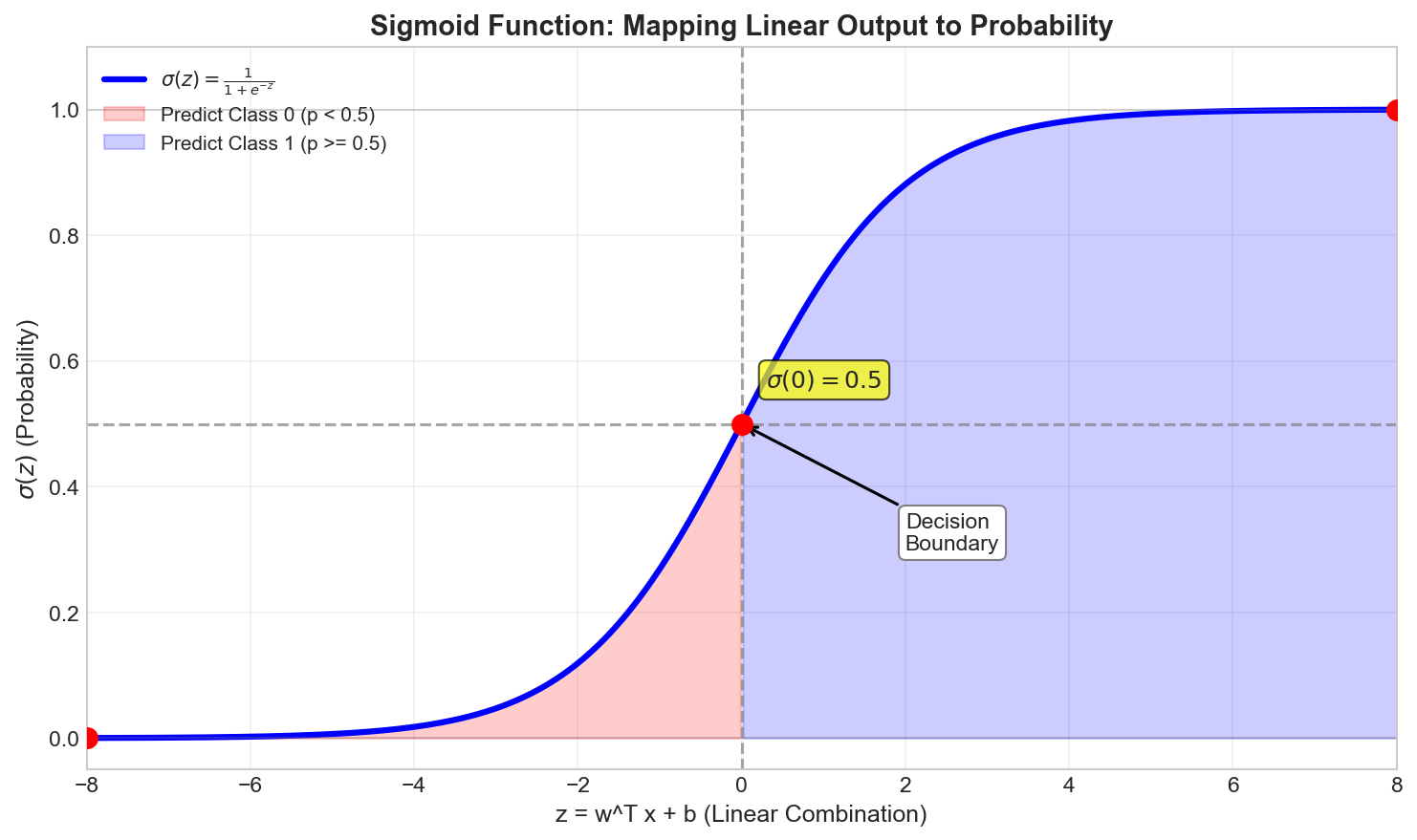
Sigmoid Function
The sigmoid function maps linear combinations to probabilities in [0, 1]:
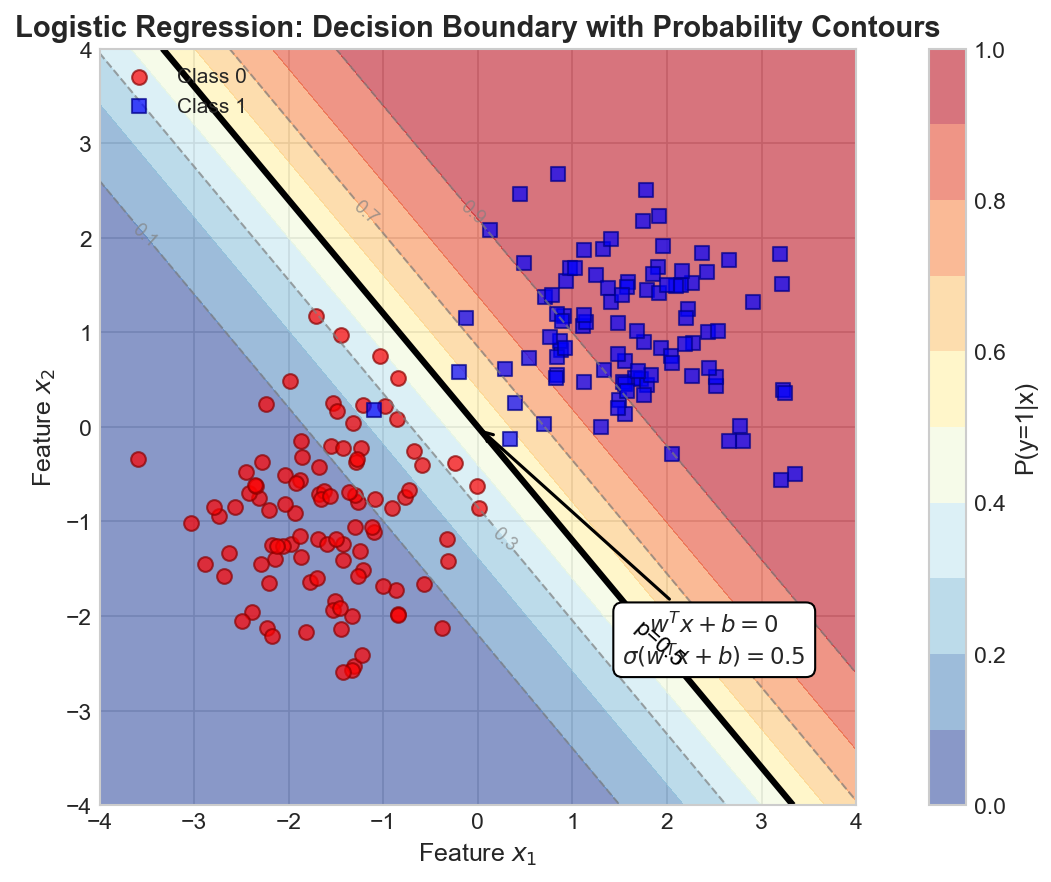
Decision Boundary
The decision boundary separates classes where P(y=1) = 0.5:
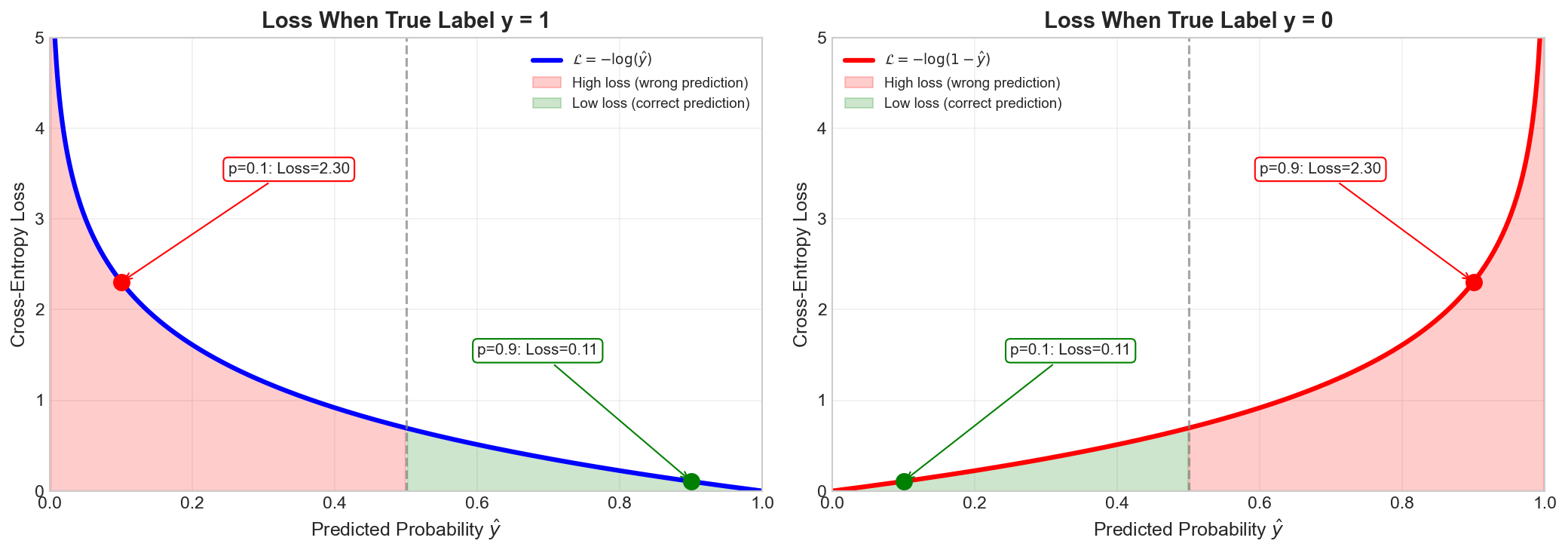
Binary Cross-Entropy Loss
The loss function penalizes confident wrong predictions heavily:
Gradients:
Implementation
from typing import List, Tuple
import math

class BinaryLogisticRegression:
    """Binary Logistic Regression with gradient descent."""

    def __init__(self, learning_rate: float = 0.01, n_iterations: int = 1000,
                 regularization: float = 0.0):
        self.lr = learning_rate
        self.n_iterations = n_iterations
        self.reg = regularization  # L2 regularization strength
        self.weights: List[float] = []
        self.bias: float = 0.0
        self.losses: List[float] = []

    def _sigmoid(self, z: float) -> float:
        """Numerically stable sigmoid."""
        if z >= 0:
            return 1 / (1 + math.exp(-z))
        else:
            exp_z = math.exp(z)
            return exp_z / (1 + exp_z)

    def _compute_z(self, x: List[float]) -> float:
        """Compute linear combination."""
        return sum(w * xi for w, xi in zip(self.weights, x)) + self.bias

    def _predict_proba_single(self, x: List[float]) -> float:
        """Predict probability for single sample."""
        z = self._compute_z(x)
        return self._sigmoid(z)

    def fit(self, X: List[List[float]], y: List[int]) -> 'BinaryLogisticRegression':
        """Train model using gradient descent."""
        n_samples = len(X)
        n_features = len(X[0])

        # Initialize weights
        self.weights = [0.0] * n_features
        self.bias = 0.0
        self.losses = []

        for iteration in range(self.n_iterations):
            # Forward pass
            y_pred = [self._predict_proba_single(x) for x in X]

            # Compute loss
            loss = 0.0
            for i in range(n_samples):
                # Clip predictions for numerical stability
                p = max(min(y_pred[i], 1 - 1e-15), 1e-15)
                loss -= y[i] * math.log(p) + (1 - y[i]) * math.log(1 - p)
            loss /= n_samples

            # Add L2 regularization
            if self.reg > 0:
                loss += (self.reg / 2) * sum(w**2 for w in self.weights)
            self.losses.append(loss)

            # Compute gradients
            errors = [y_pred[i] - y[i] for i in range(n_samples)]

            dw = [0.0] * n_features
            for j in range(n_features):
                for i in range(n_samples):
                    dw[j] += errors[i] * X[i][j]
                dw[j] = dw[j] / n_samples + self.reg * self.weights[j]

            db = sum(errors) / n_samples

            # Update parameters
            for j in range(n_features):
                self.weights[j] -= self.lr * dw[j]
            self.bias -= self.lr * db

        return self

    def predict_proba(self, X: List[List[float]]) -> List[float]:
        """Predict probabilities."""
        return [self._predict_proba_single(x) for x in X]

    def predict(self, X: List[List[float]], threshold: float = 0.5) -> List[int]:
        """Predict class labels."""
        probs = self.predict_proba(X)
return [1 if p >= threshold else 0 for p in probs]import numpy as np
class BinaryLogisticRegression:
"""Binary Logistic Regression with gradient descent."""
def __init__(self, learning_rate: float = 0.01, n_iterations: int = 1000,
regularization: float = 0.0):
self.lr = learning_rate
self.n_iterations = n_iterations
self.reg = regularization # L2 regularization strength
self.weights = None
self.bias = 0.0
self.losses = []
def _sigmoid(self, z):
"""Numerically stable sigmoid."""
return np.where(z >= 0,
1 / (1 + np.exp(-z)),
np.exp(z) / (1 + np.exp(z)))
def fit(self, X, y):
"""
Train model using gradient descent.
Args:
X: Training features, shape (n_samples, n_features)
y: Training labels, shape (n_samples,)
"""
n_samples, n_features = X.shape
# Initialize weights
self.weights = np.zeros(n_features)
self.bias = 0.0
self.losses = []
for iteration in range(self.n_iterations):
# Forward pass: z = Xw + b
z = np.dot(X, self.weights) + self.bias
y_pred = self._sigmoid(z)
# Compute binary cross-entropy loss
# Clip predictions for numerical stability
y_pred_clipped = np.clip(y_pred, 1e-15, 1 - 1e-15)
loss = -np.mean(y * np.log(y_pred_clipped) +
(1 - y) * np.log(1 - y_pred_clipped))
# Add L2 regularization
if self.reg > 0:
loss += (self.reg / 2) * np.sum(self.weights ** 2)
self.losses.append(loss)
# Compute gradients
errors = y_pred - y # Shape: (n_samples,)
dw = (1 / n_samples) * np.dot(X.T, errors) + self.reg * self.weights
db = (1 / n_samples) * np.sum(errors)
# Update parameters
self.weights -= self.lr * dw
self.bias -= self.lr * db
return self
def predict_proba(self, X):
"""Predict probabilities, shape (n_samples,)."""
z = np.dot(X, self.weights) + self.bias
return self._sigmoid(z)
def predict(self, X, threshold=0.5):
"""Predict class labels."""
return (self.predict_proba(X) >= threshold).astype(int)2. Logistic Regression as Regressor (Binning)
When you need to use logistic regression for continuous output prediction, bin the target into classes.
Binning Strategy Visualization
Implementation
from typing import List, Tuple
import math

class LogisticRegressor:
    """Use logistic regression for continuous output via binning."""

    def __init__(self, n_bins: int = 10, learning_rate: float = 0.01,
                 n_iterations: int = 1000):
        self.n_bins = n_bins
        self.lr = learning_rate
        self.n_iterations = n_iterations
        self.bin_edges: List[float] = []
        self.bin_centers: List[float] = []
        self.classifier = None  # Will hold softmax classifier

    def _create_bins(self, y: List[float]) -> Tuple[List[float], List[float]]:
        """Create equal-width bins from target values."""
        y_min, y_max = min(y), max(y)
        width = (y_max - y_min) / self.n_bins

        edges = [y_min + i * width for i in range(self.n_bins + 1)]
        centers = [(edges[i] + edges[i+1]) / 2 for i in range(self.n_bins)]

        return edges, centers

    def _assign_bins(self, y: List[float]) -> List[int]:
        """Assign continuous values to bin indices."""
        bins = []
        for val in y:
            for i in range(self.n_bins):
                if val <= self.bin_edges[i + 1]:
                    bins.append(i)
                    break
            else:
                bins.append(self.n_bins - 1)  # Edge case: val == max
        return bins

    def _softmax(self, logits: List[List[float]]) -> List[List[float]]:
        """Compute softmax probabilities."""
        probs = []
        for row in logits:
            max_val = max(row)
            exp_row = [math.exp(x - max_val) for x in row]
            sum_exp = sum(exp_row)
            probs.append([e / sum_exp for e in exp_row])
        return probs

    def fit(self, X: List[List[float]], y: List[float]) -> 'LogisticRegressor':
        """Fit by converting to classification problem."""
        # Create bins
        self.bin_edges, self.bin_centers = self._create_bins(y)

        # Convert continuous y to bin labels
        y_binned = self._assign_bins(y)

        # Train softmax classifier (simplified implementation)
        n_samples = len(X)
        n_features = len(X[0])

        # Initialize weights for each class
        self.weights = [[0.0] * n_features for _ in range(self.n_bins)]
        self.biases = [0.0] * self.n_bins

        for _ in range(self.n_iterations):
            # Compute logits
            logits = []
            for x in X:
                row = []
                for k in range(self.n_bins):
                    z = sum(w * xi for w, xi in zip(self.weights[k], x)) + self.biases[k]
                    row.append(z)
                logits.append(row)

            # Softmax
            probs = self._softmax(logits)

            # Gradient descent
            for k in range(self.n_bins):
                dw = [0.0] * n_features
                db = 0.0
                for i in range(n_samples):
                    error = probs[i][k] - (1 if y_binned[i] == k else 0)
                    for j in range(n_features):
                        dw[j] += error * X[i][j]
                    db += error

                for j in range(n_features):
                    self.weights[k][j] -= self.lr * dw[j] / n_samples
                self.biases[k] -= self.lr * db / n_samples

        return self

    def predict(self, X: List[List[float]]) -> List[float]:
        """Predict continuous values using expected value."""
        # Compute logits
        logits = []
        for x in X:
            row = []
            for k in range(self.n_bins):
                z = sum(w * xi for w, xi in zip(self.weights[k], x)) + self.biases[k]
                row.append(z)
            logits.append(row)

        # Softmax
        probs = self._softmax(logits)

        # Expected value: sum(prob * bin_center)
        predictions = []
        for prob_row in probs:
            expected = sum(p * c for p, c in zip(prob_row, self.bin_centers))
            predictions.append(expected)

return predictionsimport numpy as np
class LogisticRegressor:
"""Use logistic regression for continuous output via binning."""
def __init__(self, n_bins: int = 10, learning_rate: float = 0.01,
n_iterations: int = 1000):
self.n_bins = n_bins
self.lr = learning_rate
self.n_iterations = n_iterations
self.bin_edges = None
self.bin_centers = None
self.weights = None
self.biases = None
def _create_bins(self, y):
"""Create equal-width bins from target values."""
y_min, y_max = y.min(), y.max()
edges = np.linspace(y_min, y_max, self.n_bins + 1)
centers = (edges[:-1] + edges[1:]) / 2
return edges, centers
def _assign_bins(self, y):
"""Assign continuous values to bin indices."""
# np.digitize returns 1-indexed, adjust to 0-indexed
bins = np.digitize(y, self.bin_edges[1:-1])
return np.clip(bins, 0, self.n_bins - 1)
def _softmax(self, logits):
"""Compute softmax probabilities."""
# Subtract max for numerical stability
exp_logits = np.exp(logits - np.max(logits, axis=1, keepdims=True))
return exp_logits / np.sum(exp_logits, axis=1, keepdims=True)
def fit(self, X, y):
"""
Fit by converting to classification problem.
Args:
X: Features, shape (n_samples, n_features)
y: Continuous target, shape (n_samples,)
"""
n_samples, n_features = X.shape
# Create bins
self.bin_edges, self.bin_centers = self._create_bins(y)
# Convert continuous y to bin labels
y_binned = self._assign_bins(y)
# One-hot encode labels
y_onehot = np.eye(self.n_bins)[y_binned]
# Initialize weights
self.weights = np.zeros((n_features, self.n_bins))
self.biases = np.zeros(self.n_bins)
for _ in range(self.n_iterations):
# Forward pass
logits = np.dot(X, self.weights) + self.biases
probs = self._softmax(logits)
# Gradients
errors = probs - y_onehot
dw = (1 / n_samples) * np.dot(X.T, errors)
db = (1 / n_samples) * np.sum(errors, axis=0)
# Update
self.weights -= self.lr * dw
self.biases -= self.lr * db
return self
def predict(self, X):
"""Predict continuous values using expected value."""
logits = np.dot(X, self.weights) + self.biases
probs = self._softmax(logits)
# Expected value: sum(prob * bin_center)
return np.dot(probs, self.bin_centers)
def predict_distribution(self, X):
"""Return full probability distribution over bins."""
logits = np.dot(X, self.weights) + self.biases
return self._softmax(logits)3. Multi-class: One-vs-Rest (OvR)
Train K binary classifiers, each distinguishing one class from all others.
OvR vs Softmax Comparison
Implementation
from typing import List, Dict
import math

class OneVsRestClassifier:
    """Multi-class classification using One-vs-Rest strategy."""

    def __init__(self, learning_rate: float = 0.01, n_iterations: int = 1000):
        self.lr = learning_rate
        self.n_iterations = n_iterations
        self.classifiers: Dict[int, dict] = {}  # class -> {weights, bias}
        self.classes: List[int] = []

    def _sigmoid(self, z: float) -> float:
        """Numerically stable sigmoid."""
        if z >= 0:
            return 1 / (1 + math.exp(-z))
        else:
            exp_z = math.exp(z)
            return exp_z / (1 + exp_z)

    def _train_binary(self, X: List[List[float]], y: List[int],
                      positive_class: int) -> dict:
        """Train binary classifier for one class vs rest."""
        n_samples = len(X)
        n_features = len(X[0])

        # Convert labels: 1 if positive_class, 0 otherwise
        y_binary = [1 if label == positive_class else 0 for label in y]

        weights = [0.0] * n_features
        bias = 0.0

        for _ in range(self.n_iterations):
            # Forward pass
            y_pred = []
            for x in X:
                z = sum(w * xi for w, xi in zip(weights, x)) + bias
                y_pred.append(self._sigmoid(z))

            # Gradients
            dw = [0.0] * n_features
            db = 0.0
            for i in range(n_samples):
                error = y_pred[i] - y_binary[i]
                for j in range(n_features):
                    dw[j] += error * X[i][j]
                db += error

            # Update
            for j in range(n_features):
                weights[j] -= self.lr * dw[j] / n_samples
            bias -= self.lr * db / n_samples

        return {'weights': weights, 'bias': bias}

    def fit(self, X: List[List[float]], y: List[int]) -> 'OneVsRestClassifier':
        """Train K binary classifiers."""
        self.classes = sorted(set(y))

        for cls in self.classes:
            self.classifiers[cls] = self._train_binary(X, y, cls)

        return self

    def predict_proba(self, X: List[List[float]]) -> List[Dict[int, float]]:
        """Predict probabilities for each class."""
        all_probs = []

        for x in X:
            probs = {}
            for cls, clf in self.classifiers.items():
                z = sum(w * xi for w, xi in zip(clf['weights'], x)) + clf['bias']
                probs[cls] = self._sigmoid(z)
            all_probs.append(probs)

        return all_probs

    def predict(self, X: List[List[float]]) -> List[int]:
        """Predict class with highest probability."""
        proba = self.predict_proba(X)
return [max(p, key=p.get) for p in proba]import numpy as np
class OneVsRestClassifier:
"""Multi-class classification using One-vs-Rest strategy."""
def __init__(self, learning_rate: float = 0.01, n_iterations: int = 1000):
self.lr = learning_rate
self.n_iterations = n_iterations
self.classifiers = {} # class -> {weights, bias}
self.classes = None
def _sigmoid(self, z):
"""Numerically stable sigmoid."""
return np.where(z >= 0,
1 / (1 + np.exp(-z)),
np.exp(z) / (1 + np.exp(z)))
def _train_binary(self, X, y, positive_class):
"""Train binary classifier for one class vs rest."""
n_samples, n_features = X.shape
# Convert labels: 1 if positive_class, 0 otherwise
y_binary = (y == positive_class).astype(float)
weights = np.zeros(n_features)
bias = 0.0
for _ in range(self.n_iterations):
# Forward pass
z = np.dot(X, weights) + bias
y_pred = self._sigmoid(z)
# Gradients
errors = y_pred - y_binary
dw = (1 / n_samples) * np.dot(X.T, errors)
db = (1 / n_samples) * np.sum(errors)
# Update
weights -= self.lr * dw
bias -= self.lr * db
return {'weights': weights, 'bias': bias}
def fit(self, X, y):
"""
Train K binary classifiers.
Args:
X: Features, shape (n_samples, n_features)
y: Labels, shape (n_samples,) with values 0 to K-1
"""
self.classes = np.unique(y)
for cls in self.classes:
self.classifiers[cls] = self._train_binary(X, y, cls)
return self
def predict_proba(self, X):
"""
Predict probabilities for each class.
Returns:
Shape (n_samples, n_classes) - note: may not sum to 1
"""
n_samples = X.shape[0]
n_classes = len(self.classes)
probs = np.zeros((n_samples, n_classes))
for i, cls in enumerate(self.classes):
clf = self.classifiers[cls]
z = np.dot(X, clf['weights']) + clf['bias']
probs[:, i] = self._sigmoid(z)
return probs
def predict(self, X):
"""Predict class with highest probability."""
probs = self.predict_proba(X)
return self.classes[np.argmax(probs, axis=1)]4. Multi-class: Softmax (Multinomial)
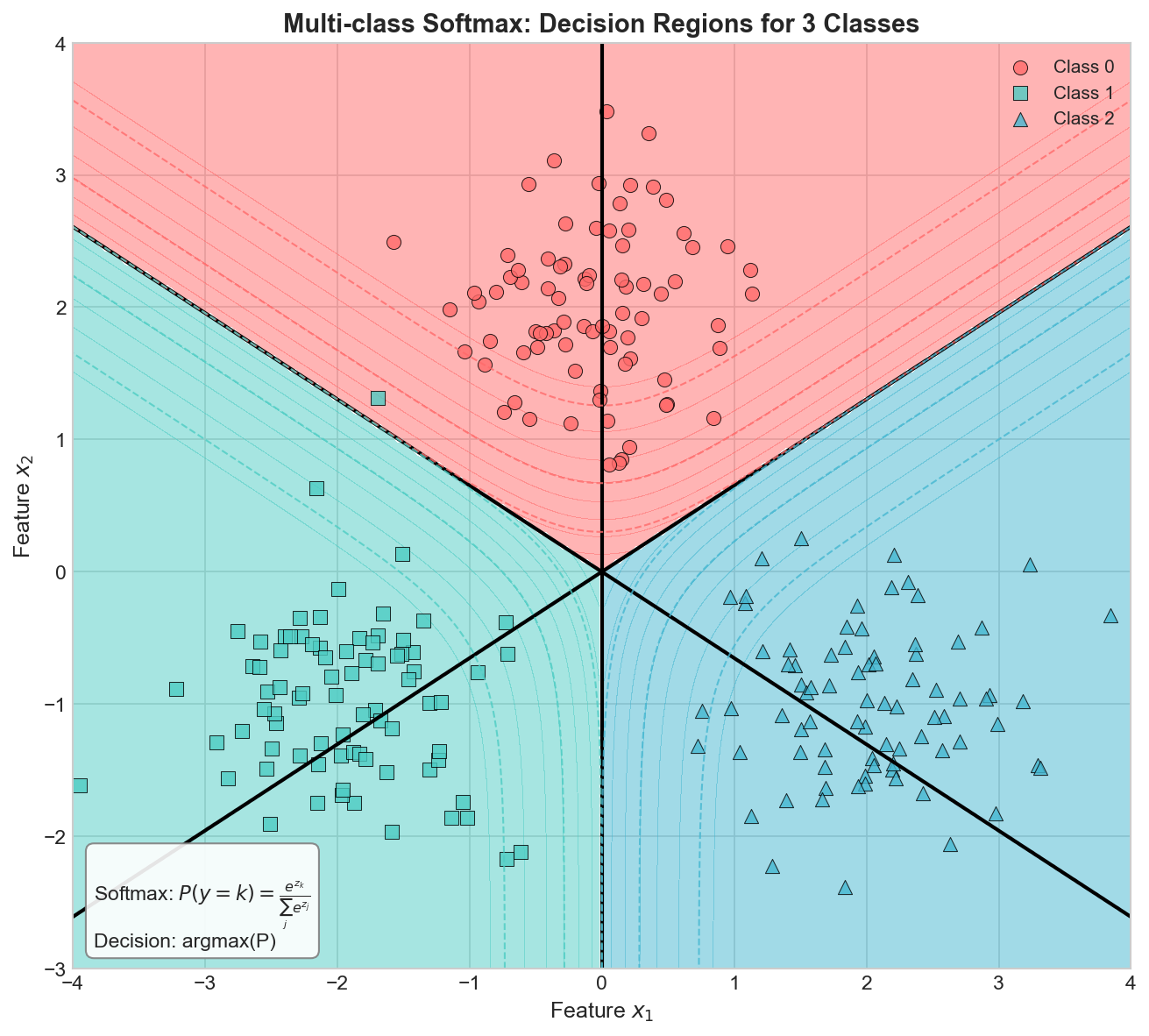
Single model with softmax activation for true multi-class probabilities.
Multi-class Decision Regions
Mathematical Foundation
Softmax:
Cross-Entropy Loss:
Training Pipeline
Implementation
from typing import List
import math

class SoftmaxClassifier:
    """Multi-class classification using Softmax/Multinomial regression."""

    def __init__(self, learning_rate: float = 0.01, n_iterations: int = 1000,
                 regularization: float = 0.0):
        self.lr = learning_rate
        self.n_iterations = n_iterations
        self.reg = regularization
        self.weights: List[List[float]] = []  # Shape: (n_features, n_classes)
        self.biases: List[float] = []
        self.n_classes = 0
        self.losses: List[float] = []

    def _softmax(self, logits: List[float]) -> List[float]:
        """Compute softmax for single sample."""
        max_val = max(logits)
        exp_logits = [math.exp(z - max_val) for z in logits]
        sum_exp = sum(exp_logits)
        return [e / sum_exp for e in exp_logits]

    def _softmax_batch(self, logits: List[List[float]]) -> List[List[float]]:
        """Compute softmax for batch."""
        return [self._softmax(row) for row in logits]

    def fit(self, X: List[List[float]], y: List[int]) -> 'SoftmaxClassifier':
        """Train using gradient descent."""
        n_samples = len(X)
        n_features = len(X[0])
        self.n_classes = max(y) + 1

        # Initialize weights
        self.weights = [[0.0] * self.n_classes for _ in range(n_features)]
        self.biases = [0.0] * self.n_classes
        self.losses = []

        # One-hot encode labels
        y_onehot = [[1.0 if j == y[i] else 0.0 for j in range(self.n_classes)]
                    for i in range(n_samples)]

        for iteration in range(self.n_iterations):
            # Forward pass
            logits = []
            for x in X:
                row = []
                for k in range(self.n_classes):
                    z = sum(self.weights[j][k] * x[j] for j in range(n_features))
                    z += self.biases[k]
                    row.append(z)
                logits.append(row)

            probs = self._softmax_batch(logits)

            # Compute cross-entropy loss
            loss = 0.0
            for i in range(n_samples):
                for k in range(self.n_classes):
                    if y_onehot[i][k] > 0:
                        loss -= math.log(max(probs[i][k], 1e-15))
            loss /= n_samples

            # Add L2 regularization
            if self.reg > 0:
                for j in range(n_features):
                    for k in range(self.n_classes):
                        loss += (self.reg / 2) * self.weights[j][k] ** 2
            self.losses.append(loss)

            # Compute gradients
            # dL/dW = X^T @ (probs - y_onehot) / n_samples
            errors = [[probs[i][k] - y_onehot[i][k]
                      for k in range(self.n_classes)]
                      for i in range(n_samples)]

            # Update weights
            for j in range(n_features):
                for k in range(self.n_classes):
                    grad = sum(errors[i][k] * X[i][j] for i in range(n_samples))
                    grad = grad / n_samples + self.reg * self.weights[j][k]
                    self.weights[j][k] -= self.lr * grad

            # Update biases
            for k in range(self.n_classes):
                grad = sum(errors[i][k] for i in range(n_samples)) / n_samples
                self.biases[k] -= self.lr * grad

        return self

    def predict_proba(self, X: List[List[float]]) -> List[List[float]]:
        """Predict probability distribution over classes."""
        n_features = len(X[0])
        logits = []

        for x in X:
            row = []
            for k in range(self.n_classes):
                z = sum(self.weights[j][k] * x[j] for j in range(n_features))
                z += self.biases[k]
                row.append(z)
            logits.append(row)

        return self._softmax_batch(logits)

    def predict(self, X: List[List[float]]) -> List[int]:
        """Predict class labels."""
        probs = self.predict_proba(X)
return [row.index(max(row)) for row in probs]import numpy as np
class SoftmaxClassifier:
"""Multi-class classification using Softmax/Multinomial regression."""
def __init__(self, learning_rate: float = 0.01, n_iterations: int = 1000,
regularization: float = 0.0):
self.lr = learning_rate
self.n_iterations = n_iterations
self.reg = regularization
self.weights = None # Shape: (n_features, n_classes)
self.biases = None # Shape: (n_classes,)
self.n_classes = 0
self.losses = []
def _softmax(self, logits):
"""Compute softmax probabilities."""
# Subtract max for numerical stability
exp_logits = np.exp(logits - np.max(logits, axis=1, keepdims=True))
return exp_logits / np.sum(exp_logits, axis=1, keepdims=True)
def fit(self, X, y):
"""
Train using gradient descent.
Args:
X: Features, shape (n_samples, n_features)
y: Labels, shape (n_samples,) with values 0 to K-1
"""
n_samples, n_features = X.shape
self.n_classes = len(np.unique(y))
# Initialize weights
self.weights = np.zeros((n_features, self.n_classes))
self.biases = np.zeros(self.n_classes)
self.losses = []
# One-hot encode labels
y_onehot = np.eye(self.n_classes)[y]
for iteration in range(self.n_iterations):
# Forward pass: logits = XW + b
logits = np.dot(X, self.weights) + self.biases
probs = self._softmax(logits)
# Compute cross-entropy loss
# Only count loss where y_onehot = 1
log_probs = np.log(np.clip(probs, 1e-15, 1.0))
loss = -np.mean(np.sum(y_onehot * log_probs, axis=1))
# Add L2 regularization
if self.reg > 0:
loss += (self.reg / 2) * np.sum(self.weights ** 2)
self.losses.append(loss)
# Compute gradients
errors = probs - y_onehot # Shape: (n_samples, n_classes)
dw = (1 / n_samples) * np.dot(X.T, errors) + self.reg * self.weights
db = (1 / n_samples) * np.sum(errors, axis=0)
# Update parameters
self.weights -= self.lr * dw
self.biases -= self.lr * db
return self
def predict_proba(self, X):
"""Predict probability distribution over classes."""
logits = np.dot(X, self.weights) + self.biases
return self._softmax(logits)
def predict(self, X):
"""Predict class labels."""
probs = self.predict_proba(X)
return np.argmax(probs, axis=1)5. Ordinal/Tiered Classification
For ordered classes (e.g., ratings 1-5, severity levels), use cumulative logits.
Mathematical Foundation
Proportional Odds Model:
Where
Individual class probabilities:
Implementation
from typing import List
import math

class OrdinalClassifier:
    """Ordinal regression using cumulative link model."""

    def __init__(self, learning_rate: float = 0.01, n_iterations: int = 1000):
        self.lr = learning_rate
        self.n_iterations = n_iterations
        self.weights: List[float] = []
        self.thresholds: List[float] = []  # K-1 thresholds for K classes
        self.n_classes = 0

    def _sigmoid(self, z: float) -> float:
        """Numerically stable sigmoid."""
        if z >= 0:
            return 1 / (1 + math.exp(-z))
        else:
            exp_z = math.exp(z)
            return exp_z / (1 + exp_z)

    def _cumulative_probs(self, x: List[float]) -> List[float]:
        """Compute P(y <= k) for each k."""
        # Linear combination (shared across all thresholds)
        linear = sum(w * xi for w, xi in zip(self.weights, x))

        cum_probs = []
        for threshold in self.thresholds:
            prob = self._sigmoid(threshold - linear)
            cum_probs.append(prob)
        cum_probs.append(1.0)  # P(y <= K-1) = 1

        return cum_probs

    def _class_probs(self, cum_probs: List[float]) -> List[float]:
        """Convert cumulative to class probabilities."""
        probs = [cum_probs[0]]  # P(y = 0) = P(y <= 0)
        for k in range(1, len(cum_probs)):
            prob = cum_probs[k] - cum_probs[k-1]
            probs.append(max(prob, 1e-15))  # Numerical stability
        return probs

    def fit(self, X: List[List[float]], y: List[int]) -> 'OrdinalClassifier':
        """Train ordinal classifier."""
        n_samples = len(X)
        n_features = len(X[0])
        self.n_classes = max(y) + 1

        # Initialize weights and thresholds
        self.weights = [0.0] * n_features
        # Initialize thresholds as evenly spaced
        self.thresholds = [float(i) for i in range(self.n_classes - 1)]

        for iteration in range(self.n_iterations):
            # Compute gradients
            dw = [0.0] * n_features
            dtheta = [0.0] * (self.n_classes - 1)

            for i in range(n_samples):
                cum_probs = self._cumulative_probs(X[i])
                class_probs = self._class_probs(cum_probs)

                linear = sum(w * xi for w, xi in zip(self.weights, X[i]))

                # Gradient computation using chain rule
                for k in range(self.n_classes - 1):
                    # P(y <= k) contribution
                    p_cum = cum_probs[k]

                    # Gradient of sigmoid
                    sigmoid_grad = p_cum * (1 - p_cum)

                    # Indicator for target class
                    if y[i] <= k:
                        factor = -1 / max(p_cum, 1e-15)
                    else:
                        factor = 1 / max(1 - p_cum, 1e-15)

                    grad = factor * sigmoid_grad

                    # Update threshold gradient
                    dtheta[k] += grad

                    # Update weight gradient (negative because of -w^Tx)
                    for j in range(n_features):
                        dw[j] -= grad * X[i][j]

            # Update parameters
            for j in range(n_features):
                self.weights[j] -= self.lr * dw[j] / n_samples

            for k in range(self.n_classes - 1):
                self.thresholds[k] -= self.lr * dtheta[k] / n_samples

            # Ensure thresholds remain ordered
            for k in range(1, self.n_classes - 1):
                if self.thresholds[k] <= self.thresholds[k-1]:
                    self.thresholds[k] = self.thresholds[k-1] + 0.01

        return self

    def predict_proba(self, X: List[List[float]]) -> List[List[float]]:
        """Predict probability distribution over ordered classes."""
        all_probs = []
        for x in X:
            cum_probs = self._cumulative_probs(x)
            class_probs = self._class_probs(cum_probs)
            all_probs.append(class_probs)
        return all_probs

    def predict(self, X: List[List[float]]) -> List[int]:
        """Predict class labels."""
        probs = self.predict_proba(X)
return [row.index(max(row)) for row in probs]import numpy as np
class OrdinalClassifier:
"""Ordinal regression using cumulative link model."""
def __init__(self, learning_rate: float = 0.01, n_iterations: int = 1000):
self.lr = learning_rate
self.n_iterations = n_iterations
self.weights = None
self.thresholds = None # K-1 thresholds for K classes
self.n_classes = 0
def _sigmoid(self, z):
"""Numerically stable sigmoid."""
return np.where(z >= 0,
1 / (1 + np.exp(-z)),
np.exp(z) / (1 + np.exp(z)))
def _cumulative_probs(self, X):
"""
Compute P(y <= k) for each k.
Returns:
Shape (n_samples, n_classes) where last column is all 1s
"""
n_samples = X.shape[0]
linear = np.dot(X, self.weights) # Shape: (n_samples,)
# Compute cumulative probabilities for each threshold
cum_probs = np.zeros((n_samples, self.n_classes))
for k, threshold in enumerate(self.thresholds):
cum_probs[:, k] = self._sigmoid(threshold - linear)
cum_probs[:, -1] = 1.0 # P(y <= K-1) = 1
return cum_probs
def _class_probs(self, cum_probs):
"""Convert cumulative to class probabilities."""
probs = np.zeros_like(cum_probs)
probs[:, 0] = cum_probs[:, 0]
probs[:, 1:] = cum_probs[:, 1:] - cum_probs[:, :-1]
return np.clip(probs, 1e-15, 1.0)
def fit(self, X, y):
"""
Train ordinal classifier.
Args:
X: Features, shape (n_samples, n_features)
y: Ordinal labels, shape (n_samples,) with values 0 to K-1
"""
n_samples, n_features = X.shape
self.n_classes = len(np.unique(y))
# Initialize weights and thresholds
self.weights = np.zeros(n_features)
self.thresholds = np.linspace(-1, 1, self.n_classes - 1)
for iteration in range(self.n_iterations):
cum_probs = self._cumulative_probs(X)
linear = np.dot(X, self.weights)
# Gradient computation
dw = np.zeros(n_features)
dtheta = np.zeros(self.n_classes - 1)
for k in range(self.n_classes - 1):
p_cum = cum_probs[:, k]
sigmoid_grad = p_cum * (1 - p_cum)
# Indicator for y <= k
indicator = (y <= k).astype(float)
# Gradient factor
factor = np.where(indicator == 1,
-1 / np.maximum(p_cum, 1e-15),
1 / np.maximum(1 - p_cum, 1e-15))
grad = factor * sigmoid_grad
# Accumulate gradients
dtheta[k] = np.sum(grad)
dw -= np.dot(X.T, grad)
# Update parameters
self.weights -= self.lr * dw / n_samples
self.thresholds -= self.lr * dtheta / n_samples
# Ensure thresholds remain ordered
self.thresholds = np.sort(self.thresholds)
return self
def predict_proba(self, X):
"""Predict probability distribution over ordered classes."""
cum_probs = self._cumulative_probs(X)
return self._class_probs(cum_probs)
def predict(self, X):
"""Predict class labels."""
probs = self.predict_proba(X)
return np.argmax(probs, axis=1)Comparison Table
| Variation | Use Case | Output | Probabilities |
|---|---|---|---|
| Binary | 2 classes | Single sigmoid | Sum to 1 (implicit) |
| OvR | Many classes, parallelizable | K binary scores | May not sum to 1 |
| Softmax | True multi-class probs | K-way softmax | Always sum to 1 |
| Ordinal | Ordered classes | Cumulative logits | Respects ordering |
| Regressor | Continuous target | Binned softmax | Expected value |
Complexity Analysis
| Operation | Time | Space |
|---|---|---|
| Binary forward | ||
| Binary gradient | ||
| Softmax forward | ||
| OvR training |
Where:
Interview Tips
When to Use Each Variation
| Scenario | Recommended Approach |
|---|---|
| Simple yes/no classification | Binary logistic regression |
| Multi-class with calibrated probabilities | Softmax/Multinomial |
| Multi-class, speed matters, can parallelize | One-vs-Rest |
| Ratings, severity levels, rankings | Ordinal regression |
| Need continuous output but have classification tools | Binning approach |
Key Points to Mention
Gradient:
X^T @ (y_pred - y_true)for both binary and softmax (elegant form from sigmoid/softmax properties)Numerical stability: Clip probabilities to avoid log(0), subtract max in softmax before exp()
OvR vs Softmax: OvR is parallelizable but probabilities may not sum to 1; Softmax gives true probabilities
Complete Test Suite
import numpy as np

def test_all_classifiers():
    """Test all logistic regression variations."""
    np.random.seed(42)

    # Generate synthetic data
    n_samples = 200
    n_features = 5
    n_classes = 3

    X = np.random.randn(n_samples, n_features)
    y = np.random.randint(0, n_classes, n_samples)

    # Split
    X_train, X_test = X[:150], X[150:]
    y_train, y_test = y[:150], y[150:]

    # Test 1: Binary Classifier
    y_binary_train = (y_train >= 1).astype(int)
    y_binary_test = (y_test >= 1).astype(int)

    binary_clf = BinaryLogisticRegression(learning_rate=0.1, n_iterations=500)
    binary_clf.fit(X_train, y_binary_train)
    binary_acc = np.mean(binary_clf.predict(X_test) == y_binary_test)
    print(f"Binary Accuracy: {binary_acc:.2%}")

    # Test 2: Softmax Classifier
    softmax_clf = SoftmaxClassifier(learning_rate=0.1, n_iterations=500)
    softmax_clf.fit(X_train, y_train)
    softmax_acc = np.mean(softmax_clf.predict(X_test) == y_test)
    print(f"Softmax Accuracy: {softmax_acc:.2%}")

    # Test 3: OvR Classifier
    ovr_clf = OneVsRestClassifier(learning_rate=0.1, n_iterations=500)
    ovr_clf.fit(X_train, y_train)
    ovr_acc = np.mean(ovr_clf.predict(X_test) == y_test)
    print(f"OvR Accuracy: {ovr_acc:.2%}")

    # Verify probabilities sum to 1 for softmax
    probs = softmax_clf.predict_proba(X_test)
    assert np.allclose(np.sum(probs, axis=1), 1.0), "Softmax probs should sum to 1"
    print("Softmax probabilities sum to 1: PASSED")

    print("\nAll tests passed!")

# Run tests
test_all_classifiers()Quick Reference
# Binary Logistic Regression
clf = BinaryLogisticRegression(learning_rate=0.01, n_iterations=1000)
clf.fit(X_train, y_train)
predictions = clf.predict(X_test)
probabilities = clf.predict_proba(X_test)

# Softmax Multi-class
clf = SoftmaxClassifier(learning_rate=0.01, n_iterations=1000)
clf.fit(X_train, y_train)  # y in {0, 1, ..., K-1}
predictions = clf.predict(X_test)
probs = clf.predict_proba(X_test)  # Shape: (n_samples, K)

# One-vs-Rest
clf = OneVsRestClassifier(learning_rate=0.01, n_iterations=1000)
clf.fit(X_train, y_train)
predictions = clf.predict(X_test)

# Ordinal Regression
clf = OrdinalClassifier(learning_rate=0.01, n_iterations=1000)
clf.fit(X_train, y_train)  # y is ordered: 0 < 1 < 2 < ...
predictions = clf.predict(X_test)

# Logistic as Regressor
reg = LogisticRegressor(n_bins=10, learning_rate=0.01)
reg.fit(X_train, y_continuous)
predictions = reg.predict(X_test)  # Continuous output