Implement K-Means Clustering
From-scratch implementation with initialization strategies and optimal K selection
Algorithm Overview
K-Means partitions data into k clusters by iteratively updating centroids (Lloyd's algorithm):
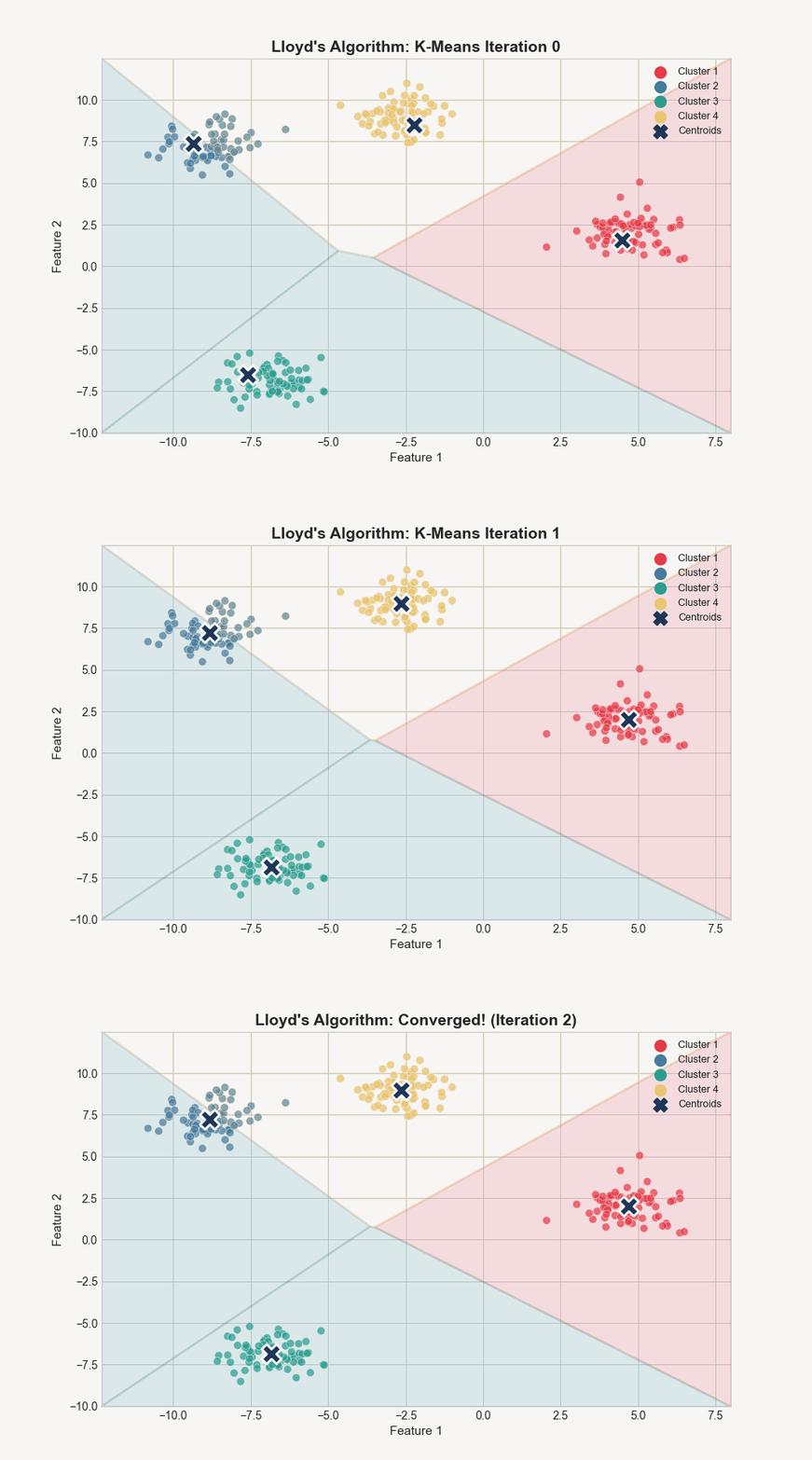
Key steps: Initialize centroids, assign points to nearest centroid, update centroids as cluster means, repeat until convergence.
Clarifying Questions to Ask
- Initialization method? (Random, K-means++, or provided?)
- Convergence criterion? (Max iterations, centroid movement threshold?)
- Empty clusters handling? (Reinitialize randomly)
- Return values? (Labels only, or centroids too?)
- Libraries allowed? (NumPy yes, sklearn no)
Solution: Basic K-Means
Step-by-Step Implementation
from typing import List, Tuple
import random
import math

def kmeans(X: List[List[float]], k: int, max_iters: int = 100,
           tolerance: float = 1e-6, random_state: int = None) -> Tuple[List[int], List[List[float]]]:
    """
    K-Means clustering algorithm.

    Args:
        X: Data points, list of feature vectors
        k: Number of clusters
        max_iters: Maximum iterations
        tolerance: Convergence threshold for centroid movement
        random_state: Random seed for reproducibility

    Returns:
        labels: Cluster assignment for each point
        centroids: Final centroid positions
    """
    if random_state is not None:
        random.seed(random_state)

    n_samples = len(X)
    n_features = len(X[0])

    # Step 1: Initialize centroids (random selection from data points)
    random_indices = random.sample(range(n_samples), k)
    centroids = [X[i][:] for i in random_indices]  # Deep copy

    for iteration in range(max_iters):
        # Step 2: Assign each point to nearest centroid
        labels = assign_clusters(X, centroids)

        # Step 3: Update centroids as mean of assigned points
        new_centroids = update_centroids(X, labels, k, n_features)

        # Step 4: Check for convergence
        centroid_shift = math.sqrt(sum(
            sum((new_centroids[i][j] - centroids[i][j]) ** 2
                for j in range(n_features))
            for i in range(k)
        ))

        if centroid_shift < tolerance:
            print(f"Converged at iteration {iteration}")
            break

        centroids = new_centroids

    return labels, centroids


def assign_clusters(X: List[List[float]], centroids: List[List[float]]) -> List[int]:
    """
    Assign each point to the nearest centroid.
    """
    labels = []
    for x in X:
        min_dist = float('inf')
        min_idx = 0
        for i, centroid in enumerate(centroids):
            dist = math.sqrt(sum((a - b) ** 2 for a, b in zip(x, centroid)))
            if dist < min_dist:
                min_dist = dist
                min_idx = i
        labels.append(min_idx)
    return labels


def update_centroids(X: List[List[float]], labels: List[int], k: int,
                     n_features: int) -> List[List[float]]:
    """
    Update centroids as mean of assigned points.
    """
    new_centroids = [[0.0] * n_features for _ in range(k)]
    counts = [0] * k

    for i, x in enumerate(X):
        cluster_idx = labels[i]
        counts[cluster_idx] += 1
        for j in range(n_features):
            new_centroids[cluster_idx][j] += x[j]

    for cluster_idx in range(k):
        if counts[cluster_idx] > 0:
            for j in range(n_features):
                new_centroids[cluster_idx][j] /= counts[cluster_idx]
        else:
            # Handle empty cluster: reinitialize randomly
            random_idx = random.randint(0, len(X) - 1)
            new_centroids[cluster_idx] = X[random_idx][:]

return new_centroidsimport numpy as np
def kmeans(X, k, max_iters=100, tolerance=1e-6, random_state=None):
"""
K-Means clustering algorithm.
Args:
X: Data points, shape (n_samples, n_features)
k: Number of clusters
max_iters: Maximum iterations
tolerance: Convergence threshold for centroid movement
random_state: Random seed for reproducibility
Returns:
labels: Cluster assignment for each point, shape (n_samples,)
centroids: Final centroid positions, shape (k, n_features)
"""
if random_state is not None:
np.random.seed(random_state)
n_samples, n_features = X.shape
# Step 1: Initialize centroids (random selection from data points)
random_indices = np.random.choice(n_samples, k, replace=False)
centroids = X[random_indices].copy()
for iteration in range(max_iters):
# Step 2: Assign each point to nearest centroid
labels = assign_clusters(X, centroids)
# Step 3: Update centroids as mean of assigned points
new_centroids = update_centroids(X, labels, k)
# Step 4: Check for convergence
centroid_shift = np.sqrt(np.sum((new_centroids - centroids) ** 2))
if centroid_shift < tolerance:
print(f"Converged at iteration {iteration}")
break
centroids = new_centroids
return labels, centroids
def assign_clusters(X, centroids):
"""
Assign each point to the nearest centroid.
Args:
X: Data points, shape (n_samples, n_features)
centroids: Current centroids, shape (k, n_features)
Returns:
labels: Cluster assignment for each point, shape (n_samples,)
"""
# Compute distance from each point to each centroid
# Using broadcasting: (n_samples, 1, n_features) - (k, n_features)
distances = np.sqrt(np.sum((X[:, np.newaxis, :] - centroids) ** 2, axis=2))
# distances shape: (n_samples, k)
# Assign to nearest centroid
labels = np.argmin(distances, axis=1)
return labels
def update_centroids(X, labels, k):
"""
Update centroids as mean of assigned points.
Args:
X: Data points, shape (n_samples, n_features)
labels: Current cluster assignments, shape (n_samples,)
k: Number of clusters
Returns:
new_centroids: Updated centroids, shape (k, n_features)
"""
n_features = X.shape[1]
new_centroids = np.zeros((k, n_features))
for cluster_idx in range(k):
# Get points assigned to this cluster
cluster_mask = labels == cluster_idx
cluster_points = X[cluster_mask]
if len(cluster_points) > 0:
# Centroid is mean of assigned points
new_centroids[cluster_idx] = np.mean(cluster_points, axis=0)
else:
# Handle empty cluster: reinitialize randomly
new_centroids[cluster_idx] = X[np.random.randint(len(X))]
return new_centroidsimport torch
from typing import Tuple
def kmeans(X: torch.Tensor, k: int, max_iters: int = 100,
tolerance: float = 1e-6, random_state: int = None) -> Tuple[torch.Tensor, torch.Tensor]:
"""
K-Means clustering algorithm.
Args:
X: Data points, shape (n_samples, n_features)
k: Number of clusters
max_iters: Maximum iterations
tolerance: Convergence threshold for centroid movement
random_state: Random seed for reproducibility
Returns:
labels: Cluster assignment for each point, shape (n_samples,)
centroids: Final centroid positions, shape (k, n_features)
"""
if random_state is not None:
torch.manual_seed(random_state)
n_samples, n_features = X.shape
# Step 1: Initialize centroids (random selection from data points)
random_indices = torch.randperm(n_samples)[:k]
centroids = X[random_indices].clone()
for iteration in range(max_iters):
# Step 2: Assign each point to nearest centroid
labels = assign_clusters(X, centroids)
# Step 3: Update centroids as mean of assigned points
new_centroids = update_centroids(X, labels, k, n_features)
# Step 4: Check for convergence
centroid_shift = torch.sqrt(torch.sum((new_centroids - centroids) ** 2))
if centroid_shift < tolerance:
print(f"Converged at iteration {iteration}")
break
centroids = new_centroids
return labels, centroids
def assign_clusters(X: torch.Tensor, centroids: torch.Tensor) -> torch.Tensor:
"""
Assign each point to the nearest centroid.
"""
# Compute distance from each point to each centroid
# Using broadcasting: (n_samples, 1, n_features) - (k, n_features)
distances = torch.sqrt(torch.sum((X.unsqueeze(1) - centroids) ** 2, dim=2))
# distances shape: (n_samples, k)
# Assign to nearest centroid
labels = torch.argmin(distances, dim=1)
return labels
def update_centroids(X: torch.Tensor, labels: torch.Tensor, k: int,
n_features: int) -> torch.Tensor:
"""
Update centroids as mean of assigned points.
"""
new_centroids = torch.zeros((k, n_features), dtype=X.dtype, device=X.device)
for cluster_idx in range(k):
# Get points assigned to this cluster
cluster_mask = labels == cluster_idx
cluster_points = X[cluster_mask]
if len(cluster_points) > 0:
# Centroid is mean of assigned points
new_centroids[cluster_idx] = torch.mean(cluster_points, dim=0)
else:
# Handle empty cluster: reinitialize randomly
random_idx = torch.randint(len(X), (1,)).item()
new_centroids[cluster_idx] = X[random_idx]
return new_centroidsVoronoi Decision Boundaries
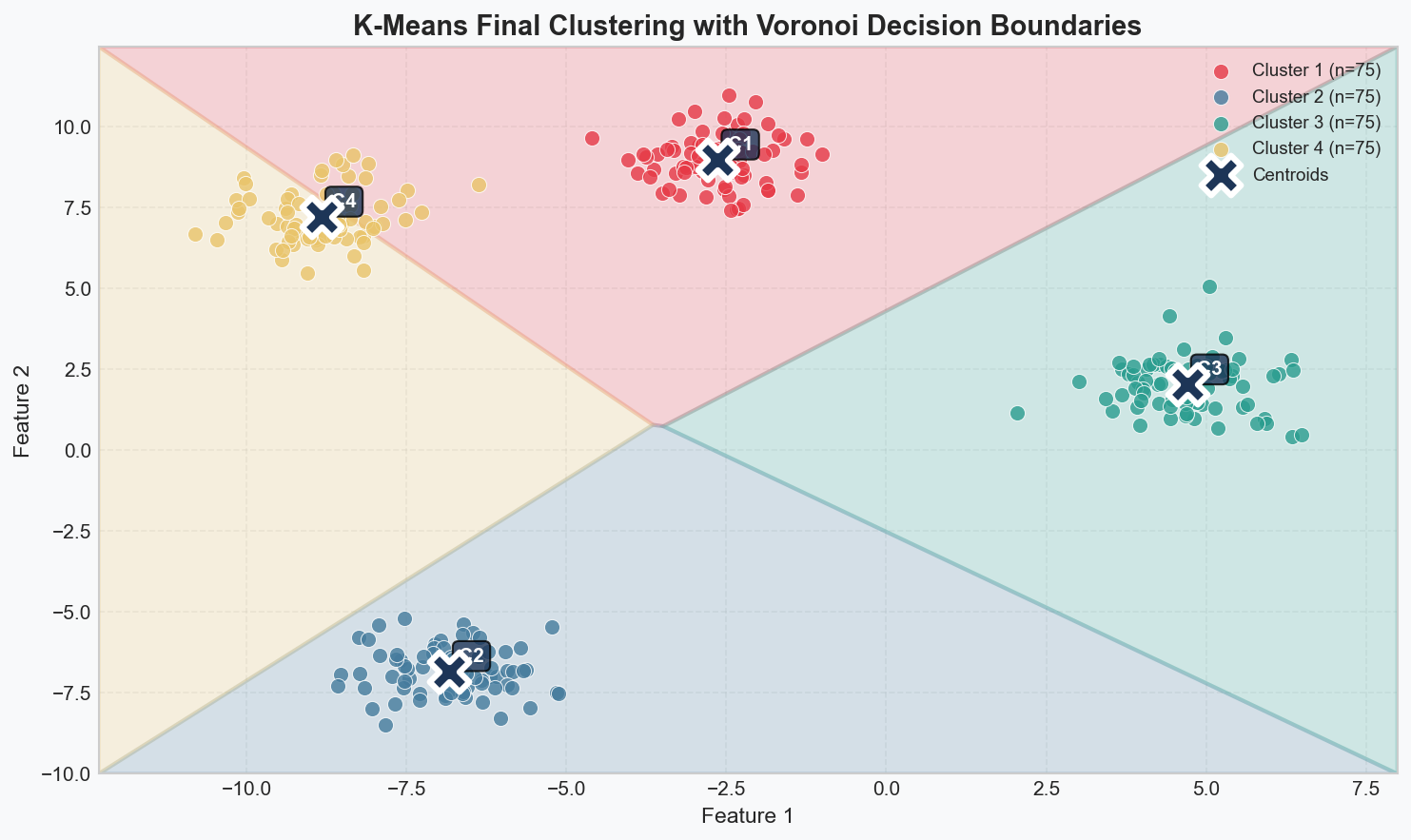
The final clustering creates Voronoi regions where each point belongs to its nearest centroid:
K-Means++ Initialization
K-Means++ selects spread-out centroids to avoid poor local minima:
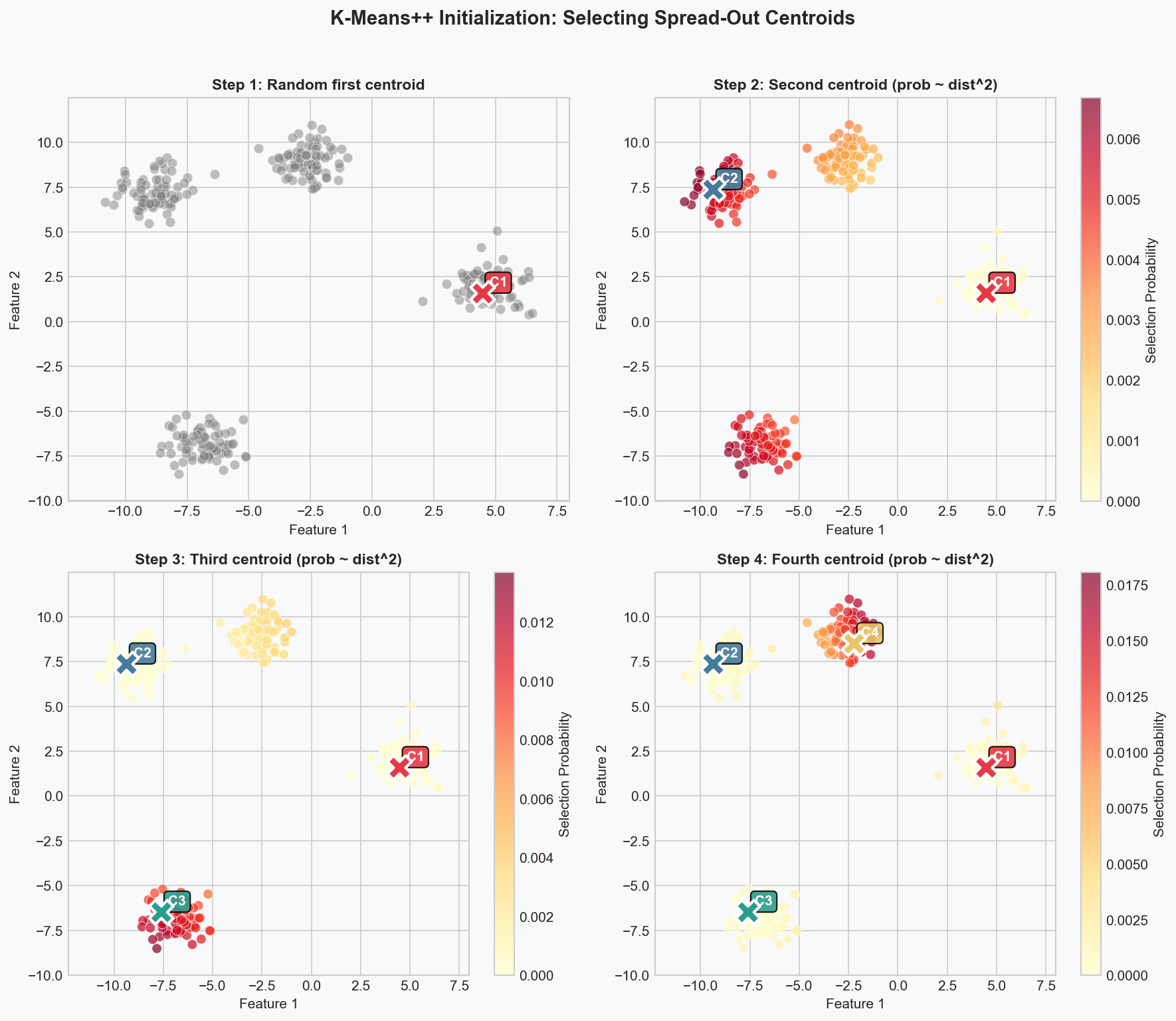
Algorithm: First centroid is random; subsequent centroids chosen with probability proportional to distance squared from existing centroids.
from typing import List
import random
import math

def kmeans_plusplus_init(X: List[List[float]], k: int,
                         random_state: int = None) -> List[List[float]]:
    """
    K-Means++ initialization: choose centroids spread apart.

    Algorithm:
    1. Choose first centroid randomly
    2. For each subsequent centroid:
       - Compute distance from each point to nearest existing centroid
       - Choose next centroid with probability proportional to distance squared
    """
    if random_state is not None:
        random.seed(random_state)

    n_samples = len(X)
    n_features = len(X[0])
    centroids = []

    # Step 1: Choose first centroid randomly
    first_idx = random.randint(0, n_samples - 1)
    centroids.append(X[first_idx][:])

    # Step 2: Choose remaining centroids
    for c in range(1, k):
        # Compute distance to nearest existing centroid
        distances = []
        for i in range(n_samples):
            min_dist = float('inf')
            for centroid in centroids:
                dist = math.sqrt(sum((X[i][j] - centroid[j]) ** 2
                                     for j in range(n_features)))
                min_dist = min(min_dist, dist)
            distances.append(min_dist)

        # Choose next centroid with probability proportional to distance squared
        probabilities = [d ** 2 for d in distances]
        total = sum(probabilities)
        probabilities = [p / total for p in probabilities]

        # Weighted random choice
        r = random.random()
        cumsum = 0
        for i, p in enumerate(probabilities):
            cumsum += p
            if r <= cumsum:
                centroids.append(X[i][:])
                break

    return centroids


def kmeans_plusplus(X: List[List[float]], k: int, max_iters: int = 100,
                    tolerance: float = 1e-6, random_state: int = None):
    """
    K-Means with K-Means++ initialization.
    """
    if random_state is not None:
        random.seed(random_state)

    n_features = len(X[0])

    # Initialize with K-Means++
    centroids = kmeans_plusplus_init(X, k, random_state)

    # Run standard K-Means iterations
    for iteration in range(max_iters):
        labels = assign_clusters(X, centroids)
        new_centroids = update_centroids(X, labels, k, n_features)

        centroid_shift = math.sqrt(sum(
            sum((new_centroids[i][j] - centroids[i][j]) ** 2
                for j in range(n_features))
            for i in range(k)
        ))
        if centroid_shift < tolerance:
            break

        centroids = new_centroids

return labels, centroidsimport numpy as np
def kmeans_plusplus_init(X, k, random_state=None):
"""
K-Means++ initialization: choose centroids spread apart.
Algorithm:
1. Choose first centroid randomly
2. For each subsequent centroid:
- Compute distance from each point to nearest existing centroid
- Choose next centroid with probability proportional to distance squared
"""
if random_state is not None:
np.random.seed(random_state)
n_samples, n_features = X.shape
centroids = np.zeros((k, n_features))
# Step 1: Choose first centroid randomly
first_idx = np.random.randint(n_samples)
centroids[0] = X[first_idx]
# Step 2: Choose remaining centroids
for c in range(1, k):
# Compute distance to nearest existing centroid
distances = np.zeros(n_samples)
for i in range(n_samples):
min_dist = np.inf
for j in range(c):
dist = np.sqrt(np.sum((X[i] - centroids[j]) ** 2))
min_dist = min(min_dist, dist)
distances[i] = min_dist
# Choose next centroid with probability proportional to distance squared
probabilities = distances ** 2
probabilities /= np.sum(probabilities)
next_idx = np.random.choice(n_samples, p=probabilities)
centroids[c] = X[next_idx]
return centroids
def kmeans_plusplus(X, k, max_iters=100, tolerance=1e-6, random_state=None):
"""
K-Means with K-Means++ initialization.
"""
if random_state is not None:
np.random.seed(random_state)
# Initialize with K-Means++
centroids = kmeans_plusplus_init(X, k, random_state)
# Run standard K-Means iterations
for iteration in range(max_iters):
labels = assign_clusters(X, centroids)
new_centroids = update_centroids(X, labels, k)
centroid_shift = np.sqrt(np.sum((new_centroids - centroids) ** 2))
if centroid_shift < tolerance:
break
centroids = new_centroids
return labels, centroidsimport torch
from typing import Tuple
def kmeans_plusplus_init(X: torch.Tensor, k: int,
random_state: int = None) -> torch.Tensor:
"""
K-Means++ initialization: choose centroids spread apart.
"""
if random_state is not None:
torch.manual_seed(random_state)
n_samples, n_features = X.shape
centroids = torch.zeros((k, n_features), dtype=X.dtype, device=X.device)
# Step 1: Choose first centroid randomly
first_idx = torch.randint(n_samples, (1,)).item()
centroids[0] = X[first_idx]
# Step 2: Choose remaining centroids
for c in range(1, k):
# Compute distance to nearest existing centroid
# Using broadcasting for efficiency
dists_to_centroids = torch.sqrt(
torch.sum((X.unsqueeze(1) - centroids[:c].unsqueeze(0)) ** 2, dim=2)
) # Shape: (n_samples, c)
distances = torch.min(dists_to_centroids, dim=1).values
# Choose next centroid with probability proportional to distance squared
probabilities = distances ** 2
probabilities = probabilities / torch.sum(probabilities)
next_idx = torch.multinomial(probabilities, 1).item()
centroids[c] = X[next_idx]
return centroids
def kmeans_plusplus(X: torch.Tensor, k: int, max_iters: int = 100,
tolerance: float = 1e-6, random_state: int = None) -> Tuple[torch.Tensor, torch.Tensor]:
"""
K-Means with K-Means++ initialization.
"""
if random_state is not None:
torch.manual_seed(random_state)
n_features = X.shape[1]
# Initialize with K-Means++
centroids = kmeans_plusplus_init(X, k, random_state)
# Run standard K-Means iterations
for iteration in range(max_iters):
labels = assign_clusters(X, centroids)
new_centroids = update_centroids(X, labels, k, n_features)
centroid_shift = torch.sqrt(torch.sum((new_centroids - centroids) ** 2))
if centroid_shift < tolerance:
break
centroids = new_centroids
return labels, centroidsRandom vs K-Means++ Comparison
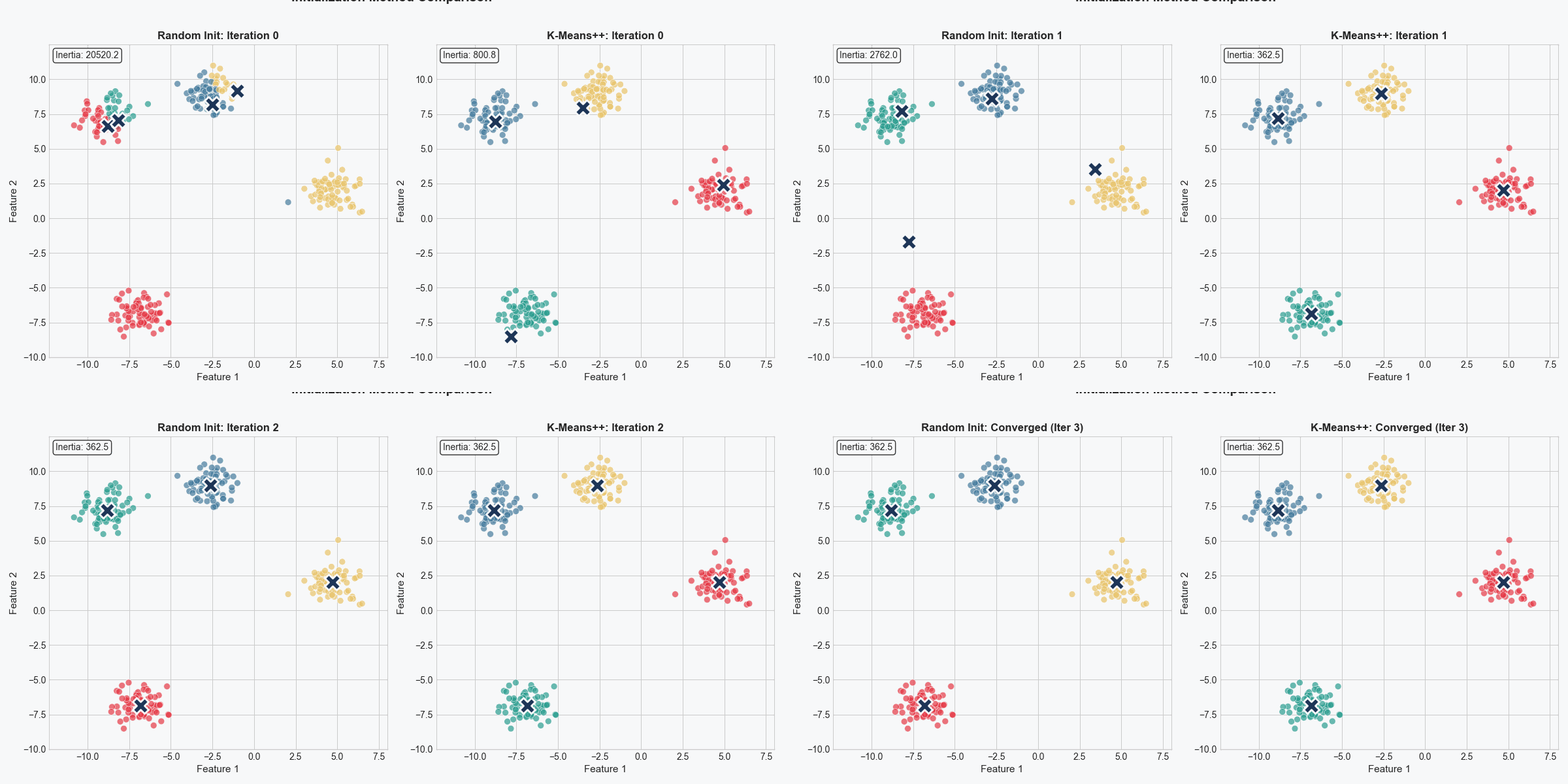
| Initialization | Time to Converge | Result Quality |
|---|---|---|
| Random | More iterations | Can get stuck in bad local minimum |
| K-Means++ | Fewer iterations | Better spread, usually better results |
Finding Optimal K: The Elbow Method
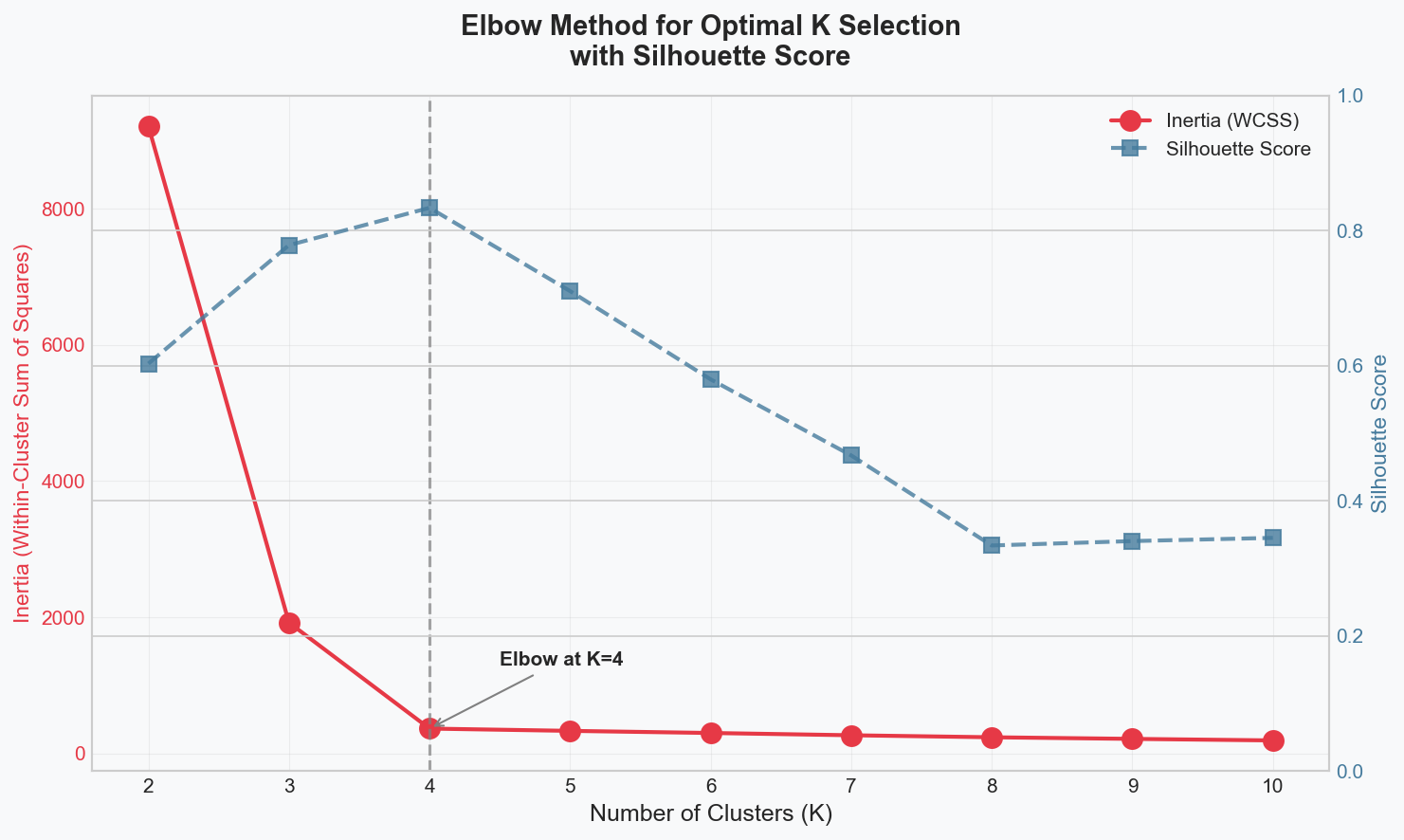
The elbow method plots inertia (within-cluster sum of squares) against K. The optimal K is at the "elbow" where additional clusters provide diminishing returns:
from typing import List, Tuple

def compute_inertia(X: List[List[float]], labels: List[int],
                    centroids: List[List[float]]) -> float:
    """
    Compute inertia (sum of squared distances to centroids).
    Also called "within-cluster sum of squares" (WCSS).
    """
    inertia = 0.0
    for i, x in enumerate(X):
        centroid = centroids[labels[i]]
        inertia += sum((a - b) ** 2 for a, b in zip(x, centroid))
    return inertia


def find_optimal_k(X: List[List[float]], k_range: range = range(1, 11),
                   random_state: int = None) -> Tuple[List[int], List[float]]:
    """
    Find optimal k using the elbow method.

    Returns:
        k_values: List of k values tested
        inertias: Corresponding inertia values
    """
    inertias = []

    for k in k_range:
        labels, centroids = kmeans(X, k, random_state=random_state)
        inertia = compute_inertia(X, labels, centroids)
        inertias.append(inertia)
        print(f"k={k}, Inertia={inertia:.2f}")

return list(k_range), inertiasimport numpy as np
def compute_inertia(X, labels, centroids):
"""
Compute inertia (sum of squared distances to centroids).
Also called "within-cluster sum of squares" (WCSS).
"""
inertia = 0
for i, x in enumerate(X):
centroid = centroids[labels[i]]
inertia += np.sum((x - centroid) ** 2)
return inertia
def find_optimal_k(X, k_range=range(1, 11), random_state=None):
"""
Find optimal k using the elbow method.
Returns:
k_values: List of k values tested
inertias: Corresponding inertia values
"""
inertias = []
for k in k_range:
labels, centroids = kmeans(X, k, random_state=random_state)
inertia = compute_inertia(X, labels, centroids)
inertias.append(inertia)
print(f"k={k}, Inertia={inertia:.2f}")
return list(k_range), inertias
def plot_elbow(k_values, inertias):
"""
Plot the elbow curve (would use matplotlib in practice).
"""
print("\nElbow Plot:")
print("k\tInertia\t\tPlot")
max_inertia = max(inertias)
for k, inertia in zip(k_values, inertias):
bar_len = int(50 * inertia / max_inertia)
print(f"{k}\t{inertia:.2f}\t\t{'#' * bar_len}")import torch
from typing import List, Tuple
def compute_inertia(X: torch.Tensor, labels: torch.Tensor,
centroids: torch.Tensor) -> float:
"""
Compute inertia (sum of squared distances to centroids).
Also called "within-cluster sum of squares" (WCSS).
"""
inertia = 0.0
for i in range(len(X)):
centroid = centroids[labels[i]]
inertia += torch.sum((X[i] - centroid) ** 2).item()
return inertia
def find_optimal_k(X: torch.Tensor, k_range: range = range(1, 11),
random_state: int = None) -> Tuple[List[int], List[float]]:
"""
Find optimal k using the elbow method.
Returns:
k_values: List of k values tested
inertias: Corresponding inertia values
"""
inertias = []
for k in k_range:
labels, centroids = kmeans(X, k, random_state=random_state)
inertia = compute_inertia(X, labels, centroids)
inertias.append(inertia)
print(f"k={k}, Inertia={inertia:.2f}")
return list(k_range), inertiasFinding the Elbow Programmatically
def find_elbow_point(k_values, inertias):
    """
    Find the elbow point using the maximum curvature method.

    The elbow is where adding more clusters doesn't significantly reduce inertia.
    """
    # Compute second derivative (rate of change of slope)
    # Elbow is where second derivative is maximum

    if len(k_values) < 3:
        return k_values[0]

    # Compute differences
    first_diff = np.diff(inertias)
    second_diff = np.diff(first_diff)

    # Elbow is at maximum second derivative
    # (where rate of decrease slows the most)
    elbow_idx = np.argmax(second_diff) + 1  # +1 because diff reduces length

return k_values[elbow_idx]Silhouette Score for K Selection
Silhouette score measures how well-separated clusters are. For each point: s(i) = (b(i) - a(i)) / max(a(i), b(i)) where a(i) is average intra-cluster distance and b(i) is average nearest-cluster distance.
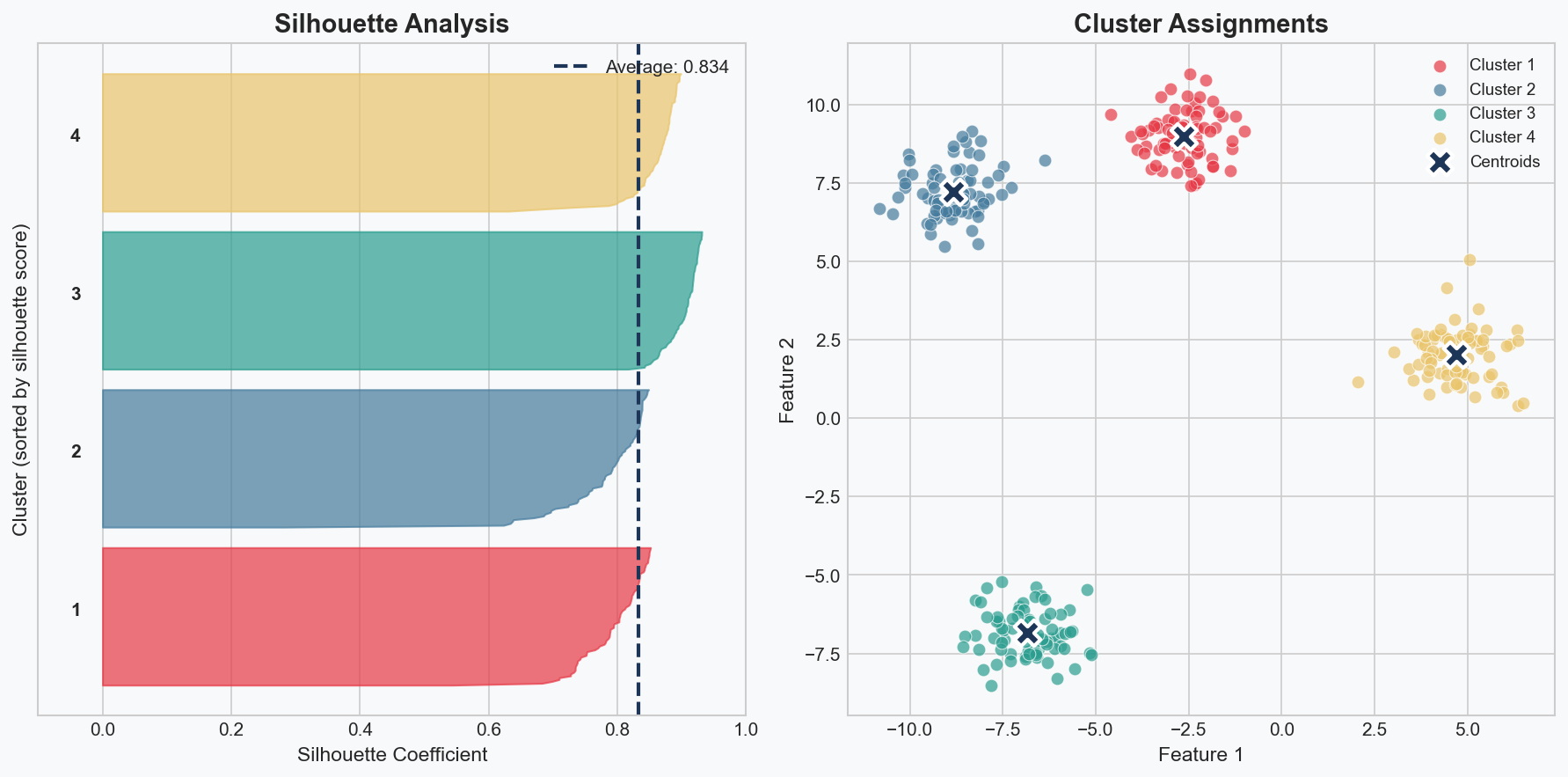
Score range: [-1, 1], higher is better. The visualization shows per-sample silhouette coefficients grouped by cluster.
from typing import List, Tuple
import math

def compute_silhouette_score(X: List[List[float]], labels: List[int]) -> float:
    """
    Compute silhouette score for clustering quality.

    For each point i:
    - a(i) = average distance to points in same cluster
    - b(i) = average distance to points in nearest other cluster
    - s(i) = (b(i) - a(i)) / max(a(i), b(i))

    Score range: [-1, 1], higher is better
    """
    n_samples = len(X)
    unique_labels = list(set(labels))
    n_clusters = len(unique_labels)

    if n_clusters == 1:
        return 0  # Can't compute silhouette with single cluster

    silhouette_scores = []

    for i in range(n_samples):
        # a(i): average distance to same-cluster points
        same_cluster_dists = []
        for j in range(n_samples):
            if j != i and labels[j] == labels[i]:
                dist = math.sqrt(sum((X[i][d] - X[j][d]) ** 2
                                     for d in range(len(X[0]))))
                same_cluster_dists.append(dist)

        a_i = sum(same_cluster_dists) / len(same_cluster_dists) if same_cluster_dists else 0

        # b(i): minimum average distance to other clusters
        b_i = float('inf')
        for cluster_label in unique_labels:
            if cluster_label != labels[i]:
                other_cluster_dists = []
                for j in range(n_samples):
                    if labels[j] == cluster_label:
                        dist = math.sqrt(sum((X[i][d] - X[j][d]) ** 2
                                             for d in range(len(X[0]))))
                        other_cluster_dists.append(dist)
                if other_cluster_dists:
                    avg_dist = sum(other_cluster_dists) / len(other_cluster_dists)
                    b_i = min(b_i, avg_dist)

        # Silhouette score for point i
        if max(a_i, b_i) > 0:
            silhouette_scores.append((b_i - a_i) / max(a_i, b_i))
        else:
            silhouette_scores.append(0)

return sum(silhouette_scores) / len(silhouette_scores)import numpy as np
def compute_silhouette_score(X, labels):
"""
Compute silhouette score for clustering quality.
For each point i:
- a(i) = average distance to points in same cluster
- b(i) = average distance to points in nearest other cluster
- s(i) = (b(i) - a(i)) / max(a(i), b(i))
Score range: [-1, 1], higher is better
"""
n_samples = len(X)
unique_labels = np.unique(labels)
n_clusters = len(unique_labels)
if n_clusters == 1:
return 0 # Can't compute silhouette with single cluster
silhouette_scores = np.zeros(n_samples)
for i in range(n_samples):
# a(i): average distance to same-cluster points
same_cluster = labels == labels[i]
same_cluster[i] = False # Exclude self
if np.sum(same_cluster) > 0:
a_i = np.mean(np.sqrt(np.sum((X[same_cluster] - X[i]) ** 2, axis=1)))
else:
a_i = 0
# b(i): minimum average distance to other clusters
b_i = np.inf
for cluster_label in unique_labels:
if cluster_label != labels[i]:
other_cluster = labels == cluster_label
if np.sum(other_cluster) > 0:
avg_dist = np.mean(np.sqrt(np.sum((X[other_cluster] - X[i]) ** 2, axis=1)))
b_i = min(b_i, avg_dist)
# Silhouette score for point i
if max(a_i, b_i) > 0:
silhouette_scores[i] = (b_i - a_i) / max(a_i, b_i)
else:
silhouette_scores[i] = 0
return np.mean(silhouette_scores)
def find_optimal_k_silhouette(X, k_range=range(2, 11), random_state=None):
"""
Find optimal k using silhouette score (higher is better).
"""
scores = []
for k in k_range:
labels, centroids = kmeans(X, k, random_state=random_state)
score = compute_silhouette_score(X, labels)
scores.append(score)
print(f"k={k}, Silhouette={score:.4f}")
best_k = k_range[np.argmax(scores)]
print(f"\nBest k by silhouette score: {best_k}")
return best_k, list(k_range), scoresimport torch
def compute_silhouette_score(X: torch.Tensor, labels: torch.Tensor) -> float:
"""
Compute silhouette score for clustering quality.
"""
n_samples = len(X)
unique_labels = torch.unique(labels)
n_clusters = len(unique_labels)
if n_clusters == 1:
return 0 # Can't compute silhouette with single cluster
silhouette_scores = torch.zeros(n_samples)
for i in range(n_samples):
# a(i): average distance to same-cluster points
same_cluster = labels == labels[i]
same_cluster[i] = False # Exclude self
if torch.sum(same_cluster) > 0:
a_i = torch.mean(torch.sqrt(torch.sum((X[same_cluster] - X[i]) ** 2, dim=1)))
else:
a_i = 0
# b(i): minimum average distance to other clusters
b_i = float('inf')
for cluster_label in unique_labels:
if cluster_label != labels[i]:
other_cluster = labels == cluster_label
if torch.sum(other_cluster) > 0:
avg_dist = torch.mean(torch.sqrt(torch.sum((X[other_cluster] - X[i]) ** 2, dim=1)))
b_i = min(b_i, avg_dist.item())
# Silhouette score for point i
a_i_val = a_i.item() if torch.is_tensor(a_i) else a_i
if max(a_i_val, b_i) > 0:
silhouette_scores[i] = (b_i - a_i_val) / max(a_i_val, b_i)
else:
silhouette_scores[i] = 0
return torch.mean(silhouette_scores).item()Complexity Analysis
| Operation | Time Complexity | Space Complexity |
|---|---|---|
| One iteration | O(n * k * d) | O(n + k * d) |
| Full algorithm (i iterations) | O(i * n * k * d) | O(n + k * d) |
| K-Means++ init | O(n * k * d) | O(k * d) |
| Silhouette score | O(n^2 * d) | O(n) |
Where:
- n = number of samples
- k = number of clusters
- d = number of features
- i = number of iterations
Edge Cases and Robustness
from typing import List, Tuple
import random

def kmeans_robust(X: List[List[float]], k: int, max_iters: int = 100,
                  n_init: int = 10, random_state: int = None) -> Tuple[List[int], List[List[float]], float]:
    """
    Robust K-Means with multiple random initializations.

    Runs K-Means n_init times and returns the best result (lowest inertia).
    """
    best_labels = None
    best_centroids = None
    best_inertia = float('inf')

    for init in range(n_init):
        seed = random_state + init if random_state is not None else None
        labels, centroids = kmeans(X, k, max_iters, random_state=seed)
        inertia = compute_inertia(X, labels, centroids)

        if inertia < best_inertia:
            best_inertia = inertia
            best_labels = labels
            best_centroids = centroids

return best_labels, best_centroids, best_inertiaimport numpy as np
def kmeans_robust(X, k, max_iters=100, n_init=10, random_state=None):
"""
Robust K-Means with multiple random initializations.
Runs K-Means n_init times and returns the best result (lowest inertia).
"""
best_labels = None
best_centroids = None
best_inertia = np.inf
for init in range(n_init):
seed = random_state + init if random_state is not None else None
labels, centroids = kmeans(X, k, max_iters, random_state=seed)
inertia = compute_inertia(X, labels, centroids)
if inertia < best_inertia:
best_inertia = inertia
best_labels = labels
best_centroids = centroids
return best_labels, best_centroids, best_inertiaimport torch
from typing import Tuple, List
def kmeans_robust(X: torch.Tensor, k: int, max_iters: int = 100,
n_init: int = 10, random_state: int = None) -> Tuple[torch.Tensor, torch.Tensor, float]:
"""
Robust K-Means with multiple random initializations.
Runs K-Means n_init times and returns the best result (lowest inertia).
"""
best_labels = None
best_centroids = None
best_inertia = float('inf')
for init in range(n_init):
seed = random_state + init if random_state is not None else None
labels, centroids = kmeans(X, k, max_iters, random_state=seed)
inertia = compute_inertia(X, labels, centroids)
if inertia < best_inertia:
best_inertia = inertia
best_labels = labels
best_centroids = centroids
return best_labels, best_centroids, best_inertiaHandling Edge Cases
def kmeans_with_checks(X, k, max_iters=100):
    """K-Means with comprehensive edge case handling."""

    # Check 1: Valid k
    if k <= 0:
        raise ValueError("k must be positive")
    if k > len(X):
        raise ValueError(f"k={k} exceeds number of samples={len(X)}")

    # Check 2: Non-empty input
    if len(X) == 0:
        raise ValueError("Input array is empty")

    # Check 3: k=1 special case
    if k == 1:
        labels = np.zeros(len(X), dtype=int)
        centroids = np.mean(X, axis=0, keepdims=True)
        return labels, centroids

    # Run standard K-Means
return kmeans(X, k, max_iters)Variations to Mention
1. Mini-Batch K-Means
For large datasets, update centroids using small random batches:
# Conceptually:
batch = X[np.random.choice(len(X), batch_size, replace=False)]
# Update centroids using only batch instead of full dataset2. K-Medoids
Use actual data points as centroids (more robust to outliers).
3. Fuzzy C-Means
Soft clustering where points belong to multiple clusters with probabilities.
Interview Tips
- Ask about initialization - K-Means++ shows best practices knowledge
- Discuss convergence - mention both max iterations AND tolerance
- Handle empty clusters - shows production awareness
- Know the elbow method - but mention it's subjective (see visualization above)
- Mention silhouette score - shows you know alternatives for K selection
- Discuss limitations - K-Means assumes spherical clusters, sensitive to scale