Self-Attention Implementation
The mechanism that powers modern LLMs
Self-attention is the revolutionary mechanism behind Transformers, GPT, BERT, and virtually every modern large language model. Understanding and implementing it from scratch is essential for ML interviews at top companies.
Why Self-Attention Matters
Interview Frequency: xxxxxxxxxx (Very High - Core ML Concept)
Companies: Google, OpenAI, Anthropic, Meta AI, DeepMind, Microsoft
Variants Asked: Scaled Dot-Product, Multi-Head, Causal/Masked, Cross-AttentionCore Concepts
The Attention Mechanism
Self-attention allows each position in a sequence to attend to all positions, capturing long-range dependencies that RNNs struggle with.
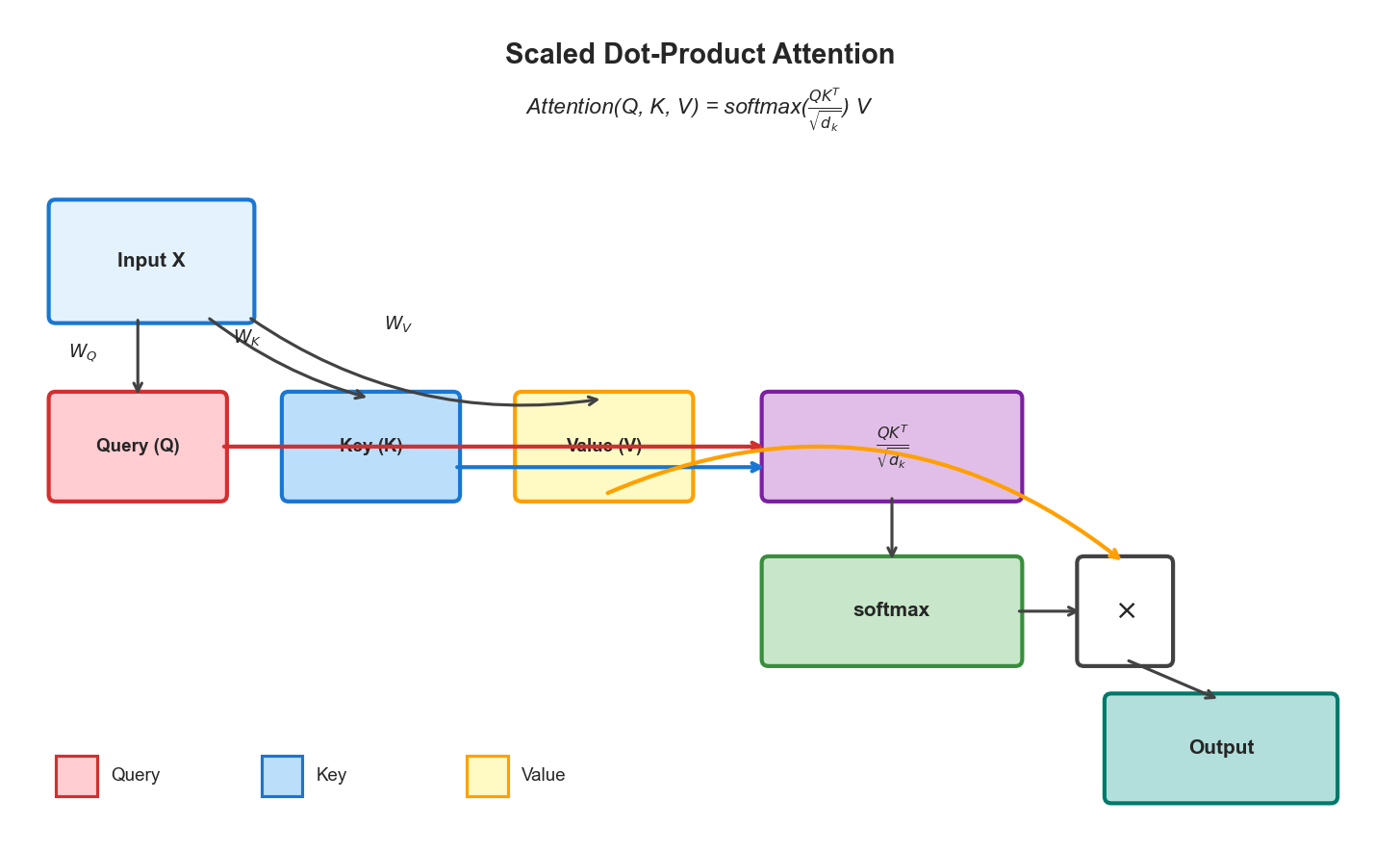
The Scaled Dot-Product Attention Formula
Where:
- Q (Query): What we're looking for
- K (Key): What we match against
- V (Value): What we retrieve
- d_k: Dimension of keys (for scaling)
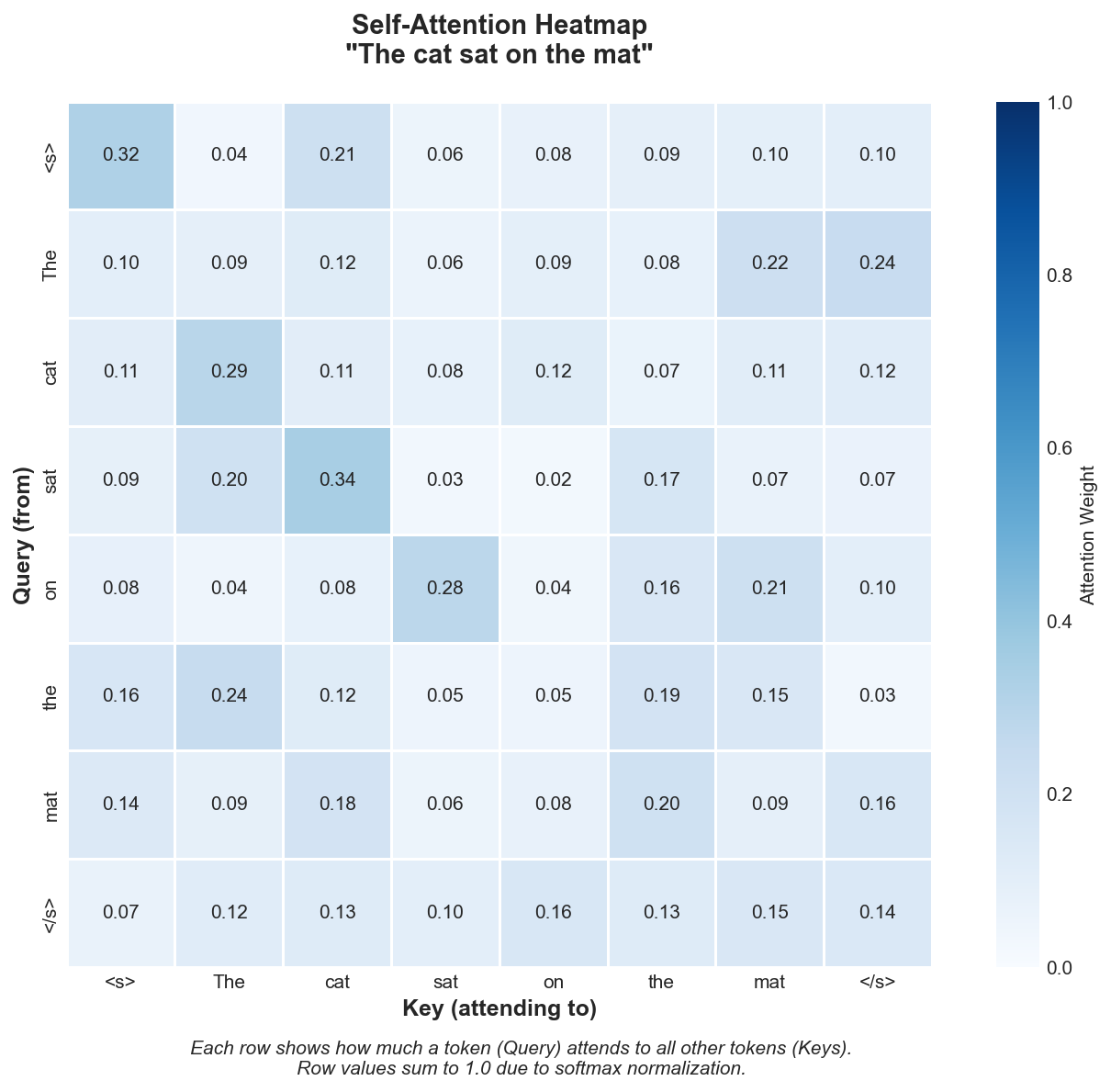
Self-Attention Heatmap
The heatmap below shows how tokens attend to each other. Each row represents a query token, and each column represents a key token. Higher values indicate stronger attention.
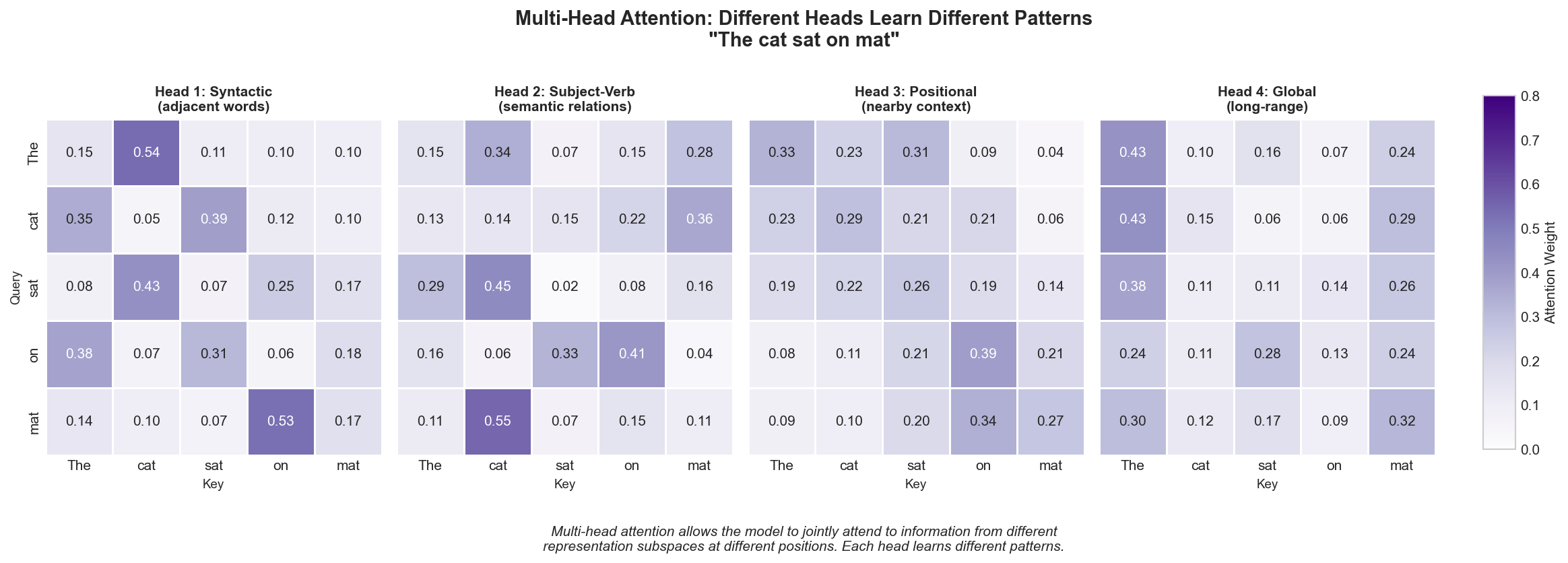
Multi-Head Attention
Different attention heads learn to focus on different types of relationships:
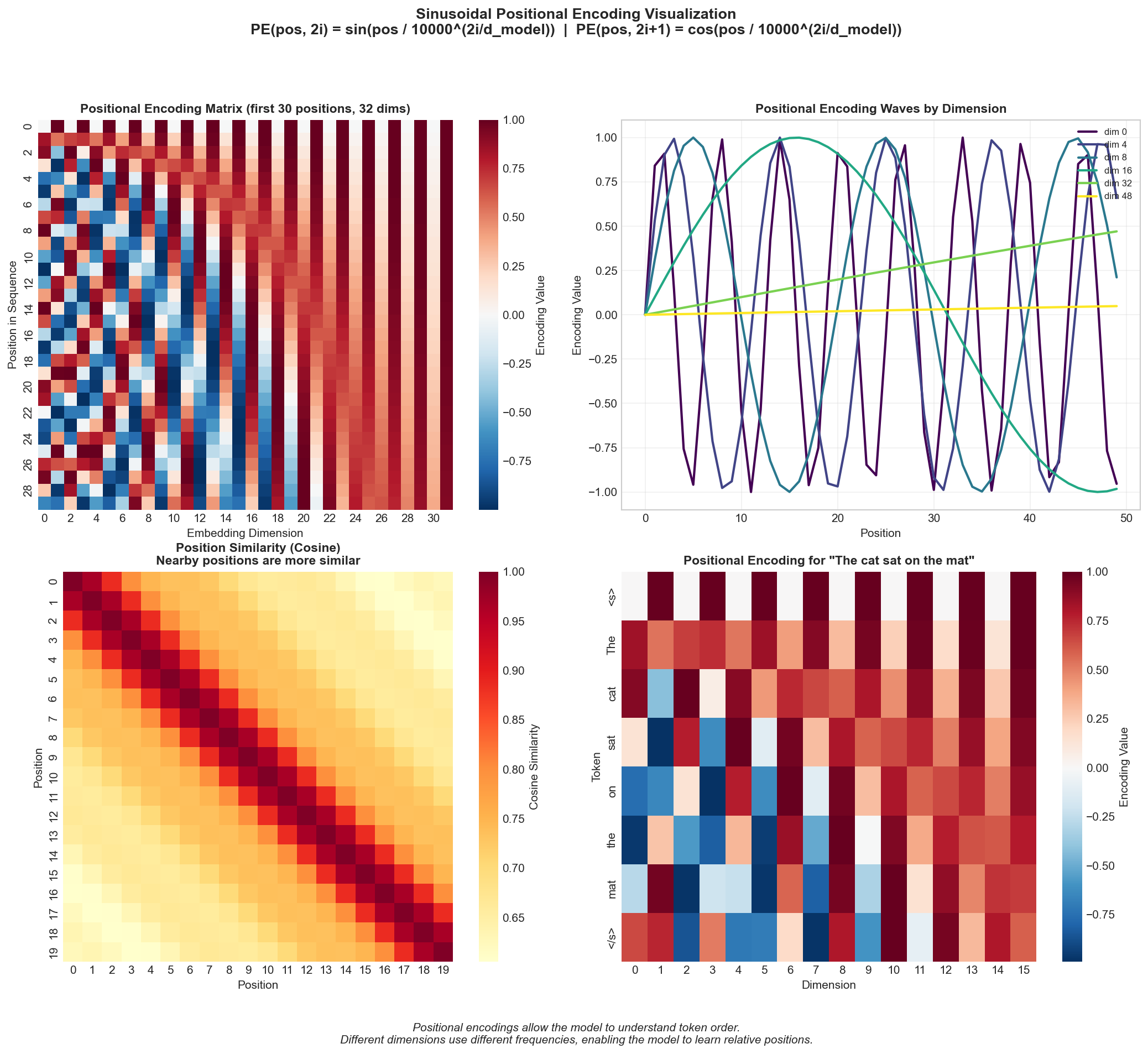
Positional Encoding
Since attention is permutation-invariant, we add positional encodings to provide sequence order information:
Attention Evolution During Training
Attention patterns evolve from random to meaningful during training:
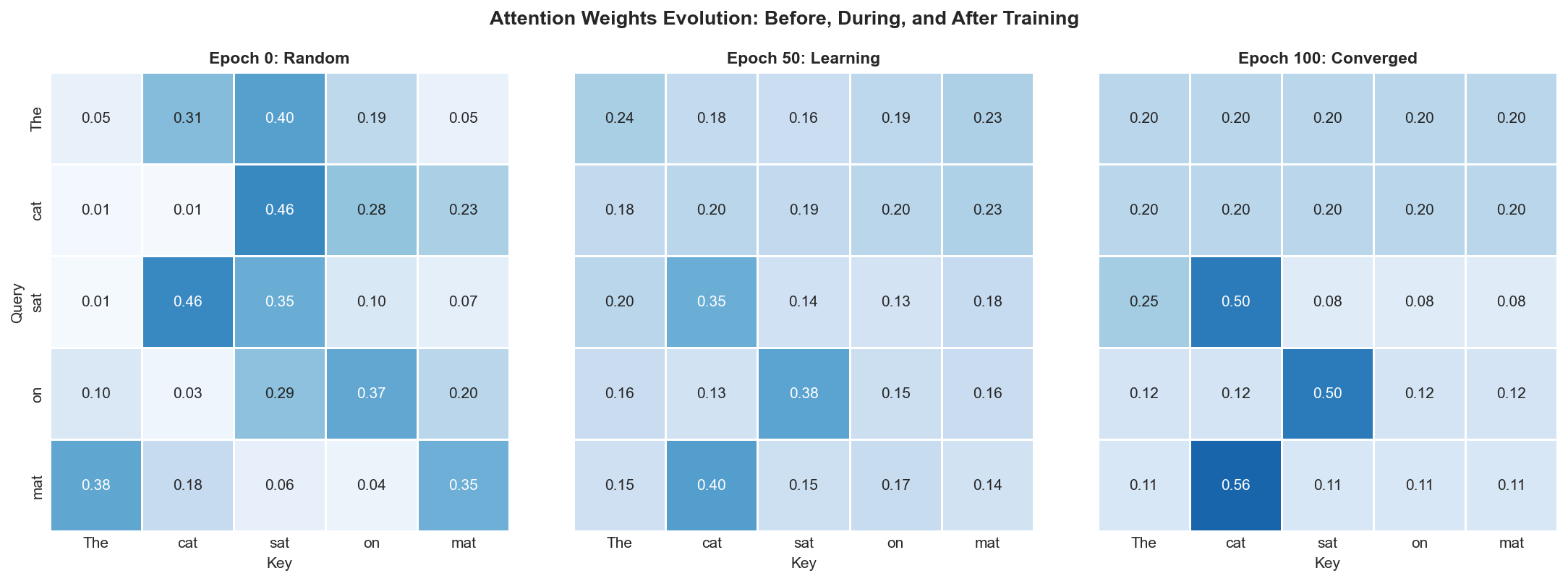
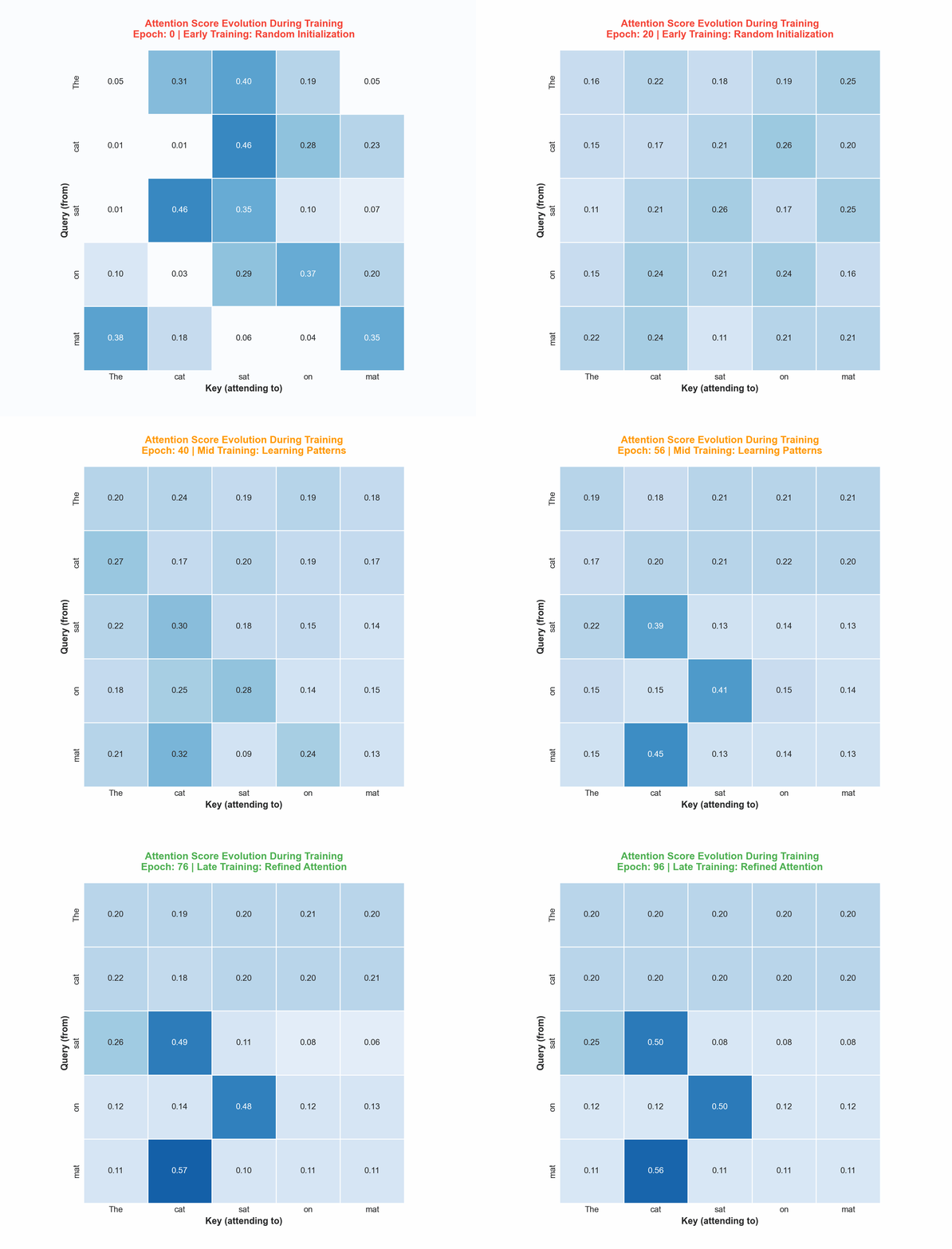
Animated visualization showing how attention weights evolve across training epochs.
Implementation 1: NumPy from Scratch
"""
Self-Attention Implementation in NumPy
=====================================
Complete implementation of attention mechanisms from scratch.
No deep learning frameworks - pure NumPy for understanding.
"""

import numpy as np
from typing import Optional, Tuple, List


def softmax(x: np.ndarray, axis: int = -1) -> np.ndarray:
    """
    Numerically stable softmax implementation.

    Args:
        x: Input array
        axis: Axis along which to compute softmax

    Returns:
        Softmax probabilities
    """
    # Subtract max for numerical stability (prevents overflow)
    x_max = np.max(x, axis=axis, keepdims=True)
    exp_x = np.exp(x - x_max)
    return exp_x / np.sum(exp_x, axis=axis, keepdims=True)


def scaled_dot_product_attention(
    query: np.ndarray,
    key: np.ndarray,
    value: np.ndarray,
    mask: Optional[np.ndarray] = None,
    dropout_rate: float = 0.0,
    training: bool = True
) -> Tuple[np.ndarray, np.ndarray]:
    """
    Compute scaled dot-product attention.

    Args:
        query: Query tensor of shape (..., seq_len_q, d_k)
        key: Key tensor of shape (..., seq_len_k, d_k)
        value: Value tensor of shape (..., seq_len_k, d_v)
        mask: Optional mask tensor, 0 for positions to mask
        dropout_rate: Dropout probability for attention weights
        training: Whether in training mode (affects dropout)

    Returns:
        output: Attention output of shape (..., seq_len_q, d_v)
        attention_weights: Attention weights of shape (..., seq_len_q, seq_len_k)
    """
    d_k = query.shape[-1]

    # Compute attention scores: Q @ K^T
    scores = np.matmul(query, key.swapaxes(-2, -1))

    # Scale by sqrt(d_k) to prevent softmax saturation
    scores = scores / np.sqrt(d_k)

    # Apply mask if provided (for causal attention or padding)
    if mask is not None:
        scores = np.where(mask == 0, -1e9, scores)

    # Compute attention weights via softmax
    attention_weights = softmax(scores, axis=-1)

    # Apply dropout during training
    if training and dropout_rate > 0:
        dropout_mask = np.random.binomial(1, 1 - dropout_rate, attention_weights.shape)
        attention_weights = attention_weights * dropout_mask / (1 - dropout_rate)

    # Compute output: weights @ V
    output = np.matmul(attention_weights, value)

    return output, attention_weights


class LinearProjection:
    """Linear projection layer for Q, K, V transformations."""

    def __init__(self, d_in: int, d_out: int, use_bias: bool = True):
        self.d_in = d_in
        self.d_out = d_out
        self.use_bias = use_bias

        # Xavier/Glorot initialization
        limit = np.sqrt(6.0 / (d_in + d_out))
        self.W = np.random.uniform(-limit, limit, (d_in, d_out))
        self.b = np.zeros(d_out) if use_bias else None

    def forward(self, x: np.ndarray) -> np.ndarray:
        output = np.matmul(x, self.W)
        if self.use_bias:
            output = output + self.b
        return output

    def __call__(self, x: np.ndarray) -> np.ndarray:
        return self.forward(x)


class MultiHeadAttention:
    """
    Multi-Head Attention mechanism.

    MultiHead(Q, K, V) = Concat(head_1, ..., head_h) @ W_O
    where head_i = Attention(Q @ W_Q_i, K @ W_K_i, V @ W_V_i)
    """

    def __init__(
        self,
        d_model: int,
        num_heads: int,
        dropout_rate: float = 0.0,
        use_bias: bool = True
    ):
        assert d_model % num_heads == 0, "d_model must be divisible by num_heads"

        self.d_model = d_model
        self.num_heads = num_heads
        self.d_k = d_model // num_heads
        self.d_v = d_model // num_heads
        self.dropout_rate = dropout_rate

        # Combined projections for efficiency
        self.W_q = LinearProjection(d_model, d_model, use_bias)
        self.W_k = LinearProjection(d_model, d_model, use_bias)
        self.W_v = LinearProjection(d_model, d_model, use_bias)
        self.W_o = LinearProjection(d_model, d_model, use_bias)

    def split_heads(self, x: np.ndarray) -> np.ndarray:
        """Split last dimension into (num_heads, d_k)."""
        batch_size, seq_len, _ = x.shape
        x = x.reshape(batch_size, seq_len, self.num_heads, self.d_k)
        return x.transpose(0, 2, 1, 3)

    def merge_heads(self, x: np.ndarray) -> np.ndarray:
        """Merge heads back together."""
        batch_size, _, seq_len, _ = x.shape
        x = x.transpose(0, 2, 1, 3)
        return x.reshape(batch_size, seq_len, self.d_model)

    def forward(
        self,
        query: np.ndarray,
        key: np.ndarray,
        value: np.ndarray,
        mask: Optional[np.ndarray] = None,
        training: bool = True,
        return_attention_weights: bool = False
    ) -> np.ndarray:
        # Linear projections
        Q = self.W_q(query)
        K = self.W_k(key)
        V = self.W_v(value)

        # Split into multiple heads
        Q = self.split_heads(Q)
        K = self.split_heads(K)
        V = self.split_heads(V)

        # Scaled dot-product attention for all heads in parallel
        attn_output, attn_weights = scaled_dot_product_attention(
            Q, K, V, mask=mask, dropout_rate=self.dropout_rate, training=training
        )

        # Merge heads and final projection
        attn_output = self.merge_heads(attn_output)
        output = self.W_o(attn_output)

        if return_attention_weights:
            return output, attn_weights
        return output

    def __call__(self, query, key, value, mask=None, training=True, return_attention_weights=False):
        return self.forward(query, key, value, mask, training, return_attention_weights)


# =============================================================================
# Positional Encoding
# =============================================================================

def sinusoidal_positional_encoding(seq_len: int, d_model: int) -> np.ndarray:
    """
    Generate sinusoidal positional encodings.

    PE(pos, 2i) = sin(pos / 10000^(2i/d_model))
    PE(pos, 2i+1) = cos(pos / 10000^(2i/d_model))
    """
    position = np.arange(seq_len)[:, np.newaxis]
    div_term = np.exp(np.arange(0, d_model, 2) * (-np.log(10000.0) / d_model))

    pe = np.zeros((seq_len, d_model))
    pe[:, 0::2] = np.sin(position * div_term)
    pe[:, 1::2] = np.cos(position * div_term)

    return pe


class PositionalEncoding:
    """Adds positional information to embeddings."""

    def __init__(self, d_model: int, max_seq_len: int = 5000, dropout_rate: float = 0.1):
        self.d_model = d_model
        self.dropout_rate = dropout_rate
        self.pe = sinusoidal_positional_encoding(max_seq_len, d_model)[np.newaxis, :, :]

    def forward(self, x: np.ndarray, training: bool = True) -> np.ndarray:
        seq_len = x.shape[1]
        x = x + self.pe[:, :seq_len, :]

        if training and self.dropout_rate > 0:
            dropout_mask = np.random.binomial(1, 1 - self.dropout_rate, x.shape)
            x = x * dropout_mask / (1 - self.dropout_rate)

        return x

    def __call__(self, x, training=True):
        return self.forward(x, training)


# =============================================================================
# Attention Masks
# =============================================================================

def create_padding_mask(seq: np.ndarray, pad_token: int = 0) -> np.ndarray:
    """Create padding mask: 1 for real tokens, 0 for padding."""
    mask = (seq != pad_token).astype(np.float32)
    return mask[:, np.newaxis, np.newaxis, :]


def create_causal_mask(seq_len: int) -> np.ndarray:
    """Create causal (look-ahead) mask for autoregressive models."""
    mask = np.tril(np.ones((seq_len, seq_len)))
    return mask[np.newaxis, np.newaxis, :, :]


def create_combined_mask(seq: np.ndarray, pad_token: int = 0) -> np.ndarray:
    """Create combined padding and causal mask."""
    seq_len = seq.shape[1]
    padding_mask = create_padding_mask(seq, pad_token)
    causal_mask = create_causal_mask(seq_len)
return np.minimum(padding_mask, causal_mask)Implementation 2: PyTorch Production-Ready
"""
Self-Attention Implementation in PyTorch
========================================
Production-ready implementation with GPU support.
"""

import torch
import torch.nn as nn
import torch.nn.functional as F
import math
from typing import Optional, Tuple


class ScaledDotProductAttention(nn.Module):
    """Attention(Q, K, V) = softmax(QK^T / sqrt(d_k)) V"""

    def __init__(self, dropout: float = 0.0):
        super().__init__()
        self.dropout = nn.Dropout(dropout)

    def forward(
        self,
        query: torch.Tensor,
        key: torch.Tensor,
        value: torch.Tensor,
        mask: Optional[torch.Tensor] = None,
        return_attention: bool = False
    ) -> Tuple[torch.Tensor, Optional[torch.Tensor]]:
        d_k = query.size(-1)

        scores = torch.matmul(query, key.transpose(-2, -1)) / math.sqrt(d_k)

        if mask is not None:
            scores = scores.masked_fill(mask == 0, float('-inf'))

        attention_weights = F.softmax(scores, dim=-1)
        attention_weights = self.dropout(attention_weights)

        output = torch.matmul(attention_weights, value)

        if return_attention:
            return output, attention_weights
        return output, None


class MultiHeadAttention(nn.Module):
    """Multi-Head Attention mechanism."""

    def __init__(
        self,
        d_model: int,
        num_heads: int,
        dropout: float = 0.0,
        bias: bool = True
    ):
        super().__init__()

        assert d_model % num_heads == 0

        self.d_model = d_model
        self.num_heads = num_heads
        self.d_k = d_model // num_heads

        self.W_q = nn.Linear(d_model, d_model, bias=bias)
        self.W_k = nn.Linear(d_model, d_model, bias=bias)
        self.W_v = nn.Linear(d_model, d_model, bias=bias)
        self.W_o = nn.Linear(d_model, d_model, bias=bias)

        self.attention = ScaledDotProductAttention(dropout)
        self._init_weights()

    def _init_weights(self):
        for module in [self.W_q, self.W_k, self.W_v, self.W_o]:
            nn.init.xavier_uniform_(module.weight)
            if module.bias is not None:
                nn.init.zeros_(module.bias)

    def forward(
        self,
        query: torch.Tensor,
        key: torch.Tensor,
        value: torch.Tensor,
        mask: Optional[torch.Tensor] = None,
        return_attention: bool = False
    ) -> Tuple[torch.Tensor, Optional[torch.Tensor]]:
        batch_size = query.size(0)

        Q = self.W_q(query).view(batch_size, -1, self.num_heads, self.d_k).transpose(1, 2)
        K = self.W_k(key).view(batch_size, -1, self.num_heads, self.d_k).transpose(1, 2)
        V = self.W_v(value).view(batch_size, -1, self.num_heads, self.d_k).transpose(1, 2)

        attn_output, attn_weights = self.attention(Q, K, V, mask, return_attention)

        attn_output = attn_output.transpose(1, 2).contiguous().view(batch_size, -1, self.d_model)
        output = self.W_o(attn_output)

        return output, attn_weights


class CausalSelfAttention(nn.Module):
    """Causal Self-Attention for autoregressive models (GPT-style)."""

    def __init__(
        self,
        d_model: int,
        num_heads: int,
        max_seq_len: int = 2048,
        dropout: float = 0.0,
        bias: bool = True
    ):
        super().__init__()

        self.mha = MultiHeadAttention(d_model, num_heads, dropout, bias)

        mask = torch.tril(torch.ones(max_seq_len, max_seq_len))
        mask = mask.view(1, 1, max_seq_len, max_seq_len)
        self.register_buffer('causal_mask', mask)

    def forward(self, x: torch.Tensor, return_attention: bool = False):
        seq_len = x.size(1)
        mask = self.causal_mask[:, :, :seq_len, :seq_len]
        return self.mha(x, x, x, mask, return_attention)


class PositionalEncoding(nn.Module):
    """Sinusoidal Positional Encoding."""

    def __init__(self, d_model: int, max_seq_len: int = 5000, dropout: float = 0.1):
        super().__init__()

        self.dropout = nn.Dropout(dropout)

        pe = torch.zeros(max_seq_len, d_model)
        position = torch.arange(0, max_seq_len, dtype=torch.float).unsqueeze(1)
        div_term = torch.exp(
            torch.arange(0, d_model, 2).float() * (-math.log(10000.0) / d_model)
        )

        pe[:, 0::2] = torch.sin(position * div_term)
        pe[:, 1::2] = torch.cos(position * div_term)

        pe = pe.unsqueeze(0)
        self.register_buffer('pe', pe)

    def forward(self, x: torch.Tensor) -> torch.Tensor:
        seq_len = x.size(1)
        x = x + self.pe[:, :seq_len, :]
        return self.dropout(x)


class RotaryPositionalEmbedding(nn.Module):
    """Rotary Position Embedding (RoPE) - used in LLaMA, GPT-NeoX."""

    def __init__(self, d_model: int, max_seq_len: int = 2048, base: int = 10000):
        super().__init__()

        self.d_model = d_model
        inv_freq = 1.0 / (base ** (torch.arange(0, d_model, 2).float() / d_model))
        self.register_buffer('inv_freq', inv_freq)
        self._build_cache(max_seq_len)

    def _build_cache(self, seq_len: int):
        t = torch.arange(seq_len, device=self.inv_freq.device).type_as(self.inv_freq)
        freqs = torch.einsum('i,j->ij', t, self.inv_freq)
        emb = torch.cat((freqs, freqs), dim=-1)
        self.register_buffer('cos_cached', emb.cos()[None, None, :, :])
        self.register_buffer('sin_cached', emb.sin()[None, None, :, :])

    def rotate_half(self, x: torch.Tensor) -> torch.Tensor:
        x1, x2 = x.chunk(2, dim=-1)
        return torch.cat((-x2, x1), dim=-1)

    def forward(self, q: torch.Tensor, k: torch.Tensor, seq_len: int):
        cos = self.cos_cached[:, :, :seq_len, :]
        sin = self.sin_cached[:, :, :seq_len, :]

        q_embed = (q * cos) + (self.rotate_half(q) * sin)
        k_embed = (k * cos) + (self.rotate_half(k) * sin)

        return q_embed, k_embed


class TransformerBlock(nn.Module):
    """Complete Transformer block with self-attention and feed-forward."""

    def __init__(
        self,
        d_model: int,
        num_heads: int,
        d_ff: int,
        dropout: float = 0.1,
        activation: str = 'gelu'
    ):
        super().__init__()

        self.attention = MultiHeadAttention(d_model, num_heads, dropout)
        self.ln1 = nn.LayerNorm(d_model)

        self.ffn = nn.Sequential(
            nn.Linear(d_model, d_ff),
            nn.GELU() if activation == 'gelu' else nn.ReLU(),
            nn.Dropout(dropout),
            nn.Linear(d_ff, d_model),
            nn.Dropout(dropout)
        )
        self.ln2 = nn.LayerNorm(d_model)
        self.dropout = nn.Dropout(dropout)

    def forward(self, x: torch.Tensor, mask: Optional[torch.Tensor] = None):
        attn_output, _ = self.attention(self.ln1(x), self.ln1(x), self.ln1(x), mask)
        x = x + self.dropout(attn_output)
        x = x + self.ffn(self.ln2(x))
        return x


# =============================================================================
# Efficient Attention Variants
# =============================================================================

class FlashAttention(nn.Module):
    """Flash Attention using PyTorch 2.0+ optimizations."""

    def __init__(self, d_model: int, num_heads: int, dropout: float = 0.0):
        super().__init__()

        self.d_model = d_model
        self.num_heads = num_heads
        self.d_k = d_model // num_heads

        self.W_qkv = nn.Linear(d_model, 3 * d_model)
        self.W_o = nn.Linear(d_model, d_model)
        self.dropout = nn.Dropout(dropout)

    def forward(self, x: torch.Tensor, mask: Optional[torch.Tensor] = None):
        batch_size, seq_len, _ = x.shape

        qkv = self.W_qkv(x).view(batch_size, seq_len, 3, self.num_heads, self.d_k)
        qkv = qkv.permute(2, 0, 3, 1, 4)
        Q, K, V = qkv[0], qkv[1], qkv[2]

        attn_output = F.scaled_dot_product_attention(
            Q, K, V,
            attn_mask=mask,
            dropout_p=self.dropout.p if self.training else 0.0,
            is_causal=mask is None
        )

        attn_output = attn_output.transpose(1, 2).contiguous().view(batch_size, seq_len, self.d_model)
        return self.W_o(attn_output)


class GroupedQueryAttention(nn.Module):
    """Grouped Query Attention (GQA) - used in LLaMA 2."""

    def __init__(
        self,
        d_model: int,
        num_query_heads: int,
        num_kv_heads: int,
        dropout: float = 0.0
    ):
        super().__init__()

        assert num_query_heads % num_kv_heads == 0

        self.d_model = d_model
        self.num_query_heads = num_query_heads
        self.num_kv_heads = num_kv_heads
        self.num_groups = num_query_heads // num_kv_heads
        self.d_k = d_model // num_query_heads

        self.W_q = nn.Linear(d_model, d_model, bias=False)
        self.W_k = nn.Linear(d_model, num_kv_heads * self.d_k, bias=False)
        self.W_v = nn.Linear(d_model, num_kv_heads * self.d_k, bias=False)
        self.W_o = nn.Linear(d_model, d_model, bias=False)

        self.dropout = nn.Dropout(dropout)

    def forward(self, x: torch.Tensor, mask: Optional[torch.Tensor] = None):
        batch_size, seq_len, _ = x.shape

        Q = self.W_q(x).view(batch_size, seq_len, self.num_query_heads, self.d_k).transpose(1, 2)
        K = self.W_k(x).view(batch_size, seq_len, self.num_kv_heads, self.d_k).transpose(1, 2)
        V = self.W_v(x).view(batch_size, seq_len, self.num_kv_heads, self.d_k).transpose(1, 2)

        K = K.repeat_interleave(self.num_groups, dim=1)
        V = V.repeat_interleave(self.num_groups, dim=1)

        scores = torch.matmul(Q, K.transpose(-2, -1)) / math.sqrt(self.d_k)

        if mask is not None:
            scores = scores.masked_fill(mask == 0, float('-inf'))

        attn_weights = F.softmax(scores, dim=-1)
        attn_weights = self.dropout(attn_weights)

        output = torch.matmul(attn_weights, V)
        output = output.transpose(1, 2).contiguous().view(batch_size, seq_len, self.d_model)

return self.W_o(output)Interview Questions and Solutions
Question 1: Why Scale by sqrt(d_k)?
"""
Q: Why do we scale the dot product by sqrt(d_k)?
A: To prevent softmax saturation as dimension grows.
"""

import numpy as np

def demonstrate_scaling_importance():
    np.random.seed(42)
    dims = [8, 64, 512, 2048]

    print("Dot product statistics for unit Gaussian vectors:")
    print("-" * 50)

    for d in dims:
        q = np.random.randn(1000, d)
        k = np.random.randn(1000, d)

        dots = np.sum(q * k, axis=1)
        dots_scaled = dots / np.sqrt(d)

        print(f"d_k = {d:4d}: "
              f"unscaled std = {dots.std():.2f}, "
              f"scaled std = {dots_scaled.std():.2f}")

    print("\nKey insight: Variance of dot product is proportional to d_k")
    print("Scaling by sqrt(d_k) keeps variance ~1, preventing softmax saturation")

demonstrate_scaling_importance()Question 2: Implement Attention Without nn.Module
"""
Q: Implement multi-head attention using only basic PyTorch operations.
"""

import torch
import torch.nn.functional as F
import math

def multi_head_attention_manual(
    query, key, value, num_heads, W_q, W_k, W_v, W_o, mask=None
):
    batch_size, seq_len_q, d_model = query.shape
    d_k = d_model // num_heads

    # Step 1: Linear projections
    Q = torch.matmul(query, W_q)
    K = torch.matmul(key, W_k)
    V = torch.matmul(value, W_v)

    # Step 2: Reshape to separate heads
    Q = Q.view(batch_size, seq_len_q, num_heads, d_k).transpose(1, 2)
    K = K.view(batch_size, -1, num_heads, d_k).transpose(1, 2)
    V = V.view(batch_size, -1, num_heads, d_k).transpose(1, 2)

    # Step 3: Compute attention scores
    scores = torch.matmul(Q, K.transpose(-2, -1)) / math.sqrt(d_k)

    # Step 4: Apply mask
    if mask is not None:
        scores = scores.masked_fill(mask == 0, float('-inf'))

    # Step 5: Softmax and apply to values
    attention_weights = F.softmax(scores, dim=-1)
    attn_output = torch.matmul(attention_weights, V)

    # Step 6: Reshape and project
    attn_output = attn_output.transpose(1, 2).contiguous().view(batch_size, seq_len_q, d_model)
return torch.matmul(attn_output, W_o)Question 3: Complexity Analysis
SELF-ATTENTION COMPLEXITY:
==========================

Given: sequence length n, model dimension d

Time Complexity: O(n^2 * d)
- QK^T computation: O(n * n * d)
- Softmax: O(n^2)
- Attention @ V: O(n^2 * d)

Space Complexity: O(n^2 + n*d)
- Attention matrix: O(n^2)
- Q, K, V matrices: O(n * d) each

EFFICIENT ATTENTION VARIANTS:
=============================

1. Flash Attention: O(n^2 * d) time but O(n) memory!
2. Linear Attention: O(n * d^2) time via kernel trick
3. Sparse Attention: O(n * k) via local windows
4. GQA: Reduce KV cache by sharing across headsCommon Interview Patterns
Pattern 1: Attention Score Computation (Most Common!)
def compute_attention_scores(query, key, mask=None):
    d_k = query.shape[-1]

    # Step 1: Dot product
    scores = np.matmul(query, key.swapaxes(-2, -1))

    # Step 2: Scale (CRITICAL - explain why!)
    scores = scores / np.sqrt(d_k)

    # Step 3: Mask (explain causal vs padding)
    if mask is not None:
        scores = np.where(mask == 0, -1e9, scores)

    # Step 4: Softmax
return softmax(scores, axis=-1)Pattern 2: KV-Cache for Inference
class CachedAttention:
    """Attention with KV-cache for efficient autoregressive generation."""

    def __init__(self, d_model, num_heads):
        self.d_model = d_model
        self.num_heads = num_heads
        self.d_k = d_model // num_heads
        self.k_cache = None
        self.v_cache = None

    def forward(self, x, W_q, W_k, W_v, W_o, use_cache=True):
        batch_size, seq_len, _ = x.shape

        # Always compute Q for current input
        Q = np.matmul(x, W_q).reshape(batch_size, seq_len, self.num_heads, self.d_k)
        Q = Q.transpose(0, 2, 1, 3)

        if use_cache and self.k_cache is not None:
            # Only compute K, V for new tokens
            K_new = np.matmul(x, W_k).reshape(batch_size, seq_len, self.num_heads, self.d_k)
            V_new = np.matmul(x, W_v).reshape(batch_size, seq_len, self.num_heads, self.d_k)
            K_new, V_new = K_new.transpose(0, 2, 1, 3), V_new.transpose(0, 2, 1, 3)

            # Append to cache
            K = np.concatenate([self.k_cache, K_new], axis=2)
            V = np.concatenate([self.v_cache, V_new], axis=2)
            self.k_cache, self.v_cache = K, V
        else:
            K = np.matmul(x, W_k).reshape(batch_size, seq_len, self.num_heads, self.d_k)
            V = np.matmul(x, W_v).reshape(batch_size, seq_len, self.num_heads, self.d_k)
            K, V = K.transpose(0, 2, 1, 3), V.transpose(0, 2, 1, 3)
            if use_cache:
                self.k_cache, self.v_cache = K, V

        # Standard attention
        scores = np.matmul(Q, K.swapaxes(-2, -1)) / np.sqrt(self.d_k)
        weights = softmax(scores, axis=-1)
        output = np.matmul(weights, V)

        output = output.transpose(0, 2, 1, 3).reshape(batch_size, seq_len, self.d_model)
        return np.matmul(output, W_o)

    def clear_cache(self):
self.k_cache = self.v_cache = NoneQuick Reference Card
+===================================================================+
|                    SELF-ATTENTION CHEAT SHEET                     |
+===================================================================+
|                                                                   |
|  FORMULA:                                                         |
|  Attention(Q,K,V) = softmax(QK^T / sqrt(d_k)) * V                |
|                                                                   |
|  DIMENSIONS:                                                      |
|  Q, K: (batch, heads, seq, d_k)                                  |
|  V:    (batch, heads, seq, d_v)                                  |
|  QK^T: (batch, heads, seq_q, seq_k)                              |
|  Out:  (batch, heads, seq_q, d_v)                                |
|                                                                   |
|  WHY SCALE?                                                       |
|  - Dot products grow with dimension                              |
|  - Large values -> softmax saturation -> vanishing gradients     |
|  - Scaling keeps variance ~1                                      |
|                                                                   |
|  MASK TYPES:                                                      |
|  - Padding mask: hide PAD tokens                                 |
|  - Causal mask: prevent attending to future (decoder)            |
|  - Combined: both padding + causal                               |
|                                                                   |
|  COMPLEXITY:                                                      |
|  - Time: O(n^2 * d) - quadratic in sequence length               |
|  - Space: O(n^2) for attention matrix                            |
|                                                                   |
|  EFFICIENT VARIANTS:                                              |
|  - Flash Attention: O(n) memory, same compute                    |
|  - Linear Attention: O(n) time via kernel trick                  |
|  - Sparse Attention: O(n*k) via local windows                    |
|  - GQA: reduce KV cache by sharing across heads                  |
|                                                                   |
|  POSITIONAL ENCODING:                                             |
|  - Sinusoidal: fixed, generalizes to longer sequences            |
|  - Learned: more flexible, limited to trained length             |
|  - RoPE: rotary, best of both worlds (LLaMA, etc.)              |
|                                                                   |
+===================================================================+Key Takeaways for Interviews
Know the Formula Cold:
softmax(QK^T / sqrt(d_k)) * VExplain Scaling: Prevents softmax saturation, maintains gradient flow
Multi-Head Purpose: Different heads learn different relationship types
Mask Types: Padding (hide PAD tokens) vs Causal (hide future)
Complexity: O(n^2) in sequence length - know the trade-offs
Modern Variants: Flash Attention, GQA, RoPE - know what they solve
KV-Cache: Critical for efficient inference in autoregressive models
Code It: Be able to implement from scratch in NumPy AND PyTorch
Further Reading
- Attention Is All You Need - Original Transformer paper
- Flash Attention - Memory-efficient attention
- RoFormer - Rotary Position Embedding
- GQA Paper - Grouped Query Attention