Decision Tree Implementation (CART)
Build classification and regression trees from scratch with Gini impurity, information gain, and pruning strategies
Problem Statement
Implement a Decision Tree algorithm (CART - Classification and Regression Trees) for both classification and regression tasks. Given training data X_train with labels y_train, build a tree structure that recursively partitions the feature space to make predictions.
Interview Context: Decision Trees are fundamental to understanding ensemble methods (Random Forests, Gradient Boosting). Interviewers expect you to implement the core splitting logic, understand impurity metrics, and discuss overfitting prevention.
When This Is Asked
| Company | Role | Frequency |
|---|---|---|
| ML Engineer, Research Scientist | High | |
| Meta | ML Engineer, Applied Scientist | High |
| Amazon | Applied Scientist, SDE-ML | High |
| Apple | ML Engineer | Medium |
| Microsoft | Data Scientist, ML Engineer | Medium |
| Netflix | ML Engineer | Medium |
Common Interview Formats:
- "Implement a decision tree classifier from scratch" (45-60 min)
- "How would you split a node? Walk me through the math" (20-30 min)
- "Extend your implementation to handle regression" (15-20 min follow-up)
Clarifying Questions to Ask
- Classification or regression? (Start with classification, extend to regression)
- Binary or multi-class? (Binary first, multi-class is straightforward extension)
- Splitting criterion? (Gini impurity vs information gain/entropy)
- Stopping conditions? (Max depth, min samples per leaf, min impurity decrease)
- Feature types? (Continuous vs categorical - continuous first)
- Libraries allowed? (NumPy yes, sklearn no for implementation questions)
Mathematical Foundation
Gini Impurity vs Entropy
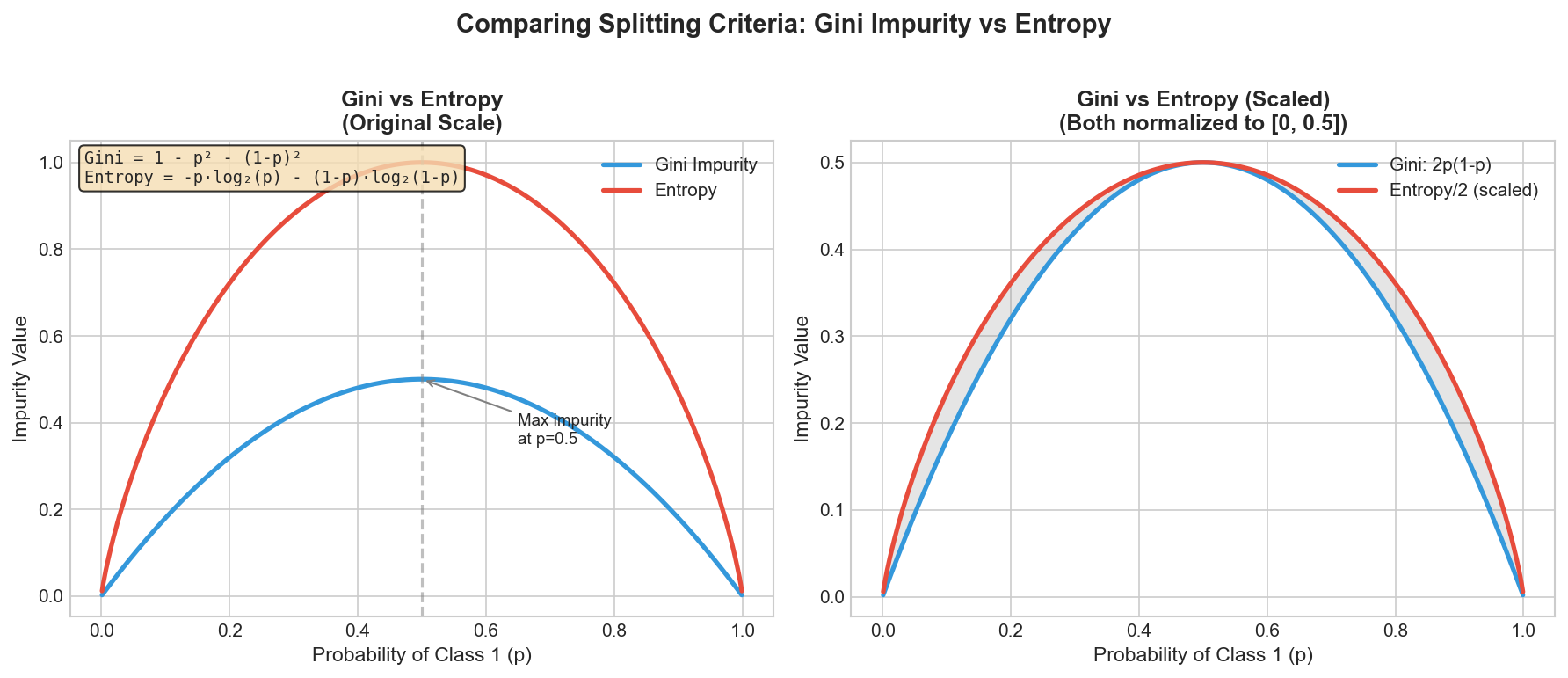
Both metrics measure node impurity. The chart above shows their behavior:
| Metric | Range (Binary) | Computation | Use Case |
|---|---|---|---|
| Gini | [0, 0.5] | Faster (no log) | sklearn default |
| Entropy | [0, 1] | Slower | C4.5 default |
In practice: Results are usually very similar. Gini is computationally cheaper.
Weighted Impurity for Splits
When evaluating a split:
The best split minimizes this weighted impurity (or maximizes information gain).
Regression: Mean Squared Error
For regression trees:
Algorithm Flowchart
Implementation
Python (From Scratch - Classification)
from typing import List, Optional, Tuple, Union
from collections import Counter
import math

class TreeNode:
    """
    Node in a decision tree.

    For internal nodes: stores split feature and threshold.
    For leaf nodes: stores predicted class/value.
    """
    def __init__(self):
        self.feature_index: Optional[int] = None  # Feature to split on
        self.threshold: Optional[float] = None     # Split threshold
        self.left: Optional['TreeNode'] = None     # Left child (<=threshold)
        self.right: Optional['TreeNode'] = None    # Right child (>threshold)
        self.value: Optional[int] = None           # Leaf prediction
        self.is_leaf: bool = False
        self.n_samples: int = 0                    # Samples at this node
        self.impurity: float = 0.0                 # Node impurity


class DecisionTreeClassifier:
    """
    Decision Tree Classifier using CART algorithm.

    Args:
        max_depth: Maximum depth of tree (None for unlimited)
        min_samples_split: Minimum samples required to split a node
        min_samples_leaf: Minimum samples required in a leaf node
        criterion: 'gini' or 'entropy'
    """
    def __init__(self, max_depth: Optional[int] = None,
                 min_samples_split: int = 2,
                 min_samples_leaf: int = 1,
                 criterion: str = 'gini'):
        self.max_depth = max_depth
        self.min_samples_split = min_samples_split
        self.min_samples_leaf = min_samples_leaf
        self.criterion = criterion
        self.root: Optional[TreeNode] = None
        self.n_classes: int = 0
        self.n_features: int = 0

    def _gini_impurity(self, y: List[int]) -> float:
        """
        Compute Gini impurity for a set of labels.

        Gini = 1 - sum(p_i^2) for all classes i
        """
        if len(y) == 0:
            return 0.0

        counts = Counter(y)
        n = len(y)
        impurity = 1.0

        for count in counts.values():
            p = count / n
            impurity -= p ** 2

        return impurity

    def _entropy(self, y: List[int]) -> float:
        """
        Compute entropy for a set of labels.

        Entropy = -sum(p_i * log2(p_i)) for all classes i
        """
        if len(y) == 0:
            return 0.0

        counts = Counter(y)
        n = len(y)
        entropy = 0.0

        for count in counts.values():
            if count > 0:
                p = count / n
                entropy -= p * math.log2(p)

        return entropy

    def _impurity(self, y: List[int]) -> float:
        """Compute impurity based on criterion."""
        if self.criterion == 'gini':
            return self._gini_impurity(y)
        else:
            return self._entropy(y)

    def _information_gain(self, y: List[int], y_left: List[int],
                          y_right: List[int]) -> float:
        """
        Compute information gain from a split.

        IG = impurity(parent) - weighted_avg(impurity(children))
        """
        n = len(y)
        n_left = len(y_left)
        n_right = len(y_right)

        if n_left == 0 or n_right == 0:
            return 0.0

        parent_impurity = self._impurity(y)
        left_impurity = self._impurity(y_left)
        right_impurity = self._impurity(y_right)

        weighted_child_impurity = (
            (n_left / n) * left_impurity +
            (n_right / n) * right_impurity
        )

        return parent_impurity - weighted_child_impurity

    def _best_split(self, X: List[List[float]], y: List[int]
                   ) -> Tuple[Optional[int], Optional[float], float]:
        """
        Find the best split for a node.

        Returns:
            (best_feature, best_threshold, best_gain)
        """
        best_gain = 0.0
        best_feature = None
        best_threshold = None

        n_samples = len(X)
        n_features = len(X[0]) if X else 0

        for feature_idx in range(n_features):
            # Get all unique values for this feature
            feature_values = sorted(set(x[feature_idx] for x in X))

            # Try thresholds between consecutive values
            for i in range(len(feature_values) - 1):
                threshold = (feature_values[i] + feature_values[i + 1]) / 2

                # Split data
                y_left = [y[j] for j in range(n_samples)
                         if X[j][feature_idx] <= threshold]
                y_right = [y[j] for j in range(n_samples)
                          if X[j][feature_idx] > threshold]

                # Check minimum samples constraint
                if (len(y_left) < self.min_samples_leaf or
                    len(y_right) < self.min_samples_leaf):
                    continue

                # Compute information gain
                gain = self._information_gain(y, y_left, y_right)

                if gain > best_gain:
                    best_gain = gain
                    best_feature = feature_idx
                    best_threshold = threshold

        return best_feature, best_threshold, best_gain

    def _build_tree(self, X: List[List[float]], y: List[int],
                    depth: int) -> TreeNode:
        """
        Recursively build the decision tree.
        """
        node = TreeNode()
        node.n_samples = len(y)
        node.impurity = self._impurity(y)

        # Check stopping conditions
        n_samples = len(y)
        n_classes = len(set(y))

        # Condition 1: Pure node (all same class)
        if n_classes == 1:
            node.is_leaf = True
            node.value = y[0]
            return node

        # Condition 2: Max depth reached
        if self.max_depth is not None and depth >= self.max_depth:
            node.is_leaf = True
            node.value = Counter(y).most_common(1)[0][0]
            return node

        # Condition 3: Not enough samples to split
        if n_samples < self.min_samples_split:
            node.is_leaf = True
            node.value = Counter(y).most_common(1)[0][0]
            return node

        # Find best split
        best_feature, best_threshold, best_gain = self._best_split(X, y)

        # Condition 4: No valid split found
        if best_feature is None or best_gain <= 0:
            node.is_leaf = True
            node.value = Counter(y).most_common(1)[0][0]
            return node

        # Create internal node
        node.feature_index = best_feature
        node.threshold = best_threshold

        # Split data
        X_left, y_left = [], []
        X_right, y_right = [], []

        for i in range(n_samples):
            if X[i][best_feature] <= best_threshold:
                X_left.append(X[i])
                y_left.append(y[i])
            else:
                X_right.append(X[i])
                y_right.append(y[i])

        # Recursively build subtrees
        node.left = self._build_tree(X_left, y_left, depth + 1)
        node.right = self._build_tree(X_right, y_right, depth + 1)

        return node

    def fit(self, X: List[List[float]], y: List[int]) -> 'DecisionTreeClassifier':
        """
        Build decision tree from training data.

        Args:
            X: Training features, list of feature vectors
            y: Training labels

        Returns:
            self
        """
        if len(X) == 0:
            raise ValueError("Training data is empty")

        self.n_features = len(X[0])
        self.n_classes = len(set(y))
        self.root = self._build_tree(X, y, depth=0)

        return self

    def _predict_single(self, x: List[float], node: TreeNode) -> int:
        """Traverse tree to predict a single sample."""
        if node.is_leaf:
            return node.value

        if x[node.feature_index] <= node.threshold:
            return self._predict_single(x, node.left)
        else:
            return self._predict_single(x, node.right)

    def predict(self, X: List[List[float]]) -> List[int]:
        """
        Predict class labels for samples.

        Args:
            X: Features to predict

        Returns:
            Predicted labels
        """
        if self.root is None:
            raise ValueError("Tree not fitted. Call fit() first.")

        return [self._predict_single(x, self.root) for x in X]

    def predict_proba(self, X: List[List[float]]) -> List[List[float]]:
        """
        Predict class probabilities (for leaves, based on training distribution).

        Note: Basic implementation - returns 1.0 for predicted class, 0.0 for others.
        """
        predictions = self.predict(X)
        proba = []

        for pred in predictions:
            p = [0.0] * self.n_classes
            p[pred] = 1.0
            proba.append(p)

return probaimport numpy as np
from collections import Counter
from typing import Optional, Tuple
class TreeNode:
"""Node in a decision tree."""
def __init__(self):
self.feature_index: Optional[int] = None
self.threshold: Optional[float] = None
self.left: Optional['TreeNode'] = None
self.right: Optional['TreeNode'] = None
self.value: Optional[int] = None
self.is_leaf: bool = False
self.n_samples: int = 0
self.impurity: float = 0.0
class DecisionTreeClassifier:
"""
Decision Tree Classifier using CART algorithm with NumPy.
Vectorized operations for improved performance.
"""
def __init__(self, max_depth: Optional[int] = None,
min_samples_split: int = 2,
min_samples_leaf: int = 1,
criterion: str = 'gini'):
self.max_depth = max_depth
self.min_samples_split = min_samples_split
self.min_samples_leaf = min_samples_leaf
self.criterion = criterion
self.root: Optional[TreeNode] = None
self.n_classes_: int = 0
self.n_features_: int = 0
self.classes_: np.ndarray = None
def _gini_impurity(self, y: np.ndarray) -> float:
"""Compute Gini impurity using vectorized operations."""
if len(y) == 0:
return 0.0
_, counts = np.unique(y, return_counts=True)
probabilities = counts / len(y)
return 1.0 - np.sum(probabilities ** 2)
def _entropy(self, y: np.ndarray) -> float:
"""Compute entropy using vectorized operations."""
if len(y) == 0:
return 0.0
_, counts = np.unique(y, return_counts=True)
probabilities = counts / len(y)
# Avoid log(0) by filtering out zero probabilities
probabilities = probabilities[probabilities > 0]
return -np.sum(probabilities * np.log2(probabilities))
def _impurity(self, y: np.ndarray) -> float:
"""Compute impurity based on criterion."""
if self.criterion == 'gini':
return self._gini_impurity(y)
else:
return self._entropy(y)
def _best_split(self, X: np.ndarray, y: np.ndarray
) -> Tuple[Optional[int], Optional[float], float]:
"""
Find the best split using vectorized operations.
"""
n_samples, n_features = X.shape
best_gain = 0.0
best_feature = None
best_threshold = None
parent_impurity = self._impurity(y)
for feature_idx in range(n_features):
# Get sorted unique thresholds
feature_values = X[:, feature_idx]
thresholds = np.unique(feature_values)
# Try midpoints between consecutive values
if len(thresholds) > 1:
thresholds = (thresholds[:-1] + thresholds[1:]) / 2
for threshold in thresholds:
# Boolean mask for split
left_mask = feature_values <= threshold
right_mask = ~left_mask
n_left = np.sum(left_mask)
n_right = np.sum(right_mask)
# Check minimum samples constraint
if n_left < self.min_samples_leaf or n_right < self.min_samples_leaf:
continue
# Compute weighted impurity
left_impurity = self._impurity(y[left_mask])
right_impurity = self._impurity(y[right_mask])
weighted_impurity = (
(n_left / n_samples) * left_impurity +
(n_right / n_samples) * right_impurity
)
gain = parent_impurity - weighted_impurity
if gain > best_gain:
best_gain = gain
best_feature = feature_idx
best_threshold = threshold
return best_feature, best_threshold, best_gain
def _build_tree(self, X: np.ndarray, y: np.ndarray, depth: int) -> TreeNode:
"""Recursively build the decision tree."""
node = TreeNode()
node.n_samples = len(y)
node.impurity = self._impurity(y)
n_samples = len(y)
unique_classes = np.unique(y)
# Stopping conditions
if (len(unique_classes) == 1 or
(self.max_depth is not None and depth >= self.max_depth) or
n_samples < self.min_samples_split):
node.is_leaf = True
# Majority class
counts = np.bincount(y.astype(int))
node.value = np.argmax(counts)
return node
# Find best split
best_feature, best_threshold, best_gain = self._best_split(X, y)
if best_feature is None or best_gain <= 0:
node.is_leaf = True
counts = np.bincount(y.astype(int))
node.value = np.argmax(counts)
return node
# Create internal node
node.feature_index = best_feature
node.threshold = best_threshold
# Split data
left_mask = X[:, best_feature] <= best_threshold
node.left = self._build_tree(X[left_mask], y[left_mask], depth + 1)
node.right = self._build_tree(X[~left_mask], y[~left_mask], depth + 1)
return node
def fit(self, X: np.ndarray, y: np.ndarray) -> 'DecisionTreeClassifier':
"""Build decision tree from training data."""
X = np.array(X)
y = np.array(y)
self.n_features_ = X.shape[1]
self.classes_ = np.unique(y)
self.n_classes_ = len(self.classes_)
self.root = self._build_tree(X, y, depth=0)
return self
def _predict_single(self, x: np.ndarray, node: TreeNode) -> int:
"""Traverse tree to predict a single sample."""
if node.is_leaf:
return node.value
if x[node.feature_index] <= node.threshold:
return self._predict_single(x, node.left)
else:
return self._predict_single(x, node.right)
def predict(self, X: np.ndarray) -> np.ndarray:
"""Predict class labels for samples."""
X = np.array(X)
return np.array([self._predict_single(x, self.root) for x in X])import torch
from typing import Optional, Tuple
from collections import Counter
class TreeNode:
"""Node in a decision tree."""
def __init__(self):
self.feature_index: Optional[int] = None
self.threshold: Optional[float] = None
self.left: Optional['TreeNode'] = None
self.right: Optional['TreeNode'] = None
self.value: Optional[int] = None
self.is_leaf: bool = False
self.n_samples: int = 0
self.impurity: float = 0.0
class DecisionTreeClassifier:
"""
Decision Tree Classifier using PyTorch tensors.
Note: PyTorch is typically used for gradient-based methods,
but this shows how to work with PyTorch tensors in tree algorithms.
"""
def __init__(self, max_depth: Optional[int] = None,
min_samples_split: int = 2,
min_samples_leaf: int = 1,
criterion: str = 'gini'):
self.max_depth = max_depth
self.min_samples_split = min_samples_split
self.min_samples_leaf = min_samples_leaf
self.criterion = criterion
self.root: Optional[TreeNode] = None
self.n_classes_: int = 0
self.n_features_: int = 0
def _gini_impurity(self, y: torch.Tensor) -> float:
"""Compute Gini impurity."""
if len(y) == 0:
return 0.0
unique, counts = torch.unique(y, return_counts=True)
probabilities = counts.float() / len(y)
return 1.0 - torch.sum(probabilities ** 2).item()
def _entropy(self, y: torch.Tensor) -> float:
"""Compute entropy."""
if len(y) == 0:
return 0.0
unique, counts = torch.unique(y, return_counts=True)
probabilities = counts.float() / len(y)
probabilities = probabilities[probabilities > 0]
return -torch.sum(probabilities * torch.log2(probabilities)).item()
def _impurity(self, y: torch.Tensor) -> float:
"""Compute impurity based on criterion."""
if self.criterion == 'gini':
return self._gini_impurity(y)
else:
return self._entropy(y)
def _best_split(self, X: torch.Tensor, y: torch.Tensor
) -> Tuple[Optional[int], Optional[float], float]:
"""Find the best split."""
n_samples, n_features = X.shape
best_gain = 0.0
best_feature = None
best_threshold = None
parent_impurity = self._impurity(y)
for feature_idx in range(n_features):
feature_values = X[:, feature_idx]
thresholds = torch.unique(feature_values)
if len(thresholds) > 1:
thresholds = (thresholds[:-1] + thresholds[1:]) / 2
for threshold in thresholds:
left_mask = feature_values <= threshold
right_mask = ~left_mask
n_left = left_mask.sum().item()
n_right = right_mask.sum().item()
if n_left < self.min_samples_leaf or n_right < self.min_samples_leaf:
continue
left_impurity = self._impurity(y[left_mask])
right_impurity = self._impurity(y[right_mask])
weighted_impurity = (
(n_left / n_samples) * left_impurity +
(n_right / n_samples) * right_impurity
)
gain = parent_impurity - weighted_impurity
if gain > best_gain:
best_gain = gain
best_feature = feature_idx
best_threshold = threshold.item()
return best_feature, best_threshold, best_gain
def _build_tree(self, X: torch.Tensor, y: torch.Tensor, depth: int) -> TreeNode:
"""Recursively build the decision tree."""
node = TreeNode()
node.n_samples = len(y)
node.impurity = self._impurity(y)
n_samples = len(y)
unique_classes = torch.unique(y)
# Stopping conditions
if (len(unique_classes) == 1 or
(self.max_depth is not None and depth >= self.max_depth) or
n_samples < self.min_samples_split):
node.is_leaf = True
counts = torch.bincount(y.long())
node.value = torch.argmax(counts).item()
return node
best_feature, best_threshold, best_gain = self._best_split(X, y)
if best_feature is None or best_gain <= 0:
node.is_leaf = True
counts = torch.bincount(y.long())
node.value = torch.argmax(counts).item()
return node
node.feature_index = best_feature
node.threshold = best_threshold
left_mask = X[:, best_feature] <= best_threshold
node.left = self._build_tree(X[left_mask], y[left_mask], depth + 1)
node.right = self._build_tree(X[~left_mask], y[~left_mask], depth + 1)
return node
def fit(self, X: torch.Tensor, y: torch.Tensor) -> 'DecisionTreeClassifier':
"""Build decision tree from training data."""
if not isinstance(X, torch.Tensor):
X = torch.tensor(X, dtype=torch.float32)
if not isinstance(y, torch.Tensor):
y = torch.tensor(y, dtype=torch.long)
self.n_features_ = X.shape[1]
self.n_classes_ = len(torch.unique(y))
self.root = self._build_tree(X, y, depth=0)
return self
def predict(self, X: torch.Tensor) -> torch.Tensor:
"""Predict class labels for samples."""
if not isinstance(X, torch.Tensor):
X = torch.tensor(X, dtype=torch.float32)
predictions = []
for x in X:
node = self.root
while not node.is_leaf:
if x[node.feature_index] <= node.threshold:
node = node.left
else:
node = node.right
predictions.append(node.value)
return torch.tensor(predictions)Decision Tree Regressor
Implementation for Regression Tasks
from typing import List, Optional, Tuple

class TreeNodeRegressor:
    """Node for regression tree."""
    def __init__(self):
        self.feature_index: Optional[int] = None
        self.threshold: Optional[float] = None
        self.left: Optional['TreeNodeRegressor'] = None
        self.right: Optional['TreeNodeRegressor'] = None
        self.value: Optional[float] = None  # Mean prediction for leaf
        self.is_leaf: bool = False
        self.n_samples: int = 0
        self.mse: float = 0.0


class DecisionTreeRegressor:
    """
    Decision Tree Regressor using CART algorithm.

    Uses Mean Squared Error (variance) as the splitting criterion.
    """
    def __init__(self, max_depth: Optional[int] = None,
                 min_samples_split: int = 2,
                 min_samples_leaf: int = 1,
                 min_impurity_decrease: float = 0.0):
        self.max_depth = max_depth
        self.min_samples_split = min_samples_split
        self.min_samples_leaf = min_samples_leaf
        self.min_impurity_decrease = min_impurity_decrease
        self.root: Optional[TreeNodeRegressor] = None

    def _mse(self, y: List[float]) -> float:
        """
        Compute Mean Squared Error (variance).

        MSE = (1/n) * sum((y_i - mean(y))^2)
        """
        if len(y) == 0:
            return 0.0

        mean_y = sum(y) / len(y)
        return sum((yi - mean_y) ** 2 for yi in y) / len(y)

    def _variance_reduction(self, y: List[float], y_left: List[float],
                            y_right: List[float]) -> float:
        """
        Compute variance reduction from a split.
        """
        n = len(y)
        n_left = len(y_left)
        n_right = len(y_right)

        if n_left == 0 or n_right == 0:
            return 0.0

        parent_mse = self._mse(y)
        left_mse = self._mse(y_left)
        right_mse = self._mse(y_right)

        weighted_child_mse = (
            (n_left / n) * left_mse +
            (n_right / n) * right_mse
        )

        return parent_mse - weighted_child_mse

    def _best_split(self, X: List[List[float]], y: List[float]
                   ) -> Tuple[Optional[int], Optional[float], float]:
        """Find best split for regression."""
        best_reduction = self.min_impurity_decrease
        best_feature = None
        best_threshold = None

        n_samples = len(X)
        n_features = len(X[0]) if X else 0

        for feature_idx in range(n_features):
            feature_values = sorted(set(x[feature_idx] for x in X))

            for i in range(len(feature_values) - 1):
                threshold = (feature_values[i] + feature_values[i + 1]) / 2

                y_left = [y[j] for j in range(n_samples)
                         if X[j][feature_idx] <= threshold]
                y_right = [y[j] for j in range(n_samples)
                          if X[j][feature_idx] > threshold]

                if (len(y_left) < self.min_samples_leaf or
                    len(y_right) < self.min_samples_leaf):
                    continue

                reduction = self._variance_reduction(y, y_left, y_right)

                if reduction > best_reduction:
                    best_reduction = reduction
                    best_feature = feature_idx
                    best_threshold = threshold

        return best_feature, best_threshold, best_reduction

    def _build_tree(self, X: List[List[float]], y: List[float],
                    depth: int) -> TreeNodeRegressor:
        """Recursively build regression tree."""
        node = TreeNodeRegressor()
        node.n_samples = len(y)
        node.mse = self._mse(y)

        # Leaf value is mean of targets
        mean_value = sum(y) / len(y) if y else 0.0

        # Stopping conditions
        if (len(y) < self.min_samples_split or
            (self.max_depth is not None and depth >= self.max_depth) or
            len(set(y)) == 1):  # All same values
            node.is_leaf = True
            node.value = mean_value
            return node

        best_feature, best_threshold, best_reduction = self._best_split(X, y)

        if best_feature is None:
            node.is_leaf = True
            node.value = mean_value
            return node

        node.feature_index = best_feature
        node.threshold = best_threshold

        X_left, y_left = [], []
        X_right, y_right = [], []

        for i in range(len(X)):
            if X[i][best_feature] <= best_threshold:
                X_left.append(X[i])
                y_left.append(y[i])
            else:
                X_right.append(X[i])
                y_right.append(y[i])

        node.left = self._build_tree(X_left, y_left, depth + 1)
        node.right = self._build_tree(X_right, y_right, depth + 1)

        return node

    def fit(self, X: List[List[float]], y: List[float]) -> 'DecisionTreeRegressor':
        """Build regression tree from training data."""
        self.root = self._build_tree(X, y, depth=0)
        return self

    def _predict_single(self, x: List[float], node: TreeNodeRegressor) -> float:
        """Traverse tree to predict a single sample."""
        if node.is_leaf:
            return node.value

        if x[node.feature_index] <= node.threshold:
            return self._predict_single(x, node.left)
        else:
            return self._predict_single(x, node.right)

    def predict(self, X: List[List[float]]) -> List[float]:
        """Predict target values for samples."""
return [self._predict_single(x, self.root) for x in X]import numpy as np
from typing import Optional, Tuple
class TreeNodeRegressor:
"""Node for regression tree."""
def __init__(self):
self.feature_index: Optional[int] = None
self.threshold: Optional[float] = None
self.left: Optional['TreeNodeRegressor'] = None
self.right: Optional['TreeNodeRegressor'] = None
self.value: Optional[float] = None
self.is_leaf: bool = False
self.n_samples: int = 0
self.mse: float = 0.0
class DecisionTreeRegressor:
"""
Decision Tree Regressor with NumPy vectorization.
"""
def __init__(self, max_depth: Optional[int] = None,
min_samples_split: int = 2,
min_samples_leaf: int = 1,
min_impurity_decrease: float = 0.0):
self.max_depth = max_depth
self.min_samples_split = min_samples_split
self.min_samples_leaf = min_samples_leaf
self.min_impurity_decrease = min_impurity_decrease
self.root: Optional[TreeNodeRegressor] = None
def _mse(self, y: np.ndarray) -> float:
"""Compute MSE (variance) using vectorized operations."""
if len(y) == 0:
return 0.0
return np.var(y)
def _best_split(self, X: np.ndarray, y: np.ndarray
) -> Tuple[Optional[int], Optional[float], float]:
"""Find best split using vectorized operations."""
n_samples, n_features = X.shape
best_reduction = self.min_impurity_decrease
best_feature = None
best_threshold = None
parent_mse = self._mse(y)
for feature_idx in range(n_features):
feature_values = X[:, feature_idx]
thresholds = np.unique(feature_values)
if len(thresholds) > 1:
thresholds = (thresholds[:-1] + thresholds[1:]) / 2
for threshold in thresholds:
left_mask = feature_values <= threshold
right_mask = ~left_mask
n_left = np.sum(left_mask)
n_right = np.sum(right_mask)
if n_left < self.min_samples_leaf or n_right < self.min_samples_leaf:
continue
left_mse = self._mse(y[left_mask])
right_mse = self._mse(y[right_mask])
weighted_mse = (
(n_left / n_samples) * left_mse +
(n_right / n_samples) * right_mse
)
reduction = parent_mse - weighted_mse
if reduction > best_reduction:
best_reduction = reduction
best_feature = feature_idx
best_threshold = threshold
return best_feature, best_threshold, best_reduction
def _build_tree(self, X: np.ndarray, y: np.ndarray, depth: int) -> TreeNodeRegressor:
"""Recursively build regression tree."""
node = TreeNodeRegressor()
node.n_samples = len(y)
node.mse = self._mse(y)
mean_value = np.mean(y) if len(y) > 0 else 0.0
# Stopping conditions
if (len(y) < self.min_samples_split or
(self.max_depth is not None and depth >= self.max_depth) or
np.var(y) < 1e-10): # Nearly constant values
node.is_leaf = True
node.value = mean_value
return node
best_feature, best_threshold, best_reduction = self._best_split(X, y)
if best_feature is None:
node.is_leaf = True
node.value = mean_value
return node
node.feature_index = best_feature
node.threshold = best_threshold
left_mask = X[:, best_feature] <= best_threshold
node.left = self._build_tree(X[left_mask], y[left_mask], depth + 1)
node.right = self._build_tree(X[~left_mask], y[~left_mask], depth + 1)
return node
def fit(self, X: np.ndarray, y: np.ndarray) -> 'DecisionTreeRegressor':
"""Build regression tree from training data."""
X = np.array(X)
y = np.array(y)
self.root = self._build_tree(X, y, depth=0)
return self
def predict(self, X: np.ndarray) -> np.ndarray:
"""Predict target values for samples."""
X = np.array(X)
predictions = []
for x in X:
node = self.root
while not node.is_leaf:
if x[node.feature_index] <= node.threshold:
node = node.left
else:
node = node.right
predictions.append(node.value)
return np.array(predictions)Walkthrough Example
# Example: Building a decision tree for binary classification
import numpy as np

# Create simple dataset
X_train = np.array([
    [2.0, 3.0],   # Class 0
    [1.0, 1.0],   # Class 0
    [3.0, 2.0],   # Class 0
    [6.0, 5.0],   # Class 1
    [7.0, 8.0],   # Class 1
    [8.0, 6.0],   # Class 1
])
y_train = np.array([0, 0, 0, 1, 1, 1])

# Initialize and train
tree = DecisionTreeClassifier(max_depth=3, criterion='gini')
tree.fit(X_train, y_train)

# Step-by-step trace:
#
# STEP 1: Root node
#   - All samples: [0, 0, 0, 1, 1, 1]
#   - Gini = 1 - (0.5^2 + 0.5^2) = 0.5
#   - Try all features and thresholds...
#
# Feature 0 (x-coordinate):
#   Threshold = 4.5 (midpoint between 3 and 6)
#   - Left (<=4.5): samples with x <= 4.5 -> [0, 0, 0], labels all 0
#   - Right (>4.5): samples with x > 4.5 -> [1, 1, 1], labels all 1
#   - Left Gini = 0.0 (pure)
#   - Right Gini = 0.0 (pure)
#   - Weighted Gini = (3/6)*0 + (3/6)*0 = 0
#   - Information Gain = 0.5 - 0 = 0.5 (BEST!)
#
# STEP 2: Split at feature 0 <= 4.5
#   - Creates perfect split
#   - Left child: leaf with value 0
#   - Right child: leaf with value 1

# Prediction
x_test = np.array([[2.5, 2.0], [7.0, 7.0]])
predictions = tree.predict(x_test)
print(f"Predictions: {predictions}")  # Output: [0, 1]

# Trace for x = [2.5, 2.0]:
#   Root: feature 0 = 2.5, threshold = 4.5
#   2.5 <= 4.5 -> go left
#   Left is leaf with value 0
# Prediction: 0Tree Visualization
Tree Structure Diagram
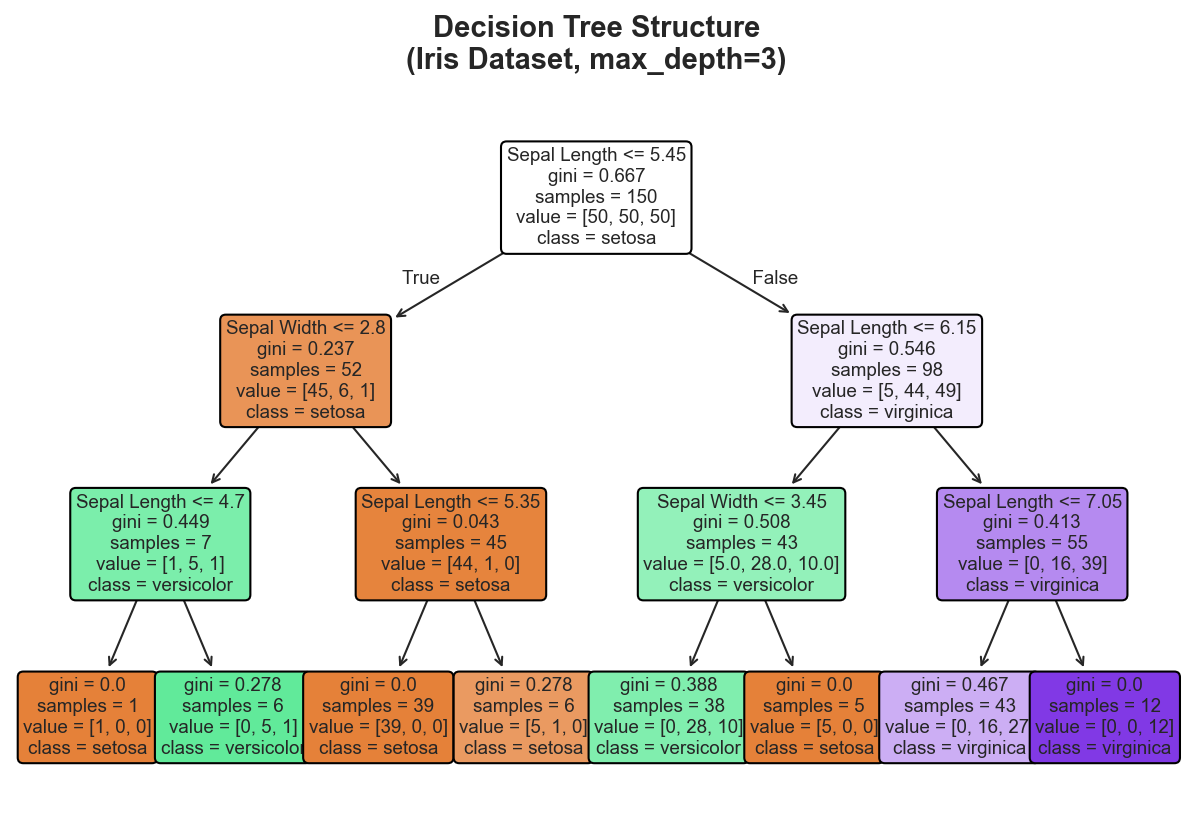
The visualization above shows a trained decision tree with:
- Internal nodes: Feature name, split threshold, Gini impurity, sample count
- Leaf nodes: Predicted class, color-coded by majority class
- Edges: True (left) for <= threshold, False (right) for > threshold
Decision Boundary Evolution
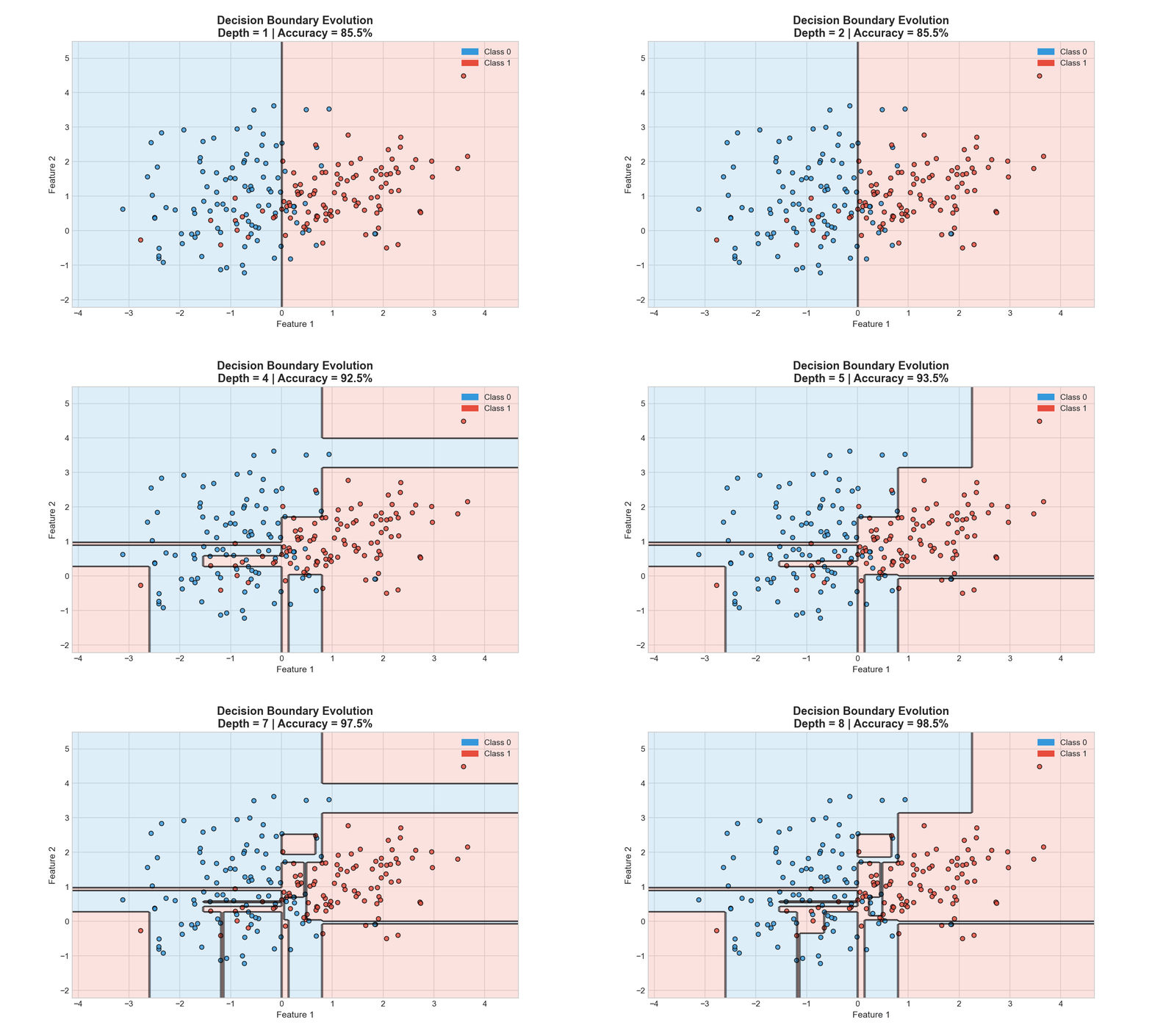
As tree depth increases, decision boundaries become more complex. The GIF above shows how the tree progressively partitions the feature space from simple (depth=1) to complex (depth=8).
ASCII Tree Representation
def print_tree(node, feature_names=None, depth=0, prefix="Root"):
    """Print decision tree in ASCII format."""
    indent = "  " * depth
    if node.is_leaf:
        print(f"{indent}{prefix}: Leaf(value={node.value}, samples={node.n_samples})")
    else:
        feature = feature_names[node.feature_index] if feature_names else f"X[{node.feature_index}]"
        print(f"{indent}{prefix}: {feature} <= {node.threshold:.2f}")
        print_tree(node.left, feature_names, depth + 1, "L")
print_tree(node.right, feature_names, depth + 1, "R")Pruning Strategies
Effect of Pruning on Accuracy
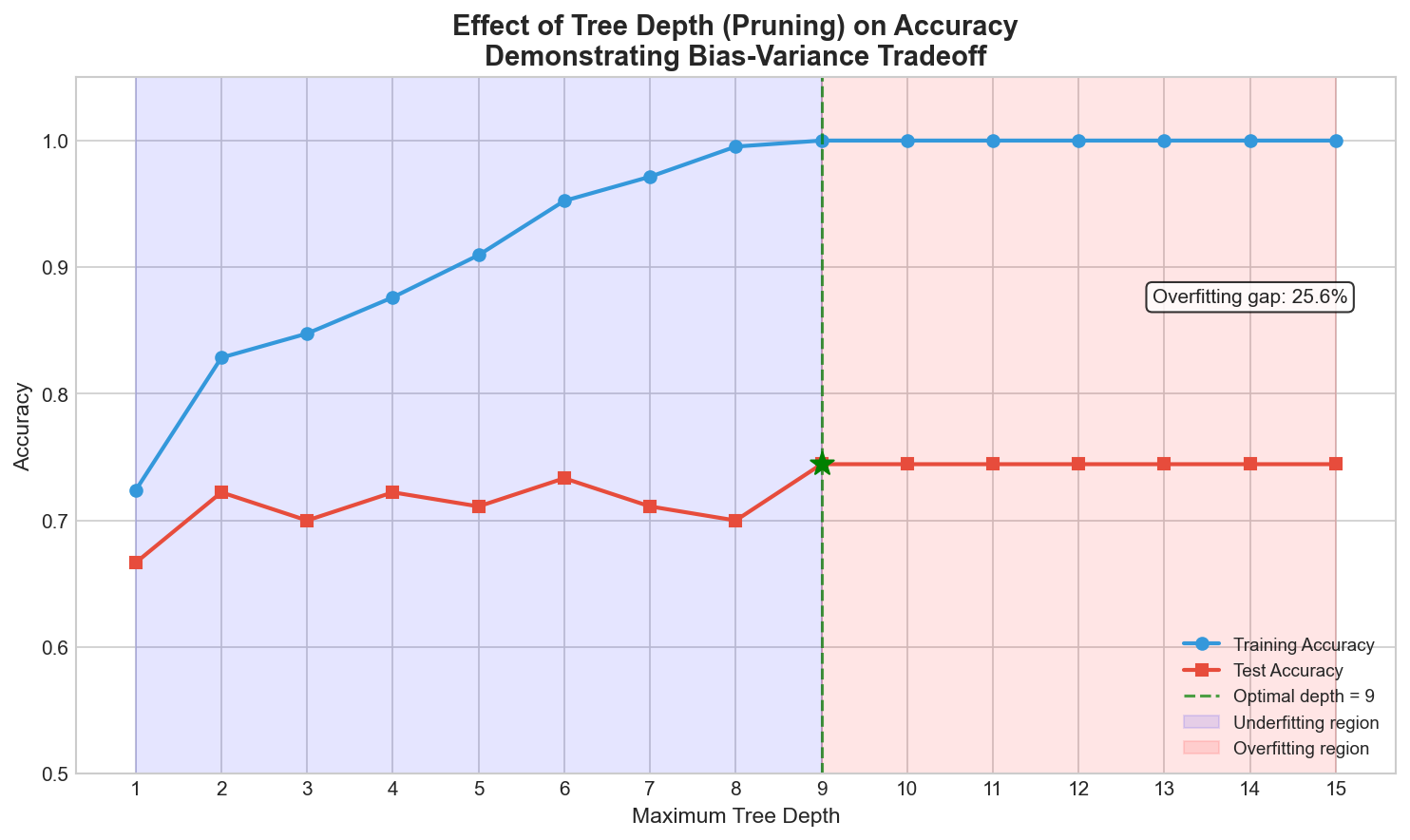
The chart above demonstrates the bias-variance tradeoff:
- Underfitting (shallow trees): High bias, low variance
- Overfitting (deep trees): Low bias, high variance
- Optimal depth: Best generalization on test data
Pre-pruning (Early Stopping)
Pre-pruning stops tree growth during construction:
class DecisionTreeWithPrePruning:
    """Pre-pruning parameters: max_depth, min_samples_split, min_samples_leaf, min_impurity_decrease"""
    def __init__(self, max_depth=None, min_samples_split=2,
                 min_samples_leaf=1, min_impurity_decrease=0.0):
        self.max_depth = max_depth
        self.min_samples_split = min_samples_split
        self.min_samples_leaf = min_samples_leaf
        self.min_impurity_decrease = min_impurity_decrease

    def _should_stop(self, depth, n_samples, impurity_decrease):
        """Check if we should stop growing."""
        return (self.max_depth is not None and depth >= self.max_depth or
                n_samples < self.min_samples_split or
impurity_decrease < self.min_impurity_decrease)Post-pruning (Cost-Complexity Pruning)
Post-pruning removes branches after full tree construction:
def cost_complexity_pruning(tree, X_val, y_val, alpha=0.01):
    """
    Minimal Cost-Complexity Pruning (CCP).

    Objective: min(R(T) + alpha * |T|)
    where R(T) is the misclassification rate and |T| is number of leaves.

    Args:
        tree: Fitted decision tree
        X_val: Validation features
        y_val: Validation labels
        alpha: Complexity parameter (higher = more pruning)
    """
    def count_leaves(node):
        if node.is_leaf:
            return 1
        return count_leaves(node.left) + count_leaves(node.right)

    def compute_error(node, X, y):
        """Compute misclassification error for samples reaching this node."""
        if len(y) == 0:
            return 0

        if node.is_leaf:
            # Error = samples that don't match leaf prediction
            return sum(1 for yi in y if yi != node.value)

        # Split samples and compute errors recursively
        left_mask = [X[i][node.feature_index] <= node.threshold
                     for i in range(len(X))]
        X_left = [X[i] for i in range(len(X)) if left_mask[i]]
        y_left = [y[i] for i in range(len(y)) if left_mask[i]]
        X_right = [X[i] for i in range(len(X)) if not left_mask[i]]
        y_right = [y[i] for i in range(len(y)) if not left_mask[i]]

        return (compute_error(node.left, X_left, y_left) +
                compute_error(node.right, X_right, y_right))

    def prune_node(node, X, y):
        """Recursively prune nodes if it reduces cost-complexity."""
        if node.is_leaf:
            return node

        # First, prune children
        left_mask = [X[i][node.feature_index] <= node.threshold
                     for i in range(len(X))]
        X_left = [X[i] for i in range(len(X)) if left_mask[i]]
        y_left = [y[i] for i in range(len(y)) if left_mask[i]]
        X_right = [X[i] for i in range(len(X)) if not left_mask[i]]
        y_right = [y[i] for i in range(len(y)) if not left_mask[i]]

        node.left = prune_node(node.left, X_left, y_left)
        node.right = prune_node(node.right, X_right, y_right)

        # Cost with subtree
        error_subtree = compute_error(node, X, y)
        leaves_subtree = count_leaves(node)
        cost_subtree = error_subtree + alpha * leaves_subtree

        # Cost if we collapse to leaf
        from collections import Counter
        majority_class = Counter(y).most_common(1)[0][0] if y else 0
        error_leaf = sum(1 for yi in y if yi != majority_class)
        cost_leaf = error_leaf + alpha * 1

        # Prune if leaf cost is better
        if cost_leaf <= cost_subtree:
            node.is_leaf = True
            node.value = majority_class
            node.left = None
            node.right = None

        return node

    # Prune the tree
    tree.root = prune_node(tree.root, list(X_val), list(y_val))
return treeReduced Error Pruning
def reduced_error_pruning(tree, X_val, y_val):
    """
    Reduced Error Pruning: Remove subtrees that don't improve validation accuracy.

    Algorithm:
    1. Evaluate validation accuracy
    2. For each internal node, consider converting to leaf
    3. If accuracy improves or stays same, prune
    4. Repeat until no improvements
    """
    def get_accuracy(tree, X, y):
        predictions = tree.predict(X)
        return sum(p == yi for p, yi in zip(predictions, y)) / len(y)

    def get_internal_nodes(node, nodes=None):
        """Get all internal (non-leaf) nodes."""
        if nodes is None:
            nodes = []
        if not node.is_leaf:
            nodes.append(node)
            get_internal_nodes(node.left, nodes)
            get_internal_nodes(node.right, nodes)
        return nodes

    improved = True
    while improved:
        improved = False
        current_accuracy = get_accuracy(tree, X_val, y_val)
        internal_nodes = get_internal_nodes(tree.root)

        for node in internal_nodes:
            # Save subtree
            old_left = node.left
            old_right = node.right
            old_is_leaf = node.is_leaf

            # Try converting to leaf
            from collections import Counter
            # Note: In practice, you'd track samples at each node
            node.is_leaf = True
            node.left = None
            node.right = None

            new_accuracy = get_accuracy(tree, X_val, y_val)

            if new_accuracy >= current_accuracy:
                # Keep pruning
                improved = True
                current_accuracy = new_accuracy
            else:
                # Restore subtree
                node.is_leaf = old_is_leaf
                node.left = old_left
                node.right = old_right

return treeHandling Categorical Features
from collections import Counter

def _gini(y):
    """Gini impurity for a list of labels."""
    if len(y) == 0:
        return 0.0
    n = len(y)
    return 1.0 - sum((c / n) ** 2 for c in Counter(y).values())

def compute_information_gain(y, y_left, y_right):
    """IG = impurity(parent) - weighted_avg(impurity(children))."""
    n = len(y)
    n_left, n_right = len(y_left), len(y_right)
    if n_left == 0 or n_right == 0:
        return 0.0
    weighted_child = (n_left / n) * _gini(y_left) + (n_right / n) * _gini(y_right)
    return _gini(y) - weighted_child

def handle_categorical_split(X, y, feature_idx, categories):
    """
    Handle categorical features with multi-way splits.

    For each category value, create a separate branch.
    Note: CART typically uses binary splits even for categorical features.
    """
    best_gain = 0
    best_split = None

    unique_categories = list(set(x[feature_idx] for x in X))

    # Binary split: one category vs rest (CART approach)
    for category in unique_categories:
        left_mask = [x[feature_idx] == category for x in X]
        y_left = [y[i] for i in range(len(y)) if left_mask[i]]
        y_right = [y[i] for i in range(len(y)) if not left_mask[i]]

        # Compute gain
        gain = compute_information_gain(y, y_left, y_right)

        if gain > best_gain:
            best_gain = gain
            best_split = ('categorical', feature_idx, category)

    return best_split, best_gain


def handle_categorical_one_hot(X, categorical_features):
    """
    One-hot encode categorical features for standard CART.

    Args:
        X: Feature matrix
        categorical_features: List of indices of categorical features

    Returns:
        Transformed feature matrix with one-hot encoding
    """
    X_new = []

    for x in X:
        x_new = []
        for i, val in enumerate(x):
            if i in categorical_features:
                # One-hot encode: create binary features for each category
                # This requires knowing all possible categories in advance
                pass  # Implementation depends on category mappings
            else:
                x_new.append(val)
        X_new.append(x_new)

return X_newComplexity Analysis
| Operation | Time Complexity | Space Complexity |
|---|---|---|
| Building tree (balanced) | O(n * m * log(n)) | O(n) |
| Building tree (worst case) | O(n^2 * m) | O(n) |
| Single prediction | O(log(n)) balanced, O(n) worst | O(1) |
| Batch prediction (k samples) | O(k * log(n)) | O(k) |
| Finding best split | O(n * m) | O(n) |
Where:
- n = number of training samples
- m = number of features
- Tree depth: O(log n) balanced, O(n) worst case
Memory Considerations:
- Each node stores: feature index, threshold, pointers to children
- Total nodes: up to 2n - 1 for binary tree
- Practical memory: O(number of nodes * node size)
Common Interview Follow-ups
1. How do you handle continuous vs categorical features?
Continuous features:
- Sort unique values
- Try thresholds at midpoints between consecutive values
- Binary split: left <= threshold, right > threshold
Categorical features:
- CART approach: Binary split (one category vs rest)
- ID3/C4.5 approach: Multi-way split (one branch per category)
- Practical: One-hot encode, then treat as binary features
2. How do you prevent overfitting?
See the pruning effect chart above. Key strategies:
| Strategy | Type | Parameters |
|---|---|---|
| Max depth | Pre-pruning | max_depth=5 |
| Min samples | Pre-pruning | min_samples_split=10, min_samples_leaf=5 |
| Cost-complexity | Post-pruning | ccp_alpha=0.01 |
| Ensembles | Alternative | Random Forest, Gradient Boosting |
3. Why Gini vs Entropy?
See the Gini vs Entropy comparison chart above. Key differences:
| Aspect | Gini | Entropy |
|---|---|---|
| Computation | Faster (no log) | Slower (requires log) |
| Range | [0, 0.5] for binary | [0, 1] for binary |
| Practice | Default in sklearn | C4.5 default |
4. How does feature importance work?
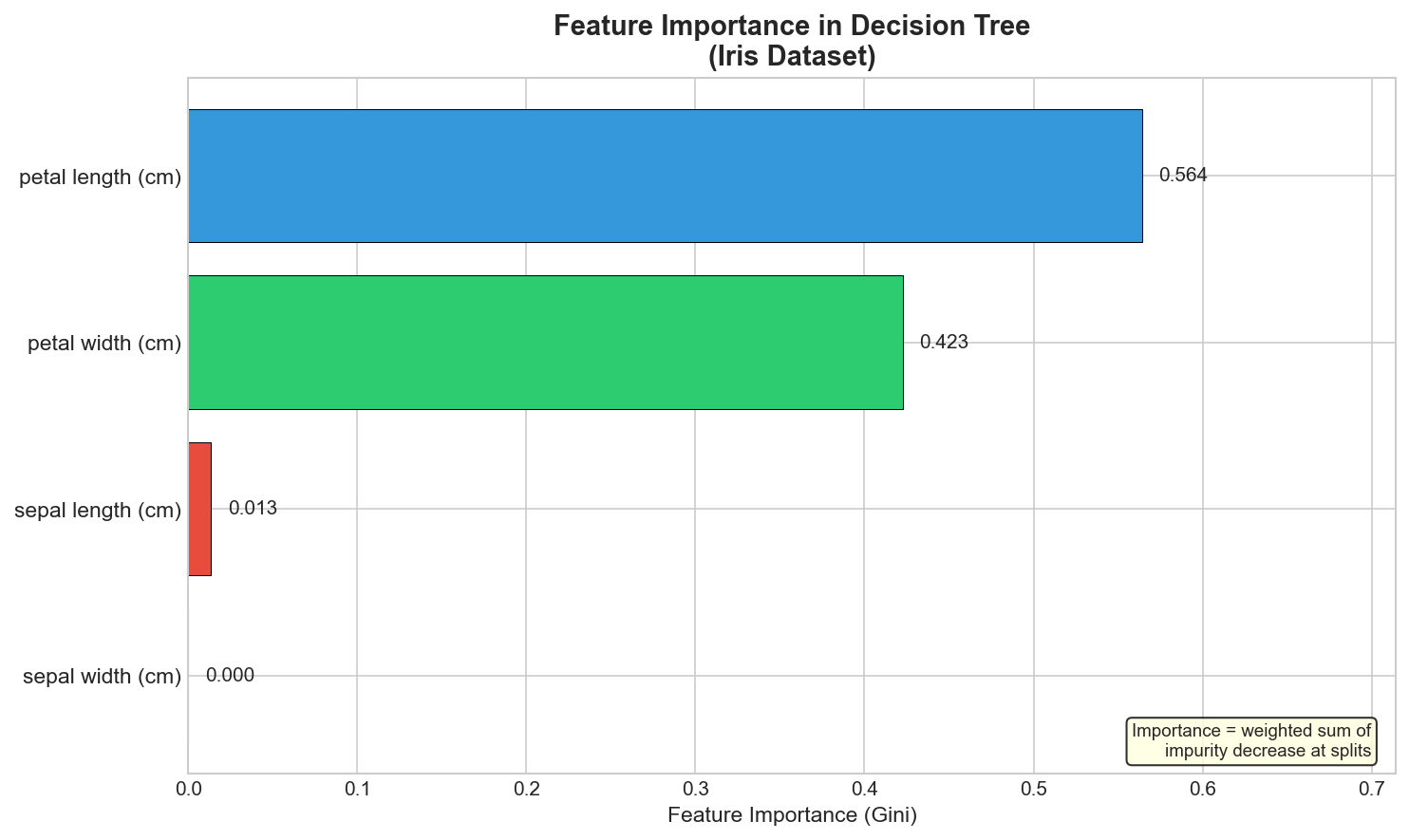
Feature importance is computed as the weighted sum of impurity decreases across all splits using that feature:
def compute_feature_importance(tree):
    """Compute feature importance based on impurity decrease."""
    importance = {}
    total_samples = tree.root.n_samples

    def traverse(node):
        if node.is_leaf:
            return
        n = node.n_samples
        decrease = (n / total_samples) * (
            node.impurity -
            (node.left.n_samples / n) * node.left.impurity -
            (node.right.n_samples / n) * node.right.impurity
        )
        importance[node.feature_index] = importance.get(node.feature_index, 0) + decrease
        traverse(node.left)
        traverse(node.right)

    traverse(tree.root)
    total = sum(importance.values())
return {k: v / total for k, v in importance.items()} if total > 0 else importance5. How do decision trees handle missing values?
Common approaches:
- Surrogate splits: Find alternative features that produce similar splits
- Send to majority: Missing values go to the child with more samples
- Fractional samples: Distribute sample to both children weighted by proportions
- Imputation: Fill missing values before training
def predict_with_missing(node, x):
    """Handle missing values during prediction."""
    if node.is_leaf:
        return node.value

    feature_val = x[node.feature_index]

    if feature_val is None or np.isnan(feature_val):
        # Strategy: go to child with more training samples
        if node.left.n_samples >= node.right.n_samples:
            return predict_with_missing(node.left, x)
        else:
            return predict_with_missing(node.right, x)

    if feature_val <= node.threshold:
        return predict_with_missing(node.left, x)
    else:
return predict_with_missing(node.right, x)Edge Cases and Pitfalls
Edge Case 1: All samples have same label
# All samples belong to class 0
X = [[1, 2], [3, 4], [5, 6]]
y = [0, 0, 0]

# Tree should immediately create a leaf node
# Gini/Entropy = 0 (pure), no split neededEdge Case 2: Single feature value
# All samples have same feature value
X = [[1, 1], [1, 2], [1, 3]]  # First feature is always 1
y = [0, 1, 0]

# Cannot split on first feature (no threshold variation)
# Must use second feature for splittingEdge Case 3: Numerical stability
def safe_log(x, epsilon=1e-15):
    """Avoid log(0) in entropy calculation."""
    return np.log2(np.maximum(x, epsilon))

def safe_gini(y):
    """Handle empty arrays."""
    if len(y) == 0:
        return 0.0
    counts = Counter(y)
    n = len(y)
return 1.0 - sum((c/n)**2 for c in counts.values())Edge Case 4: Highly imbalanced classes
# 95% class 0, 5% class 1
# Tree might predict all samples as class 0

# Solutions:
# 1. Class weights in impurity calculation
# 2. Oversample minority class
# 3. Use balanced accuracy as metric
# 4. Cost-sensitive learning

def weighted_gini(y, class_weights=None):
    """Gini with class weights for imbalanced data."""
    if len(y) == 0:
        return 0.0

    counts = Counter(y)
    n = len(y)

    if class_weights is None:
        class_weights = {c: 1.0 for c in counts.keys()}

    # Weight each class by its importance
    weighted_sum = sum(
        class_weights.get(c, 1.0) * (count/n)**2
        for c, count in counts.items()
    )

return 1.0 - weighted_sumEdge Case 5: Very deep trees
# Deep trees can lead to:
# 1. Overfitting
# 2. Stack overflow in recursive implementations
# 3. Very long prediction times

# Solution: Use iterative traversal
def predict_iterative(tree, x):
    """Non-recursive prediction to avoid stack overflow."""
    node = tree.root
    while not node.is_leaf:
        if x[node.feature_index] <= node.threshold:
            node = node.left
        else:
            node = node.right
return node.valueComplete Test Suite
import numpy as np

def test_decision_tree():
    """Comprehensive test suite for Decision Tree implementation."""

    # Test 1: Perfect separation
    print("Test 1: Perfect linear separation")
    X = np.array([[1, 1], [2, 2], [3, 3], [7, 7], [8, 8], [9, 9]])
    y = np.array([0, 0, 0, 1, 1, 1])

    tree = DecisionTreeClassifier(max_depth=3)
    tree.fit(X, y)
    predictions = tree.predict(X)
    accuracy = np.mean(predictions == y)
    assert accuracy == 1.0, f"Expected 100% accuracy, got {accuracy*100}%"
    print(f"  Accuracy: {accuracy*100}%  PASSED")

    # Test 2: XOR problem (non-linear)
    print("\nTest 2: XOR problem")
    X = np.array([[0, 0], [0, 1], [1, 0], [1, 1]])
    y = np.array([0, 1, 1, 0])

    tree = DecisionTreeClassifier(max_depth=3)
    tree.fit(X, y)
    predictions = tree.predict(X)
    accuracy = np.mean(predictions == y)
    assert accuracy == 1.0, f"Expected 100% accuracy, got {accuracy*100}%"
    print(f"  Accuracy: {accuracy*100}%  PASSED")

    # Test 3: Regression
    print("\nTest 3: Regression task")
    X = np.array([[1], [2], [3], [4], [5]])
    y = np.array([1.0, 2.0, 3.0, 4.0, 5.0])

    tree = DecisionTreeRegressor(max_depth=5)
    tree.fit(X, y)
    predictions = tree.predict(X)
    mse = np.mean((predictions - y) ** 2)
    print(f"  MSE: {mse:.4f}  {'PASSED' if mse < 0.1 else 'FAILED'}")

    # Test 4: Max depth constraint
    print("\nTest 4: Max depth constraint")
    X = np.random.randn(100, 5)
    y = (X[:, 0] > 0).astype(int)

    tree = DecisionTreeClassifier(max_depth=1)
    tree.fit(X, y)

    def get_depth(node, current=0):
        if node.is_leaf:
            return current
        return max(get_depth(node.left, current+1),
                   get_depth(node.right, current+1))

    depth = get_depth(tree.root)
    assert depth <= 1, f"Expected depth <= 1, got {depth}"
    print(f"  Tree depth: {depth}  PASSED")

    # Test 5: Min samples split
    print("\nTest 5: Min samples split")
    X = np.array([[1], [2], [3], [4], [5]])
    y = np.array([0, 0, 1, 1, 1])

    tree = DecisionTreeClassifier(min_samples_split=10)  # Won't split
    tree.fit(X, y)
    assert tree.root.is_leaf, "Root should be leaf with min_samples_split=10"
    print("  Root is leaf as expected  PASSED")

    # Test 6: Entropy criterion
    print("\nTest 6: Entropy criterion")
    X = np.array([[1, 1], [2, 2], [5, 5], [6, 6]])
    y = np.array([0, 0, 1, 1])

    tree = DecisionTreeClassifier(criterion='entropy')
    tree.fit(X, y)
    predictions = tree.predict(X)
    accuracy = np.mean(predictions == y)
    assert accuracy == 1.0
    print(f"  Accuracy with entropy: {accuracy*100}%  PASSED")

    # Test 7: Multiclass classification
    print("\nTest 7: Multiclass classification")
    X = np.array([[0, 0], [1, 1], [2, 2], [3, 3], [4, 4], [5, 5]])
    y = np.array([0, 0, 1, 1, 2, 2])

    tree = DecisionTreeClassifier(max_depth=5)
    tree.fit(X, y)
    predictions = tree.predict(X)
    accuracy = np.mean(predictions == y)
    print(f"  3-class accuracy: {accuracy*100}%  {'PASSED' if accuracy >= 0.8 else 'FAILED'}")

    print("\n" + "="*50)
    print("All tests completed!")

# Run tests
test_decision_tree()Optimization: Vectorized Split Finding
import numpy as np

def find_best_split_vectorized(X, y, min_samples_leaf=1):
    """
    Highly optimized split finding using vectorization.

    Uses cumulative sums for O(n*m) instead of O(n*m*n) complexity.
    """
    n_samples, n_features = X.shape
    n_classes = len(np.unique(y))

    best_gain = 0.0
    best_feature = None
    best_threshold = None

    # Pre-compute parent impurity
    parent_counts = np.bincount(y, minlength=n_classes)
    parent_probs = parent_counts / n_samples
    parent_gini = 1.0 - np.sum(parent_probs ** 2)

    for feature_idx in range(n_features):
        # Sort by feature value
        sorted_indices = np.argsort(X[:, feature_idx])
        sorted_y = y[sorted_indices]
        sorted_x = X[sorted_indices, feature_idx]

        # Find unique threshold positions
        unique_mask = np.concatenate([[True], sorted_x[1:] != sorted_x[:-1]])
        threshold_positions = np.where(unique_mask)[0][1:]  # Skip first

        if len(threshold_positions) == 0:
            continue

        # Cumulative class counts
        cumsum = np.zeros((n_samples + 1, n_classes))
        for c in range(n_classes):
            cumsum[1:, c] = np.cumsum(sorted_y == c)

        for pos in threshold_positions:
            n_left = pos
            n_right = n_samples - pos

            if n_left < min_samples_leaf or n_right < min_samples_leaf:
                continue

            # Left and right class distributions
            left_counts = cumsum[pos]
            right_counts = parent_counts - left_counts

            # Gini impurities
            left_gini = 1.0 - np.sum((left_counts / n_left) ** 2)
            right_gini = 1.0 - np.sum((right_counts / n_right) ** 2)

            weighted_gini = (n_left * left_gini + n_right * right_gini) / n_samples
            gain = parent_gini - weighted_gini

            if gain > best_gain:
                best_gain = gain
                best_feature = feature_idx
                # Threshold is midpoint between consecutive values
                best_threshold = (sorted_x[pos - 1] + sorted_x[pos]) / 2

return best_feature, best_threshold, best_gainPractice Problems
Problem 1: Implement Feature Importance
"""
Given a trained decision tree, implement a function to compute
feature importance based on total impurity decrease.

Example:
    tree = DecisionTreeClassifier().fit(X, y)
    importance = get_feature_importance(tree)
    # Returns: {0: 0.6, 1: 0.3, 2: 0.1}  (normalized to sum to 1)
"""

def get_feature_importance(tree):
    # Your implementation here
passProblem 2: Serialize and Deserialize Tree
"""
Implement functions to serialize a decision tree to JSON
and deserialize it back.

This is useful for model deployment and persistence.
"""

def serialize_tree(tree):
    # Your implementation here
    pass

def deserialize_tree(json_str):
    # Your implementation here
passProblem 3: Implement Random Forest
"""
Using your DecisionTreeClassifier, implement a basic Random Forest:
1. Bootstrap sampling
2. Random feature selection at each split
3. Majority voting for predictions

class RandomForestClassifier:
    def __init__(self, n_estimators=100, max_features='sqrt'):
        pass

    def fit(self, X, y):
        pass

    def predict(self, X):
        pass
"""Interview Tips
Start with clarifying questions - Ask about classification vs regression, splitting criterion preference
Draw the algorithm flow - Visualize the recursive structure before coding
Implement Gini first - It's simpler (no log) and commonly used
Handle edge cases early - Empty data, all same labels, insufficient samples
Trace through an example - Show the interviewer you understand the algorithm
Discuss trade-offs - Gini vs entropy, pre-pruning vs post-pruning
Know sklearn API - Even when implementing from scratch, match the familiar interface
Connect to ensemble methods - Show you understand Random Forests and Boosting
Complexity matters - Know that building is O(nmlog n) and prediction is O(log n)
Production considerations - Mention pruning, handling missing values, feature importance
Key Takeaways
| Concept | Key Point |
|---|---|
| Splitting Criterion | Gini is faster, entropy gives slightly different results |
| Stopping Conditions | Max depth, min samples, min impurity decrease |
| Overfitting | Use pruning (pre or post) or ensemble methods |
| Prediction | O(log n) - just traverse from root to leaf |
| Feature Importance | Based on total impurity decrease |
| Categorical Features | One-hot encode or use binary splits |
| Missing Values | Surrogate splits or go to majority child |
| Extensions | Random Forest = bagging + feature sampling |