Palindrome Partitioning
LeetCode: 131. Palindrome PartitioningDifficulty: Medium Pattern: Backtracking
Problem Statement
Given a string s, partition s such that every substring of the partition is a palindrome. Return all possible palindrome partitionings of s.
Examples
Example 1
Input: s = "aab"
Output: [["a", "a", "b"], ["aa", "b"]]Example 2
Input: s = "a"
Output: [["a"]]Example 3
Input: s = "aabb"
Output: [["a", "a", "b", "b"], ["a", "a", "bb"], ["aa", "b", "b"], ["aa", "bb"]]Constraints
1 <= s.length <= 16scontains only lowercase English letters
Backtracking Tree Visualization
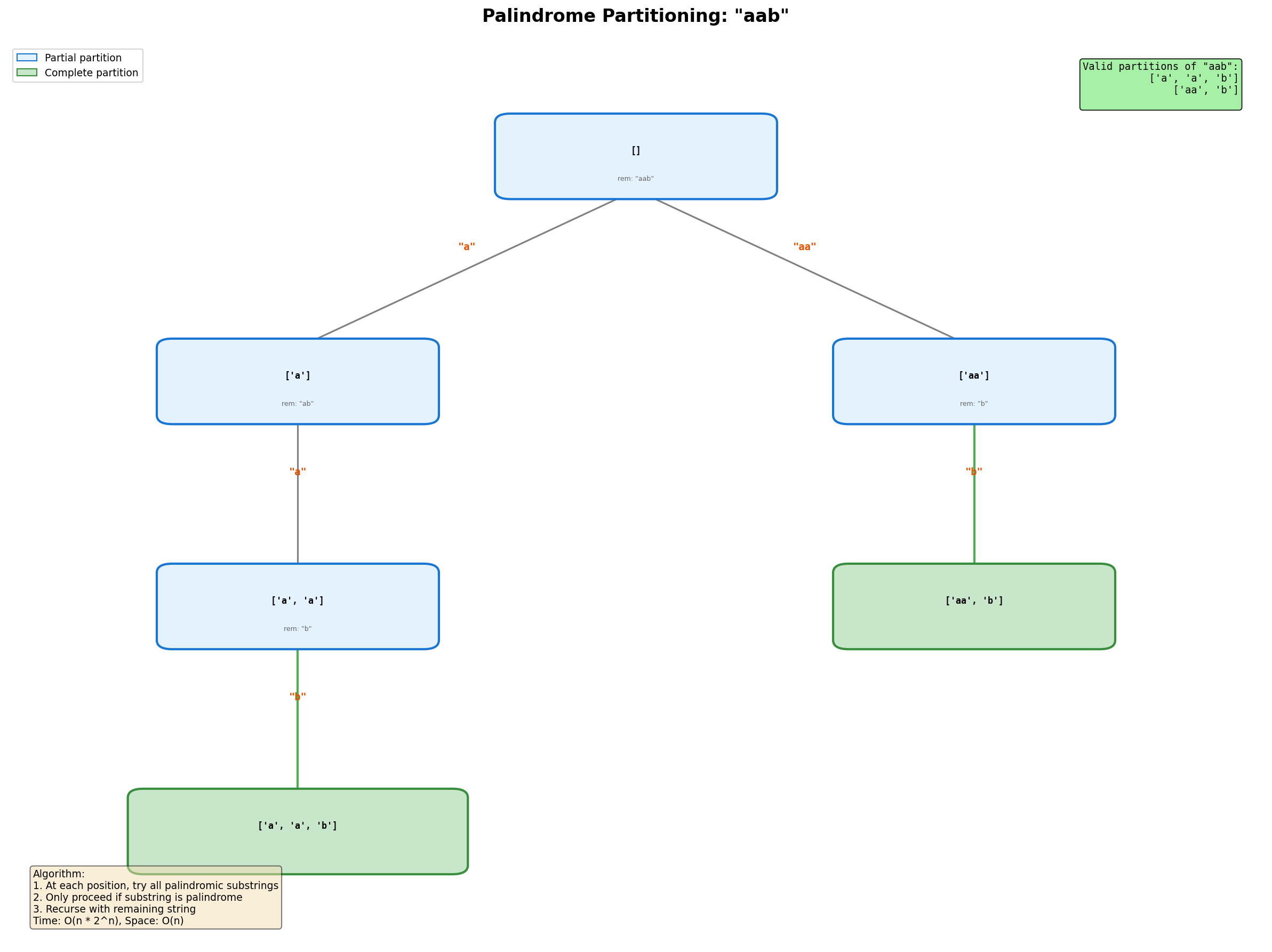
Decision Tree for "aab"
At each position, try all possible palindromic substrings starting there:
                    "" (remaining: "aab")
                   /       \
            ["a"]          ["aa"]
       (rem: "ab")        (rem: "b")
         /    \              |
   ["a","a"]  X           ["aa","b"]
   (rem:"b")  ("ab" not    (complete!)
      |        palindrome)
  ["a","a","b"]
   (complete!)

Result: [["a","a","b"], ["aa","b"]]Backtracking Template
def partition(s):
    """
    Palindrome partitioning template.

    At each position, try all palindromic substrings starting there.
    Only proceed if the substring is a palindrome.
    """
    result = []

    def is_palindrome(sub):
        return sub == sub[::-1]

    def backtrack(start, path):
        # BASE CASE: reached end of string
        if start == len(s):
            result.append(path[:])
            return

        # Try all possible substrings from start
        for end in range(start + 1, len(s) + 1):
            substring = s[start:end]

            # Only proceed if substring is palindrome
            if is_palindrome(substring):
                path.append(substring)
                backtrack(end, path)
                path.pop()

    backtrack(0, [])
return resultSolutions
Solution 1: Basic Backtracking
def partition(s: str) -> list:
    """
    Find all palindrome partitions using backtracking.

    Time Complexity: O(n * 2^n)
        - 2^n possible partitions
        - O(n) to check each palindrome
    Space Complexity: O(n) for recursion depth
    """
    result = []

    def is_palindrome(sub):
        return sub == sub[::-1]

    def backtrack(start, path):
        if start == len(s):
            result.append(path[:])
            return

        for end in range(start + 1, len(s) + 1):
            substring = s[start:end]
            if is_palindrome(substring):
                path.append(substring)
                backtrack(end, path)
                path.pop()

    backtrack(0, [])
    return result


# Test
print(partition("aab"))
# Output: [['a', 'a', 'b'], ['aa', 'b']]import java.util.*;
class Solution {
private String s;
private List<List<String>> result;
public List<List<String>> partition(String s) {
this.s = s;
this.result = new ArrayList<>();
backtrack(0, new ArrayList<>());
return result;
}
private void backtrack(int start, List<String> path) {
if (start == s.length()) {
result.add(new ArrayList<>(path)); // deep copy
return;
}
for (int end = start + 1; end <= s.length(); end++) {
String sub = s.substring(start, end);
if (isPalindrome(sub)) {
path.add(sub);
backtrack(end, path);
path.remove(path.size() - 1);
}
}
}
private boolean isPalindrome(String sub) {
int lo = 0, hi = sub.length() - 1;
while (lo < hi) {
if (sub.charAt(lo++) != sub.charAt(hi--)) return false;
}
return true;
}
}Complexity: Time O(n * 2^n) · Space O(n)
- Time: There are 2^(n-1) ways to partition (n-1 cut positions), and each palindrome check takes O(n) time, giving O(n * 2^n).
- Space: Recursion depth is at most n (one substring per level), plus the current path stores at most n substrings.
Solution 2: With DP Palindrome Pre-computation
def partition_dp(s: str) -> list:
    """
    Optimize palindrome checking with DP.

    Pre-compute all palindrome substrings for O(1) lookup.

    Time Complexity: O(n^2 + 2^n)
        - O(n^2) for palindrome DP
        - O(2^n) for backtracking
    Space Complexity: O(n^2) for palindrome DP
    """
    n = len(s)

    # Pre-compute palindromes
    # is_palin[i][j] = True if s[i:j+1] is palindrome
    is_palin = [[False] * n for _ in range(n)]

    # Single characters are palindromes
    for i in range(n):
        is_palin[i][i] = True

    # Check substrings of length 2+
    for length in range(2, n + 1):
        for i in range(n - length + 1):
            j = i + length - 1
            if s[i] == s[j]:
                if length == 2:
                    is_palin[i][j] = True
                else:
                    is_palin[i][j] = is_palin[i + 1][j - 1]

    result = []

    def backtrack(start, path):
        if start == n:
            result.append(path[:])
            return

        for end in range(start, n):
            if is_palin[start][end]:  # O(1) lookup!
                path.append(s[start:end + 1])
                backtrack(end + 1, path)
                path.pop()

    backtrack(0, [])
    return result


# Test
print(partition_dp("aab"))Complexity: Time O(n^2 + 2^n) · Space O(n^2)
- Time: O(n^2) to pre-compute all palindrome substrings in the DP table, then O(2^n) backtracking with O(1) palindrome lookups.
- Space: The is_palin table is n x n, storing boolean values for all substring pairs (i, j).
Solution 3: With Memoized Palindrome Check
from functools import lru_cache

def partition_memo(s: str) -> list:
    """
    Memoize palindrome checks without full pre-computation.

    Time Complexity: O(n * 2^n)
    Space Complexity: O(n^2) for memoization
    """
    result = []

    @lru_cache(maxsize=None)
    def is_palindrome(i, j):
        if i >= j:
            return True
        if s[i] != s[j]:
            return False
        return is_palindrome(i + 1, j - 1)

    def backtrack(start, path):
        if start == len(s):
            result.append(path[:])
            return

        for end in range(start, len(s)):
            if is_palindrome(start, end):
                path.append(s[start:end + 1])
                backtrack(end + 1, path)
                path.pop()

    backtrack(0, [])
    return result


# Test
print(partition_memo("aab"))Complexity: Time O(n * 2^n) · Space O(n^2)
- Time: Same O(2^n) backtracking; palindrome checks are lazily computed and cached via @lru_cache, avoiding redundant work.
- Space: The lru_cache can store up to O(n^2) entries (all possible (i, j) pairs), plus O(n) recursion depth.
Solution 4: Iterative with Stack
def partition_iterative(s: str) -> list:
    """
    Iterative approach using explicit stack.

    Time Complexity: O(n * 2^n)
    Space Complexity: O(n * 2^n)
    """
    def is_palindrome(sub):
        return sub == sub[::-1]

    result = []
    stack = [(0, [])]  # (start_index, current_partition)

    while stack:
        start, path = stack.pop()

        if start == len(s):
            result.append(path)
            continue

        for end in range(start + 1, len(s) + 1):
            substring = s[start:end]
            if is_palindrome(substring):
                stack.append((end, path + [substring]))

    return result


# Test
print(partition_iterative("aab"))Complexity: Time O(n * 2^n) · Space O(n * 2^n)
- Time: Same exploration as recursive approach; iterative stack traverses the same decision space.
- Space: The stack can hold multiple partial partitions; in the worst case, many paths are stored simultaneously before completion.
Complexity Analysis
| Approach | Time | Space | Notes |
|---|---|---|---|
| Basic | O(n * 2^n) | O(n) | Recomputes palindromes |
| DP Pre-compute | O(n^2 + 2^n) | O(n^2) | O(1) palindrome lookup |
| Memoized | O(n * 2^n) | O(n^2) | Lazy palindrome computation |
Why O(2^n)?
For a string of length n, there are n-1 positions where we can cut or not cut.
- Cut at position i: creates a new partition boundary
- Don't cut: extends current substring
This gives 2^(n-1) possible ways to partition.
DP Palindrome Table Visualization
For s = "aab":

      0   1   2
    +---+---+---+
  0 | T | T | F |   is_palin[0][1] = s[0]==s[1] = "aa" is palindrome
    +---+---+---+
  1 |   | T | F |   is_palin[1][2] = "ab" is NOT palindrome
    +---+---+---+
  2 |   |   | T |   is_palin[2][2] = "b" is palindrome (single char)
    +---+---+---+

Diagonal: All True (single characters)
is_palin[i][j] = s[i]==s[j] AND is_palin[i+1][j-1]Common Mistakes
1. Wrong Index in Range
# WRONG - excludes last character
for end in range(start, len(s)):  # Should be len(s) + 1 for slicing
    substring = s[start:end]  # s[start:len(s)-1] misses last char

# CORRECT - slice goes up to (but not including) end
for end in range(start + 1, len(s) + 1):
substring = s[start:end] # s[start:len(s)] includes all2. Off-by-One in DP Lookup
# WRONG - using wrong indices
if is_palin[start][end]:  # end is exclusive in slice but inclusive in DP!
    path.append(s[start:end + 1])

# CORRECT - match indices properly
for end in range(start, n):
    if is_palin[start][end]:  # end is INCLUSIVE here
path.append(s[start:end + 1]) # slice needs end + 13. Modifying Path Without Copy
# WRONG - all results point to same list
result.append(path)

# CORRECT - append a copy
result.append(path[:])Related Problems
Palindrome Partitioning II (LeetCode 132)
Problem: Return the minimum cuts needed to partition string into palindromes.
Key Insight: Optimization (min cuts) vs enumeration (all partitions) - use DP instead of backtracking.
Approach: DP with dp[i] = min cuts to partition s[0:i]. Use is_palindrome DP table for O(1) checks.
Complexity: O(n^2) time, O(n^2) space
Link: LeetCode 132
Longest Palindromic Substring (LeetCode 5)
Problem: Return the longest palindromic substring in s.
Key Insight: Same DP table construction for palindrome checking.
Approach: Expand around center OR DP table. Track longest while building table.
Complexity: O(n^2) time, O(1) space (expand) or O(n^2) (DP)
Link: LeetCode 5
Subsets (LeetCode 78)
Problem: Return all possible subsets of distinct integers.
Key Insight: Same backtracking structure - at each position, make choices and recurse.
Approach: Similar template - add to result, iterate choices, recurse, backtrack.
Complexity: O(n * 2^n) time
Link: Local Solution
Word Break II (LeetCode 140)
Problem: Return all sentences where string can be segmented into dictionary words.
Key Insight: Same partition structure - instead of palindrome check, check if prefix in dictionary.
Approach: At each position, try all valid word prefixes, recurse on suffix.
Complexity: O(2^n * n) worst case
Link: LeetCode 140
Interview Tips
- Start with brute force: Show basic backtracking first
- Identify repeated work: Palindrome checks are O(n) each
- Optimize with DP: Pre-compute palindrome table for O(1) lookup
- Discuss tradeoffs: O(n^2) extra space vs repeated computation
- Walk through example: Use "aab" to demonstrate branching
Key Takeaways
- Partition problem = backtracking at cut points
- Only proceed if substring is palindrome - this prunes the tree
- DP pre-computation reduces palindrome check from O(n) to O(1)
- 2^n possible partitions in worst case
- Common pattern: Similar to word break and subset problems
Last updated: January 2026