Coin Change
Problem Statement
You are given an integer array coins representing coins of different denominations and an integer amount representing a total amount of money. Return the fewest number of coins that you need to make up that amount. If that amount of money cannot be made up by any combination of the coins, return -1.
You may assume that you have an infinite number of each kind of coin.
Input/Output Format
Input:
coins(List[int]): Array of coin denominationsamount(int): Target amount to achieve
Output:
- (int): Minimum number of coins needed, or -1 if impossible
Constraints
1 <= coins.length <= 121 <= coins[i] <= 2^31 - 10 <= amount <= 10^4
Examples
Example 1: Standard Case
Input: coins = [1, 2, 5], amount = 11
Output: 3
Explanation: 11 = 5 + 5 + 1 (3 coins)
Possible combinations:
=====================
11 = 5 + 5 + 1     = 3 coins  <-- Optimal
11 = 5 + 2 + 2 + 2 = 4 coins
11 = 5 + 2 + 2 + 1 + 1 = 5 coins
11 = 2 + 2 + 2 + 2 + 2 + 1 = 6 coins
... and many more

Greedy doesn't always work!
For amount = 11, coins = [1, 5, 6]:
Greedy: 6 + 5 = 11 (2 coins) - happens to be optimal
For amount = 10, coins = [1, 5, 6]:
Greedy: 6 + 1 + 1 + 1 + 1 = 10 (5 coins)
Optimal: 5 + 5 = 10 (2 coins)Example 2: Impossible Case
Input: coins = [2], amount = 3
Output: -1
Explanation: Cannot make amount 3 with only coin denomination 2.
With only coin 2:
- 2 coins = 4 (too much)
- 1 coin = 2 (too little)
- No way to make exactly 3Example 3: Zero Amount
Input: coins = [1], amount = 0
Output: 0
Explanation: No coins needed to make amount 0.
Example 4: Single Coin Type
Input: coins = [1], amount = 5
Output: 5
Explanation: 5 = 1 + 1 + 1 + 1 + 1 (5 coins)
Visual Explanation
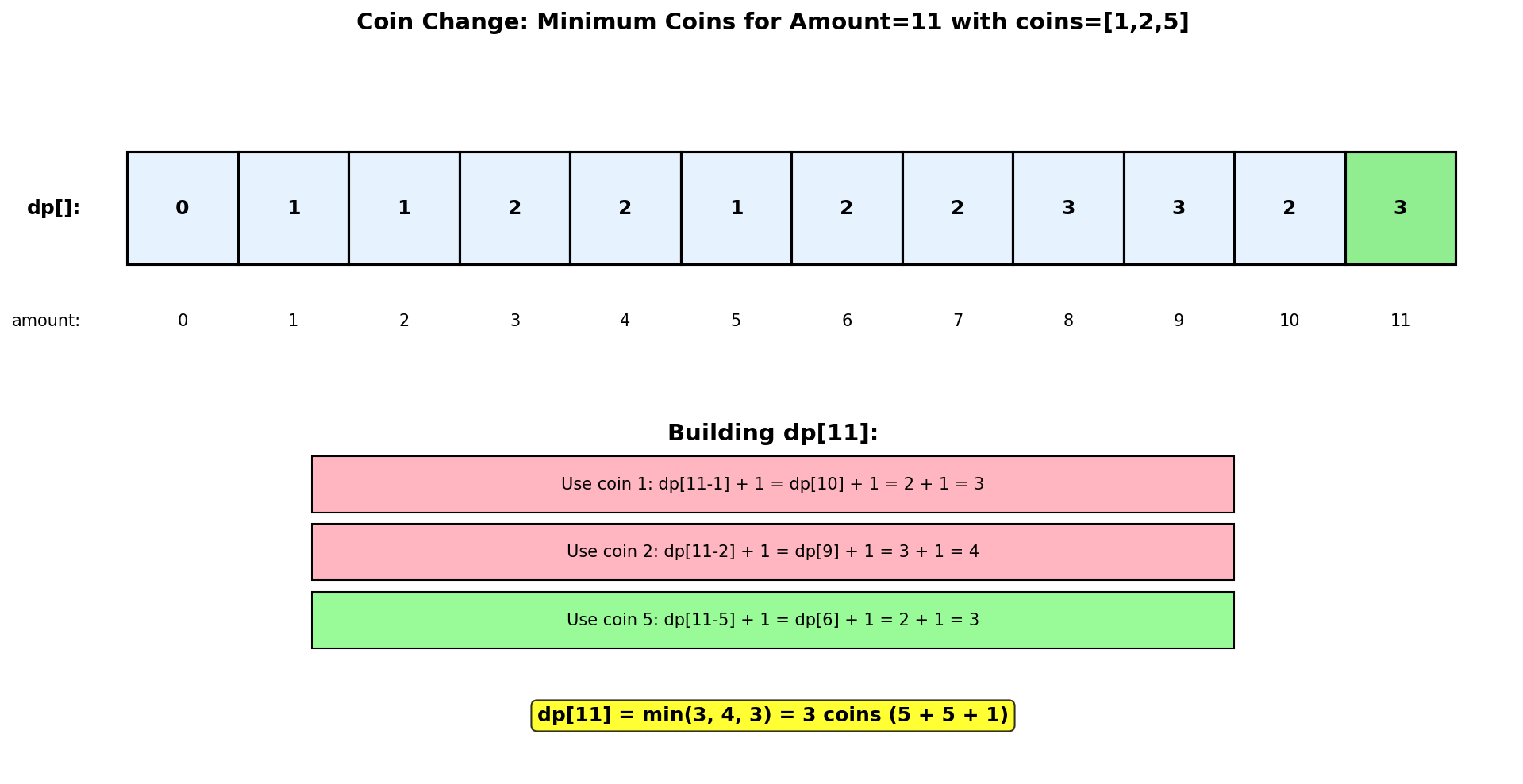
ASCII Art: DP Table Building
coins = [1, 2, 5], amount = 11

DP Table: dp[i] = minimum coins needed for amount i
        (INF means impossible)

Amount:    0    1    2    3    4    5    6    7    8    9   10   11
         +----+----+----+----+----+----+----+----+----+----+----+----+
dp[]:    | 0  | 1  | 1  | 2  | 2  | 1  | 2  | 2  | 3  | 3  | 2  | 3  |
         +----+----+----+----+----+----+----+----+----+----+----+----+

Building dp[11]:
================
For each coin c in [1, 2, 5]:
  - coin 1: dp[11-1] + 1 = dp[10] + 1 = 2 + 1 = 3
  - coin 2: dp[11-2] + 1 = dp[9] + 1 = 3 + 1 = 4
  - coin 5: dp[11-5] + 1 = dp[6] + 1 = 2 + 1 = 3

dp[11] = min(3, 4, 3) = 3

Reconstruction: 11 -> 6 (used 5) -> 1 (used 5) -> 0 (used 1)
Answer: [5, 5, 1] = 3 coinsSolution Code
Approach 1: Top-Down (Memoization)
from typing import List
from functools import lru_cache

def coinChange(coins: List[int], amount: int) -> int:
    """
    Find minimum coins using memoization.

    For each amount, try using each coin and take the minimum.

    Args:
        coins: Available coin denominations
        amount: Target amount

    Returns:
        Minimum number of coins, or -1 if impossible

    Time Complexity: O(amount * len(coins))
    Space Complexity: O(amount)
    """
    @lru_cache(maxsize=None)
    def dp(remaining: int) -> int:
        """Return min coins needed for remaining amount."""
        # Base cases
        if remaining == 0:
            return 0
        if remaining < 0:
            return float('inf')

        # Try each coin
        min_coins = float('inf')
        for coin in coins:
            result = dp(remaining - coin)
            if result != float('inf'):
                min_coins = min(min_coins, result + 1)

        return min_coins

    result = dp(amount)
return result if result != float('inf') else -1Complexity: Time O(amount * n) · Space O(amount)
- Time: Each amount from 0 to target is computed once via memoization. For each amount, we try all n coin denominations.
- Space: The memoization cache stores at most amount+1 entries, plus recursion stack depth proportional to amount.
Approach 2: Bottom-Up (Tabulation)
from typing import List

def coinChange(coins: List[int], amount: int) -> int:
    """
    Find minimum coins using bottom-up DP.

    Build solution from amount 0 to target amount.

    Args:
        coins: Available coin denominations
        amount: Target amount

    Returns:
        Minimum number of coins, or -1 if impossible

    Time Complexity: O(amount * len(coins))
    Space Complexity: O(amount)
    """
    # dp[i] = minimum coins needed for amount i
    # Initialize with amount + 1 (impossible value)
    dp = [amount + 1] * (amount + 1)
    dp[0] = 0  # 0 coins for amount 0

    for i in range(1, amount + 1):
        for coin in coins:
            if coin <= i:
                dp[i] = min(dp[i], dp[i - coin] + 1)

return dp[amount] if dp[amount] <= amount else -1public int coinChange(int[] coins, int amount) {
// dp[i] = minimum coins needed for amount i
int[] dp = new int[amount + 1];
Arrays.fill(dp, amount + 1); // impossible sentinel
dp[0] = 0;
for (int i = 1; i <= amount; i++) {
for (int coin : coins) {
if (coin <= i) {
dp[i] = Math.min(dp[i], dp[i - coin] + 1);
}
}
}
return dp[amount] <= amount ? dp[amount] : -1;
}Complexity: Time O(amount * n) · Space O(amount)
- Time: Outer loop runs amount times, inner loop tries all n coins for each amount, giving O(amount * n) total operations.
- Space: The dp array of size amount+1 stores the minimum coins needed for each sub-amount.
Approach 3: BFS (Shortest Path)
from typing import List
from collections import deque

def coinChange(coins: List[int], amount: int) -> int:
    """
    Find minimum coins using BFS.

    Treat this as a shortest path problem where each state
    is a remaining amount and edges are coin choices.

    Args:
        coins: Available coin denominations
        amount: Target amount

    Returns:
        Minimum number of coins, or -1 if impossible

    Time Complexity: O(amount * len(coins))
    Space Complexity: O(amount)
    """
    if amount == 0:
        return 0

    visited = [False] * (amount + 1)
    queue = deque([amount])
    visited[amount] = True
    level = 0

    while queue:
        level += 1
        for _ in range(len(queue)):
            curr = queue.popleft()

            for coin in coins:
                remaining = curr - coin

                if remaining == 0:
                    return level

                if remaining > 0 and not visited[remaining]:
                    visited[remaining] = True
                    queue.append(remaining)

return -1Complexity: Time O(amount * n) · Space O(amount)
- Time: BFS visits each reachable amount at most once. For each visited state, we try all n coin transitions.
- Space: The visited array and queue can each hold up to amount elements in the worst case.
Approach 4: With Coin Tracking
from typing import List, Tuple

def coinChangeWithCoins(coins: List[int], amount: int) -> Tuple[int, List[int]]:
    """
    Find minimum coins and return the actual coins used.

    Args:
        coins: Available coin denominations
        amount: Target amount

    Returns:
        Tuple of (minimum coins, list of coins used)

    Time Complexity: O(amount * len(coins))
    Space Complexity: O(amount)
    """
    if amount == 0:
        return (0, [])

    dp = [amount + 1] * (amount + 1)
    dp[0] = 0

    # Track which coin was used to reach each amount
    parent = [-1] * (amount + 1)

    for i in range(1, amount + 1):
        for coin in coins:
            if coin <= i and dp[i - coin] + 1 < dp[i]:
                dp[i] = dp[i - coin] + 1
                parent[i] = coin

    if dp[amount] > amount:
        return (-1, [])

    # Reconstruct the coins used
    coins_used = []
    current = amount
    while current > 0:
        coin = parent[current]
        coins_used.append(coin)
        current -= coin

return (dp[amount], coins_used)Complexity: Time O(amount * n) · Space O(amount)
- Time: Same as Approach 2, with additional O(amount) work to reconstruct the coins used by following parent pointers.
- Space: Two arrays of size amount+1 (dp and parent) for tracking both minimum coins and which coin was used.
Complexity Analysis
| Approach | Time Complexity | Space Complexity |
|---|---|---|
| Top-Down (Memoization) | O(amount * n) | O(amount) |
| Bottom-Up (Tabulation) | O(amount * n) | O(amount) |
| BFS | O(amount * n) | O(amount) |
Where n = number of coin denominations.
Edge Cases
Amount is 0:
pythoncoinChange([1, 2, 5], 0) # Returns 0Single coin that divides evenly:
pythoncoinChange([5], 10) # Returns 2 (5 + 5)Single coin that doesn't divide evenly:
pythoncoinChange([5], 11) # Returns -1Coin equals amount:
pythoncoinChange([1, 5, 10], 5) # Returns 1Large coin denominations:
pythoncoinChange([100, 200], 50) # Returns -1Amount smaller than all coins:
pythoncoinChange([5, 10], 3) # Returns -1
Key Insights
Unbounded Knapsack Variant: This is a classic unbounded knapsack problem where each coin can be used unlimited times.
Optimal Substructure: The minimum coins for amount
acan be computed from minimum coins for amounta - coinfor each coin.Greedy Doesn't Work: A greedy approach (always pick largest coin) fails for cases like coins=[1,3,4], amount=6 where greedy gives 4+1+1=3 coins but optimal is 3+3=2 coins.
State Definition:
dp[i]= minimum number of coins needed to make amounti.Recurrence Relation:
dp[i] = min(dp[i - coin] + 1)for all valid coins.Initialization: Use
amount + 1orinfinityas impossible marker, not-1, to make min comparisons work correctly.
Related Problems
Coin Change II (LeetCode 518)
Problem: Count the number of distinct combinations to make up the target amount using given coins (unlimited supply).
Key Insight: Unlike Coin Change I (minimizing), this counts combinations. Iterate coins in outer loop to avoid counting permutations.
Approach: dp[a] += dp[a - coin] with outer loop over coins. This ensures each combination is counted once, not each permutation.
Complexity: O(amount * n) time, O(amount) space
Perfect Squares (LeetCode 279)
Problem: Given integer n, find the minimum number of perfect square numbers (1, 4, 9, 16, ...) that sum to n.
Key Insight: Identical structure to Coin Change, but "coins" are perfect squares up to sqrt(n).
Approach: dp[n] = min(dp[n - i*i] + 1) for all i where i*i <= n. Every number can be represented (by Lagrange's Four Square Theorem, max 4).
Complexity: O(n * sqrt(n)) time, O(n) space
Minimum Cost For Tickets (LeetCode 983)
Problem: Given travel days and ticket costs for 1-day, 7-day, 30-day passes, find minimum cost to cover all travel days.
Key Insight: Similar unbounded knapsack but with variable "coverage" per ticket type.
Approach: dp[d] = min(dp[d-1] + cost[0], dp[d-7] + cost[1], dp[d-30] + cost[2]) on travel days.
Complexity: O(max(days)) time, O(max(days)) space
Integer Break (LeetCode 343)
Problem: Given integer n >= 2, break it into sum of positive integers and maximize their product.
Key Insight: Similar DP structure but maximize product instead of minimize count. Choose optimal split point.
Approach: dp[i] = max(j * (i-j), j * dp[i-j]) for j in [1, i-1]. The key is choosing between (i-j) directly or dp[i-j].
Complexity: O(n^2) time, O(n) space