Group Anagrams
Problem Statement
Given an array of strings strs, group the anagrams together. You can return the answer in any order.
An Anagram is a word or phrase formed by rearranging the letters of a different word or phrase, typically using all the original letters exactly once.
LeetCode: 49. Group Anagrams
Examples
Example 1:
Input: strs = ["eat","tea","tan","ate","nat","bat"]
Output: [["bat"],["nat","tan"],["ate","eat","tea"]]Example 2:
Input: strs = [""]
Output: [[""]]Example 3:
Input: strs = ["a"]
Output: [["a"]]Constraints
1 <= strs.length <= 10^40 <= strs[i].length <= 100strs[i]consists of lowercase English letters.
Hash Map Approach
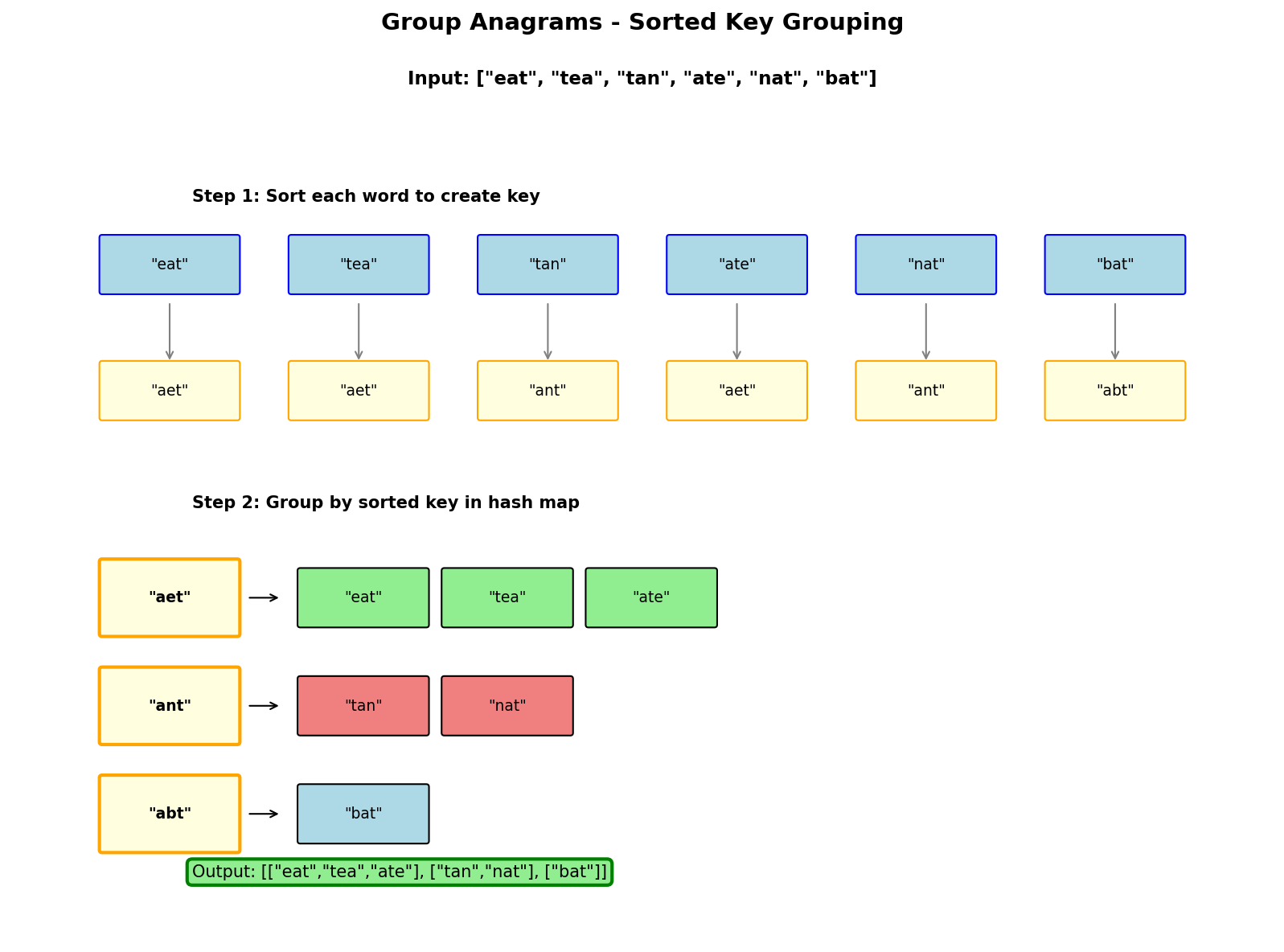
Key Insight
Anagrams have the same characters with the same frequencies. Use a canonical form (sorted string or character count) as the hash map key.
Algorithm
- Create a hash map where key = canonical form, value = list of anagrams
- For each string, compute its canonical form
- Add the string to the corresponding group
- Return all groups
Solution
from collections import defaultdict
from typing import List

def groupAnagrams(strs: List[str]) -> List[List[str]]:
    """
    Group anagrams using sorted string as key.

    Time: O(n * k log k) where n = len(strs), k = max string length
    Space: O(n * k) - storing all strings
    """
    groups = defaultdict(list)

    for s in strs:
        # Sorted string as key
        key = tuple(sorted(s))
        groups[key].append(s)

return list(groups.values())import java.util.*;
class Solution {
public List<List<String>> groupAnagrams(String[] strs) {
Map<String, List<String>> groups = new HashMap<>();
for (String s : strs) {
char[] chars = s.toCharArray();
Arrays.sort(chars);
String key = new String(chars);
groups.computeIfAbsent(key, k -> new ArrayList<>()).add(s);
}
return new ArrayList<>(groups.values());
}
}Complexity: Time O(n * k log k) · Space O(n * k)
- Time: For each of n strings, sorting k characters takes O(k log k); total is O(n * k log k)
- Space: Hash map stores all n strings; each key is a tuple of length k
# Optimized: Character count as key (avoids sorting)
def groupAnagramsOptimized(strs: List[str]) -> List[List[str]]:
    """
    Use character count tuple as key.

    Time: O(n * k) - no sorting needed
    Space: O(n * k)
    """
    groups = defaultdict(list)

    for s in strs:
        # Count characters
        count = [0] * 26
        for char in s:
            count[ord(char) - ord('a')] += 1

        # Tuple of counts as key
        groups[tuple(count)].append(s)

return list(groups.values())Complexity: Time O(n * k) · Space O(n * k)
- Time: Counting k characters per string is O(k); no sorting needed - linear in total characters
- Space: Hash map stores n strings; keys are 26-element tuples (constant per key)
# Using Counter as key
from collections import Counter

def groupAnagramsCounter(strs: List[str]) -> List[List[str]]:
    """
    Use frozenset of Counter items as key.

    Time: O(n * k)
    Space: O(n * k)
    """
    groups = defaultdict(list)

    for s in strs:
        # frozenset of (char, count) pairs
        key = frozenset(Counter(s).items())
        groups[key].append(s)

return list(groups.values())Complexity: Time O(n * k) · Space O(n * k)
- Time: Counter creation is O(k) per string; frozenset creation is O(unique chars) per string
- Space: Hash map for n strings; frozenset keys store only non-zero character counts
Complexity Analysis
| Approach | Time | Space |
|---|---|---|
| Sorted Key | O(n * k log k) | O(n * k) |
| Count Key | O(n * k) | O(n * k) |
| Counter Key | O(n * k) | O(n * k) |
Where n = number of strings, k = maximum string length
Why Count Key is Faster
- Sorting each string: O(k log k)
- Counting characters: O(k)
For long strings, the count-based approach is more efficient.
Edge Cases
- Empty string:
[""]- Empty string is its own group - Single string:
["a"]- One group with one element - All same:
["a","a","a"]- All in one group - No anagrams:
["a","b","c"]- Each in separate group - Different lengths: Cannot be anagrams, separate groups
Variations
Find All Anagrams in a String
Find all start indices of p's anagrams in s:
def findAnagrams(s: str, p: str) -> List[int]:
    """
    Sliding window approach.

    Time: O(n)
    Space: O(1)
    """
    if len(p) > len(s):
        return []

    result = []
    p_count = [0] * 26
    s_count = [0] * 26

    # Count characters in p
    for char in p:
        p_count[ord(char) - ord('a')] += 1

    # Initialize window
    for i in range(len(p)):
        s_count[ord(s[i]) - ord('a')] += 1

    if s_count == p_count:
        result.append(0)

    # Slide window
    for i in range(len(p), len(s)):
        # Add new character
        s_count[ord(s[i]) - ord('a')] += 1
        # Remove old character
        s_count[ord(s[i - len(p)]) - ord('a')] -= 1

        if s_count == p_count:
            result.append(i - len(p) + 1)

return resultComplexity: Time O(n) · Space O(1)
- Time: Single pass with fixed-size array comparison (O(26) = O(1) per position)
- Space: Two 26-element arrays regardless of input size
Group Shifted Strings
Group strings that can be shifted to form each other (e.g., "abc" -> "bcd"):
def groupStrings(strings: List[str]) -> List[List[str]]:
    """
    Group strings by their shift pattern.

    Time: O(n * k)
    Space: O(n * k)
    """
    groups = defaultdict(list)

    for s in strings:
        if not s:
            groups[()].append(s)
            continue

        # Calculate shift pattern (differences between consecutive chars)
        key = tuple((ord(s[i]) - ord(s[i-1])) % 26 for i in range(1, len(s)))
        groups[key].append(s)

return list(groups.values())Complexity: Time O(n * k) · Space O(n * k)
- Time: Computing shift pattern for each string is O(k); n strings total
- Space: Hash map stores n strings; keys are tuples of length k-1 differences
Check If Two Strings Are K-Anagrams
Two strings are k-anagrams if they can become anagrams by changing at most k characters:
def areKAnagrams(s1: str, s2: str, k: int) -> bool:
    """
    Check if s1 and s2 are k-anagrams.

    Time: O(n)
    Space: O(1)
    """
    if len(s1) != len(s2):
        return False

    count = [0] * 26

    for char in s1:
        count[ord(char) - ord('a')] += 1

    for char in s2:
        count[ord(char) - ord('a')] -= 1

    # Count characters that need to change
    changes_needed = sum(c for c in count if c > 0)

return changes_needed <= kComplexity: Time O(n) · Space O(1)
- Time: Two passes through strings of length n, plus O(26) sum operation
- Space: Fixed 26-element array for lowercase letter counts
Interview Tips
- Clarify constraints: ASCII only? Case sensitive?
- Discuss trade-offs: Sorting vs counting approaches
- Consider edge cases: Empty strings, single characters
- Mention optimizations: Count-based key for long strings
Common Mistakes
- Using string as key instead of tuple (strings are mutable in some contexts)
- Not handling empty strings
- Forgetting to convert Counter to hashable type
Related Problems
Valid Anagram (LeetCode 242)
Problem: Determine if two strings are anagrams of each other.
Key Insight: Anagrams have identical character frequencies.
Approach: Count characters in both strings. Compare counts - must be equal.
Complexity: Time O(n), Space O(1) - only 26 letters
Find All Anagrams in a String (LeetCode 438)
Problem: Find all starting indices of p's anagrams in s.
Key Insight: Sliding window of fixed size with frequency matching.
Approach: Maintain window of size len(p). Compare frequency counts at each position.
Complexity: Time O(n), Space O(1)
Group Shifted Strings (LeetCode 249)
Problem: Group strings that can become each other by shifting all characters.
Key Insight: Normalize by computing relative differences between consecutive characters.
Approach: Create key from character differences (mod 26). Group by this key.
Complexity: Time O(n * k), Space O(n * k)
Permutation in String (LeetCode 567)
Problem: Check if s2 contains a permutation of s1.
Key Insight: A permutation has the same character frequency as original.
Approach: Fixed-size sliding window over s2 with frequency comparison against s1.
Complexity: Time O(n), Space O(1)