Rotate Array
Problem Statement
Given an integer array nums, rotate the array to the right by k steps, where k is non-negative.
Follow up:
- Try to come up with as many solutions as you can. There are at least three different ways to solve this problem.
- Could you do it in-place with O(1) extra space?
Examples
Example 1
Input: nums = [1, 2, 3, 4, 5, 6, 7], k = 3
Output: [5, 6, 7, 1, 2, 3, 4]
Explanation:
rotate 1 step to the right: [7, 1, 2, 3, 4, 5, 6]
rotate 2 step to the right: [6, 7, 1, 2, 3, 4, 5]
rotate 3 steps to the right: [5, 6, 7, 1, 2, 3, 4]Example 2
Input: nums = [-1, -100, 3, 99], k = 2
Output: [3, 99, -1, -100]
Explanation:
rotate 1 step to the right: [99, -1, -100, 3]
rotate 2 steps to the right: [3, 99, -1, -100]Visual Explanation
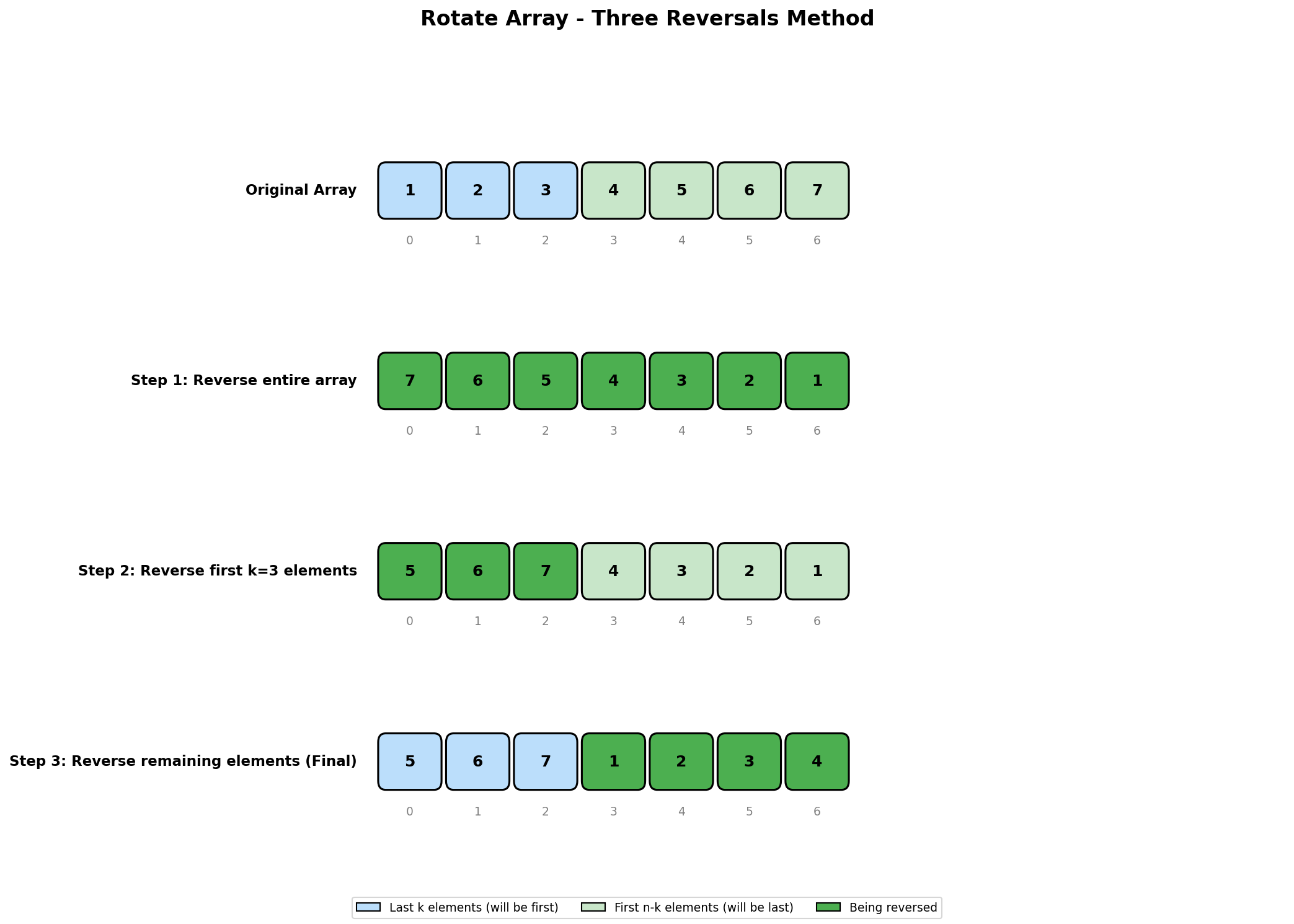
Multiple Approaches
Approach 1: Three Reversals (Optimal)
- Reverse entire array
- Reverse first k elements
- Reverse remaining elements
- O(n) time, O(1) space
Approach 2: Extra Array
- Create new array with rotated elements
- O(n) time, O(n) space
Approach 3: Cyclic Replacements
- Move elements in cycles
- O(n) time, O(1) space
Solution
def rotate(nums: list[int], k: int) -> None:
    """
    Rotate array right by k steps using three reversals.

    Time Complexity: O(n)
    Space Complexity: O(1)
    """
    n = len(nums)
    k = k % n  # Handle k >= n

    def reverse(start: int, end: int) -> None:
        while start < end:
            nums[start], nums[end] = nums[end], nums[start]
            start += 1
            end -= 1

    # Three reversals
    reverse(0, n - 1)      # Reverse entire array
    reverse(0, k - 1)      # Reverse first k elements
reverse(k, n - 1) # Reverse remaining elementspublic void rotate(int[] nums, int k) {
int n = nums.length;
k = k % n; // Handle k >= n
reverse(nums, 0, n - 1); // Reverse entire array
reverse(nums, 0, k - 1); // Reverse first k elements
reverse(nums, k, n - 1); // Reverse remaining elements
}
private void reverse(int[] nums, int start, int end) {
while (start < end) {
int tmp = nums[start];
nums[start] = nums[end];
nums[end] = tmp;
start++;
end--;
}
}Complexity: Time O(n) · Space O(1)
- Time: Three reversal operations, each visiting a subset of elements - a total of about n element swaps across all reversals (n/2 + k/2 + (n-k)/2 = n)
- Space: In-place reversal using only swap operations with no additional arrays
# Extra array approach
def rotate_extra_array(nums: list[int], k: int) -> None:
    """
    Use extra array.

    Time Complexity: O(n)
    Space Complexity: O(n)
    """
    n = len(nums)
    k = k % n
    rotated = nums[-k:] + nums[:-k]
nums[:] = rotated # Copy back to originalComplexity: Time O(n) · Space O(n)
- Time: Slicing creates a new list in O(n), then copying back to original in O(n)
- Space: Creates a temporary array of size n to hold the rotated elements before copying back
# Cyclic replacements approach
def rotate_cyclic(nums: list[int], k: int) -> None:
    """
    Use cyclic replacements.

    Time Complexity: O(n)
    Space Complexity: O(1)
    """
    n = len(nums)
    k = k % n
    count = 0  # Number of elements placed

    start = 0
    while count < n:
        current = start
        prev = nums[start]

        while True:
            next_idx = (current + k) % n
            nums[next_idx], prev = prev, nums[next_idx]
            current = next_idx
            count += 1

            if current == start:
                break

start += 1Complexity: Time O(n) · Space O(1)
- Time: Each element is moved exactly once to its final position, resulting in exactly n placements
- Space: Only uses a constant number of variables (
start,current,prev,count) for tracking cycle state
# Python one-liner (creates new list)
def rotate_pythonic(nums: list[int], k: int) -> None:
    """
    Pythonic approach using slicing.
    """
    k = k % len(nums)
nums[:] = nums[-k:] + nums[:-k]Complexity: Time O(n) · Space O(n)
- Time: Slicing operations
nums[-k:]andnums[:-k]each take O(n), concatenation takes O(n) - Space: Creates two temporary slices and a new concatenated list before assigning back
Step-by-Step Trace (Three Reversals)
For nums = [1, 2, 3, 4, 5, 6, 7], k = 3:
n = 7, k = 3

Step 1: reverse(0, 6) - Reverse entire array
Before: [1, 2, 3, 4, 5, 6, 7]
After:  [7, 6, 5, 4, 3, 2, 1]

Step 2: reverse(0, 2) - Reverse first 3 elements
Before: [7, 6, 5, 4, 3, 2, 1]
After:  [5, 6, 7, 4, 3, 2, 1]

Step 3: reverse(3, 6) - Reverse last 4 elements
Before: [5, 6, 7, 4, 3, 2, 1]
After:  [5, 6, 7, 1, 2, 3, 4]

Result: [5, 6, 7, 1, 2, 3, 4] ✓Cyclic Replacements Trace
For nums = [1, 2, 3, 4, 5, 6], k = 2:
Cycle starting at index 0:
  0 -> 2 -> 4 -> 0 (back to start)
  Move: 1 to index 2, 3 to index 4, 5 to index 0

  [1,2,3,4,5,6] -> [5,2,1,4,3,6]

Cycle starting at index 1:
  1 -> 3 -> 5 -> 1 (back to start)
  Move: 2 to index 3, 4 to index 5, 6 to index 1

  [5,2,1,4,3,6] -> [5,6,1,2,3,4]

Result: [5, 6, 1, 2, 3, 4] ✓Complexity Analysis
| Approach | Time | Space | Notes |
|---|---|---|---|
| Three Reversals | O(n) | O(1) | Best for in-place |
| Extra Array | O(n) | O(n) | Simple but uses space |
| Cyclic Replacements | O(n) | O(1) | Tricky to implement |
Edge Cases
- k = 0: No rotation needed
- k = n: Same as k = 0 (full rotation)
- k > n: Use k = k % n
- Single element:
[1], k = 5 ->[1] - Two elements:
[1, 2], k = 1 ->[2, 1] - All same elements:
[1, 1, 1], k = 2 ->[1, 1, 1]
Left vs Right Rotation
# Right rotation by k = Left rotation by (n - k)
def rotate_left(nums: list[int], k: int) -> None:
    """Rotate left by k steps."""
    n = len(nums)
    k = k % n

    def reverse(start, end):
        while start < end:
            nums[start], nums[end] = nums[end], nums[start]
            start += 1
            end -= 1

    reverse(0, k - 1)      # Reverse first k
    reverse(k, n - 1)      # Reverse rest
reverse(0, n - 1) # Reverse allComplexity: Time O(n) · Space O(1)
- Time: Three reversal operations, each processing a portion of the array - a total of about n element swaps
- Space: In-place modification using only swap operations within the reverse helper function
Common Mistakes
- Forgetting k % n - k can be larger than array length
- Modifying during iteration - Cyclic approach needs careful tracking
- Off-by-one in reverse - End index is inclusive
- Confusing left and right rotation - Right rotation moves elements toward higher indices
Related Problems
Rotate String (LeetCode 796)
Problem: Check if string s can become goal after some rotations.
Key Insight: s rotated is always a substring of s + s.
Approach: Check if goal is substring of (s + s) and lengths are equal.
Complexity: O(n) time, O(n) space
Rotate List (LeetCode 61)
Problem: Rotate linked list to the right by k places.
Key Insight: Connect tail to head (make circular), then cut at appropriate position.
Approach: Find length, connect tail to head. New tail is at (length - k % length) from head. Cut there.
Complexity: O(n) time, O(1) space
Rotate Image (LeetCode 48)
Problem: Rotate n x n matrix 90 degrees clockwise in-place.
Key Insight: Rotation = transpose + reverse each row. Or rotate four cells at a time.
Approach: First transpose matrix (swap [i][j] with [j][i]), then reverse each row.
Complexity: O(n^2) time, O(1) space
Key Takeaways
- The three reversals method is elegant and O(1) space
- Always handle k >= n by taking k % n
- The reversal approach works because
reverse(reverse(A) + reverse(B)) = B + A - Cyclic replacement is theoretically interesting but harder to implement correctly
- Python's slicing makes this trivial but uses O(n) space