Maximum Subarray (Kadane's Algorithm)
Problem Statement
Given an integer array nums, find the subarray with the largest sum, and return its sum.
A subarray is a contiguous non-empty sequence of elements within an array.
Examples
Example 1
Input: nums = [-2, 1, -3, 4, -1, 2, 1, -5, 4]
Output: 6
Explanation: The subarray [4, -1, 2, 1] has the largest sum = 6.Example 2
Input: nums = [1]
Output: 1
Explanation: The subarray [1] has the largest sum = 1.Example 3
Input: nums = [5, 4, -1, 7, 8]
Output: 23
Explanation: The subarray [5, 4, -1, 7, 8] has the largest sum = 23 (entire array).Visual Explanation
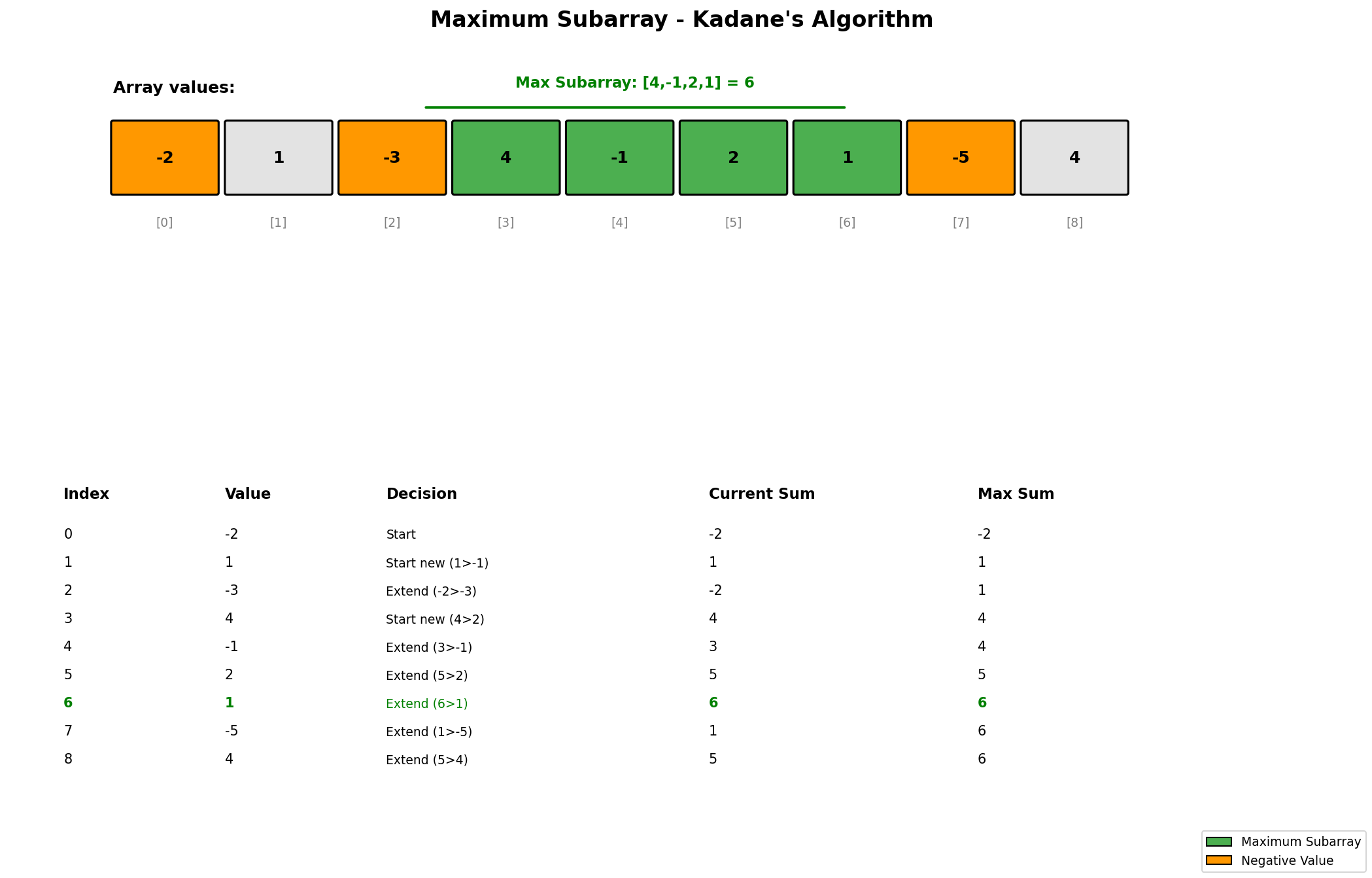
Key Insight: Kadane's Algorithm
The core idea is: at each position, decide whether to:
- Extend the current subarray by adding the current element
- Start fresh with just the current element
If the current running sum is negative, it's better to start fresh because a negative prefix can only decrease the sum of any future subarray.
Solution
def maxSubArray(nums: list[int]) -> int:
    """
    Find maximum subarray sum using Kadane's Algorithm.

    Time Complexity: O(n)
    Space Complexity: O(1)
    """
    current_sum = nums[0]
    max_sum = nums[0]

    for i in range(1, len(nums)):
        # Either extend current subarray or start new one
        current_sum = max(nums[i], current_sum + nums[i])
        max_sum = max(max_sum, current_sum)

return max_sumpublic int maxSubArray(int[] nums) {
int currentSum = nums[0];
int maxSum = nums[0];
for (int i = 1; i < nums.length; i++) {
// Either extend current subarray or start new one
currentSum = Math.max(nums[i], currentSum + nums[i]);
maxSum = Math.max(maxSum, currentSum);
}
return maxSum;
}Complexity: Time O(n) · Space O(1)
- Time: Single pass through the array, performing constant-time operations (max, addition) at each element
- Space: Only two variables (
current_sum,max_sum) regardless of input size
# Alternative formulation
def maxSubArray_v2(nums: list[int]) -> int:
    """
    Equivalent logic: if current_sum becomes negative, reset it.
    """
    current_sum = 0
    max_sum = float('-inf')

    for num in nums:
        current_sum += num
        max_sum = max(max_sum, current_sum)
        if current_sum < 0:
            current_sum = 0

return max_sumComplexity: Time O(n) · Space O(1)
- Time: Single linear scan with constant-time comparisons and updates per element
- Space: Uses only three scalar variables (
current_sum,max_sum, and loop variable)
# Return the actual subarray indices
def maxSubArray_indices(nums: list[int]) -> tuple[int, int, int]:
    """
    Return (max_sum, start_index, end_index).
    """
    current_sum = nums[0]
    max_sum = nums[0]
    start = end = temp_start = 0

    for i in range(1, len(nums)):
        if nums[i] > current_sum + nums[i]:
            current_sum = nums[i]
            temp_start = i
        else:
            current_sum = current_sum + nums[i]

        if current_sum > max_sum:
            max_sum = current_sum
            start = temp_start
            end = i

return max_sum, start, endComplexity: Time O(n) · Space O(1)
- Time: One pass through the array; each index involves constant-time comparisons and pointer updates
- Space: Only five scalar variables (
current_sum,max_sum,start,end,temp_start) used
# Divide and Conquer approach (for learning)
def maxSubArray_divideConquer(nums: list[int]) -> int:
    """
    Divide and conquer approach.

    Time Complexity: O(n log n)
    Space Complexity: O(log n) - recursion stack
    """
    def helper(left: int, right: int) -> int:
        if left > right:
            return float('-inf')
        if left == right:
            return nums[left]

        mid = (left + right) // 2

        # Max sum in left half
        left_max = helper(left, mid)
        # Max sum in right half
        right_max = helper(mid + 1, right)

        # Max sum crossing the midpoint
        left_cross = float('-inf')
        current = 0
        for i in range(mid, left - 1, -1):
            current += nums[i]
            left_cross = max(left_cross, current)

        right_cross = float('-inf')
        current = 0
        for i in range(mid + 1, right + 1):
            current += nums[i]
            right_cross = max(right_cross, current)

        cross_max = left_cross + right_cross

        return max(left_max, right_max, cross_max)

return helper(0, len(nums) - 1)Complexity: Time O(n log n) · Space O(log n)
- Time: Recursion divides array in half (log n levels), and at each level we do O(n) work scanning for crossing subarrays
- Space: Recursion stack depth is O(log n) due to balanced partitioning at each step
Step-by-Step Trace
For nums = [-2, 1, -3, 4, -1, 2, 1, -5, 4]:
| i | nums[i] | current_sum (before) | Decision | current_sum (after) | max_sum |
|---|---|---|---|---|---|
| 0 | -2 | - | Initial | -2 | -2 |
| 1 | 1 | -2 | max(1, -1) = 1 | 1 | 1 |
| 2 | -3 | 1 | max(-3, -2) = -2 | -2 | 1 |
| 3 | 4 | -2 | max(4, 2) = 4 | 4 | 4 |
| 4 | -1 | 4 | max(-1, 3) = 3 | 3 | 4 |
| 5 | 2 | 3 | max(2, 5) = 5 | 5 | 5 |
| 6 | 1 | 5 | max(1, 6) = 6 | 6 | 6 |
| 7 | -5 | 6 | max(-5, 1) = 1 | 1 | 6 |
| 8 | 4 | 1 | max(4, 5) = 5 | 5 | 6 |
Result: Maximum sum = 6, subarray = [4, -1, 2, 1]
Complexity Analysis
| Approach | Time | Space |
|---|---|---|
| Kadane's Algorithm | O(n) | O(1) |
| Divide and Conquer | O(n log n) | O(log n) |
| Brute Force | O(n^2) | O(1) |
Edge Cases
- Single element:
[5]-> 5 - All negative:
[-3, -2, -1]-> -1 (must include at least one element) - All positive:
[1, 2, 3]-> 6 (entire array) - Contains zero:
[0, -1, 0]-> 0 - Large negative followed by large positive:
[-100, 50]-> 50
Variations
Maximum Product Subarray
def maxProduct(nums: list[int]) -> int:
    """
    Find maximum product subarray.
    Track both max and min because negative * negative = positive.
    """
    max_prod = min_prod = result = nums[0]

    for i in range(1, len(nums)):
        if nums[i] < 0:
            max_prod, min_prod = min_prod, max_prod

        max_prod = max(nums[i], max_prod * nums[i])
        min_prod = min(nums[i], min_prod * nums[i])
        result = max(result, max_prod)

return resultComplexity: Time O(n) · Space O(1)
- Time: Single pass through array, with constant-time min/max operations and swaps per element
- Space: Three variables (
max_prod,min_prod,result) maintained regardless of input size
Maximum Circular Subarray Sum
def maxSubarraySumCircular(nums: list[int]) -> int:
    """
    Array is circular - end connects to beginning.
    """
    total = sum(nums)

    # Case 1: Max subarray is not circular (normal Kadane)
    max_sum = current_max = nums[0]
    # Case 2: Max subarray wraps around (total - min_subarray)
    min_sum = current_min = nums[0]

    for i in range(1, len(nums)):
        current_max = max(nums[i], current_max + nums[i])
        max_sum = max(max_sum, current_max)

        current_min = min(nums[i], current_min + nums[i])
        min_sum = min(min_sum, current_min)

    # If all elements are negative, min_sum = total
    if max_sum < 0:
        return max_sum

return max(max_sum, total - min_sum)Complexity: Time O(n) · Space O(1)
- Time: Two Kadane passes (for max and min) merged into one loop, plus O(n) for computing total sum
- Space: Only constant variables (
total,max_sum,min_sum,current_max,current_min)
Common Mistakes
- Initializing max_sum to 0 - Should be first element or -infinity
- Not handling all-negative arrays - Must return the largest negative
- Confusing subarray with subsequence - Subarray must be contiguous
- Off-by-one errors in divide and conquer
Related Problems
Maximum Product Subarray (LeetCode 152)
Problem: Find subarray with largest product (multiplication instead of sum).
Key Insight: Track both max AND min product because negative times negative = positive.
Approach: Maintain maxProd and minProd ending at current position. When encountering negative, swap them before updating.
Complexity: O(n) time, O(1) space
Maximum Sum Circular Subarray (LeetCode 918)
Problem: Find maximum subarray sum where array is circular (end connects to beginning).
Key Insight: Answer is either max normal subarray OR total sum minus min subarray (wrapping case).
Approach: Run Kadane's for max and min subarray. Return max(maxSum, totalSum - minSum). Handle all-negative case.
Complexity: O(n) time, O(1) space
Best Time to Buy and Sell Stock (LeetCode 121)
Problem: Find maximum profit from single buy-sell transaction.
Key Insight: Equivalent to maximum subarray of daily price differences. Track minimum price seen.
Approach: For each price, calculate profit if selling today (price - minPriceSoFar). Track max profit.
Complexity: O(n) time, O(1) space
Maximum Sum of Two Non-Overlapping Subarrays (LeetCode 1031)
Problem: Find maximum sum of two non-overlapping subarrays of given lengths L and M.
Key Insight: Use prefix sums and track best L-length subarray seen so far while scanning M-length subarrays.
Approach: Compute prefix sums. For each position, track best subarray of one length that ends before current subarray of other length.
Complexity: O(n) time, O(n) space
Key Takeaways
- Kadane's Algorithm is the optimal O(n) solution
- The key decision: extend or start fresh based on running sum
- A negative running sum is always worth discarding
- This pattern extends to many "maximum contiguous" problems
- Divide and conquer is useful for understanding but less efficient