Surrounded Regions
Capturing regions not connected to the border
Problem Statement
LeetCode 130: Surrounded Regions
Given an m x n matrix board containing 'X' and 'O', capture all regions that are 4-directionally surrounded by 'X'.
A region is captured by flipping all 'O's into 'X's in that surrounded region.
Key Insight: An 'O' is NOT surrounded if it is:
- On the border of the board, OR
- Connected to a border
'O'(directly or through other'O's)
Visual Overview
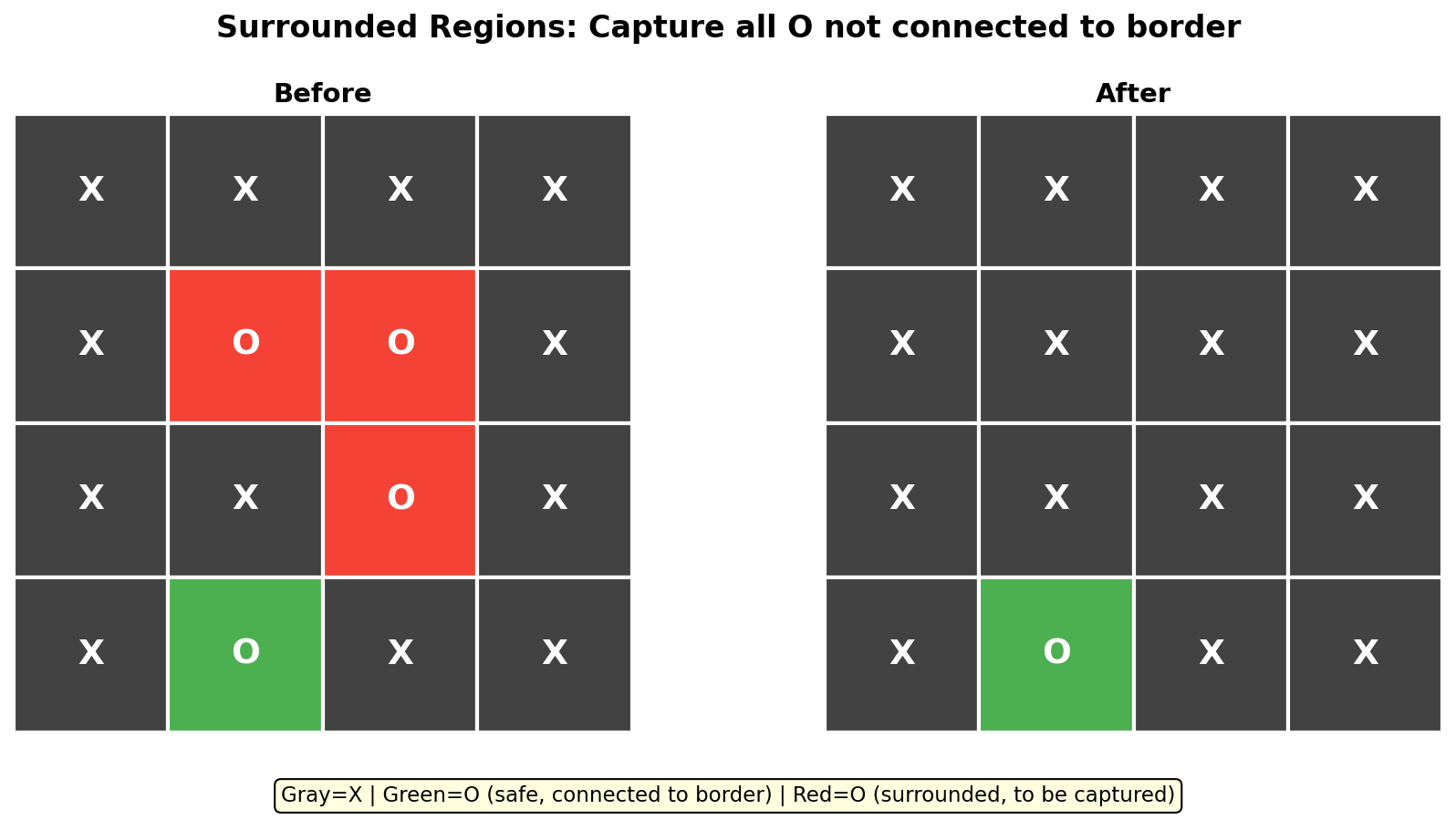
Examples
Example 1
Input:
X X X X
X O O X
X X O X
X O X X

Output:
X X X X
X X X X
X X X X
X O X X

Explanation:
- The O at (3,1) is on the border, so it's NOT captured
- The O's at (1,1), (1,2), (2,2) are surrounded, so they ARE capturedExample 2
Input:
X X X X
X O O X
X O O X
X X X X

Output:
X X X X
X X X X
X X X X
X X X X

Explanation:
All O's are surrounded (not connected to border)Example 3
Input:
O O O
O O O
O O O

Output:
O O O
O O O
O O O

Explanation:
All O's are on or connected to the borderApproach
Key Insight: Start from the Border
Naive approach (slow): For each 'O', check if it can reach the border
Optimal approach: Start from border 'O's and mark all connected 'O's as "safe"
Algorithm
- Mark safe cells: DFS/BFS from all border
'O's, mark them with temporary marker'T' - Capture surrounded: Change all remaining
'O's to'X' - Restore safe cells: Change all
'T's back to'O'
Step 1: Mark border-connected O's as T
X X X X       X X X X
X O O X  -->  X O O X
X X O X       X X O X
X O X X       X T X X

Step 2: Capture remaining O's (change to X)
X X X X       X X X X
X O O X  -->  X X X X
X X O X       X X X X
X T X X       X T X X

Step 3: Restore T's to O's
X X X X       X X X X
X X X X  -->  X X X X
X X X X       X X X X
X T X X X O X XSolution 1: DFS from Border
def solve(board: list[list[str]]) -> None:
    """
    Modify board in-place.
    """
    if not board or not board[0]:
        return

    rows, cols = len(board), len(board[0])

    def dfs(r: int, c: int) -> None:
        """Mark cell and all connected O's as safe (T)."""
        if (r < 0 or r >= rows or c < 0 or c >= cols or
            board[r][c] != 'O'):
            return

        board[r][c] = 'T'  # Temporary marker for "safe"

        dfs(r + 1, c)
        dfs(r - 1, c)
        dfs(r, c + 1)
        dfs(r, c - 1)

    # Step 1: Mark all O's connected to border
    # Check first and last row
    for c in range(cols):
        dfs(0, c)
        dfs(rows - 1, c)

    # Check first and last column
    for r in range(rows):
        dfs(r, 0)
        dfs(r, cols - 1)

    # Step 2 & 3: Capture surrounded O's and restore safe cells
    for r in range(rows):
        for c in range(cols):
            if board[r][c] == 'O':
                board[r][c] = 'X'  # Capture
            elif board[r][c] == 'T':
board[r][c] = 'O' # Restorepublic void solve(char[][] board) {
if (board == null || board.length == 0) return;
int rows = board.length, cols = board[0].length;
int[][] DIRS = {{0,1},{0,-1},{1,0},{-1,0}};
// BFS from all border 'O's, mark safe with 'T'
Deque<int[]> q = new ArrayDeque<>();
for (int c = 0; c < cols; c++) {
if (board[0][c] == 'O') { board[0][c] = 'T'; q.offer(new int[]{0, c}); }
if (board[rows-1][c] == 'O') { board[rows-1][c] = 'T'; q.offer(new int[]{rows-1, c}); }
}
for (int r = 1; r < rows - 1; r++) {
if (board[r][0] == 'O') { board[r][0] = 'T'; q.offer(new int[]{r, 0}); }
if (board[r][cols-1] == 'O') { board[r][cols-1] = 'T'; q.offer(new int[]{r, cols-1}); }
}
while (!q.isEmpty()) {
int[] cur = q.poll();
for (int[] d : DIRS) {
int nr = cur[0] + d[0], nc = cur[1] + d[1];
if (nr >= 0 && nr < rows && nc >= 0 && nc < cols && board[nr][nc] == 'O') {
board[nr][nc] = 'T';
q.offer(new int[]{nr, nc});
}
}
}
// Capture remaining 'O's; restore 'T's to 'O'
for (int r = 0; r < rows; r++)
for (int c = 0; c < cols; c++) {
if (board[r][c] == 'O') board[r][c] = 'X';
else if (board[r][c] == 'T') board[r][c] = 'O';
}
}Complexity: Time O(m * n) · Space O(m * n)
- Time: Border traversal O(m + n), DFS visits each cell at most once, final sweep O(m * n)
- Space: Recursion stack up to O(m * n) for large connected border regions; in-place board modification
Solution 2: BFS from Border
from collections import deque

def solve(board: list[list[str]]) -> None:
    if not board or not board[0]:
        return

    rows, cols = len(board), len(board[0])
    directions = [(0, 1), (0, -1), (1, 0), (-1, 0)]

    def bfs(start_r: int, start_c: int) -> None:
        if board[start_r][start_c] != 'O':
            return

        queue = deque([(start_r, start_c)])
        board[start_r][start_c] = 'T'

        while queue:
            r, c = queue.popleft()

            for dr, dc in directions:
                nr, nc = r + dr, c + dc
                if (0 <= nr < rows and 0 <= nc < cols and
                    board[nr][nc] == 'O'):
                    board[nr][nc] = 'T'
                    queue.append((nr, nc))

    # Mark border-connected O's
    for c in range(cols):
        bfs(0, c)
        bfs(rows - 1, c)
    for r in range(rows):
        bfs(r, 0)
        bfs(r, cols - 1)

    # Capture and restore
    for r in range(rows):
        for c in range(cols):
            if board[r][c] == 'O':
                board[r][c] = 'X'
            elif board[r][c] == 'T':
board[r][c] = 'O'Complexity: Time O(m * n) · Space O(m * n)
- Time: Border initialization O(m + n), BFS visits each O cell once, final sweep O(m * n)
- Space: Queue can hold O(m * n) cells for large border-connected regions; in-place marking
Solution 3: Union-Find
class UnionFind:
    def __init__(self, n):
        self.parent = list(range(n))
        self.rank = [0] * n

    def find(self, x):
        if self.parent[x] != x:
            self.parent[x] = self.find(self.parent[x])
        return self.parent[x]

    def union(self, x, y):
        px, py = self.find(x), self.find(y)
        if px == py:
            return
        if self.rank[px] < self.rank[py]:
            px, py = py, px
        self.parent[py] = px
        if self.rank[px] == self.rank[py]:
            self.rank[px] += 1

def solve(board: list[list[str]]) -> None:
    if not board or not board[0]:
        return

    rows, cols = len(board), len(board[0])

    # Create a "dummy" border node
    # All border O's will be connected to this dummy
    dummy = rows * cols
    uf = UnionFind(rows * cols + 1)

    def index(r, c):
        return r * cols + c

    directions = [(0, 1), (0, -1), (1, 0), (-1, 0)]

    for r in range(rows):
        for c in range(cols):
            if board[r][c] == 'O':
                # If on border, connect to dummy
                if r == 0 or r == rows - 1 or c == 0 or c == cols - 1:
                    uf.union(index(r, c), dummy)
                else:
                    # Connect to adjacent O's
                    for dr, dc in directions:
                        nr, nc = r + dr, c + dc
                        if board[nr][nc] == 'O':
                            uf.union(index(r, c), index(nr, nc))

    # Capture O's not connected to dummy
    for r in range(rows):
        for c in range(cols):
            if board[r][c] == 'O' and uf.find(index(r, c)) != uf.find(dummy):
board[r][c] = 'X'Complexity: Time O(m * n * alpha(m * n)) · Space O(m * n)
- Time: Processing each cell with union operations; alpha is inverse Ackermann (effectively constant)
- Space: UnionFind parent and rank arrays store m * n + 1 elements (including dummy border node)
Complexity Analysis
| Approach | Time | Space |
|---|---|---|
| DFS | O(m * n) | O(m * n) worst case recursion |
| BFS | O(m * n) | O(m * n) for queue |
| Union-Find | O(m * n * alpha) | O(m * n) |
Process Visualization
Common Mistakes
1. Starting DFS from Interior Cells
# WRONG - starts from all O's
for r in range(rows):
    for c in range(cols):
        if board[r][c] == 'O':
            dfs(r, c)  # This marks ALL O's, not just border-connected

# CORRECT - start only from border
for c in range(cols):
    dfs(0, c)
dfs(rows - 1, c)2. Forgetting to Restore Safe Cells
# WRONG - forgets to restore T's
for r in range(rows):
    for c in range(cols):
        if board[r][c] == 'O':
            board[r][c] = 'X'
# Missing: restore T's to O's!3. Modifying Board While Checking
# WRONG - changes board before fully exploring
def dfs(r, c):
    if board[r][c] != 'O':
        return
    board[r][c] = 'X'  # Too early! Might be connected to border
    # ...

# CORRECT - use temporary marker
def dfs(r, c):
    if board[r][c] != 'O':
        return
    board[r][c] = 'T'  # Temporary, will decide later
# ...Edge Cases
- Board with all X's: Nothing to capture
- Board with all O's: All on/connected to border, nothing captured
- Single row/column: All cells are border cells
- 1x1 board with O: Border cell, not captured
- O's forming ring around X's: O's are border-connected, not captured
Related Problems
Number of Islands (LeetCode 200)
Problem: Count number of islands (connected '1' regions) in a 2D grid.
Key Insight: Flood fill to mark and count connected components.
Approach: For each unvisited land cell, DFS to mark entire island, increment count.
Complexity: O(MN) time, O(MN) space
Pacific Atlantic Water Flow (LeetCode 417)
Problem: Find cells where water can flow to both Pacific (top/left) and Atlantic (bottom/right) oceans.
Key Insight: Reverse approach - DFS from ocean borders going uphill.
Approach: DFS from each ocean boundary going uphill, return intersection of both sets.
Complexity: O(MN) time, O(MN) space
Number of Enclaves (LeetCode 1020)
Problem: Count land cells that cannot reach border (surrounded land cells).
Key Insight: Same as Surrounded Regions but count instead of modify.
Approach: DFS from border land cells to mark escapable land, count remaining land cells.
Complexity: O(MN) time, O(MN) space
Flood Fill (LeetCode 733)
Problem: Change all connected cells of same color to new color starting from given pixel.
Key Insight: Basic DFS flood fill - foundation for grid traversal problems.
Approach: DFS from start pixel, change color of all connected same-color cells.
Complexity: O(MN) time, O(MN) space
Interview Tips
Explain the reversal: Instead of checking if each O is surrounded, check which O's are safe (border-connected)
Choose marker wisely: Any character not in original board works (T, #, *, etc.)
Handle in-place modification: Use temporary marker to avoid corrupting state during traversal
Consider Union-Find: Mention it as alternative, useful if multiple queries
Follow-up Questions
Q: What if we want to count surrounded regions instead of capturing?
- A: Count DFS starts from interior O's not marked as safe
Q: What if 8-directional connectivity?
- A: Add 4 more directions: (1,1), (1,-1), (-1,1), (-1,-1)
Q: What if we want to find the largest surrounded region?
- A: Track size during DFS, keep max