Two Sum
Problem Statement
Given an array of integers nums and an integer target, return indices of the two numbers such that they add up to target.
You may assume that each input would have exactly one solution, and you may not use the same element twice.
You can return the answer in any order.
Examples
Example 1
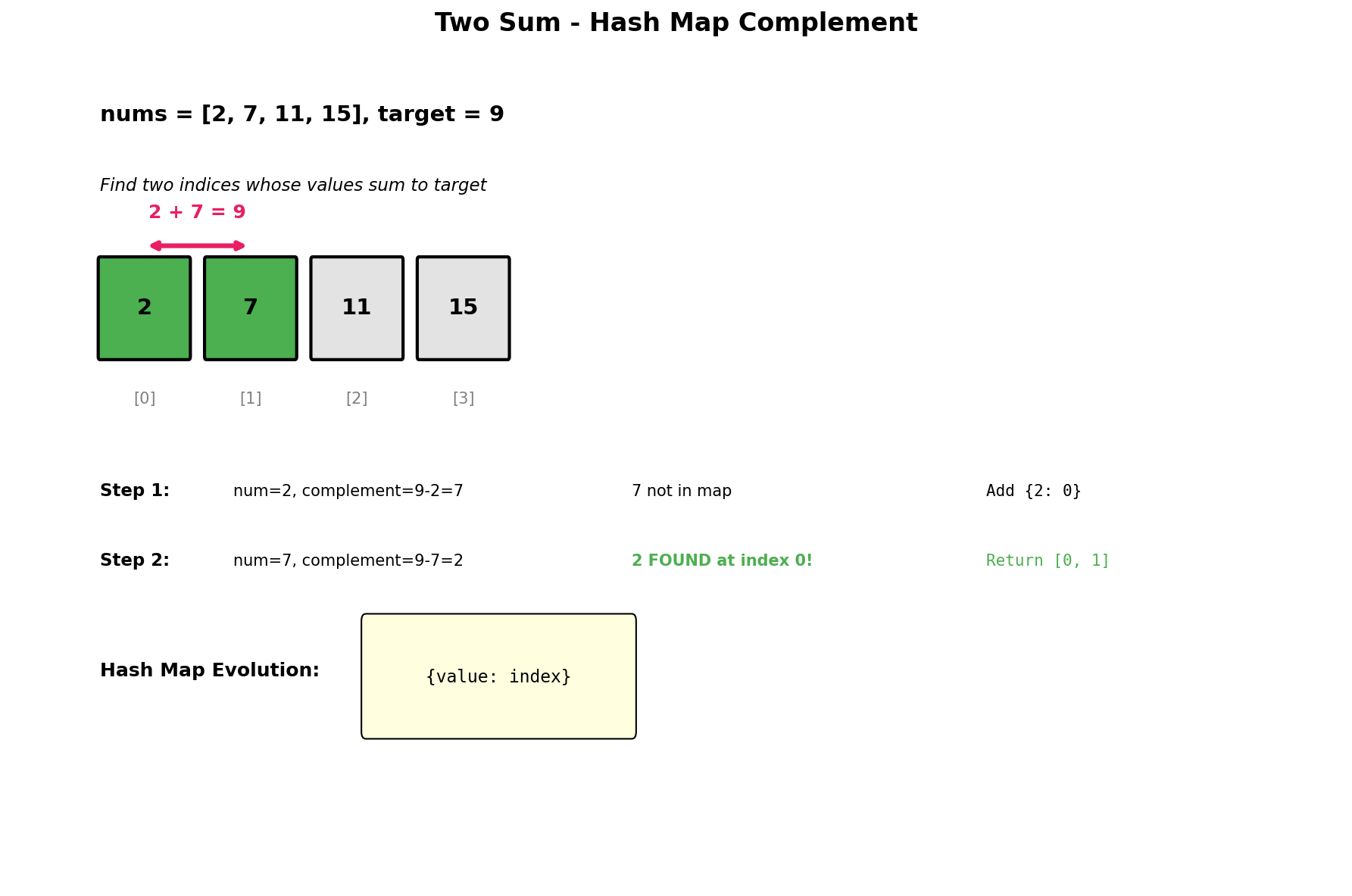
Input: nums = [2, 7, 11, 15], target = 9
Output: [0, 1]
Explanation: nums[0] + nums[1] = 2 + 7 = 9, so we return [0, 1].Example 2
Input: nums = [3, 2, 4], target = 6
Output: [1, 2]
Explanation: nums[1] + nums[2] = 2 + 4 = 6Example 3
Input: nums = [3, 3], target = 6
Output: [0, 1]
Explanation: Both 3s add up to 6.Visual Explanation
Multiple Approaches
Approach 1: Hash Map (Optimal)
- Store each number's index in a hash map
- For each number, check if its complement exists
- O(n) time, O(n) space
Approach 2: Two Pointers (If Array is Sorted)
- Use two pointers from both ends of the sorted array
- Note: Returns indices in the sorted array; for the original-index variant you must sort first (O(n log n)) and track original positions
- O(n) time, O(1) space
Approach 3: Brute Force
- Check every pair
- O(n^2) time, O(1) space
Solution
def twoSum(nums: list[int], target: int) -> list[int]:
    """
    Find two indices that sum to target using hash map.

    Time Complexity: O(n)
    Space Complexity: O(n)
    """
    num_to_index = {}

    for i, num in enumerate(nums):
        complement = target - num

        if complement in num_to_index:
            return [num_to_index[complement], i]

        num_to_index[num] = i

return [] # No solution found (shouldn't happen per problem statement)public int[] twoSum(int[] nums, int target) {
Map<Integer, Integer> numToIndex = new HashMap<>();
for (int i = 0; i < nums.length; i++) {
int complement = target - nums[i];
if (numToIndex.containsKey(complement)) {
return new int[]{numToIndex.get(complement), i};
}
numToIndex.put(nums[i], i);
}
return new int[]{}; // No solution found (shouldn't happen per problem statement)
}Complexity: Time O(n) · Space O(n)
- Time: Single pass through array; each element requires O(1) hash map lookup and O(1) insertion
- Space: Hash map stores at most n-1 elements (all elements except the one currently being checked)
# Two-pass hash map (easier to understand)
def twoSum_twopass(nums: list[int], target: int) -> list[int]:
    """
    Two-pass approach: first build map, then search.

    Time Complexity: O(n)
    Space Complexity: O(n)
    """
    # First pass: build the hash map
    num_to_index = {num: i for i, num in enumerate(nums)}

    # Second pass: find complement
    for i, num in enumerate(nums):
        complement = target - num
        # Ensure we don't use the same element twice
        if complement in num_to_index and num_to_index[complement] != i:
            return [i, num_to_index[complement]]

return []Complexity: Time O(n) · Space O(n)
- Time: First pass O(n) builds the hash map; second pass O(n) searches for complements; total 2n = O(n)
- Space: Hash map stores all n elements with their indices
# Two pointers approach (for sorted array variant)
def twoSum_sorted(nums: list[int], target: int) -> list[int]:
    """
    Two pointers for sorted array (returns 1-indexed for LeetCode variant).

    Time Complexity: O(n)
    Space Complexity: O(1)
    """
    left, right = 0, len(nums) - 1

    while left < right:
        current_sum = nums[left] + nums[right]

        if current_sum == target:
            return [left + 1, right + 1]  # 1-indexed
        elif current_sum < target:
            left += 1
        else:
            right -= 1

return []Complexity: Time O(n) · Space O(1)
- Time: Single pass through sorted array; left and right pointers each move at most n times total
- Space: Only uses constant extra variables (left, right pointers and current_sum)
# Brute force (for reference)
def twoSum_bruteforce(nums: list[int], target: int) -> list[int]:
    """
    Check every pair - O(n^2).
    """
    n = len(nums)
    for i in range(n):
        for j in range(i + 1, n):
            if nums[i] + nums[j] == target:
                return [i, j]
return []Complexity: Time O(n^2) · Space O(1)
- Time: Nested loops check all O(n^2/2) unique pairs in the array; each comparison is O(1)
- Space: Only uses constant extra variables for loop indices
Step-by-Step Trace
For nums = [2, 7, 11, 15], target = 9:
| i | num | complement | num_to_index (before) | Found? | Action |
|---|---|---|---|---|---|
| 0 | 2 | 7 | {} | No | Add {2: 0} |
| 1 | 7 | 2 | {2: 0} | Yes! | Return [0, 1] |
For nums = [3, 2, 4], target = 6:
| i | num | complement | num_to_index (before) | Found? | Action |
|---|---|---|---|---|---|
| 0 | 3 | 3 | {} | No | Add {3: 0} |
| 1 | 2 | 4 | {3: 0} | No | Add {2: 1} |
| 2 | 4 | 2 | {3: 0, 2: 1} | Yes! | Return [1, 2] |
Complexity Analysis
| Approach | Time | Space |
|---|---|---|
| Hash Map | O(n) | O(n) |
| Two Pointers (sorted) | O(n) | O(1) |
| Brute Force | O(n^2) | O(1) |
Edge Cases
- Two elements:
[3, 3], target = 6 ->[0, 1] - Negative numbers:
[-1, 2, 3], target = 2 ->[0, 2] - Zero in array:
[0, 4, 3, 0], target = 0 ->[0, 3] - Target is double:
[3, 2, 4], target = 6 (not[0, 0]) - Large numbers: Handle integer overflow in other languages
Variations
Three Sum (Find triplets summing to 0)
def threeSum(nums: list[int]) -> list[list[int]]:
    """
    Find all unique triplets that sum to zero.
    """
    nums.sort()
    result = []

    for i in range(len(nums) - 2):
        if i > 0 and nums[i] == nums[i - 1]:
            continue

        left, right = i + 1, len(nums) - 1

        while left < right:
            total = nums[i] + nums[left] + nums[right]

            if total == 0:
                result.append([nums[i], nums[left], nums[right]])
                while left < right and nums[left] == nums[left + 1]:
                    left += 1
                while left < right and nums[right] == nums[right - 1]:
                    right -= 1
                left += 1
                right -= 1
            elif total < 0:
                left += 1
            else:
                right -= 1

return resultComplexity: Time O(n^2) · Space O(1) excluding output
- Time: Sorting O(n log n) plus outer loop O(n) with inner two-pointer O(n), giving O(n^2) total
- Space: In-place sorting; constant extra variables for pointers; output array excluded
Four Sum
def fourSum(nums: list[int], target: int) -> list[list[int]]:
    """
    Find all unique quadruplets that sum to target.
    """
    nums.sort()
    result = []
    n = len(nums)

    for i in range(n - 3):
        if i > 0 and nums[i] == nums[i - 1]:
            continue

        for j in range(i + 1, n - 2):
            if j > i + 1 and nums[j] == nums[j - 1]:
                continue

            left, right = j + 1, n - 1

            while left < right:
                total = nums[i] + nums[j] + nums[left] + nums[right]

                if total == target:
                    result.append([nums[i], nums[j], nums[left], nums[right]])
                    while left < right and nums[left] == nums[left + 1]:
                        left += 1
                    while left < right and nums[right] == nums[right - 1]:
                        right -= 1
                    left += 1
                    right -= 1
                elif total < target:
                    left += 1
                else:
                    right -= 1

return resultComplexity: Time O(n^3) · Space O(1) excluding output
- Time: Two nested outer loops O(n^2) each containing inner two-pointer search O(n), giving O(n^3) total
- Space: In-place sorting uses O(log n); constant variables for indices and pointers; output excluded
Common Mistakes
- Using same element twice:
nums[i] + nums[i]is not valid - Returning values instead of indices: Problem asks for indices
- Not handling duplicates properly in variations
- Using two-pass when one-pass is cleaner
Related Problems
Two Sum II - Input Array Is Sorted (LeetCode 167)
Problem: Given a 1-indexed sorted array, find two numbers that add up to target.
Key Insight: Since array is sorted, use two pointers instead of hash map.
Approach: Initialize left=0, right=n-1. If sum < target, move left right. If sum > target, move right left.
Complexity: O(n) time, O(1) space
3Sum (LeetCode 15)
Problem: Find all unique triplets in array that sum to zero.
Key Insight: Sort array, then for each element, use two pointers on remaining elements.
Approach: Fix first element, use Two Sum II approach for remaining two. Skip duplicates carefully.
Complexity: O(n^2) time, O(1) space (excluding output)
4Sum (LeetCode 18)
Problem: Find all unique quadruplets that sum to target.
Key Insight: Extend 3Sum pattern with one more nested loop.
Approach: Fix two elements with nested loops, then use two pointers for remaining two.
Complexity: O(n^3) time, O(1) space (excluding output)
Two Sum III - Data Structure Design (LeetCode 170)
Problem: Design a data structure that supports add and find operations for two-sum queries.
Key Insight: Trade-off between add() and find() efficiency using hash map.
Approach: Store number frequencies in hash map. For find(value), check if complement exists.
Complexity: O(1) add, O(n) find with O(n) space
Subarray Sum Equals K (LeetCode 560)
Problem: Count subarrays with sum equal to k.
Key Insight: Use prefix sum + hash map to find subarrays in O(n).
Approach: Track prefix sums and their frequencies. For each position, count how many previous prefix sums equal (current_prefix - k).
Complexity: O(n) time, O(n) space
Key Takeaways
- Hash maps transform O(n^2) pair problems into O(n)
- The "complement" technique: look for
target - current - One-pass is sufficient since we check before adding to map
- This is one of the most important patterns in interview problems
- For sorted arrays, two pointers is more space-efficient